
On this page
- Public Brokerages Kept About a Quarter or Less of Each Revenue Dollar
- Tax-Return Margins Measure a Different Population
- Seven in Ten Studied Brokerages Made Money in 2025, Mostly by Cutting Costs
- Only 259 Brokerages Had 100 to 499 Employees
- Close to Half a Firm's Volume Comes Back From Past Clients
- Mortgage, Title and Insurance Pay Only Where Someone Counts Them
- RESPA Limits What a Partner Line Can Pay
- Frequently asked questions
A residential brokerage's revenue mostly passes through it. A closing brings in a commission, the agent's share goes out on the split, and what stays has to pay for the offices, the staff who check every file, the technology and the broker's own salary.
In 2025 agent commissions took 74.7% of revenue at Douglas Elliman, and commissions and other related expense 81.6% at Compass, by our arithmetic on their annual figures, while Real and eXp, which run revenue-share models for their agents, kept 8.4% and 7.0% as gross profit.1234
An owner with several offices runs the rest of the arithmetic every month: home sales stuck just above 4 million a year nationally, agents who can take their business to a richer split, and partner income from mortgage, title and insurance work.5
Below are the figures an owner can set beside their own books, each footnoted to the filing, survey or tax table it came from and scoped to what that source measured.
Public Brokerages Kept About a Quarter or Less of Each Revenue Dollar
The public brokerages publish the split in their annual results, which makes them the one place it can be read company by company. Read each row on its own: the traditional split firms report commissions paid out (Compass with other related expense), and the revenue-share firms report gross profit, what is left after their cost of revenue.
| Brokerage, 2025 | Revenue | Paid out first | Kept by the brokerage |
|---|---|---|---|
| Compass | $6.96 billion2 | 81.6% as commissions and other related expense2 | 18.4%2 |
| Douglas Elliman | $1.03 billion1 | 74.7% as agent commissions1 | 25.3%1 |
| The Real Brokerage | $1.97 billion3 | 91.6% as cost of sales3 | 8.4% gross margin3 |
| eXp | $4.77 billion4 | 93.0% as cost of revenue4 | 7.0% gross margin4 |
What a brokerage keeps is not its profit. Compass reported an adjusted EBITDA margin of 4.2% for 2025 (EBITDA is operating profit before interest, taxes, depreciation and amortization; Compass adjusts it further), up from 2.2% a year earlier.2 Real posted an operating loss of $9.2 million, and eXp a net loss of $22.7 million.34
Across the industry the slice has been shrinking for a decade. RealTrends, which benchmarks brokerage finances, tracked more than 2,000 brokerage firms from 2012 to 2021 and found gross margin, the share of gross commission revenue left after agents and teams are paid, down by 50.8% on its own calculation.6
RealTrends' database average was 13.8% in 2019, and Steve Murray, whose firm values brokerages for sales and mergers, put it near 10% at the end of 2024.1112 Firms answered by filling their offices: EBITDA per office rose 94.3% while each agent closed fewer deals, and operating costs fell 7.0%, with advertising and marketing down 60.9%.6
At Anywhere's own brokerages the commission itself got smaller: an average of 2.37% per side in 2024, down from 2.42% in 2023, on $18,557 of gross commission income per side.10
The split is priced in the recruiting market, where an agent can move their business to a richer plan, so a brokerage looking for margin rarely finds it in the split. It looks at its costs, its agents' productivity and the revenue it does not share with agents, which is where mortgage, title and insurance work comes in.
Tax-Return Margins Measure a Different Population
Tax returns give a much higher number. For tax year 2022, 195,063 corporations filed as offices of real estate agents and brokers, and 147,891 of them reported a profit.13 Net income less the losses of the rest came to 15.3% of their receipts, by our arithmetic on the IRS table.13
| Who filed | Returns | Receipts | Net income less losses |
|---|---|---|---|
| Corporations, 2022 | 195,06313 | $121.1 billion13 | 15.3% of receipts (20.5% for the profitable ones)13 |
| Sole proprietors, 2023 | 1,046,47114 | $66.3 billion14 | $23.2 billion, about 35% of receipts14 |
Those figures describe a different population from the brokerages above. The industry code covers offices of real estate agents as well as brokers, so an agent's own corporation files under the same heading as a brokerage with hundreds of agents, and on a sole proprietor's return the owner's own earnings are the profit.
An owner checking their own books should hold them against gross margin and EBITDA, which measure what a brokerage keeps after its agents are paid. The tax figures mix brokerages with agents' and other real estate professionals' own businesses, in shares the IRS tables do not break out.
 Vlad ShvetsPartner @ Qvery
When a brokerage keeps seven or eight cents of each revenue dollar, one more cent from a title or mortgage partner is a large share of its margin. That is why I would count partner use every month the way an owner counts the split: by office, by partner, with the blanks shown, before anyone decides which partnerships to renew.
Seven in Ten Studied Brokerages Made Money in 2025, Mostly by Cutting Costs
AccountTECH, which sells accounting software to brokerages, standardizes the books of the firms in its benchmark each year. Of 157 brokerages in its 2025 study, 69.4% had positive EBITDA, up from 55.8% in 2023, and Real Estate News, reading the same report, put 2024 at 61%.78 AccountTECH says the sample is not a census of US brokerages.7
Seven in Ten Studied Brokerages Were Profitable in 2025
% of studied brokerages
View the data
Loss-makers in the study fell by more than 30%. Firms with EBITDA above 10% went from six to ten, and firms losing more than 10% from four or five to one.7 AccountTECH attributes the change to cost-cutting, efficiency and productivity.8
Its monthly index shows the size of it: the October EBITDA margin across its clients went from -0.61585% in 2022 to 2.1946% in 2025, and EBITDA per agent in October 2025 was 85% higher than a year earlier, which it ties to tighter agent rosters.15
All of it happened with existing-home sales just above 4 million a year, the lowest level since 1995.5
The margins are still thin. In AccountTECH's mid-2024 study of 100 randomly selected brokerages, which closed 51,769 sides with 17,749 agents, 62% were profitable in the first half of the year.16 The profitable ones earned $589 per transaction side, or $294 per agent a month, and the rest lost $462 per side and $214 per agent a month.16
More than half sat between -3% and +3% EBITDA, and 5% cleared 9%.16 Mark Blagden, AccountTECH's chief executive, said margins of 3% or lower "may not withstand even minor reductions in commission rates."16
Owners expect better, in NAR's survey of its firm leaders and in the annual poll of more than 100 brokerage executives by Delta Media Group, a real estate technology company, two in five of them running 101 to 499 agents.1718
| Year | NAR firm leaders | Delta's brokerage executives |
|---|---|---|
| 2021 | 58%19 | not asked |
| 2023 | 30%17 | 18%18 |
| 2024 | not surveyed | 48%18 |
| 2025 | 38%17 | nearly two-thirds18 |
| 2026 | not yet surveyed | 85%20 |
NAR's firm leaders named housing affordability (56%) and industry costs (36%) as their biggest challenges.17
With volume flat and the split set by the market, AccountTECH's reading is that firms moved into profit by spending less and getting more from each agent, and a firm that has already made those cuts needs its next point of margin from somewhere else.
Only 259 Brokerages Had 100 to 499 Employees
Census counts brokerages by the employees on their payroll, and agents paid as independent contractors are not employees, so a firm can count far fewer employees than people. The shape is plain anyway. In 2022 there were 150,892 employer firms in offices of real estate agents and brokers, with 165,585 offices and $180.0 billion of receipts.9
Of those, 140,557 had fewer than five employees and took about a third of the receipts. Only 259 had 100 to 499 employees, running 1,585 offices for $12.5 billion, and 139 firms with 500 or more took $51.9 billion.9
The Smallest and the Largest Brokerages Take Most of the Receipts
receipts, US$ thousands
View the data
| Label | Value | Note |
|---|---|---|
| Under 5 employees9 | 63,189,082 | 140,557 firms. |
| 5 to 9 employees9 | 19,003,360 | 6,638 firms. |
| 10 to 19 employees9 | 13,545,474 | 2,095 firms. |
| 20 to 99 employees9 | 19,846,993 | 1,204 firms. |
| 100 to 499 employees9 | 12,506,185 | 259 firms running 1,585 offices. |
| 500 or more employees9 | 51,922,250 | 139 firms running 10,675 offices. |
NAR's survey of its Brokers of Record, more than 4,500 executives, sees the same skew from inside: 81% of firms run a single office, with two full-time licensees on average.2117 The median one-office firm sold $4.6 million of property in 2024 on 12 transaction sides; the median firm with four or more offices sold $169.2 million on 300.22
Firms With Four or More Offices Sold a Median $169.2 Million in 2024
median sales volume, US$ millions
View the data
The gap widened from 2022 to 2024. In 2022 the two medians were $5.3 million and $154.6 million.19 In 2024, 47% of one-office firms sold under $5 million, while 21% of firms with four or more offices sold $1 billion or more, and 35% of all firms were actively recruiting.2217
A firm with four or more offices closes a median of 300 sides a year, and every partner relationship it holds is spread across those offices and the agents in them.
If your firm runs several offices, our real estate page shows where AI agents take repeated work off a brokerage's operations team.
Close to Half a Firm's Volume Comes Back From Past Clients
NAR: 2025 Profile of Real Estate Firms and 2026 Profile of Home Buyers and Sellers
NAR's firm figures are separate medians, so they do not add up to one firm's total, and both slipped slightly from 48% and 47% two years earlier.1719 Read separately, each says a large share of a brokerage's volume comes back through people it already served.
The typical REALTOR shows the same pattern: 28% of 2025 business from repeat clients and 22% from their referrals, on nine transaction sides and, among brokerage specialists, a median sales volume of $2.7 million, for a median gross income of $59,200.5 Agent use itself is the highest in four decades, at 90% of buyers and 92% of sellers, and Redfin drew 40% of its sales from returning customers in the first quarter of 2025, up from 35% a year earlier.2324
The client relationship outlives the closing, and so do the lender, the title officer and the insurer the client met through it.
Mortgage, Title and Insurance Pay Only Where Someone Counts Them
Few brokerages run these services themselves. In NAR's 2025 survey, 5% of firms offered mortgage lending in-house, 4% title or escrow and 2% homeowners insurance. Among firms with four or more offices the shares rise to 13%, 16% and 7%, and settlement services to 19%.22 The commonest add-on is business brokerage, at 26% of firms, and relocation reaches 42% of the largest.22
Larger Firms Run Mortgage, Title and Insurance In-House More Often
% of firms
View the data
The partner rates on record come from companies that publish them in their annual reports. Anywhere's title, escrow and settlement business handled about 31% of the buyers and sellers its own brokerages represented in 2024, from about 34% in 2020, roughly 39,000 transactions; across its title business the average fee was $3,341 per closing.102526
Anywhere's Title Capture From Its Own Brokerages Settled Near 31%
% of own brokerages' clients
View the data
Redfin closed loans for 29% of its buyers who took a mortgage in the first quarter of 2025, or 23% of all its buyers counting cash deals.24 Compass told investors that agents who order title and escrow through its one-click integration attach those services at about twice the rate of agents who do not.2
The money is real, and it swings from year to year. Realogy's mortgage joint venture earned it $126 million in 2020, a year the company lost $360 million overall after $682 million of impairments; the same venture lost $8 million in 2018, earned $49 million in 2021 and lost $22 million in 2022.2526
At Real, title brought in $5.0 million and mortgage brokering $6.0 million in 2025: together under 1% of Real's revenue, but equal to 6.7% of its gross profit, by our arithmetic.3
RealTrends left these lines out of its decade benchmark and says they materially raise the EBITDA brokerages earn.6
Buyers were warming to them at the last count: in NAR's 2019 Harris Poll, 86% of buyers said knowing a firm offered one-stop shopping had a positive impact on choosing an agent, up from 68% in 2015, and among recent buyers who used an agent, use of agent-affiliated home warranty and homeowners insurance had risen to 57% and 36%.27
Agents pick those partners on service, and they say so.
What Reddit says
Agents on why they send clients to the title companies they know
I rather work with a title company that I know provides excellent service not only to the agent but to the sellers or buyers. Makes a transaction smooth.
Slow and/or incompetent title companies can and do kill deals, and it won’t be long before you witness it firsthand unfortunately.
Your brokerage absolutely has the right to require you to present their preferred option. You have the right to decide if you want to work there under those rules.
Many brokers/agents affiliate, and even own shares in title companies and use them as an income stream.
None of these figures tells an owner what their own partners bring in. Anywhere and Redfin publish a capture rate because they count it; a brokerage that wants the same number for its own closings has to read every deal's title, lender and insurance fields, match partner names typed several ways, and decide what an empty field means.
When you are deciding which preferred lenders and title companies to keep, that count is the evidence.
At Qvery, we help brokerages spend less on manual partner tallies, with custom AI agents that read every closed deal and count partner use by office and partner.
Once a month, after the books close, Qvery's agents read the closed-deal export from your transaction system and your partner list with every spelling your offices use. Each deal's title, lender and insurance provider is matched to a partner, to another firm, or kept as unknown, so an empty field is never counted as a buyer who went elsewhere.
Leadership gets partner use by office and by partner with the unknown count beside every share, and each office manager gets the deals whose records need fixing. What a partnership is worth, and whether to renew it, stays with your leadership.
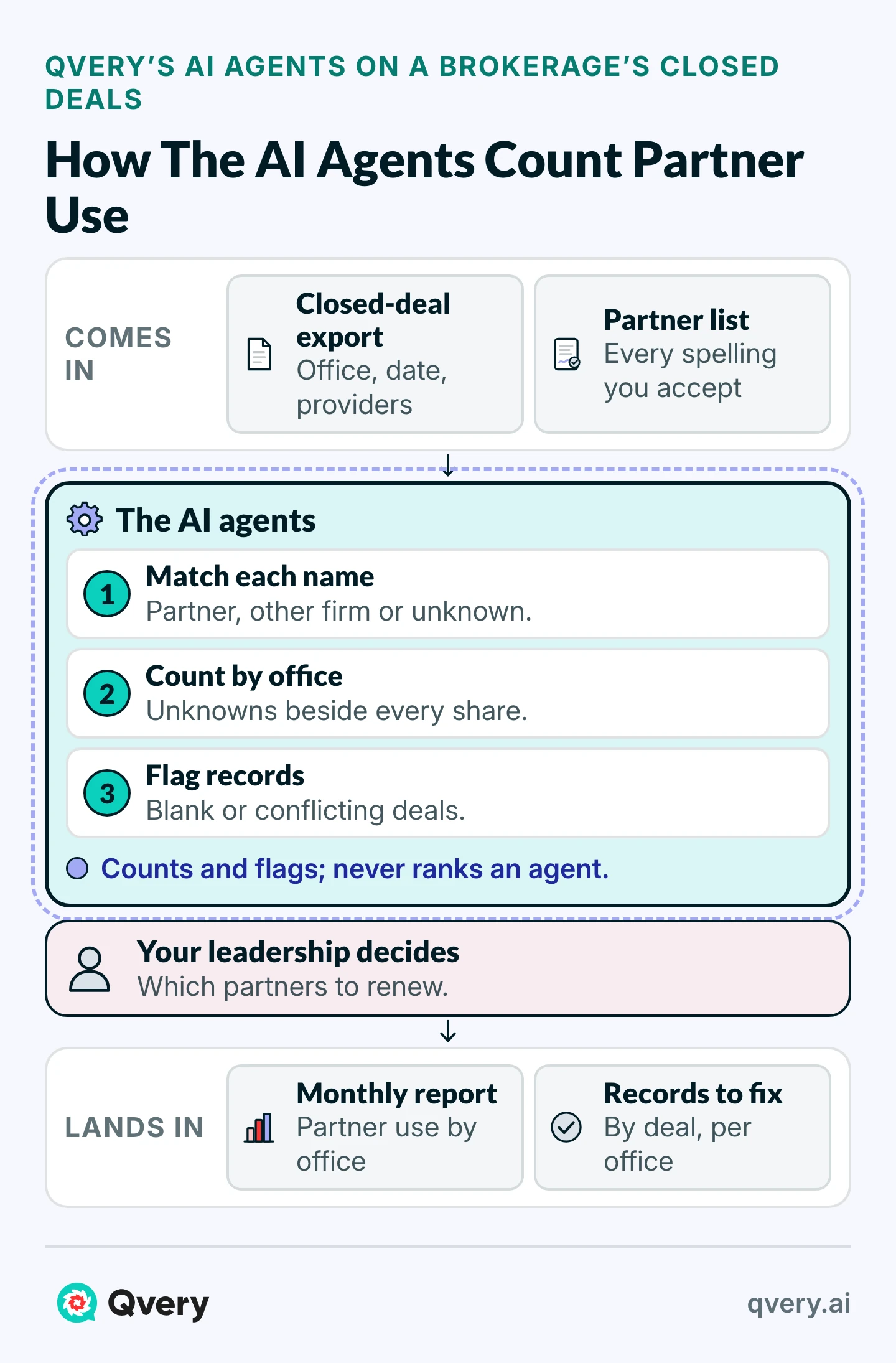
Before the agents open anything, we agree in writing what they may read and do and where the data is processed. They start with the export and your partner list, log every count, and never rank an office or an agent or tell anyone to steer a buyer.
Try it on a quarter of your own closings: drop the export and your partner list, or start from the sample.
The first report covers your last three months of closings and is read with your leadership. For the next weeks the agents run beside your current tally until every difference is explained, and after that the report arrives each month once your books close.
 Piotr BabelPartner @ Qvery
The empty provider field is where partner counts go wrong. A deal with no title company entered is not a deal your partner lost, and counting it as another firm understates that office's title-partner share. Our agents keep those deals as unknown, show how many there are in each office, and list the records to fix, so the share you read rests on deals someone filled in.
If a lender or title agreement renews this year, the count is worth having before that conversation rather than after it.
RESPA Limits What a Partner Line Can Pay
The Real Estate Settlement Procedures Act (RESPA) bans fees and kickbacks for referring settlement business. A brokerage that owns part of a title, mortgage or insurance company may refer clients to it only under the affiliated business arrangement rules, which set three conditions.28
- A written disclosure of the relationship and the provider's estimated charges, at or before each referral.
- No requirement that the client use the affiliate, outside the lender exceptions the rule spells out.
- Nothing of value from the arrangement beyond a return on the ownership interest, apart from payments the rule lists separately.
The rule is enforced. By 2015 the Consumer Financial Protection Bureau said RESPA violations had cost the industry more than $75 million in penalties.29 It ordered a New Jersey title company to pay $30,000 for paying commissions of up to 40% of its premiums to people who sent it business, and a Missouri lender and its president to pay $81,076 for kickbacks disguised as inflated rent.3031
An owner growing the partner line can own part of a provider and disclose it at every referral, or keep preferred partners and take no referral money. Either way, counting the attach rate office by office is what shows which partnerships earn their place.
Frequently asked questions
What is a good profit margin for a real estate brokerage?
Measured as gross margin, what a brokerage keeps after paying its agents, RealTrends' benchmark of more than 2,000 firms averaged 11.0% in 2021.6 Measured as EBITDA, the same benchmark found 3.7% of gross commission revenue, and only 5% of the brokerages in AccountTECH's mid-2024 study cleared 9%.616 A firm above both marks beats those benchmarks.
Is a 40% profit margin high for a real estate business?
For a brokerage it would be far above every benchmark on this page. Margins near that size appear on sole proprietors' returns, where the owner's own earnings count as profit: sole proprietors filing as agents, brokers, property managers and appraisers reported $23.2 billion of net income on $66.3 billion of receipts for 2023.14
What is company dollar in real estate?
Company dollar is the part of a commission the brokerage keeps after the agent's split, also called retained company dollar or gross margin; RealTrends' database averaged 13.8% in 2019.11 As an illustration, 11% of a side worth $18,557, the 2024 average at Anywhere's own brokerages, is about $2,040 before rent, staff and technology.10 RealTrends found brokerages turning 33.3% of their company dollar into EBITDA in 2021.6
How much do real estate brokerage owners make?
None of the sources here measures brokerage owners' pay directly. Profitable brokerages in AccountTECH's mid-2024 study earned $1,767 of operating profit per agent over six months, so a 100-agent firm at that rate would make roughly $350,000 a year, by our arithmetic.16 The typical REALTOR's median gross income was $59,200 in 2025.5
What does the 80/20 rule mean for realtors?
As a commission plan, an 80/20 split pays the agent 80% and the brokerage 20%. At the traditional public brokerages, agent commissions and related expense ran to about three quarters to four fifths of 2025 revenue, the largest line a brokerage pays.12 The same label is used for the idea that a few agents do most of the business; the sources here measure averages, such as RealTrends' 8.9 to 7.3 transactions per agent, not that spread.6
How do real estate brokerages make money besides commissions?
Through services attached to the closing, run in-house or with partners: mortgage, title and escrow, insurance, relocation and business brokerage. In NAR's 2025 survey, 26% of firms offered business brokerage in-house and 5% mortgage lending.22 Realogy's mortgage joint venture earned it $126 million in 2020, and Real's title and mortgage lines equaled 6.7% of its 2025 gross profit.253
What is a mortgage attach rate?
It is the share of a brokerage's buyers who also close their loan with the brokerage's own or partner lender. Redfin counts closed loans for its buyers against its buyers who took a mortgage: 29% in the first quarter of 2025, or 23% counting cash buyers.24 The same idea for title: Anywhere's own title business handled about 31% of its brokerages' clients in 2024.10
How many real estate brokerages are there in the US?
Census counted 150,892 employer firms in offices of real estate agents and brokers in 2022, and NAR finds 81% of firms run a single office.917 Tax returns count more, because agents file as businesses too: 195,063 corporations for 2022, and 1,046,471 sole proprietors for 2023 under a code that adds property managers and appraisers.1314
What is an affiliated business arrangement disclosure?
It is the written notice RESPA requires when a brokerage refers a client to a settlement provider it partly owns. It goes on a separate piece of paper, in the format of the Affiliated Business Arrangement Disclosure Statement, no later than each referral, and states the relationship and the provider's estimated charges.28 The CFPB has fined providers over referral payments, from $30,000 to $81,076 in the two orders above.3031
Can a broker require agents to use a preferred title company?
RESPA speaks to the client: under the affiliated business rules, no one making a referral may require the client to use a particular provider, with exceptions for lenders that the rule spells out.28 How far a brokerage may go with its own agents is a matter of their contract and state rules, a question for its counsel. Counting which partners clients choose, office by office, shows whether a preferred list works without pressuring anyone.
Sources
- Douglas Elliman Inc.: Douglas Elliman Inc. Reports Fourth Quarter and Full Year 2025 Financial Results (2026)
- Compass, Inc.: Compass, Inc. Reports Record Fourth Quarter and Full-Year 2025 Results (2026)
- The Real Brokerage Inc.: Q4 2025 Earnings Results Press Release (2026)
- SEC EDGAR: AGNT, Inc. (eXp World Holdings) Form 10-K for 2025, XBRL financial data (2026)
- National Association of REALTORS: The Feature Sheet: 2026 Member Profile (2026)
- RealTrends: Brokerage Benchmark Report: Over past 10 years, firms are outperforming expectations (2022)
- AccountTECH: AccountTECH research shows steady increase in profitable brokerages (2026)
- Real Estate News: Brokerage profitability rose in 2025 despite tepid home sales (2026)
- U.S. Census Bureau: Statistics of U.S. Businesses, 2022 (2025)
- SEC EDGAR: Anywhere Real Estate Inc. Form 10-K for 2024 (2025)
- RealTrends: Brokerage Retained Company Dollar Down Again (2020)
- HousingWire: Average real estate brokerage gross margin continues to decline (2025)
- IRS Statistics of Income: Returns of Active Corporations, Table 1, Tax Year 2022 (2022)
- IRS Statistics of Income: Nonfarm Sole Proprietorships, Table 1, Tax Year 2023 (2023)
- AccountTECH: EBITDA margin index October 2025 (2026)
- AccountTECH: Modest Gains: More Brokerages Turn Profitable by Mid-Year 2024 (2024)
- National Association of REALTORS: Real Estate Firms Cite Housing Affordability and Rising Costs as Biggest Challenges (2025)
- Delta Media Group: New Survey Reveals Real Estate Leaders' Confidence in US Economy and Business at Three-Year High (2025)
- National Association of REALTORS: 2023 Profile of Real Estate Firms (2023)
- Real Estate News: Brokerage leaders bullish on profits in 2026 (2026)
- National Association of REALTORS: Real Estate Firms Expect Stable Profitability at Year's End, Despite Market Challenges (2025)
- National Association of REALTORS: 2025 Profile of Real Estate Firms, exhibits published with its news release (2025)
- National Association of REALTORS: First-Time Home Buyer Share Inches Up to 22%; Median Age Remains at Record High of 40 (2026)
- Redfin: Redfin Reports First Quarter 2025 Financial Results (2025)
- SEC EDGAR: Realogy Holdings Corp. Form 10-K for 2020 (2021)
- SEC EDGAR: Realogy and Anywhere Real Estate Forms 10-K for 2021 to 2023 (2024)
- National Association of REALTORS (Real Estate Services): Homebuyers Increasingly Interested in One-Stop Shopping (2019)
- eCFR (Office of the Federal Register): 12 CFR 1024.15, Affiliated business arrangements (2026)
- Consumer Financial Protection Bureau: Compliance Bulletin 2015-05, RESPA Compliance and Marketing Services Agreements (2015)
- Consumer Financial Protection Bureau: CFPB Takes Action Against Illegal Mortgage Referrals (2014)
- Consumer Financial Protection Bureau: CFPB Takes Action Against Mortgage Kickbacks (2014)
