
On this page
- An Affiliated Business Arrangement Is Ownership Plus a Referral
- Two of the Three Conditions Are Tested on Every Closing
- Regulators Judge the Arrangement by Where Its Business Comes From
- A Blank Provider Field Is Not a Choice
- Where Qvery's AI Agents Keep the Partner Record
- What the Count Costs by Hand and With the Agents
- The First Count Covers Your Last Three Months of Closings
- Frequently asked questions
If your brokerage owns part of a title agency or a mortgage company, the question comes every quarter: how many of our closings went to it? The answer usually comes from a spreadsheet someone in operations rebuilds by hand from a closing export full of blanks, while agents argue about being pushed toward the in-house title rep.
Federal law allows the arrangement on conditions, and you prove them deal by deal.
RESPA, the Real Estate Settlement Procedures Act, is the 1974 federal law that, among other things, bans paying anyone for referrals in a home closing. An affiliated business arrangement is its exception for owning part of the company you refer clients to.
For last quarter's closings, can your office answer these without a week of digging?
- Which closings used your title company, office by office.
- On how many the title, lender or insurance field is blank.
- Whether every client you referred got the disclosure, or a refusal was noted.
Keeping that record by hand runs about 12 minutes a closed deal, by our estimate. At a brokerage closing 250 deals a month, that is about 50 hours of office managers' time, some $30,700 a year. That record is the job we build AI agents for at Qvery; this page explains the rule behind it.
At Qvery, we help brokerages spend less tracking their partnerships, with custom AI agents that check every deal file for the disclosure and count which closings used each partner.
An Affiliated Business Arrangement Is Ownership Plus a Referral
RESPA's section 8 bans any fee, kickback or "thing of value" given under an agreement to refer settlement business. Settlement services are what a buyer pays for at closing: title insurance, the loan, escrow, homeowner's insurance.
A share of a title agency's profits, paid to the brokerage that sends it clients, is the kind of thing of value that ban is about. So in 1983 Congress wrote an exemption.
An affiliated business arrangement is one where someone who can refer settlement business, such as a broker or an agent, owns more than 1 percent of a settlement service provider, directly or beneficially, or is affiliated with it by control or common control, and refers business to it or "affirmatively influences the selection" of it.
The same goes for an associate: a spouse, a company under common control, a franchisor, a partner. A joint venture, a company your brokerage owns together with a title company or a lender, is the common shape.
The exemption matters because the alternative is expensive. A section 8 violation carries a fine of up to $10,000 or a year in prison, and liability to the client for three times what they paid for the service. A state attorney general or insurance commissioner can sue to stop it, and states may set stricter limits.
Two of the Three Conditions Are Tested on Every Closing
The exemption holds only while three conditions hold, from the statute and Regulation X, the federal rule that carries it out. The first two are about one client and one referral; the third is about how the owners get paid.
| The Condition | On One Closing | What You Can Show |
|---|---|---|
| The client is told, in writing | at or before the referral (three business days after a phone referral), on its own sheet | the signed disclosure in the file, or a note that the client declined |
| The client is free to choose | nothing the client wants depends on using your partner; the sheet says they may shop | which closings used another firm, office by office |
| The owners' money follows ownership | payouts follow what each owner holds, never what each owner referred | how payouts are calculated, kept apart from any referral count |
The statute names the record itself. For a referral made in person, in writing or electronically, the disclosure "may be evidenced by a notation in a written, electronic, or similar system of records maintained in the regular course of business".
When a client referred in person declines to acknowledge the receipt, "that fact shall be noted" there. Regulation X has the documents kept for 5 years.
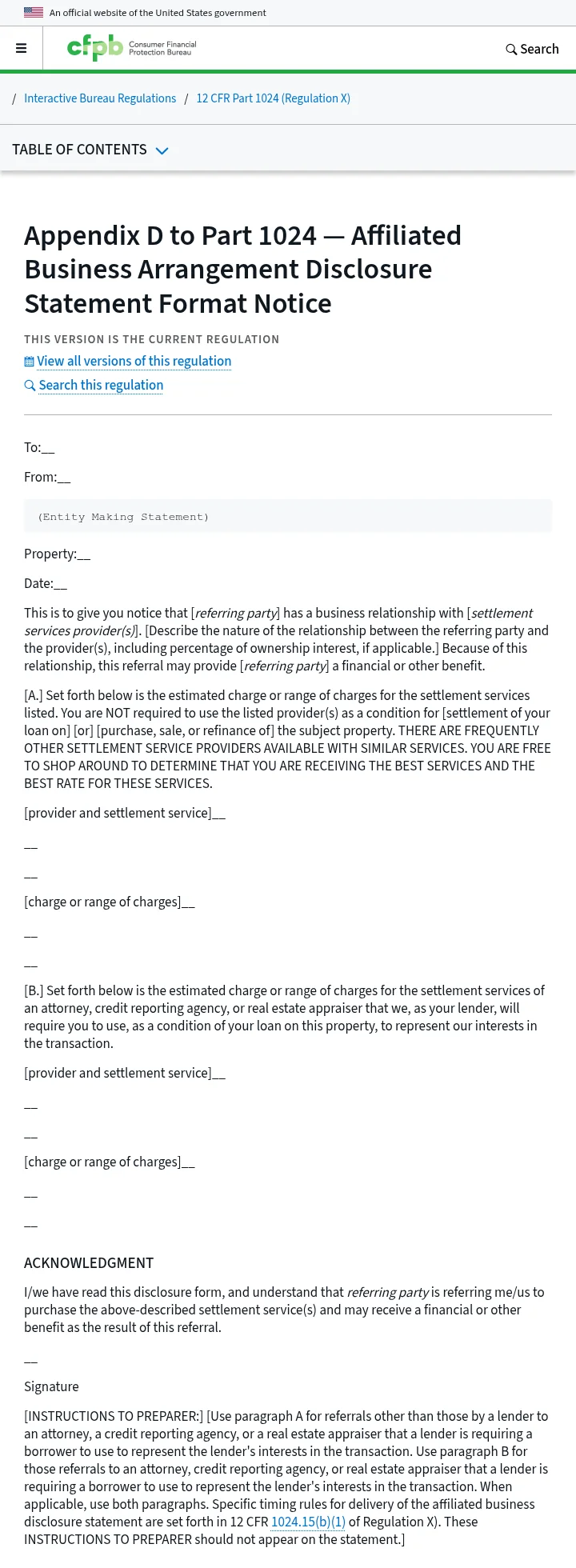
The federal format fits on one page: who refers, the relationship and the ownership share, the estimated charges, the line that the client is not required to use the provider, and an acknowledgment to sign.
The regulation is just as plain about mistakes. A missed disclosure can be forgiven only if the brokerage proves that procedures reasonably adopted to get it right were maintained, and that the miss was unintentional, the result of a bona fide error.
A wrong reading of the law does not count. So the procedure has to leave something behind: a signed sheet or a dated note in each file.
Tips from Reddit
The brokerage wants you to sign it so they have proof that they disclosed it to you. If you say, "I'm not signing that form," they can proceed without your signature. A smart agent would make a note that they disclosed the information to you and you refused to sign it.
No, People aren't required to sign anything. Not even required to buy a house or live in one. Now, I know your question, for your compliance, and for you to get paid, are they required. I say no. I know someone who had clients that wouldn't sign and the agent asked for the client to respond to an email saying "I refuse to sign ___ document" and that email was put in the file in lieu of the disclosure. The compliance person accepted it and the agent got paid.
I always ask when using our affiliated title company, but you can say no. As long as I can show compliance I tried. The last agent I asked said no. No biggie.
The third condition is about the arrangement's money rather than one client. Regulation X's own example is a broker who owns more than 1 percent of a title agent.
Dividends paid by how much each owner referred break the exemption. Dividends in proportion to the stock each owner holds keep it, as long as the broker also disclosed, required no one to use the agent, and takes nothing else from it.
Regulators Judge the Arrangement by Where Its Business Comes From
An arrangement can meet all three conditions on paper and still be called a sham. In 1996 the Department of Housing and Urban Development (HUD), then RESPA's regulator, published ten questions it weighs to decide whether a jointly owned company is a real business or "a conduit for referral fee payments".
The Consumer Financial Protection Bureau (CFPB), RESPA's regulator since 2011, still lists that statement among the HUD documents it applies; its withdrawal of 67 guidance documents in May 2025 did not touch it.
The federal appeals court for Kentucky, Michigan, Ohio and Tennessee held in 2013 that the questions are not binding there, so the three conditions alone decide it in those states.
| What HUD Asks | Where the Answer Lives |
|---|---|
| Does the company have its own capital, staff and office, and do the work itself? | the affiliate's own books and payroll |
| Does it compete beyond its creators, or send business only to one of them? | your count of closings that went to it, beside the affiliate's total |
| Do payouts follow what each owner put in, or what each owner referred? | the operating agreement and the distribution records |
Your closing count is one row of that table. It says nothing about the affiliate's capital, staff or premises, and it should never touch the third row.
A case in Pennsylvania shows why. In January 2025 Pennsylvania's Attorney General sued a group of mortgage brokerages and their owner.
The complaint alleges that half their ownership units were sold only to real estate agents and brokers, at $450 a unit, and returned upwards of 900% a year. It also alleges that disclosures were routinely not given, and that each owner's referral volume was tracked in quarterly spreadsheets used to decide further shares and payouts.
On August 27, 2026 the federal court let the case go forward. It found the complaint plausibly alleges that the disclosure and ownership-return conditions were not met, and it pointed to the referral spreadsheet as support that the referrals happened. Nothing has been decided on the merits.
So the question is what the count is for. Kept by office and by partner, with the blanks shown, it records what clients chose. Kept by owner and fed into payouts, it is the spreadsheet the Pennsylvania complaint describes.
 Vlad ShvetsPartner @ Qvery
Before you renew a partnership, or before anyone outside the company asks about it, you want one dated page: how many closings each office sent to the partner, how many went to another firm, and how many nobody recorded. Keep names and payouts off that page. It tells you how much business the partnership gets, and it is the record you would want to show.
Whether these joint ventures are good for buyers is argued both ways. A 2025 law review article by Christopher Peterson and Jeffrey Ehrlich argues that ventures in which agents take a sizable share without putting in significant capital "stifle competition and increase homebuying costs".
A broker-owner in one such venture says a partner title company may issue the policy early while it clears a defect, so the buyer can close. Your counsel decides what your arrangement needs; this page explains the rule.
A Blank Provider Field Is Not a Choice
The count starts in your transaction system, the software your coordinators run each deal through. Its closing export carries a title company, a lender and an insurance provider for every deal, typed by whoever filled the field: a coordinator, a loan officer, an agent in a hurry, or nobody.
To see what that does to the count, we built a sample export for a 400-person brokerage with five offices: one quarter, 640 closed deals.
On 127 of them at least one provider is unknown: a blank field, two rows for the same deal that disagree, or a short name that fits two lenders. One office left insurance blank on 63 of 112 deals after it moved the insurance step from a task to a shared inbox.
How Far a Partner's Share Moves With What a Blank Is Called
% of closed deals
View the data
| Label | Range | Marked point | Note |
|---|---|---|---|
| Title company | 37.8% – 41.7% | 39.3% | Few title fields are blank, so the range is narrow. |
| Lender | 24.4% – 29.1% | 25.6% | Includes a short name the partner list accepts for two lenders, which stays unknown. |
| Homeowner's insurance | 24.4% – 36.3% | 27.7% | Most of the unknowns sit in one office that stopped recording insurance in March. |
What a blank is called moves the answer. On the sample, the insurance partner's share is 27.7% of the deals where the provider is known.
Call every blank another firm and it reads 24.4%; call every blank the partner and it reads 36.3%. Nothing in the files supports either reading, so the count has to carry the blanks as a number of their own.
Making the field required in your transaction system is the first fix: new deals can no longer leave it empty.
What it leaves is the matching: a partner's name spelled three ways across offices, a title company your memo calls preferred that nobody added to the partner list, a deal exported twice after an edit. On the sample those touch more than a hundred deals.
By hand, finding and recording the three providers on a closed deal takes about 12 minutes, our assumption for a deal whose fields are mostly filled. That is the 50 hours a month above, before anyone chases the agent on a deal for what is missing.
Where Qvery's AI Agents Keep the Partner Record
At Qvery, the AI agents we build for this job run once a month, after your books close. They read the closing export and your partner list, with every spelling your offices accept for each partner, and they work only from the deal code, office, close date and the three provider fields.
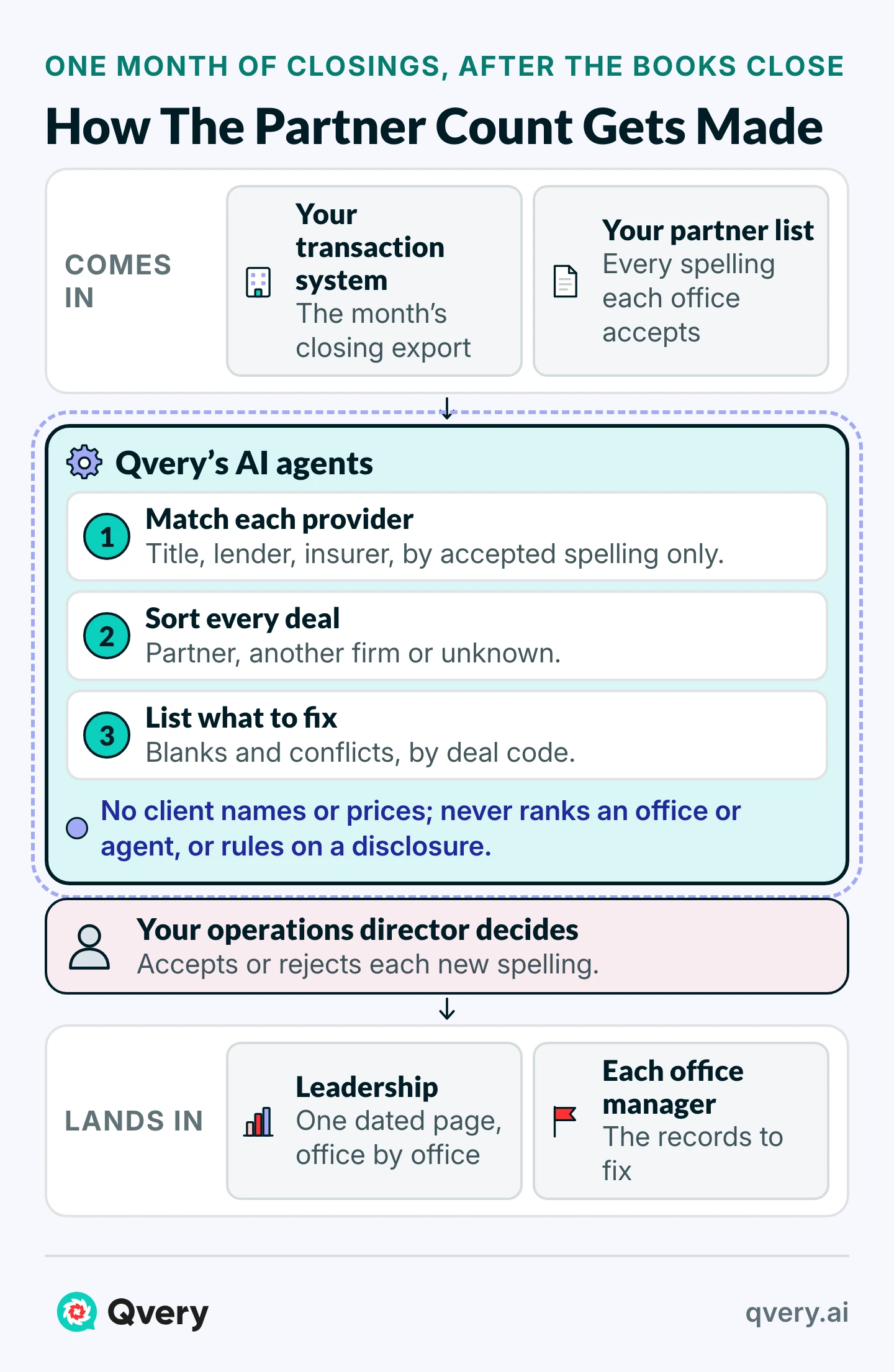
A provider counts as your partner only when its name matches the list for that service. A close spelling the list does not accept is listed with its deal count for a person to accept or reject, because adding it changes the share.
A short name that fits two partners stays unknown. Two rows that disagree on one deal make that service unknown, and both rows are kept.
What leadership gets is one dated page: partner, other firm and unknown for each office and service, with the unknown count beside every share, and each partner's deals by office. Each office manager gets the deal codes their office must fix, with what is wrong on each.
The disclosure half runs on the deal file. The file-review agents we build read every page of a deal file against your office's list of required forms.
Put the affiliated business disclosure on that list and every file is checked for it, with its signature and date blocks; a missing form or a blank block comes up with its page.
 Piotr BabelPartner @ Qvery
Most of the work in a partner count is deciding what a name in the title field means. So the partner list carries every spelling your offices accept, and our agents match only against it. A close name that is not on the list goes to a person with its deal count, since accepting it moves the share. A field nobody filled is reported as unknown, never guessed.
The partner record touches money and clients, so the limits are written down before anything is connected. The agents never use or show a buyer's name, an address or a price.
They never rank an office or an agent, never tell anyone to steer a client, never rule on whether your arrangement or a disclosure complies, and never work out what a partnership is worth.
Every count traces back to its rows. We agree with you in writing which exports the agents read and where the data is processed, and your counsel decides who in the company sees which counts.
Run the count on your own closing export and partner list, or on our sample brokerage's, and a three-page report comes back by email.
What the Count Costs by Hand and With the Agents
Put your own closings, minutes and pay into the calculator. It opens on the brokerage above.
Partner Tracking ROI Calculator
What Each Closed Deal Costs You To Record, And With The Agents
Saved Per Year
$15,668
400 hours handed back, after $4,800 a year to run it
- Hours Handed Back
- 400 hours a year
- Agent Running Cost (Estimate)
- $400 a month
- Payback Per $10,000 Of Build
- 7.7 months
On these numbers, each deal costs $5.01 instead of $10.23, the agent saves $15,668 a year after its own running cost, and every $10,000 of the build is earned back in 7.7 months.
The example closes 250 deals a month, about what 330 agents at the nine transaction sides a year that NAR's 2026 Member Profile reports for a typical agent would close. By hand, at 12 minutes a deal and an office manager's $51.17 an hour, the record costs $10.23 a deal.
With the agents, a person still handles the deals they flag. On our sample that was a third of them, so we assume about 4 minutes a deal on average.
The agents run for about $400 a month, mostly hosting and upkeep; the model use for one monthly count is well under a dollar. A deal then costs $5.01.
On those assumptions, that leaves $15,668 a year saved and 400 hours handed back to your office managers, and each $10,000 of build pays for itself in 7.7 months.
The hours go back to running offices. The calculator does not count the exposure the record protects against: three times what a client paid for a service, for each client a missed disclosure touches.
The First Count Covers Your Last Three Months of Closings
The build runs on what your office already keeps: the closing export, the partner list with every spelling your offices use, one person who owns the records, and your counsel's view on who may see the counts.
Map Your Export
In the first week we find where each provider is typed and load your partner list, with about two hours of your records owner's time.
Count the Last Three Months
Within two weeks of access the agents count your last quarter of closings, leadership reads the first page with us, and each office gets its records to fix.
Run Beside Your Tally
The agents run next to whatever count you keep today until every difference is explained and every new spelling is on the list.
Report Every Month
After that, one dated page each month, once your books close.
What we count with you each month is the unknown share by office, the records fixed, and the hours your office managers no longer spend on the tally.
Partner tracking is one of the jobs we build AI agents for at brokerages; the others are on our real estate page.
Frequently asked questions
What is an affiliated business arrangement in real estate?
Someone who refers settlement business, such as a broker or an agent, owns more than 1 percent of a settlement service provider (a title agency, lender, insurance agency or escrow company), or is affiliated with it, and refers clients to it. RESPA allows it if the client is told in writing, is free to go elsewhere, and the owner's only return is on ownership.
When is the affiliated business arrangement disclosure due, and does the client have to sign it?
At or before the referral, on a separate sheet in the federal format, with the ownership and the estimated charges; after a referral by phone, within three business days. The form ends with an acknowledgment the client can sign. If a client referred in person declines to sign, the statute says that fact is noted in your records.
How long does a brokerage keep the disclosure?
Regulation X says documents provided under the rule are kept for five years after they are signed. Your state, your errors and omissions (professional liability) insurer or your own policy may ask for longer.
Does a preferred title company or lender we do not own need the disclosure?
The disclosure belongs to an affiliated business arrangement, which needs ownership of more than 1 percent or an affiliate relationship. Without one, there is no exemption to claim, and section 8 still bans anything of value given for referrals, whatever it is called. Where a preferred partner pays for anything, that is a question for counsel.
Can a broker require agents to use the in-house title company?
The rule is written about the client: no referral may be made a condition of something the client wants, and the disclosure tells them they may shop around. How a brokerage directs its own agents turns on your agreements and your state. Whatever the policy, the client keeps the choice, and counsel should see the policy.
What makes an affiliated business arrangement a sham?
A company that exists mainly to pass money to the people who refer to it. HUD's 1996 policy statement asks about its capital, staff and office, whether it does the work itself, whether it competes beyond its owners, and whether payouts follow ownership or referrals. The CFPB still applies it, though a federal appeals court held in 2013 it is not binding in four states.
Who enforces RESPA?
The CFPB has primary authority over section 8. A state attorney general or insurance commissioner can also sue to stop violations, as Pennsylvania's Attorney General did in 2025, and a client can sue for three times the charge paid for the service.
Do states add rules of their own?
Some do, and the statute lets stricter state limits stand. Colorado, for one, asks brokers to disclose an affiliated business in writing to all parties no later than the contract, even when the affiliate is not used on that deal, and asks employing brokers to report their arrangements to the Real Estate Commission every year.
Does RESPA apply to title companies?
Yes. Title searches, title examinations and title insurance are settlement services under the statute, so a title company may neither pay nor take anything of value for a referral. A title agency your brokerage owns part of is exactly what the affiliated business rules cover.
Does RESPA apply to a cash purchase?
RESPA's section 8 covers deals with a federally related mortgage loan: a loan on a one-to-four-family home from a federally insured or regulated lender, a federal program, a lender selling to Fannie Mae or Freddie Mac, or one making over $1 million of home loans a year. A cash purchase has none, though a state rule like Colorado's can still ask for the disclosure.
Do the AI agents see our clients' details?
They use only the deal code, office, close date and the title, lender and insurance provider fields, and leave out names, addresses, prices and agent codes even when the export carries them. The counts and the list of records to fix carry deal codes, never a client's name.
Does the count tell us what the partnership is worth?
Not by itself. The agents count deals by office and partner and show the unknowns; what a partnership is worth, and whether to renew it, is your leadership's call.
