
On this page
Every preferred-partner agreement a brokerage signs comes back with one question: how many of our closed deals used you? A straight answer means matching every row of the closed-deal export against the partner list, office by office, and deciding what each blank and odd spelling means.
Without it, the renewal meeting runs on whatever is at hand.
- The partner’s own count of the files it closed for you.
- What each branch manager thinks of the rep.
- Who paid for the last sales meeting lunch.
- The one deal the lender nearly lost in the spring.
Take a typical brokerage of about 400 people closing 250 deals a month, and assume 12 minutes a deal to find, match and record the title company, lender and insurer. That’s 600 hours a year of an office manager’s time, $30,702 with benefits. At that price I wouldn’t run the count monthly either.
My view is that every preferred lender, title company and insurer should be chosen and renewed on a count of your closed deals, office by office, taken every month, with the records nobody filled in shown beside it.
The count already sits in the export your transaction system produces. What’s missing is someone to read every row of it, every month, and that’s work for AI agents, not for your agents’ typing or a partner’s report.
At Qvery, we help brokerages spend less counting partner deals, with custom AI agents that read every closed deal and show which partners each office used.
Partner Decisions Run on Who Shows Up
Agents choose partners for good reasons. A lender who answers at eight at night and a title officer who sorts out a title problem before closing day save deals, and agents remember both.
They drop partners just as fast. One bad closing moves a lender down the list, and an agent’s loyalty often follows a person rather than a company: when a favorite title officer changes firms, the business goes with her.
Your agreement is with the company. Around it sit the perks, from the sponsored lunch to the golf day to the lender who helps pay for a team’s marketing, and agents say as much in the forums where they talk shop.
What Reddit says
My preferred lender gets like 80% of my buyers and I expect nothing in return but the kick ass service he always delivers. He does send a few buyers my way a year and usually takes me golfing once or twice, but I'd refer him even if he did none of that.
I have a two strike policy. First strike I'll let you know what the problem was and what I expect moving forward. Second strike and you're in "only if I HAVE to use you" territory.
This is why I always use the same title person for 90% of my transactions. My business moves to whatever company she is with.
We also have lenders who help pay for our marketing, so we are urged to use them as well. Both sets of people do a very good job - so I recommend them to my clients. But when the client wants to use someone else - it's totally fine.
None of this reaches a number, so a partner’s share of your deals can slide without anyone at the brokerage seeing it. A brokerage that owns a title business can see the share, and one listed brokerage has published how much an average hides.
The Same Title Company Ranged From 3.24% to 67% of a Brokerage’s Deals
% of eligible closed deals
View the data
| Label | Value | Note |
|---|---|---|
| Across the company | 3.24% | All eligible deals; about the same as the quarter before, management said |
| Markets with a title joint venture | 45% | Where Real runs a title business jointly with others in that market |
| Its Texas joint venture | 67% | Management named it among its highest; others ran higher still |
Real, which closed 62,380 deals in the second quarter of 2026, told investors its own title company was on 3.24% of eligible deals across the company and 45% in the markets where it runs a title joint venture, a title business it owns jointly with others in that market.
Its Texas venture was at 67%, and management said others ran higher still. That’s one partner in one quarter, and an average across your offices can hide a gap like it.
Three of the Four Ways to Count Leave a Gap
Once an owner wants the number, there are four ways to get it.
| Route | Who does it, and how often | What it misses |
|---|---|---|
| Match the export by hand | An office manager, accounting or an outside analyst, quarterly or before a renewal | Blanks, odd spellings, and every month in between |
| Make the partner field required | Your agents, on every deal as it’s entered | Whatever got typed to clear the screen, and the insurer, which often lives in a note |
| Ask each partner to report | The partner, when it chooses | Every deal that went to someone else |
| AI agents read the export | The AI agents every month, with a person settling what they flag | Only what no record names |
The hand match is the thorough route and the expensive one, and its shortcuts cost accuracy. Take the sample brokerage we built for our AI agents’ free try, a different example from the one above.
There, an outside analyst bills $1,650 a month for 14 hours of tallying a quarter’s 640 closed deals, and the invoice says blank provider cells are counted as other firms. That one rule makes every partner look smaller than it is.
A required field is worth having, since it’s what any count reads. It records what someone typed to get past the screen, though, and a field filled with initials, a company’s old name or “other” says less than it seems to.
Title company and lender are often fields on the deal. The insurer may sit only in a note or a closing paper.
A partner’s report is free, and it’s the weakest of the four. A title company sees the files it handled, so it can tell you how many of your closings it had.
A partner can count the deals it closed for you. Only your own records count the ones it didn’t.
Counting Closings Isn’t Steering Buyers
Both halves are fair. No count sees the Friday save, and the buyer chooses their title company, lender and insurer.
The count doesn’t judge service. A share measures how much of your business a partner gets, which is what a renewal prices. Whether the partner earned more is the service question your managers answer, now with the number in front of them.
When a share drops in one office, the count tells you where to go and ask why. That’s also why ours stops at the office: no agent is named, and no rate is shown as good or bad.
 Vlad ShvetsPartner @ Qvery
I’d never drop a partner on a count alone. A lender who saves your hardest deals can carry a small share and still earn the renewal. But I’d want that share in front of me before the meeting, office by office, with the blanks beside it, so the argument in the room is about service and not about whose memory of last spring is better.
The legal side gets one plain paragraph. The Real Estate Settlement Procedures Act (RESPA), the federal law over home-loan closings, bars giving or taking anything of value under an agreement, spoken or not, to refer settlement business.
The rules written under it count services at free rates and paying someone’s expenses among those things. They also treat a thing of value received again and again, tied in any way to the volume of business referred, as evidence of a referral agreement.
So keep the count away from anything a partner gives you or an agent earns. What you may do with it, including whether a partner sees its own number, is a question for your counsel.
If you own part of a title or lending business, the arrangement must also meet three conditions of its own under RESPA.
Qvery’s AI Agents Count Every Closed Deal by Office
The AI agents we build for a brokerage take the closed-deal export your transaction system already produces each month, with your partner list, and find the title, lender and insurance columns however each office labels them.
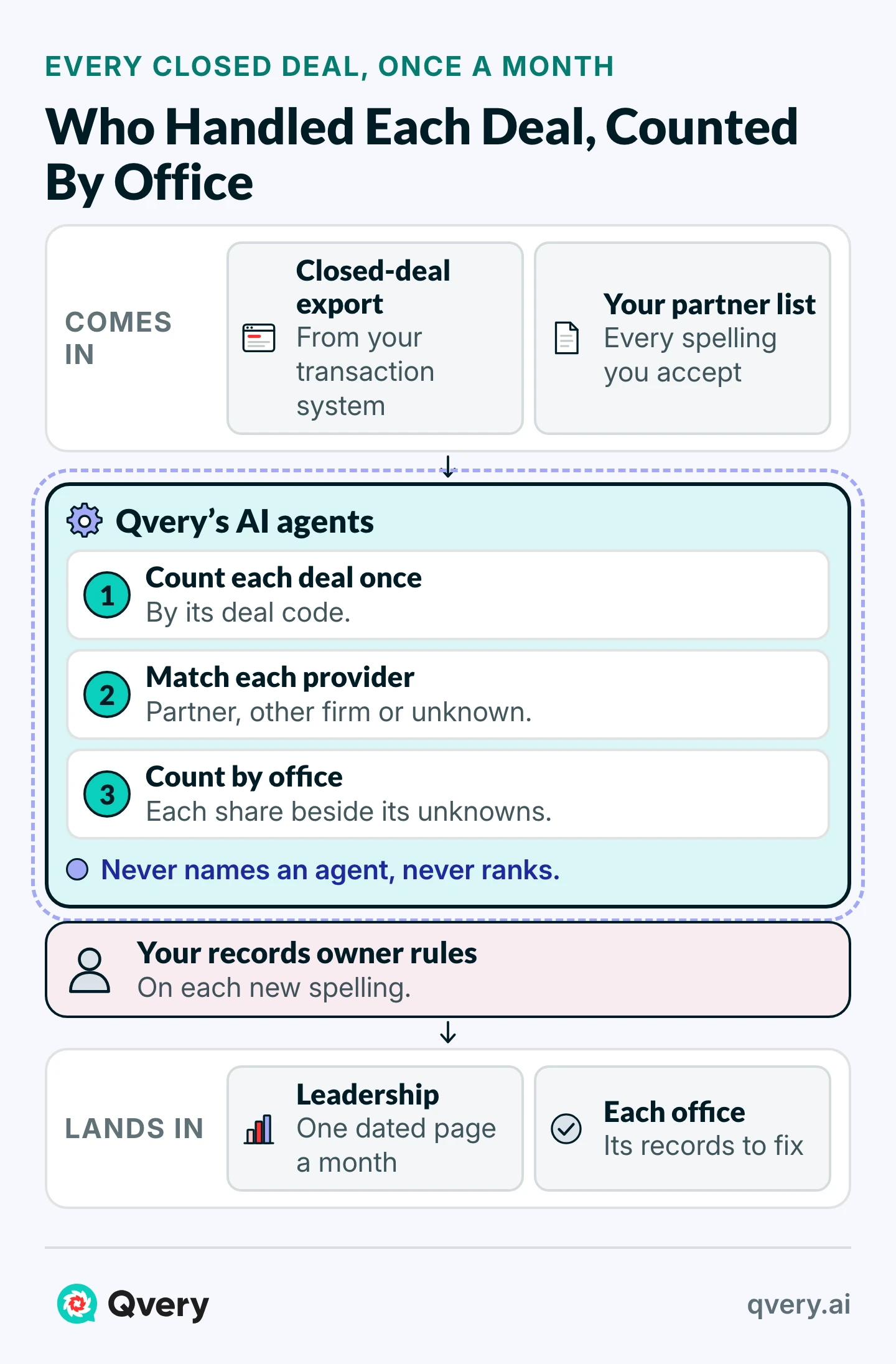
Each deal is counted once, by its deal code. A provider counts for a partner only when the record names the partner or a spelling your list accepts. Another named firm is filed as other, and a blank stays unknown, never read as a buyer who went elsewhere.
Where no field exists, the AI agents read the settlement statement (the closing document that lists every charge) or the title commitment (the title company’s written promise of the policy it will issue) in the deal file.
In our sample brokerage, four of six partner agreements renew on the same December date. The insurance partner added in April appears on 3 of the quarter’s 640 closed deals, and a different firm with a similar name appears on 41.
A tally that matched on the shared word would credit the partner with 44. The AI agents file the 41 as another firm and list the name with its deal count, so a person can confirm it isn’t a spelling of your partner.
 Piotr BabelPartner @ Qvery
The number that protects you is the unknown count. Every share we print sits beside how many of that office’s deals had no provider recorded, and an office with too many blanks stays out of the comparison. A low share on a thin record is a records problem. The page should say that, not let it pass for a partner problem.
The AI agents read four things on each deal: its code, its office, its close date and the three provider fields. Buyer names, addresses, loan numbers and fees aren’t read, and neither are agent names, so no view by person exists.
Who at Qvery may open the export, and when copies are erased, goes into the data processing agreement before the build. A partner sees nothing unless your leadership decides it may, and then only its own closings, to check against its books.
If you have last quarter’s closed-deal export and your partner list, try the AI agents on them and get the report split by office.
What the count costs you depends on your volume and how messy your records are. Put your own monthly closings, minutes per deal and office manager’s pay in.
Partner Tracking ROI Calculator
What Each Closed Deal Costs You To Record, And With The Agents
Saved Per Year
$15,668
400 hours handed back, after $4,800 a year to run it
- Hours Handed Back
- 400 hours a year
- Agent Running Cost (Estimate)
- $400 a month
- Payback Per $10,000 Of Build
- 7.7 months
On these numbers, each deal costs $5.01 instead of $10.23, the agent saves $15,668 a year after its own running cost, and every $10,000 of the build is earned back in 7.7 months.
The calculator opens on the 400-person example: 250 closed deals a month, 12 minutes a deal by hand, and an office manager at $51.17 an hour with benefits. By hand the count costs $10.23 a deal and $30,702 a year.
That pay is the closest federal figure: the Bureau of Labor Statistics’ May 2025 mean of $35.82 for office supervisors in real estate, over the 70% of an employer’s cost that wages make up.
With the AI agents, a person’s time falls to about 4 minutes a deal, spent on the ones they flag, and the AI agents run for about $400 a month. That’s $5.01 a deal and $15,034 a year.
The difference, after the AI agents’ running cost, is $15,668 a year and 400 hours handed back. It pays back in 7.7 months for every $10,000 of build.
Those hours are worth most if your office manager spends them on work you’d otherwise hire for. The calculator prices the tally only, not the renewal decision it feeds.
If a renewal is on your calendar, that’s a good date to work back from.
Renew Each Partner on Last Quarter’s Count
The rule I’d set is short: no partner agreement is renewed, widened or signed without the count, by office, with the unknowns beside it. A partner your agents rely on will show it there, and one whose share is falling in a single office will show that months before the renewal comes up.
Working with us on it starts with your export and a partner list that carries every spelling your offices accept. In the first two weeks we map where each provider lives in your system, and the AI agents count your last few months of closings.
Leadership reads that first page with us while each office gets its records to fix. From then on the page arrives each month after your books close, dated, so the count you renewed on can be pulled again unchanged.
The same goes for two other back-office jobs at a brokerage: checking every deal file against your required forms, and chasing what’s still missing before closing.
Frequently asked questions
What is a preferred lender in real estate?
A preferred lender is a mortgage lender a brokerage or agent recommends to buyers, sometimes under a written agreement or a shared marketing program. The buyer is free to use any lender. What a brokerage may receive from the arrangement is limited by RESPA, so the terms belong with your counsel.
What is a preferred title company?
It’s a title company a brokerage recommends for title insurance and the closing itself. Some brokerages part-own one through a joint venture. Either way the buyer or seller who pays chooses, and a brokerage that owns part of the company must disclose it.
Can a broker require agents to use a preferred title company?
A brokerage can recommend one. Federal rules treat requiring a buyer to use a particular provider as a referral, and an affiliated arrangement keeps its exemption only if nobody is required to use the provider. How that applies to your agents and your agreements is a question for your counsel.
Is it legal for a lender to help pay for a brokerage’s marketing?
It depends on what the payment is for and whether it moves with the business you send. RESPA’s rules treat a thing of value received repeatedly and tied to referral volume as evidence of a referral agreement. A marketing agreement is your counsel’s to review; the count only shows which deals used whom.
What is an attach rate or capture rate?
It’s the share of a brokerage’s closed deals that used its own or affiliated lender or title company. Real, a listed brokerage, reports it to investors: it put its title company at 3.24% of eligible deals companywide and 45% in its joint-venture markets in the second quarter of 2026.
Does the count show which agents use our partners?
No. The AI agents stop at the office and never read agent names. A closing record shows who handled the title, not what anyone told the buyer, so it can’t fairly judge a person, and a count by person invites exactly the pressure the referral rules worry about.
What if our transaction system has no insurance field?
The insurer may sit only in a note or a closing paper. During setup we map where each provider lives, and where there’s no field the AI agents read the settlement statement or title commitment in the deal file. Your first report also shows how complete each field is in every office.
What happens to a deal with a blank provider?
It stays unknown. A blank is a missing record, never a buyer who chose another firm, so it is never counted against a partner. The deal goes on that office’s list of records to fix, with the field that’s empty.
What does a partner get to see?
Nothing, unless your leadership decides it may. If it does, a partner sees only its own closings, never a rival’s, so it can reconcile them against its own books. Whether to share at all is a call for your leadership and counsel.
What if a partner changes its name or is bought?
Your partner list keeps each partner’s current name with its former names and short forms, and both count together. Months already reported stay as they were counted, with a note where the name changed.
Do our agents have to change how they enter deals?
No. The AI agents read the export your offices already produce. What changes is that each office gets a monthly list of the records to fix, by deal and by field, so the blanks shrink without anyone retyping a deal.
What if one deal shows two different title companies?
A deal exported twice with different providers is treated as a question, not a guess. Both records stay in view, that service stays unknown for the deal, and it goes on the office’s list to settle. A row repeated exactly is counted once.
Can a partner check the count against its own statements?
Yes, if your leadership allows it. In the build, each partner can get a view of only its own closings, which it can reconcile against its books. Where the two disagree, the difference points to a record to fix on one side or the other.
Which transaction systems does it work with?
Any system that exports closed deals to a spreadsheet or CSV file, one row a deal, with a deal code, office, close date and the provider columns. The AI agents read the export you already pull each month.
How soon do we get the first count?
About two weeks from kickoff. Setup goes to mapping your export and loading every spelling your offices use, then the AI agents count your last few months of closings and leadership reads the first page with us.
What do the AI agents cost to run?
On our example of 250 closed deals a month, about $400 a month in all, nearly all of it hosting, the dated monthly page and upkeep of your partner list. The model usage for one monthly count of the whole export is well under a dollar, an estimate.
Do the counts tell us which partner to keep?
No. They show each partner’s share of every office’s known deals and how many deals are unknown. Which partners to keep, and on what terms, stays with your leadership.
