
On this page
- Your Call Score Was Built to Win the Tour
- Fair Housing Risk Is What a Caller Wasn’t Told
- “Our Leasing CRM Already Flags the Risky Phrases”
- Qvery’s Agents Hear Every Call on Your Own Questions
- The Agents Cost Less Than the Replays They Replace
- Review Every Recorded Call for Fair Housing
- Frequently asked questions
Your leasing staff take calls all day across your communities, and your call tracking records every one. It tells marketing which ad made the phone ring, and the score it gives each call tells your managers whether the caller booked a tour.
A few managers replay a call or two a week and coach from it.
Take a company with 45 communities and about 4,500 leasing calls a month. If each community’s manager replays one call a week, that is 180 calls, 4 in 100, and at 20 minutes a replay it costs $39,586 of their time a year.
The other 4,320 are never played back.
| On the call | Call one | Call two |
|---|---|---|
| What the caller asks | Two-bedroom availability | Two-bedroom availability, a child heard in the background |
| What your leasing consultant says | This week’s units, the move-in special, a tour time | This week’s units, how many children, a tour time |
| What the call score shows | Tour booked | Tour booked |
| What a fair housing review sees | Nothing to mark | No special offered, and a question about children |
The score your call tracking or leasing CRM (customer relationship management software, where your leasing staff log every prospect) gives a call was built to win the tour. It can’t tell you whether one caller was offered what another wasn’t, and that difference is where fair housing exposure sits.
So every recorded leasing call needs its own review, on your company’s own questions, with your compliance lead deciding each moment it marks. It holds less for a community that takes so few calls that its manager hears all of them, and not at all for lines you don’t record.
At Qvery, we help property managers spend less on replays and find fair housing risk early, with custom AI agents that review every recorded leasing call against your own questions.
Your Call Score Was Built to Win the Tour
Call tracking was built to answer a marketing question: which ad, listing, or sign made the phone ring. The AI added to it in the last few years answers the next one, whether the call became a lead, and the vendors say so on their own pages.
- CallRail scores every call for how likely the caller is to buy and tags outcomes such as an appointment booked. Its product page opens with “Stop listening to every call” as the pitch.
- CallSource, which calls itself the inventor of call tracking, scores each call on four criteria of its own, the last of them asking for the commitment, and ties higher scores to booked appointments.
- Funnel, a leasing CRM, scores every prospect call on a rubric you can tune by property type, and reports the lift in tour conversions.
Each of them does the job it was built for.
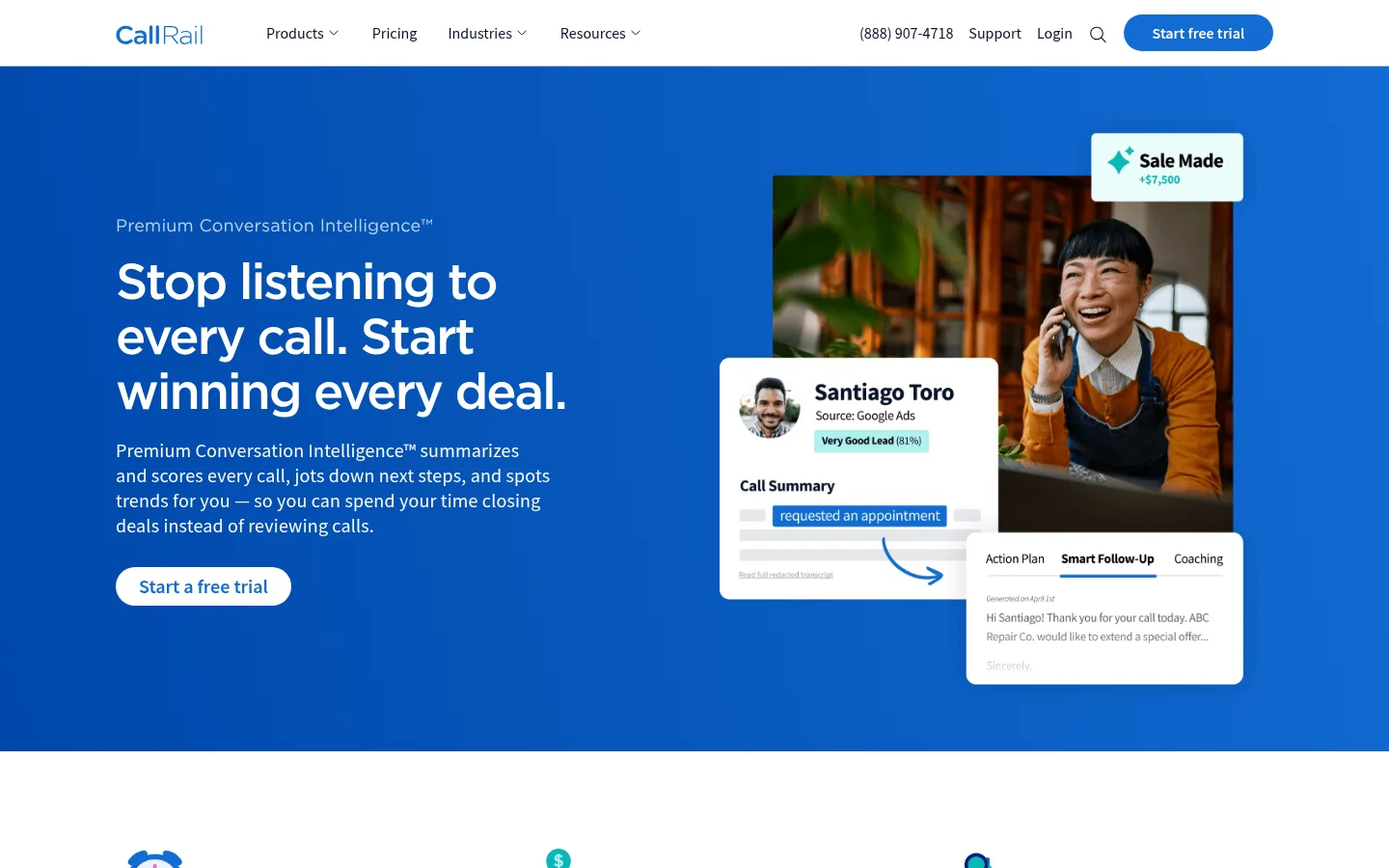
A call that books the tour scores well whatever else the caller heard, and a call that never books scores badly even when your leasing consultant handled it perfectly.
Fair Housing Risk Is What a Caller Wasn’t Told
The Department of Housing and Urban Development counts it as steering to discourage a renter by “failing to inform any person of desirable features” of a home or a community, when that happens because of race, disability, children in the household, or another characteristic the law protects.
Its rule allows the few questions about disability only if every applicant gets them, and it covers what is said aloud exactly as it covers what is printed.
Enforcement compares callers as well. A fair housing test is usually a pair: two people ask about the same apartment, one of them with a protected characteristic, and any difference in how they’re treated can become evidence.
When California’s Civil Rights Department sponsored tests in Los Angeles and Ventura counties in 2024, more than 120 of them were phone calls.
Testers Found Discrimination at More Than One in Five Tested Properties
% of tested properties
View the data
| Label | Value | Note |
|---|---|---|
| Source of income | 54% | Of 54 properties tested, including statements that federal rent vouchers were not accepted. |
| Criminal history | 44% | Of 32 properties tested. |
| Families with children | 26% | Of 19 properties tested, including available promotional rates not offered. |
| Disability | 23% | Of 13 properties tested. |
| Race | 22% | Of 90 properties tested. |
Among the properties tested on how they treated families with children, what the testers found included promotional rates that were available and never offered. A special nobody mentioned leaves no words in a recording to match, and a difference between two callers only shows when someone hears both calls.
The price of a finding starts at $26,262, the most a federal administrative judge can fine a company for a first discriminatory housing practice, and rises to $131,308 with earlier findings, before damages, counsel, or the months an investigation takes.
The Justice Department has resolved 111 cases built on its own testers’ evidence since 1992, most of them about availability misstated or terms that changed with the caller.
 Vlad ShvetsPartner @ Qvery
If I ran leasing for 45 communities, the first thing I’d ask is who hears the 4,320 calls nobody replays. Today the answer is a tester, eventually. I’d want it to be my compliance lead, every week, with each moment marked and the call it came from one click away, long before an investigator asks about one call from March.
“Our Leasing CRM Already Flags the Risky Phrases”
That’s the strongest objection, and part of it is right.
Leasing CRMs now score every call, and at least one says its AI “can be configured to flag high-risk phrases or steering behaviors instantly” for corrective training.
A few call review products go further and score every inquiry against a rubric with fair housing lines in it. That is the review I’m arguing for, bought ready-made, and if one fits your phones and your checklist, it’s a fair choice.
A phrase list matches the words someone said, so the special a caller was never offered slips past it: there is nothing to match.
It also reads each sentence without the call around it. Asking how many people will live in the apartment is routine when every caller is asked, and a problem when only the caller with children in the background hears it.
The flag also lands with the wrong person. A call score feeds the coaching report your leasing managers read for tours. A fair housing mark belongs with whoever owns compliance, with the moment and the lines before it, and someone has to decide each one and keep the decision.
Mystery shops don’t close the gap either. One shop per community a quarter, at $200 to $600 a shop by one tour-recording vendor’s count, tests your script four times a year.
A tester can call on any Tuesday, and California’s civil rights director warned that housing providers “could be subject to testing at any time” when he released the 2024 results.
Leasing staff describe both grades from their side of the desk.
What Reddit says
Leasing staff on what a shop grades and what every caller has to hear
Not giving the same exact information (i.e. failing to mention an amenity) to every prospective tenant could be deemed discrimination.
It’s tough when you’re doing your best, and then you get dinged on things that feel a bit nitpicky, like not mentioning amenities over the phone.
Had the highest closing ratio for my company 6 quarters in a row, most leases in the company 6 quarters in a row, 6 worst shop scores in a row.
Qvery’s Agents Hear Every Call on Your Own Questions
Your call tracking stays where it is.
It already holds the recordings, so it becomes the pipe: the agents we build take each recording as the call ends and write it out with who spoke and when.
They mark every phrase on the list your compliance lead builds with us (steering by neighborhood, questions about children, and remarks about a disability or a voucher), each with its time and the lines around it.
They also score the call on your own checklist, which can hold what every caller must hear: this week’s available units, the current special, and the same qualifying questions. Each point carries the quote behind it. The list catches what was said, and the checklist catches what wasn’t.
That is how the agents compare callers without guessing who anyone is. Every call is held to the same items, so on the two example calls above, call one gets no marks and call two gets two: the special your consultant never mentioned, and the question about children, each with its time.
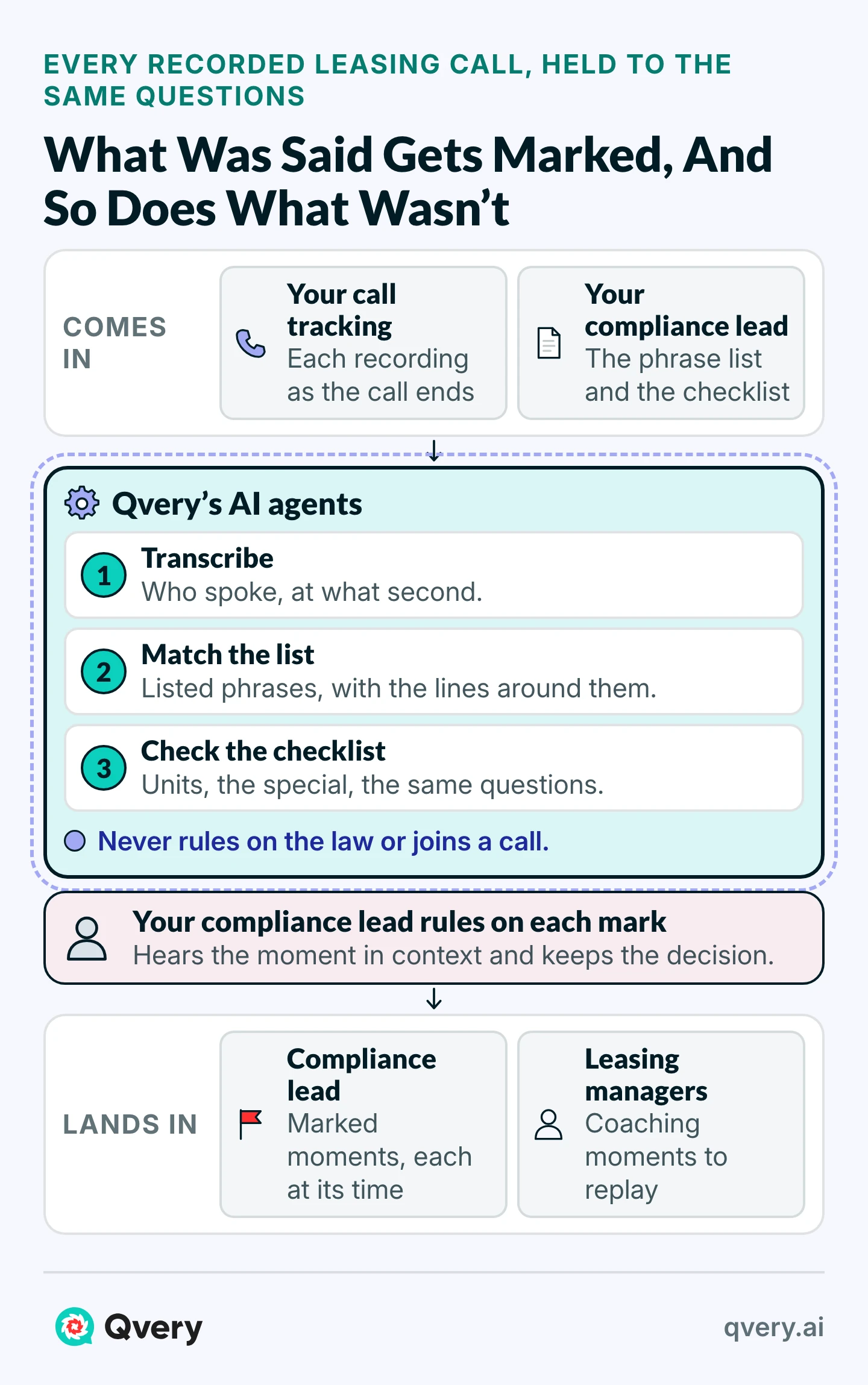
Your compliance lead gets the marked moments and your leasing managers get the coaching ones, each opened at the right second. A pattern no sample shows, like one community where the special keeps going unmentioned, turns up because every call was scored on the same items.
The agents never rule on the law and never call a remark a violation. Your compliance lead decides every mark, and any decision about a person stays with your managers.
A call with no marks isn’t a cleared call. A remark nobody thought to list can slip past, so the list stays your lead’s to change.
Before anyone relies on a score, we run the agents on recent calls your managers already scored and show where the two agree, with every disagreement and its quote.
Recording consent stays as you handle it today, and your counsel confirms it before we connect live calls. The data processing agreement names the transcription service, who may hear a call, and when the audio is deleted. The agents never place or join a call.
 Piotr BabelPartner @ Qvery
Every point we score rests on who said the line. Where crosstalk or a weak mobile signal leaves a stretch nobody can make out, the transcript labels it unclear and any point resting on it drops out of the score. Your consultant is never marked down for bad audio, and a manager who doubts a score replays the quoted moment.
To see the marks on one of your own calls, send a recording and the checklist your managers score with.
The Agents Cost Less Than the Replays They Replace
The example company’s arithmetic is the one the calculator below opens on.
Today its managers replay 180 calls a month at about 20 minutes each: finding the recording, listening, scoring, and writing the coaching note. At $54.98 an hour, a manager’s pay plus benefits built on the federal wage survey’s mean of $37.66 for property managers in real estate, that’s $39,586 a year.
With the agents hearing all 4,500 calls, the managers still open 180 a month and spend about 5 minutes on each, reading the score and replaying the marked moment.
The agents run for about $1,225 a month, an estimate: roughly 25 cents a call to write out and score 4,500 calls, plus about $100 of upkeep. The year costs $24,596: $14,989 back, 540 hours of managers’ time, and every $10,000 of the build earned back in about 8 months.
The penalty side isn’t in that number. The calculator counts replays and leaves out the one finding the review exists to prevent, which starts at $26,262 in penalties alone. Put in your own number of replays, minutes, and pay.
Leasing Call Review ROI Calculator
What Replaying Leasing Calls Costs Your Managers, And With The Agents' Marks
Saved Per Year
$14,989
540 hours handed back, after $14,700 a year to run it
- Hours Handed Back
- 540 hours a year
- Agent Running Cost (Estimate)
- $1,225 a month
- Payback Per $10,000 Of Build
- 8 months
On these numbers, each call costs $11.39 instead of $18.33, the agent saves $14,989 a year after its own running cost, and every $10,000 of the build is earned back in 8 months.
The calculator also leaves out new work: your compliance lead’s time on the marks. That time is the review itself, the part no sample ever did, and its size follows the length of your lead’s list.
a month to hear every call by hand
Review Every Recorded Call for Fair Housing
Keep your call tracking for what it does well: telling you which ads ring the phone and which calls book tours. Stop counting it, or your CRM’s call score, as your fair housing review.
Testers compare callers, so every recorded leasing call should be heard on your own questions, with your compliance lead deciding each moment that’s marked.
We start from what you already have: the recordings, your checklist, and your compliance lead’s list.
Connect the phones
Week one connects your phone system or call tracking and turns the checklist and the list into the agents’ rules.
Test on calls your managers know
Week two runs the agents on recent calls, so the comparison with your managers’ scores happens on calls they already scored.
Replay from live calls
By week three your managers are replaying marked moments from live calls.
Every week after that, we count the hours handed back to your managers and the marks your compliance lead decided.
Frequently asked questions
Does call tracking software check calls for fair housing?
Call tracking records each call and its source, and its AI scoring grades the sale: lead or not, appointment booked, tour converted. Some leasing CRMs add phrase alerts, and a few call review products score fair housing lines. What different callers were offered only shows when every call is held to the same questions.
Can AI decide whether a leasing call broke fair housing rules?
No. The agents mark moments that match your compliance lead’s list, and checklist items a call missed, each with its time and the lines around it. Your lead listens and decides. A harmless line can be marked, and a remark nobody listed can slip past, so the list grows as your lead hears new wording.
What goes on the list your compliance lead builds?
It holds whatever your lead wants every consultant to avoid: steering by neighborhood, questions about children, remarks about a disability, and comments about how a renter will pay, such as a voucher. The checklist holds what every caller must hear, like this week’s units and specials. Your lead can change either at any time.
Is it legal to record leasing calls?
It depends on each state’s recording law, which your counsel already applies to the calls you record today. Nothing about that changes when the agents start listening: we connect live calls only after your counsel confirms consent and the disclosure your callers hear, and lines you leave unconnected are never read.
How do fair housing testers test a leasing office?
Usually in pairs. Two people call or visit about the same apartment, one with a protected characteristic, and the organization compares what each was told about availability, rent, and specials. A difference can support a complaint. In California’s 2024 testing in Los Angeles and Ventura counties, more than 120 tests were made by phone.
What does a fair housing violation cost a property management company?
Before a federal administrative judge, a first discriminatory housing practice can draw a penalty of up to $26,262, then $65,653 or $131,308 with earlier findings. The judge can also order damages to the person harmed, including for humiliation, and changes to how you run leasing. Counsel and the months of an investigation come on top.
Can the agents use the recordings our call tracking already keeps?
Yes. Your phone system or call tracking service sends each recording to the agents as the call ends, and your team answers the phone exactly as before. Calls that aren’t leasing inquiries, such as maintenance lines, can be left out by line or menu choice.
How do we know the agents score calls the way our managers would?
We measure it before you rely on it. In setup the agents score recent calls your managers already scored, and you see where the two agree item by item, with every disagreement and its quote. Where an item reads differently, we tighten its wording with your leasing manager and run the comparison again.
Can we see scores for each leasing consultant?
Yes. Every score sits on a recording that shows who took the call, so a manager can read one consultant’s calls together. The agents rank no one and blame no one: a low score points to moments worth coaching, each with its quote and time. How scores feed reviews or bonuses is your managers’ call.
Doesn’t reviewing every call create evidence against us?
The recordings already exist: your call tracking keeps them whether anyone listens or not. Reviewing them means your compliance lead hears a problem first and can correct it, coach it, and note what was done. How long audio and transcripts are kept is set in the data processing agreement, on your counsel’s advice.
Do we still need mystery shops?
A shop still tells you how a tour feels in person, which a phone recording can’t. As a check on what callers hear, four shops a year per community is a thin sample beside every call reviewed. I’d keep a smaller shop program for tours and let the agents carry the phones.
Does it work on calls in Spanish?
Yes. A call in Spanish is written out in Spanish and scored on the same checklist, with an English summary if your lead wants one. When a caller switches languages halfway, the transcript keeps both. Each language has its own phrase list, so your compliance lead adds the Spanish wording for every entry.
