
On this page
- An Attach Rate Is a Fraction, and the Base Is a Choice
- Your Export Gives a Different Share for Each Way of Counting
- Nobody Owns the Number, So It’s Rebuilt for Every Renewal
- How Qvery’s AI Agents Sort Every Deal
- With the AI Agents, the Count Costs About Half
- We Start From the Export Your System Already Makes
- Frequently asked questions
Every title company (the firm that checks the property’s ownership record and issues the title insurance), lender and insurer your brokerage partners with comes up for renewal with one question: what share of your closed deals used it? The trade calls that share the attach rate, or the capture rate.
Ask for it before a renewal and you get the partner’s own count, or a spreadsheet an office manager rebuilt from the closed-deal export. The spreadsheet is the one that costs money.
Take a brokerage of about 400 people closing 250 deals a month, the example our calculator opens on. If finding the title company, the lender and the insurer on a deal takes 12 minutes, that’s 50 hours of an office manager’s month, $30,702 a year with benefits.
The number it produces still depends on who counted. On the sample brokerage we built for our free try, one title partner’s share of the same quarter comes out three ways.
Only the last one is worth a renewal, and only with the 25 unknown deals printed beside it. Counted by the same rule from your own deals every month, it’s the number to argue over.
At Qvery, we help brokerages cut what the partner count costs, with custom AI agents that match every closed deal to the partner list and flag missing records.
An Attach Rate Is a Fraction, and the Base Is a Choice
On top of the fraction sit the closed deals on which your client also used your title company, lender or insurer. Underneath sit the deals you chose to count as the base, and that choice often doesn’t travel with the number.
Redfin shows how far it moves the result. By its own results release, its 2024 mortgage attach rate was 27% of buy-side deals that used a mortgage. With cash purchases left in the base, the same year’s rate was 22%. For 2023 the pair was 24% and 19%.
Redfin’s Own Mortgage Attach Rate Moved Five Points With Its Base
% of Redfin buy-side transactions
View the data
| Label | Cash purchases in the base | Mortgage deals only | Note |
|---|---|---|---|
| 2023 | 19% | 24% | The rate Redfin used to report: every buy-side deal in the base, cash included |
| 2024 | 22% | 27% | The same inclusive count, a year later |
That’s the same company and the same loans, five points apart in both years. Rocket, which bought Redfin in July 2025, told investors in August 2026 that 47% of Redfin’s buy-side clients now financed with Rocket Mortgage, without saying whether cash buyers sit in that base.
The trade’s mortgage average, about 15%, comes from an April 2010 RISMedia article on 2009 that gave no base and no method. An outside rate may keep cash deals in or out, count one side or both, cover every market or only the partner’s, so it can’t tell you how your partner is doing.
Your Export Gives a Different Share for Each Way of Counting
That sample has five offices and 640 closed deals in one quarter, and we built it to look like a typical brokerage of about 400 people. Its title partner appears three ways the partner list accepts: Cedar Avenue Title on 98 deals, CAT on 35 and Cedar Ave Title on 33.
Another 22 deals say Cedar Avenue Title & Escrow, a name the list doesn’t accept. On 25 the title company is blank, or the deal shows up twice with a different one on each row.
Filter on the exact name and the partner holds 15.3% of the quarter. Search for names starting with “Cedar” and it holds 23.9%, because the search catches the near-miss and misses CAT. Every accepted spelling gives 25.9% of all deals; with the near-miss counted in, 30.6% of the deals that name a title company.
What separates those numbers is a rule for each kind of record, and a spreadsheet doesn’t record which rule its builder used.
| The record says | It counts as | Why |
|---|---|---|
| The partner, or a spelling on your list | The partner | Your list is the agreement |
| Another firm, even a similar name | Another firm, listed with its count | Only your team can say it’s yours |
| A short name two partners share | Unknown | A guess credits the wrong partner |
| Nothing | Unknown | A missing record, not a lost deal |
| Two firms on one deal | Unknown, both rows kept | The record needs fixing |
Divide by every closed deal and you get the floor: the share if none of the unknown deals used the partner. Divide by the deals whose record names a provider and you get the share.
The unknown count tells you how far apart the two can be. On the sample they’re 25.9% and 27.0%, with 25 deals unknown.
 Vlad ShvetsPartner @ Qvery
Before I renewed, widened or dropped a title or lending partner, I’d want two numbers for every office: the partner’s share of the deals whose record names a provider, and how many deals name none. Where an office’s unknowns run high, I’d fix its records before arguing about the partner, and I’d keep that office out of any comparison until then.
Insurance is where the unknowns pile up. On the sample, 76 deals have no insurer recorded or two different ones, against 25 for the title company, because the insurer often lives in a task, a note or a closing paper rather than on the deal record.
Nobody Owns the Number, So It’s Rebuilt for Every Renewal
The fields behind the count are typed by different people. In the sample’s export notes, the closing coordinator enters the title company, the lender is copied from the loan record, and the insurer comes from a task that one office swapped for a shared inbox.
One commercial real estate practitioner put the week plainly in a forum post: tools that each show a slightly different number for the same property, none connected, and Mondays spent copying from one into another.
Even the choice of title company isn’t always your side’s to make. Agents report that in some areas the buyer chooses and a lender sometimes insists, and that where the seller pays, the listing’s notes on the MLS, the listing database brokerages share, name the company.
Tips from Reddit
Usually, at least in my area, it's the buyer that chooses the title company. Sometimes a lender will insist on one.
Or read the broker notes in the MLS of the listing where many of us put the name of the title co IF the seller is paying.
Listing agents in seller-driven markets- especially the really hot markets- will often send their listings to their preferred title company to get a preliminary title report back before the listing goes live.
So a share can differ between offices for reasons that have nothing to do with the partner: the market, the mix of listings and purchases, who typed what. Offices compare fairly only with each one’s count and unknowns beside its share.
The 12 minutes is an assumption for records that are mostly filled in. The $51.17 an hour is federal wage data: a mean $35.82 for office supervisors in real estate in May 2025, over the 70% of employer cost that wages make up. At 250 deals a month, that’s $10.23 a deal.
The larger cost is the decision. A partner that holds 15.3% on one filter and 27.0% on another can be dropped, kept or offered a wider agreement on whichever number reached the meeting.
How Qvery’s AI Agents Sort Every Deal
The AI agents we build for a brokerage start once a month, after your books close, with two files you already have: the closed-deal export from your transaction system, and your partner list with every spelling your offices use.
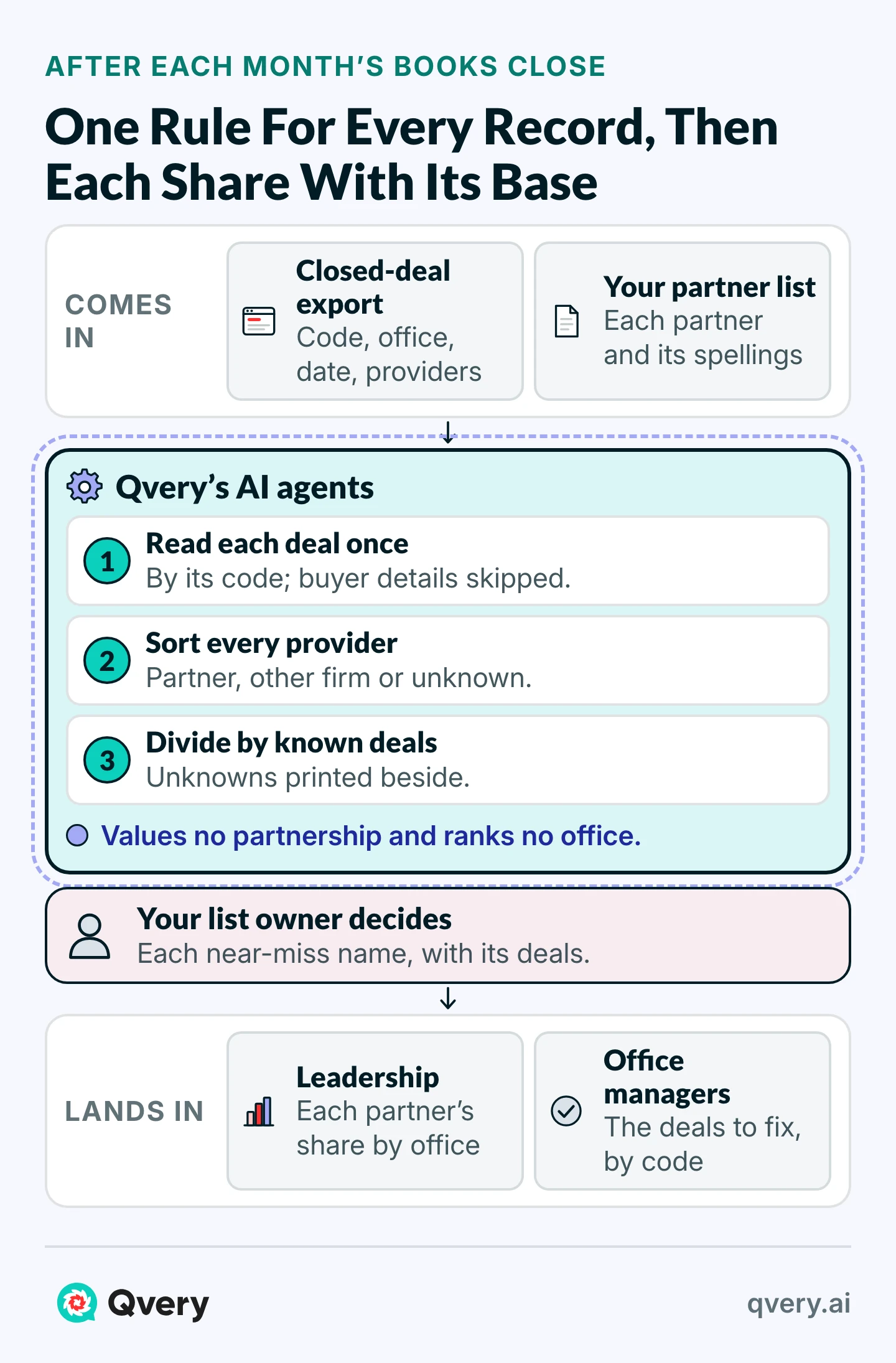
On each deal they read the deal code, the office, the close date and the title, lender and insurance columns, however each office labels them. The export’s columns for buyer names, addresses, prices and agent codes are listed as left out, and never read.
Where an office has no field for a provider, they take the provider’s name from the settlement statement (the closing sheet with every charge on it) or the title commitment, where the title company states the policy it will issue.
Each deal counts once, by its code. A provider counts for your partner only when the record names it or a spelling on your list, so CAT counts and Cedar Avenue Title & Escrow doesn’t until someone says it should.
That near-miss goes on a short list with its 22 deals, and whoever owns your partner list decides.
 Piotr BabelPartner @ Qvery
A deal edited after closing can export twice, sometimes with a different title company on each row. We never pick one. The deal counts once, that service goes to unknown, and both rows land on the office’s fix list, because a count that quietly chooses is one nobody can check later. The same rule holds for a short name two of your partners share.
What comes out is one page a month. For title, lender and insurance, each office shows its partner deals, other firms and unknowns, with the share of known deals beside the count behind it. Offices appear alphabetically, and each gets its deals to fix by code, with the field at fault.
No office is ranked, and no real estate agent’s name is read, so no view by person exists. Who at Qvery may open the export, and when copies are erased, is written into the data processing agreement before the build.
What you may do with a partner’s share, including whether the partner sees its own, is a question for your counsel. A title or lending business you own part of also has rules of its own under federal law.
If you have last quarter’s closed-deal export and your partner list at hand, run them through the AI agents and see your own shares by office, unknowns included.
With the AI Agents, the Count Costs About Half
The calculator opens on the 250-deal example. Type your own closings, minutes and pay over it.
Partner Tracking ROI Calculator
What Each Closed Deal Costs You To Record, And With The Agents
Saved Per Year
$15,668
400 hours handed back, after $4,800 a year to run it
- Hours Handed Back
- 400 hours a year
- Agent Running Cost (Estimate)
- $400 a month
- Payback Per $10,000 Of Build
- 7.7 months
On these numbers, each deal costs $5.01 instead of $10.23, the agent saves $15,668 a year after its own running cost, and every $10,000 of the build is earned back in 7.7 months.
With the AI agents, a person spends about 4 minutes a deal on average, all of it on the deals they flag. The agents run for about $400 a month, nearly all of it hosting, the dated monthly page and the upkeep of your partner list. Both are the example’s estimates.
The year falls from $30,702 to $15,034, or $5.01 a deal. That’s $15,668 a year and 400 hours handed back, and the agents repay every $10,000 of build in about 7.7 months.
Those hours pay most when your office manager spends them on work you’d otherwise hire for. The calculator prices the count itself, not the renewal it feeds.
If any of your partner agreements renews this year, the first count belongs before that meeting.
We Start From the Export Your System Already Makes
About two weeks after kickoff, the AI agents have counted your last three months of closings. Leadership reads that first page with us while each office works through its fix list.
For the next two weeks the agents run beside your current tally, and every difference gets explained. From then on the page arrives monthly, after your books close, dated so the share a renewal was decided on reads the same a year later.
The partner count is one of the jobs we take off a brokerage’s back office. Checking each deal file against your required forms, and chasing what’s missing before closing day, are two more.
To start, we need four things from you.
- One quarter’s closed-deal export, or read access to your transaction system.
- Your partner list, with every spelling your offices accept.
- About two hours in the first week from whoever owns your records.
- Your counsel’s view on who may see which counts.
Frequently asked questions
What is an attach rate in real estate?
It’s the share of a brokerage’s closed deals on which the client also used the brokerage’s own or partner title company, lender or insurer. The base varies: all closed deals, buyer sides only, or deals that used a mortgage. Redfin’s 2024 mortgage rate was 27% on one base and 22% on another.
Is a capture rate the same as an attach rate?
In practice, yes. Both name the share of your deals that used a partner: older trade coverage says capture rate, and Redfin and Rocket say attach rate. What separates two figures is the base they’re divided by, never the word on top of them.
What is a good attach rate for a brokerage?
The mortgage average in trade coverage, about 15%, dates from 2009 and states no base, so it can’t be matched to yours. The useful comparison is with yourself: the same partner across your own offices and months, counted by one rule, with the unknowns beside each share.
Should cash purchases count in a mortgage attach rate?
A cash buyer can’t use a lender, so counting cash deals in the base pulls the rate down: that’s the gap between Redfin’s 27% and 22% for 2024. Leave them out if the question is how often your financed buyers use the partner lender. Whichever you choose, print it next to the rate.
Do listing-side deals count toward a title company’s share?
They’re closed deals, so they’re in the count unless you decide otherwise. On a listing the title company is often the seller’s or the buyer’s choice, so a share across both sides measures something different from a buyer-side rate like Redfin’s. Say which one you mean wherever the number appears.
Can we compare our rate with a public brokerage’s?
Only when the bases match, which takes checking. Public figures may leave out cash deals, count only buyer sides, or cover only the markets where the partner operates. A rate divided by a different base answers a different question, however close the two numbers look.
Which transaction systems do the AI agents work with?
Whichever system you run, the AI agents work from its closed-deal export, a spreadsheet or CSV file. They read it each month, from a folder your team drops it in or through read access you grant. During setup we map where each office keeps the title company, lender and insurer, since offices often label them differently.
What if the AI agents match a name wrongly?
Each match shows the text from your export beside the partner-list name it was counted as, so a wrong one stands out on the page. Similar names stay apart unless your list links them. When your team corrects a match, the spelling joins the list and next month’s count uses it.
Does the count cover home warranty or other services?
It covers the three provider fields a closed deal usually carries: title company, lender and insurer. Each gets its own share by office, with its own unknowns, because the three are recorded in different places and by different people.
Why not just make the provider field required?
A required field helps, since it’s what any count reads, but it records whatever someone typed to get past the screen, such as initials or a firm’s old name. The spellings still have to be matched to your partner list, and the insurer often sits outside the deal record altogether.
Does the count show what a partner earns us?
No. It counts deals, not money. What a partnership is worth to the brokerage, and whether to keep it, stays with your leadership; the count gives that judgment a number of closings per office to start from, with the unknowns beside it.
What happens when we add or drop a partner mid-year?
A new partner counts from the month it joins your list. When an agreement ends, that firm is filed as another firm from then on, and the months already reported stay as they were counted. A partner that renames or is bought keeps one entry with both names.
Who sees the partner shares?
Your leadership and your office managers see the same totals, office by office, with no real estate agent named. A partner sees nothing unless leadership decides it may, and then only its own closings, to check against its books.
What do the AI agents cost to run?
On the 250-deal example, about $400 a month in all, an estimate, nearly all of it hosting, the dated monthly page and keeping your partner list current. Reading a whole monthly export costs well under a dollar in model usage.
How soon do we get the first count?
Within about two weeks of kickoff, on your last three months of closings. Leadership reads that first page with us, each office gets its records to fix, and after that the count runs monthly once your books close.
