
On this page
- Read Every Page Before Trusting a File Name
- Let the Contract Decide Which Forms Apply
- Mark Every Line Found, Missing or Out of Date
- Check Every Signature, Initial and Date
- Apply the Amendment, Then Compare Every Figure
- Hand the Reviewer the Exceptions and a Drafted Note
- Where Qvery's Agents Sit Between Upload and Closing
- What Reading Every File Costs, Per File and a Year
- Partnering on Your Files Starts With Your List
- Frequently asked questions
Every deal your agents close leaves a file behind: the contract, its addenda, the disclosures your state requires, the amendment after the inspection, the commission statement. Before closing, someone in your office opens that file and works down your forms list by hand, page by page, initial by initial.
At 135 files a month and about 45 minutes each, that is roughly 100 hours of a reviewer's month, close to $40,000 a year.
Most files pass, so the file with the missing addendum or the blank date looks like all the others. It gets found at closing, when accounting holds the commission, or later, when the state asks to see your records.
AI agents do this reading now, every page of every file, and they leave the decisions with your reviewer.
At Qvery, we help brokerages spend fewer hours on file review, with custom AI agents that check every deal file against your forms list and flag what is missing.
To show the work, we built one deal file and ran our agents on it. Everything in it is invented: Larkfield and Boone Realty, a Durham brokerage that does not exist, its own ten-line forms list, and a financed resale of a 1968 house in an owners' association, uploaded the way agents upload, 17 pages in ten files.
We planted seven faults of the kinds reviewers say they find and wrote the answers down before the agents read a page.
Below are the six steps the agents ran, each with the screen it produced, then what this review costs your office by hand and what Qvery builds to run it on every file. You can run the same check on one of your own files from step six.
This walks one resale purchase through one list. Listings, leases and new construction run the same way against their own lists; they are not shown here.
Read Every Page Before Trusting a File Name
Each page goes in as an image under a number, with no file name attached, and comes back named by what is printed on it: the form code, the title, the revision, every name, figure and date, and every signature, initial and date block. Code then joins the pages back to the files they came in.
Agents name their uploads however they like. In our file, the upload named HOA_addendum.pdf holds the owners' association's statement of account: dues paid, no violations, a $250 transfer fee. The page is useful, and it is not the addendum the contract requires; a reviewer working down the list by file name would tick that line.
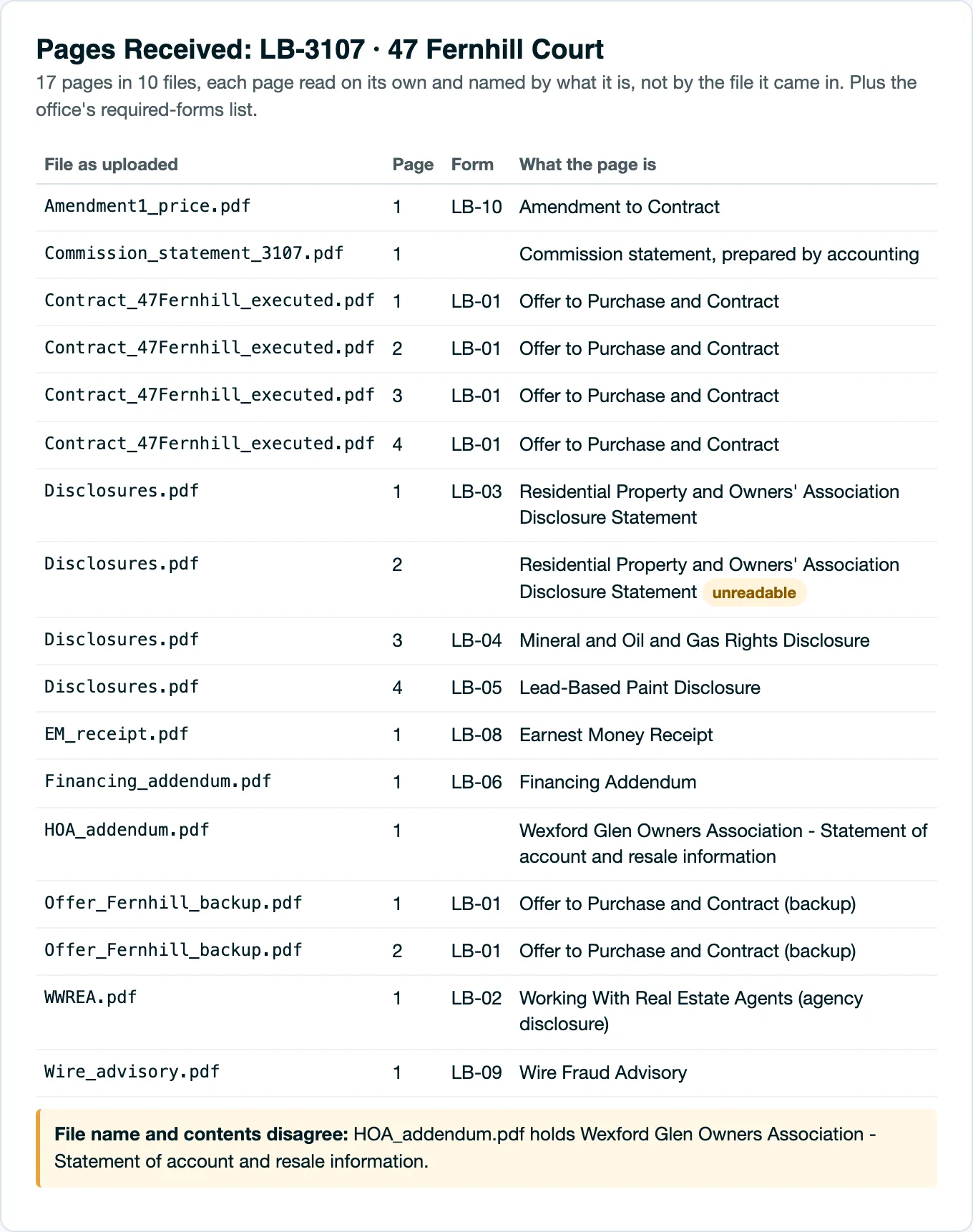
Check that it worked: the pages named must equal the pages received. Here, 17 went in and 17 came back named, plus the office's list.
One page did not read. Page two of the property disclosure was a phone photo taken at an angle, washed out by glare across the signature lines. The agents made out the title and nothing else, and marked all six signature and date blocks unreadable.
The reader had just read the sellers' names on the contract pages and could have written them in; it did not. A guessed date in a compliance record is worse than a blank one, because nobody goes back to check it.

Let the Contract Decide Which Forms Apply
Your list says when each form is required: the lead disclosure only for a house built before 1978, the financing addendum only with a loan, the association addendum only in an association. So before marking anything, the agents read the year built, the loan and the association from the contract.
| Fact in the file | Where it was read | What it brings in |
|---|---|---|
| Built in 1968 | Contract page 1 and the lead disclosure | The lead-based paint disclosure |
| A new loan of 80% of the price | Contract page 1 and the financing addendum | The financing addendum |
| An owners' association, named | Contract page 2 | The owners' association addendum |
| A price change after the contract | The signed amendment | The amendment itself |
The contract also names the forms attached to it. A form the contract names that is not in the file is not found, whatever the file names say.
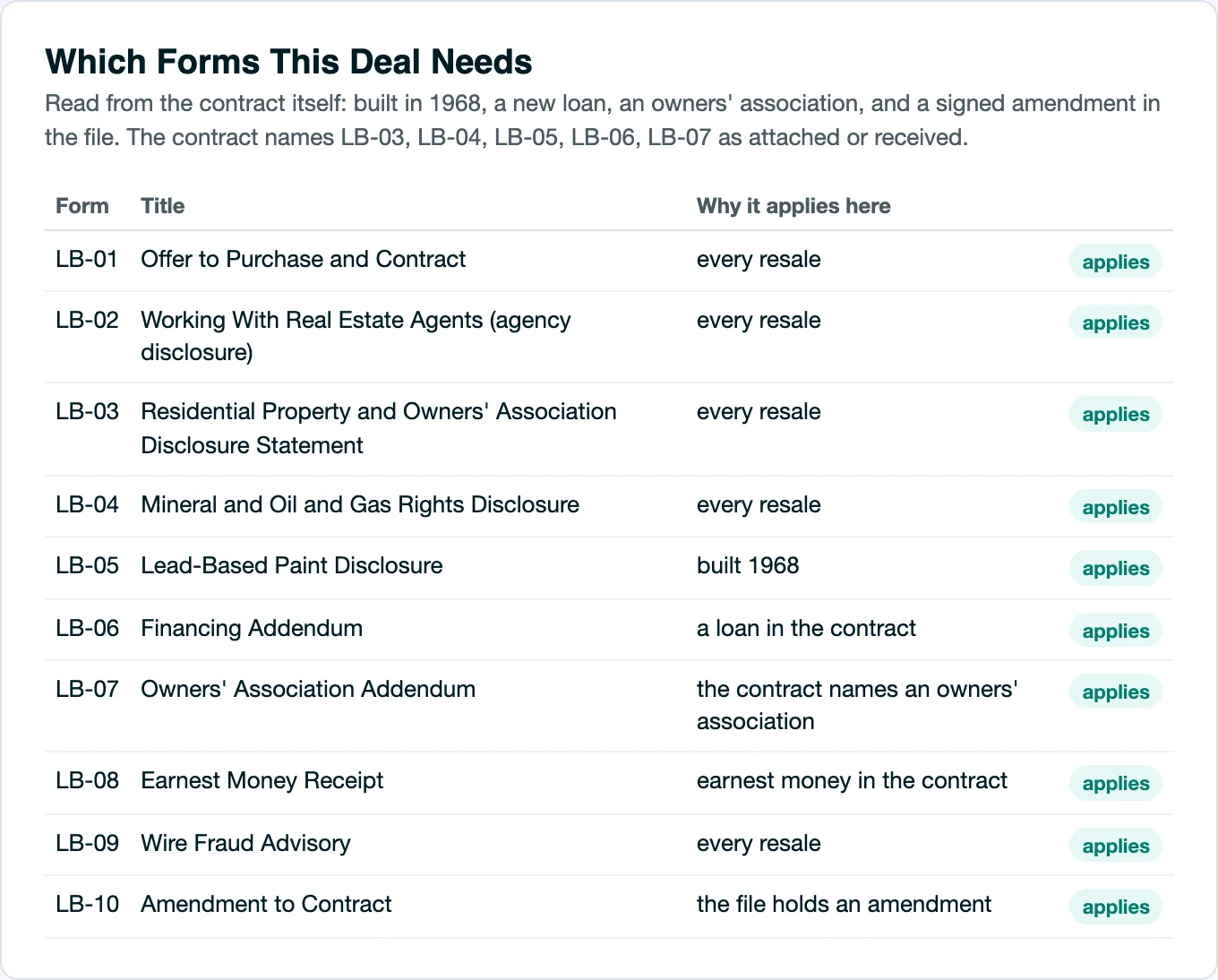
Some of those lines are law and some are your office's policy, and the agents treat them the same way: they check against your list.
The federal rule for houses built before 1978 requires a lead attachment signed by the sellers, the agents and the buyers, with the date of each signature, kept for three years.
North Carolina requires the property and owners' association disclosure statement and the mineral and oil and gas rights disclosure, on the Real Estate Commission's forms, and the Commission's agency brochure, Working with Real Estate Agents, at first substantial contact.
Which revision you accept, which addenda you hold commission for and what a reviewer signs off is your list. The agents never add a rule your list does not name.
Mark Every Line Found, Missing or Out of Date
Every line comes back with a status and the page it rests on: eight found, one not found, one on an older revision.
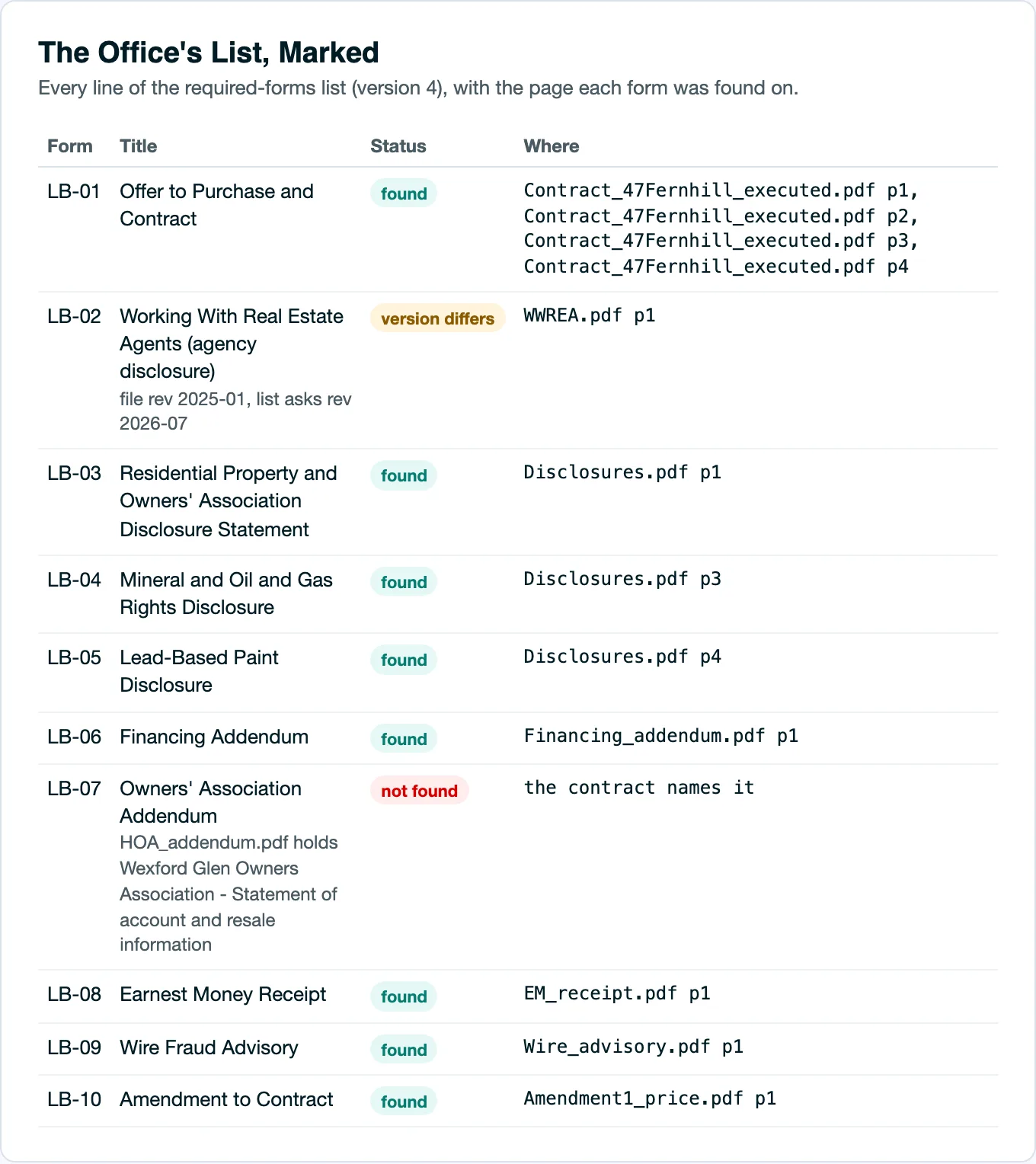
Two lines need a person.
The association addendum is not in the file
It binds the buyer to the association's rules, dues and transfer fee. Contract page 2 names it as attached, no page carries it, and the file named for it holds the account statement. The buyer's agent sends the signed addendum, and the next run marks the line found, with its page.
The agency disclosure is an older revision
The file holds the 2025-01 revision; your list asks for 2026-07. Whether the older one stands for this deal or gets replaced is your compliance manager's call, and the agents do not rule on it. The decision and its reason go into the file's record.
Check Every Signature, Initial and Date
The agents list every signature, initial and date block the forms show, with its form and page, and mark it filled, blank or unreadable: 73 in this file.
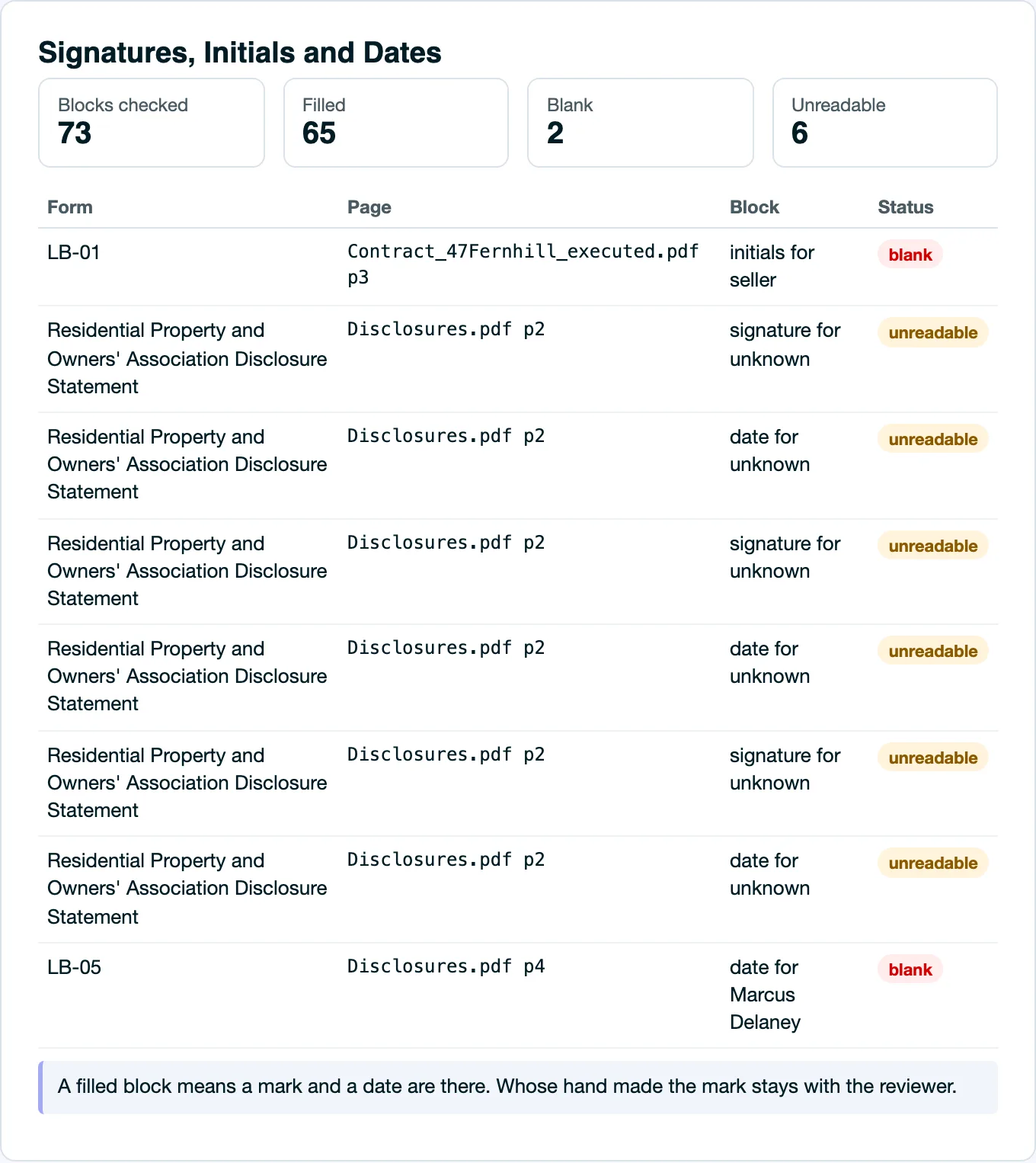
The two blanks are the ones a tired reader misses. The second seller's initials on page 3 of the contract are missing; the box beside them is filled, so the footer looks done at a glance. And the buyer signed the lead disclosure but left the date line empty, which is one of the elements the federal rule asks for.
A filled block means a mark and a date are there. Whose hand made the mark is a question the agents never answer; it stays with your reviewer. A typed name on a signature line counts as blank.
Reviewers who check files by hand describe the same job, and the commission hold that waits on it.
Tips from Reddit
Each required agents to upload every required document for a listing or transaction, and those documents were reviewed by the compliance officer.
I’ve even made example folders of how the files should look, and I provided them a checklist from GAR as to why I check over these things so they know I’m not asking for nonsense its basically it’s the brokers transaction checklist.
For example, in our state, a broker may be permitted to hold a check for a reasonable period while attempting to obtain missing signatures or initials on documents that are legally required or considered essential by the state.
My brokerage can be audited at any time for file compliance. Not individual agents, my broker, and the office. Those transactions belong to the brokerage.
Apply the Amendment, Then Compare Every Figure
After the inspection, buyer and sellers signed an amendment taking the price from $389,000 to $381,500. Every document made after that has to carry the new price, so the agents apply the amendment first and then compare every later figure with it, in code, to the cent.
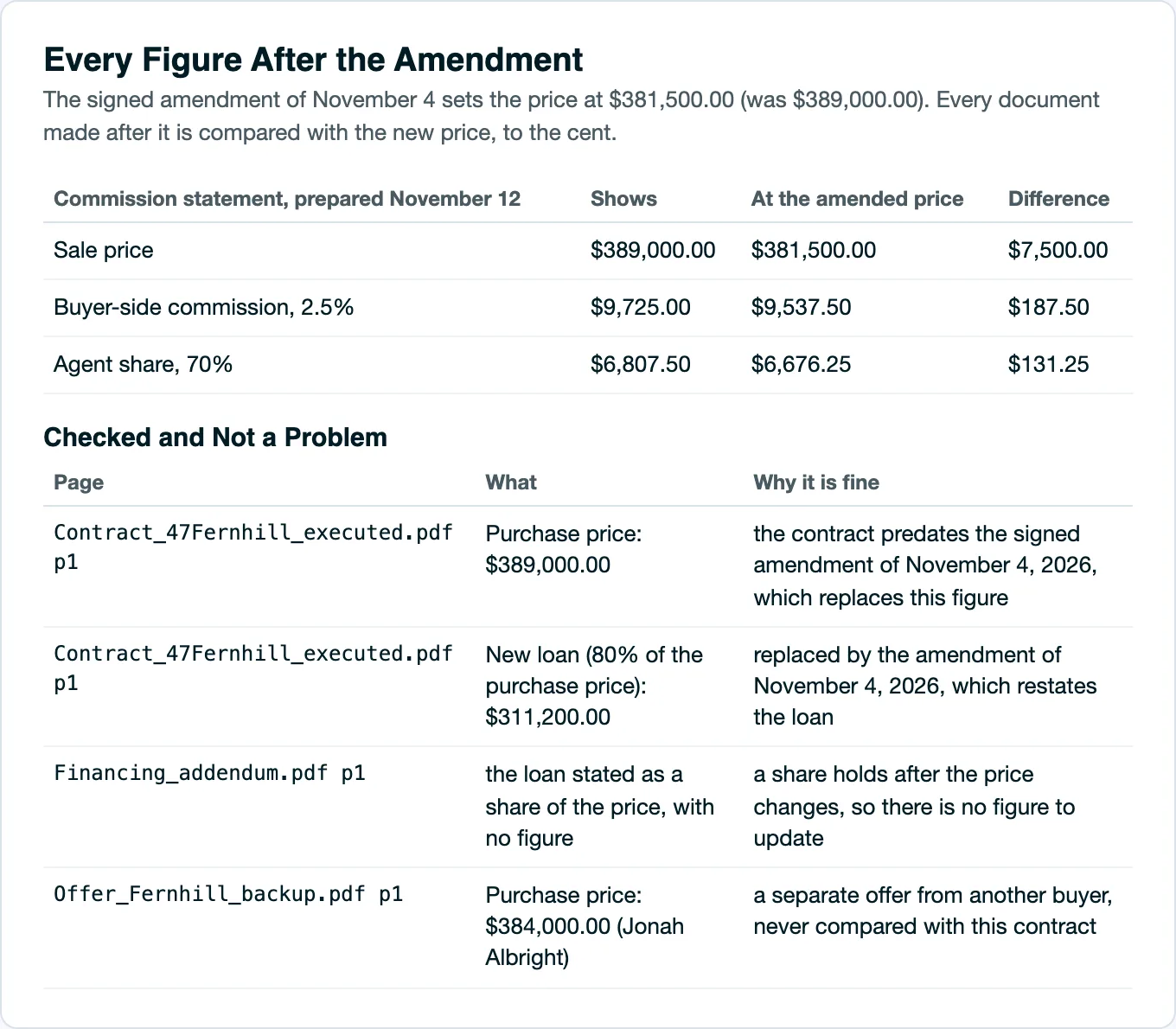
The commission statement accounting prepared on November 12, eight days after the amendment, still shows a sale price of $389,000. At 2.5%, it pays $9,725.00 instead of $9,537.50: $187.50 too much, $131.25 of it in the agent's share. That one goes to the top of the list, because it moves money.
The agents also say what they checked and left alone, and why. The contract's own $389,000 predates the amendment that replaced it. The financing addendum states the loan as 80% of the price, so it holds whatever the price is. And the $384,000 offer from another buyer is a backup offer, a separate contract, never a conflict with this one.
 Piotr BabelPartner @ Qvery
We split the work on purpose. A model reads each page and says what is printed on it; code does every comparison, to the cent, the same way every time. When the two disagree, or a page will not read, the file goes to your reviewer with the page number, and the agent stops there. I would rather it ask about one page than smooth it over.
Our first version got this step wrong. It dated each document by the latest date printed on it, and the contract mentions a December closing date, so the code decided the contract was made after the amendment and flagged the contract's own price. A document is now dated by when it was signed, received or prepared, never by a date it only mentions.
Hand the Reviewer the Exceptions and a Drafted Note
The reviewer gets the file with seven exceptions on top, money first, each with the page to open. Everything else on the list was found, signed, dated and agrees with the amendment.
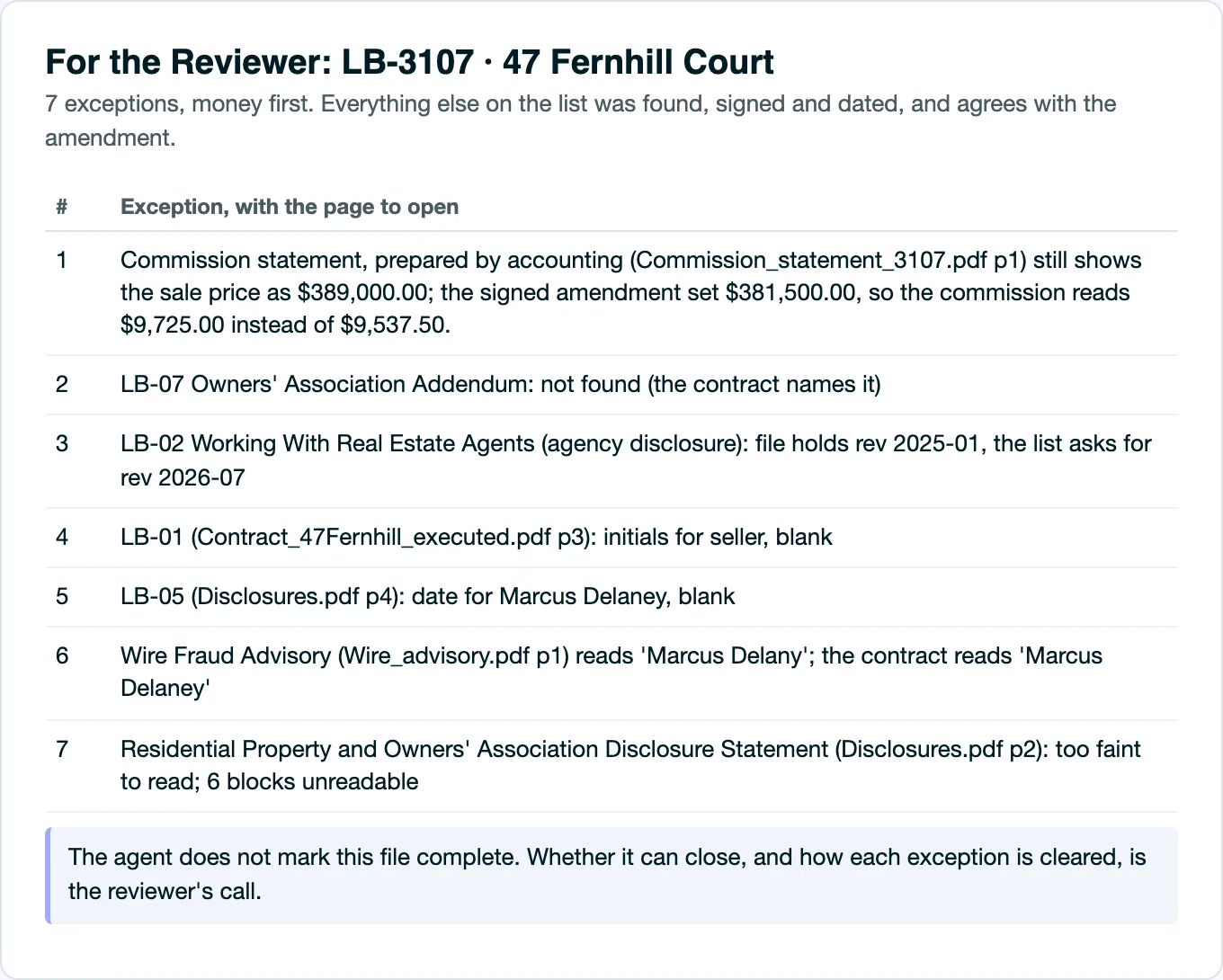
One of the seven came through despite a slip. On the wire fraud advisory the buyer signed "Marcus Delany", and the page prints his name the same way. The reader copied the signature exactly and, in another field, wrote the printed name as "Delaney", fixing the spelling for us. The name check compares every field in code, so the mismatch with the contract surfaced anyway.
Then the agents draft a note for the reviewer to send to the brokerage's own agent on the deal: each fix with its form and page, and a line saying the commission statement is going back to accounting with both figures.
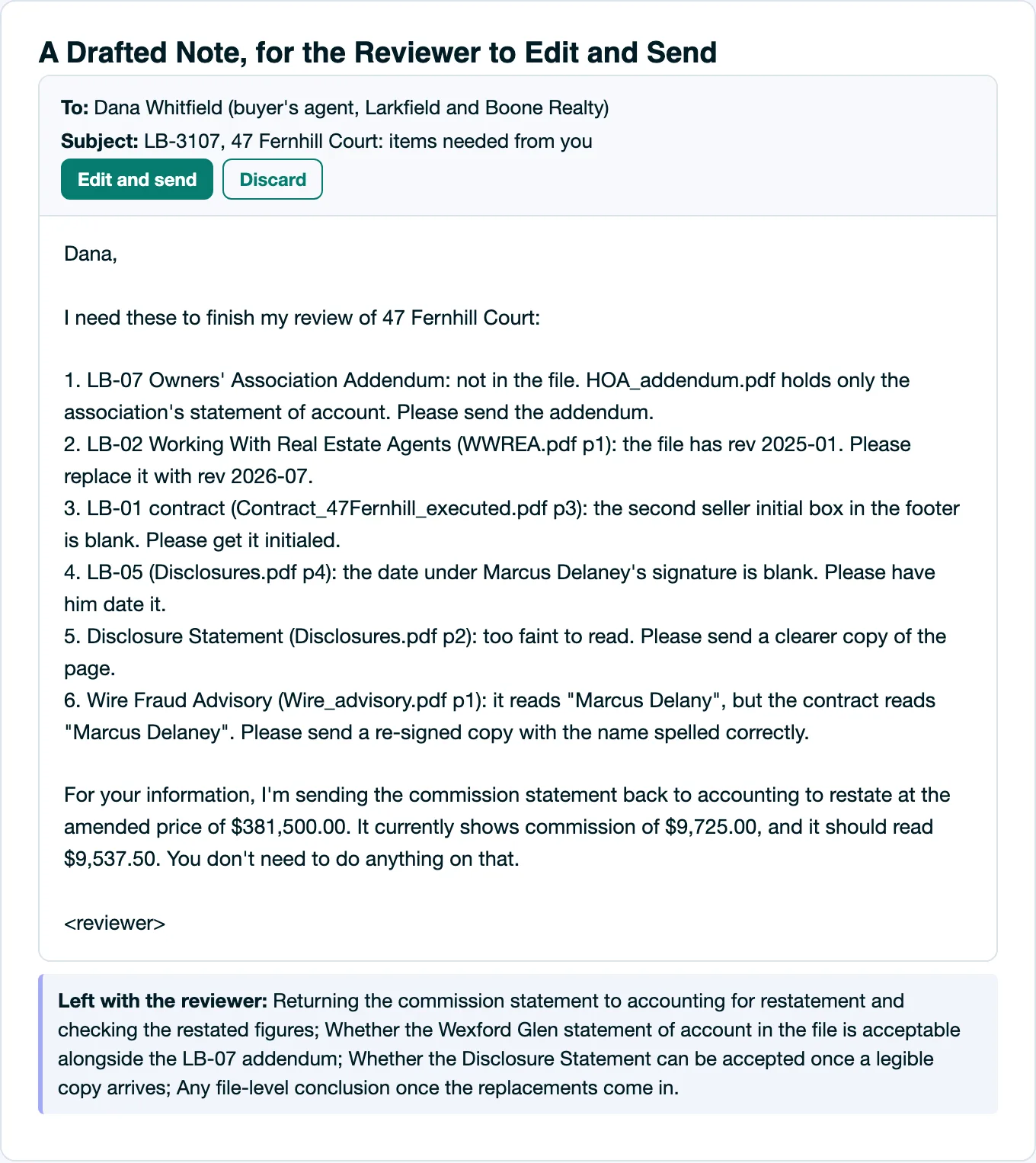
The note goes only to your own agent, never to a buyer, a seller or the other side, and it never says the file is complete or ready to close. Our draft ran 171 words against a cap of 170; the reviewer trims it in a few seconds.
Try the same check on one of your own deal files, with your forms list if you have one.
Where Qvery's Agents Sit Between Upload and Closing
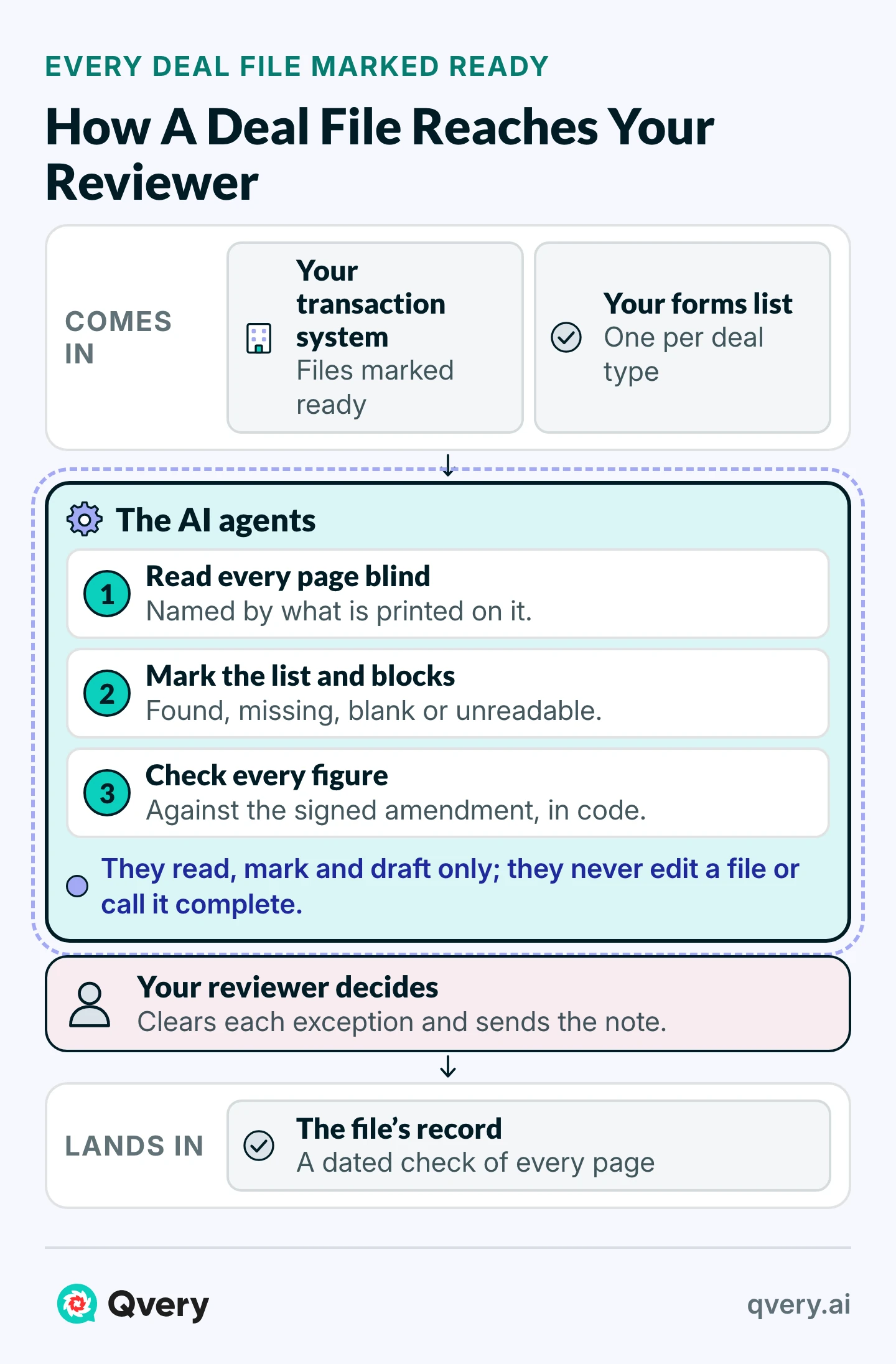
At a brokerage, our agents run this review on every file without anyone starting them. A file marked ready in your transaction system, or dropped in a watched folder, is read that day: every page against your list for its deal type, every block, every figure after every amendment.
When a missing form arrives, the file is read again and the record shows the day it came in. Your reviewer opens the exceptions, your compliance manager rules on what the list does not settle, and your broker signs off. The commission release stays where it is today.
The questions a broker asks first are about the files themselves: buyers' and sellers' names, loan figures, signatures.
| The agents may | The agents never |
|---|---|
| Read the folders and systems you link, read only | Edit, move or delete a document |
| Check every page against your list and your amendments | Call a file compliant, approved or ready to close |
| Draft a note to your own agent for your reviewer to send | Send anything to a buyer, a seller or the other side |
| Keep a dated record of every check and every flag | Say a signature is genuine, or add a rule your list does not name |
Before we connect anything, we agree in writing what the agents may read, where the data is processed and who on our side can open your files; Qvery AI OÜ puts all of it in a data processing agreement you sign before the build.
The record of every check is what you hand the Real Estate Commission if it asks, and in North Carolina it can ask without notice.
What Reading Every File Costs, Per File and a Year
Transaction Compliance Review ROI Calculator
What Each Deal File Costs You To Review, And With The Agents
Saved Per Year
$23,800
891 hours handed back, after $5,220 a year to run it
- Hours Handed Back
- 891 hours a year
- Agent Running Cost (Estimate)
- $435 a month
- Payback Per $10,000 Of Build
- 5 months
On these numbers, each file costs $9.74 instead of $24.43, the agent saves $23,800 a year after its own running cost, and every $10,000 of the build is earned back in 5 months.
The example is a brokerage of about 200 people: some 180 agents at the nine transaction sides a year the typical agent reported in NAR's 2026 Member Profile, about 135 files a month. A reviewer at an administrative assistant's pay in real estate, $22.80 an hour on average in May 2025 by the federal wage survey, costs about $32.57 an hour with benefits.
By hand, at our estimate of 45 minutes a file, that is about 101 hours a month, roughly $39,600 a year of review. With the agents, the reviewer spends about 12 minutes on a file: reading the exceptions, opening the pages they point to, sending the note. That frees about 74 hours a month.
The agents' running cost is about $1 a file in model usage plus $300 a month for hosting and upkeep, about $435 a month at this volume. What remains is about $23,800 a year, so each $10,000 of build pays back in about five months.
 Vlad ShvetsPartner @ Qvery
Checking a sample of files is a trade: you save a person's week and accept that the unread files are where the missing form will be. Once agents do the reading, that trade is gone. Every file is read the day it is marked ready, and your reviewer's hours go to the pages where a person has to decide. That is the job I want a brokerage paying people for.
The calculator counts hours. It does not count what a late miss costs: a commission held while someone chases a signature, a buyer's lawyer finding the blank date after closing, or an inspection of your records that arrives without notice.
Those are the reason to read every file instead of a sample, and none of them has a fair average to put in a field.
Partnering on Your Files Starts With Your List
Your list is where the build starts, because the agents check nothing your list does not name.
| You bring | What it is for |
|---|---|
| Your forms list for each deal type, and its owner | The agents check nothing the list does not name |
| Read access to your transaction system | Files are read the day they are marked ready |
| A month of files your reviewers already cleared, with their notes | The first run, set beside your reviewers' own marks |
| Three hours of your compliance manager's time in week one | Settling what the list leaves open |
In the first two weeks our agents read last month's cleared files beside your reviewers, and you see what each found that the other missed. After that, live files, read the day they are marked ready, and you decide when your reviewers start from the agents' list.
If a line on your list has no condition or no revision, the first week is where it surfaces, while the agents read files your reviewers already cleared and nothing live depends on the answer.
Frequently asked questions
Can AI tell whether a document is signed?
It can tell whether a signature, initial or date block has a mark in it, and read what the mark says when it is legible. It cannot tell whose hand made it. Our agents report each block as filled, blank or unreadable with its page, count a typed name as blank, and leave genuineness to your reviewer.
Can ChatGPT review a real estate contract?
A general assistant can read a contract and summarize it, but it does not know your office's list, it does not keep a record, and it may smooth over what it cannot read. Our agents check each page against your own list, compare figures in code to the cent, and mark a faint page unreadable instead of guessing.
What is a compliance review at a brokerage?
It is the check that every deal file holds the forms, disclosures, signatures and dates your office and your state require, in the right revision, before the deal closes and before commission is released. It also leaves a record that the broker supervised the file, which is what a regulator asks to see.
Does it know our state's required forms?
It checks against the list your brokerage already uses, so your state's forms are covered the way your broker set them. We load one list per deal type, with the revision and the condition for each form. When your state revises a form, the updated list applies from the next file. Without a list, the agents report "unknown" instead of guessing.
Will it work with SkySlope, Dotloop or Lone Wolf?
It works with the system your files already live in. Where the system lets an outside tool read files and set a review status, the agents work inside it; where it can only export, a watched folder does the job. We confirm what your system allows in the first days. Your agents keep uploading the way they do today.
Does it replace our transaction coordinator or compliance manager?
No. It takes the reading: every page, every block, every figure. Your coordinator still chases signatures and your compliance manager still decides what the list does not settle, from a short list instead of a full file. The hours it frees can go to reviewing every file instead of a sample.
Can it check files that have already closed?
Yes. Closed files read the same way, which is how you find the ones that closed with a form missing before an inspection does. In North Carolina a broker keeps transaction records for three years and the Real Estate Commission can inspect them without notice, so a dated record of each check is worth having.
What if our agents' handout and our office list disagree?
The agents read both and report each difference, such as a lead rule tied to another year or a disclosure required only above a price, as a decision for your compliance manager. They never pick one list over the other. Once your manager rules, every file from then on is checked against the corrected list.
Does it read a price changed by hand on a counteroffer?
Yes. A price or date written over by hand is read and held against the typed figure it replaces, and both go on the report with the page. When the ink is too faint or the scan too crooked to trust, the page is marked unreadable and a clearer copy is asked for, never guessed.
Can it check listing files and leases as well as purchases?
Yes, each against its own list. A listing file needs its listing agreement and the disclosures the seller signs; a lease has its own forms. We load one list per deal type, listing, resale, new construction and lease, and every file is checked against the list for its type.
Who on Qvery's side can see our buyers' and sellers' details?
Only the people named in our data processing agreement, settled before the build. It also sets where data is processed and how long each copy is kept. The agents read only the folders and systems you link, never edit a document, and send nothing outside your office.
How much does each file cost the agents to read?
We estimate one full read of a 17-page file like our sample at about 40 cents of model usage. A live file is read again when a missing form arrives and before closing, so we count about $1 a file, plus about $300 a month for hosting, the dated record and upkeep of your lists.
How soon does it read our live files?
About two weeks after we have access. The first week turns your lists into checks and sets up access; then the agents read files your reviewers already cleared, and you compare the two. Live files follow, read the day they are marked ready.
