
On this page
- Set Each Date From the Papers Both Sides Signed
- Hold the Contract's Rule Against Your Checklist
- Mark Each Paper by What It Says, Not What the Tracker Says
- Put the Money at the Top of the List
- Count What Status Updates Cost the Desk
- Draft One Chase Per Party, and Let the Coordinator Send It
- Finding and Chasing Costs About $65 a File
- Where Qvery's AI Agents Sit on the Closing Desk
- The First Two Weeks Run on Last Month's Closed Files
- Frequently asked questions
Every open deal carries a list of papers still out: the buyer's deposit receipt, the loan approval, the title commitment (the title company's promise to insure the sale, with the conditions to clear first), the proof of insurance.
Someone on your closing desk rebuilds that list every morning from the transaction system, the contract, its addenda and the inbox. They work out who owes each paper and by when, chase it, then type the same status again for the buyer's agent, the lender and the title company.
For a brokerage of about 200 people closing some 135 files a month, two hours of that per file is 270 hours of coordinator time a month, $105,527 a year.
The chasing is the part people see. Most of the work is finding what to chase, and the hard part is the dates: an addendum, a signed change to the contract, moves one date and everything counted from it.
| Paper | The closing date it states | Does it count? |
|---|---|---|
| The contract, signed 14 October | 20 November | replaced by Addendum 1 |
| Addendum 1, signed by both buyers and the seller | 4 December | yes |
| Addendum 1 (revised), signed by the seller only | 2 December | no: the buyers never signed it |
| The transaction system | 20 November | out of date since 4 November |
That is one deal in the sample files below. The lender's rate lock, the interest rate the lender holds for the buyers until a set day, still ends on 20 November, so a deal that now closes on 4 December needs an extension the lender priced at $910.
A coordinator finds that by reading each addendum against the tracker, file by file. AI agents do that reading now, every morning, on every open file, and hand the coordinator a ranked list with the chase emails already written.
At Qvery, we help brokerages spend less to close each file, with custom AI agents that find what every deal still lacks and draft the chase emails.
To show the work, we ran Qvery's agents on the files built for this agent's free try. Everything in them is invented: Redbud Home Brokerage, a 200-person Austin brokerage that does not exist, and its two coordinators' 22 open files on 6 November.
The files are its closing checklist, one contract with two addenda, two weeks of its closing inbox and four email threads. The answers were written down with the files, before any model read them.
Each of the six steps carries the screen the run produced, and after the last one you can run the same check on one of your own deal files.
This walks purchase files. Listings and leases run on their own checklists and are not shown here.
Set Each Date From the Papers Both Sides Signed
The agents start with the contract's own rule for changes. Redbud's agreement states it in paragraph 14: a change to a date is valid only in an addendum signed by the buyer and the seller, and dates that run from another date move with it.
So every addendum is checked for who signed it before anything it says is used.
Addendum 1 moves the closing to 4 December and the financing deadline from 4 to 13 November. Both buyers signed it on 3 November and the seller on 4 November, so it counts.
The revised Addendum 1 says 2 December and carries one signature, the seller's; the buyers' line is blank. It changes nothing, and the agents say why on the file.
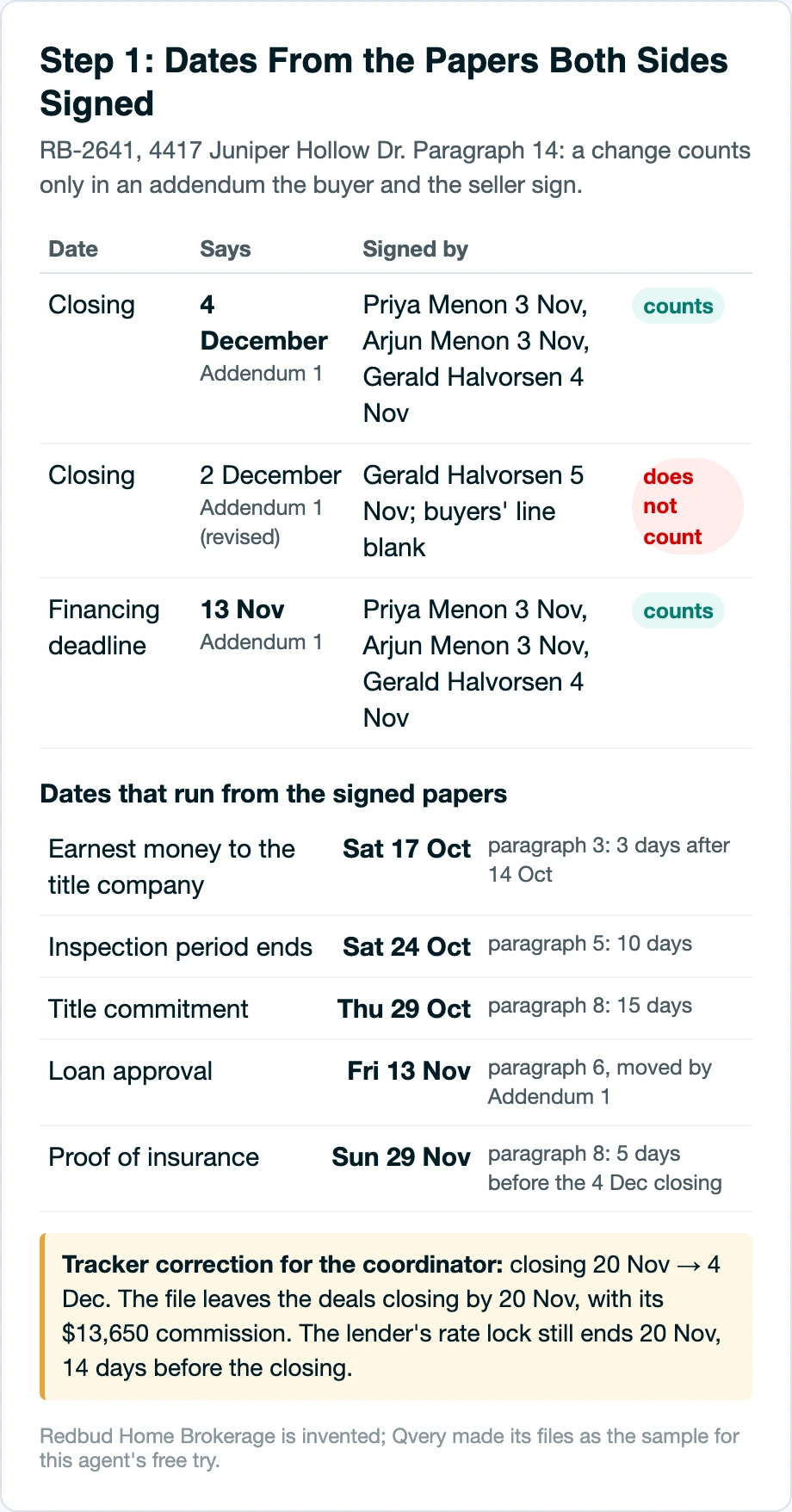
Check that it worked: every date on the sheet names a signed paper. Both models we ran, Sonnet and the smaller Haiku, set 4 December and 13 November and set the revised version aside for the missing signatures, in about two minutes each.
The one thing the agents never do is choose between two signed papers. If the buyers sign the revised version tomorrow, two signed papers will say 2 December and 4 December, and neither says it replaces the other. The closing date then reads unknown and goes to your closing lead with both papers attached.
The signed date also changes the morning's list. The file drops out of the deals closing in the next two weeks, and its $13,650 commission drops out with it.
Hold the Contract's Rule Against Your Checklist
Redbud's contract gives the buyers 3 days after the effective date to deliver the earnest money, their deposit. Redbud's own checklist says 3 business days. On this deal, effective Wednesday 14 October, those are two different days.
| The rule | Where it is written | Due date on this deal |
|---|---|---|
| 3 days after the effective date | the contract, paragraph 3 | Saturday 17 October |
| 3 business days | Redbud's closing checklist | Monday 19 October |
| 3 days, and a weekend or legal holiday moves it to the next day that is not one | Texas's standard resale contract, for comparison | Monday 19 October |
The deposit arrived on 19 October: on time by the checklist, two days late by the contract. The tracker mixes the rules as well. Of its 22 deposit due dates, 20 count calendar days, one counts business days, and one matches neither.
Which rule the desk follows is not the agents' call. They list each difference once for your closing lead, with both rules, and keep counting by the contract until someone decides.
The same list carries the other gap in Redbud's checklist: nobody is named to order the homeowners association (HOA) resale certificate, the association's statement a sale needs. It is open on seven files, and the title company has written about two of them.
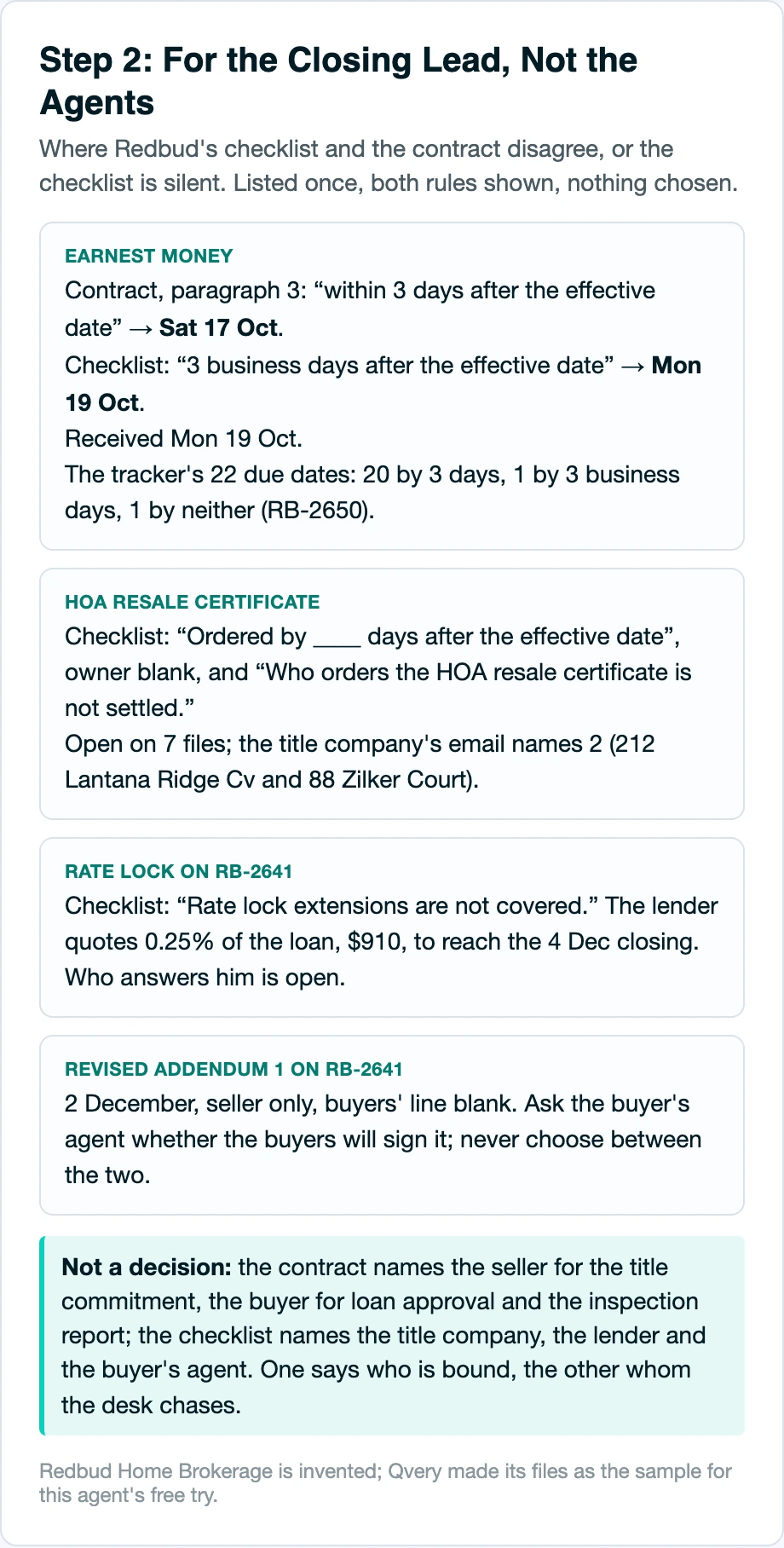
Both models also flagged that the contract names the seller for the title commitment while the checklist names the title company. That difference needs no decision: the contract says who is bound to deliver the paper, and your checklist says whom the desk chases.
Mark Each Paper by What It Says, Not What the Tracker Says
For each of the 22 files and each paper on the checklist, the agents mark found, open, different or date unknown. A tracker cell that says received is not proof. The paper's own address and file number are set against the deal.
That is how the inspection report on 4417 Juniper Hollow Dr gets caught. The tracker says it came in on 24 October.
The only inspection report in the sample's files came by email on 5 November, for Priya Menon, one of the buyers, and it prints 4471 Juniper Hollow Dr. The house number's digits are transposed, and the tracker counts the paper as done.
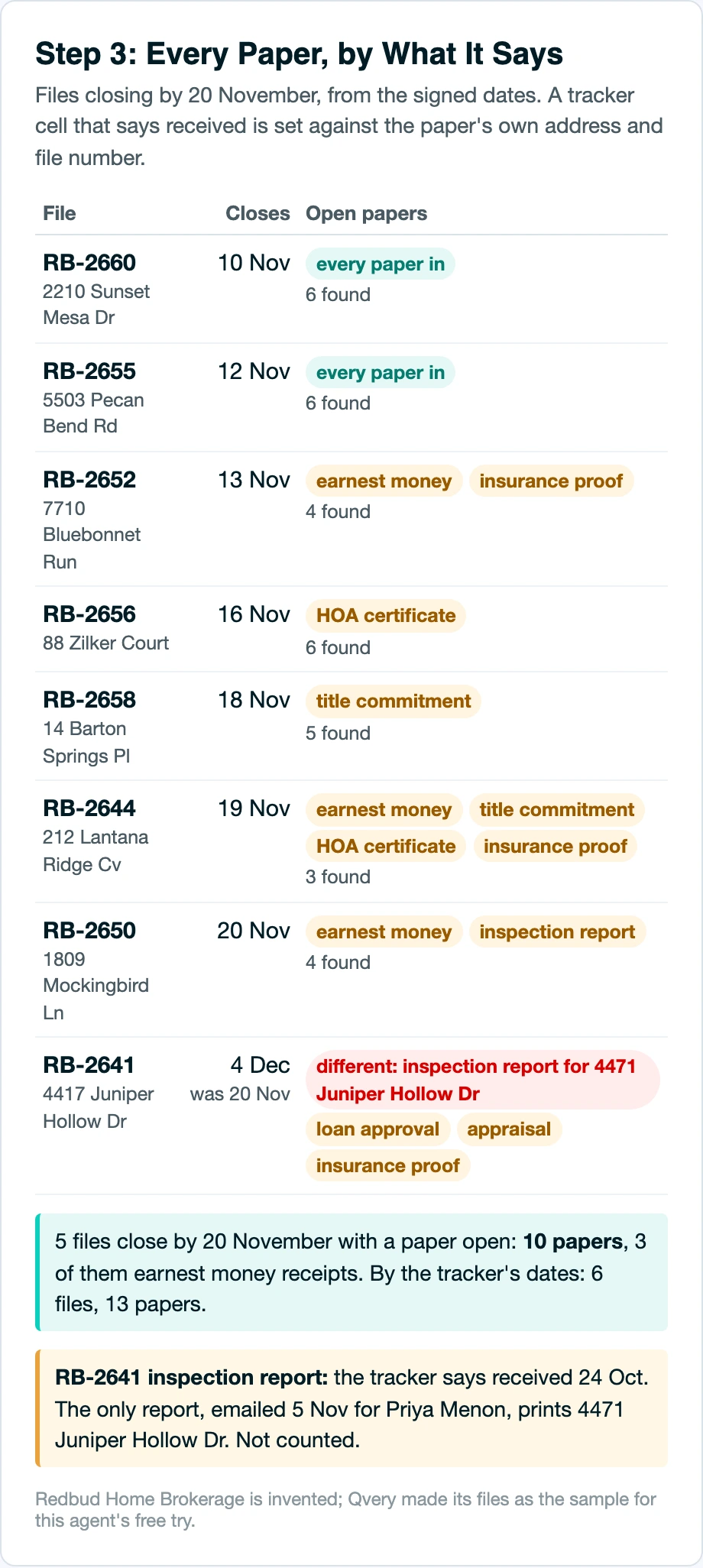
Check that it worked: the marks add up to the files. On Redbud's desk, 5 files close in the next two weeks with a paper still open, 10 papers in all, three of them deposit receipts. Two files close in that window with every paper in, and the sheet says so.
By the tracker's dates the count would be 6 files and 13 papers; the difference is the deal the signed addendum moved.
Put the Money at the Top of the List
Some open items cost money the day they slip, so they go first, each with the paper it comes from.
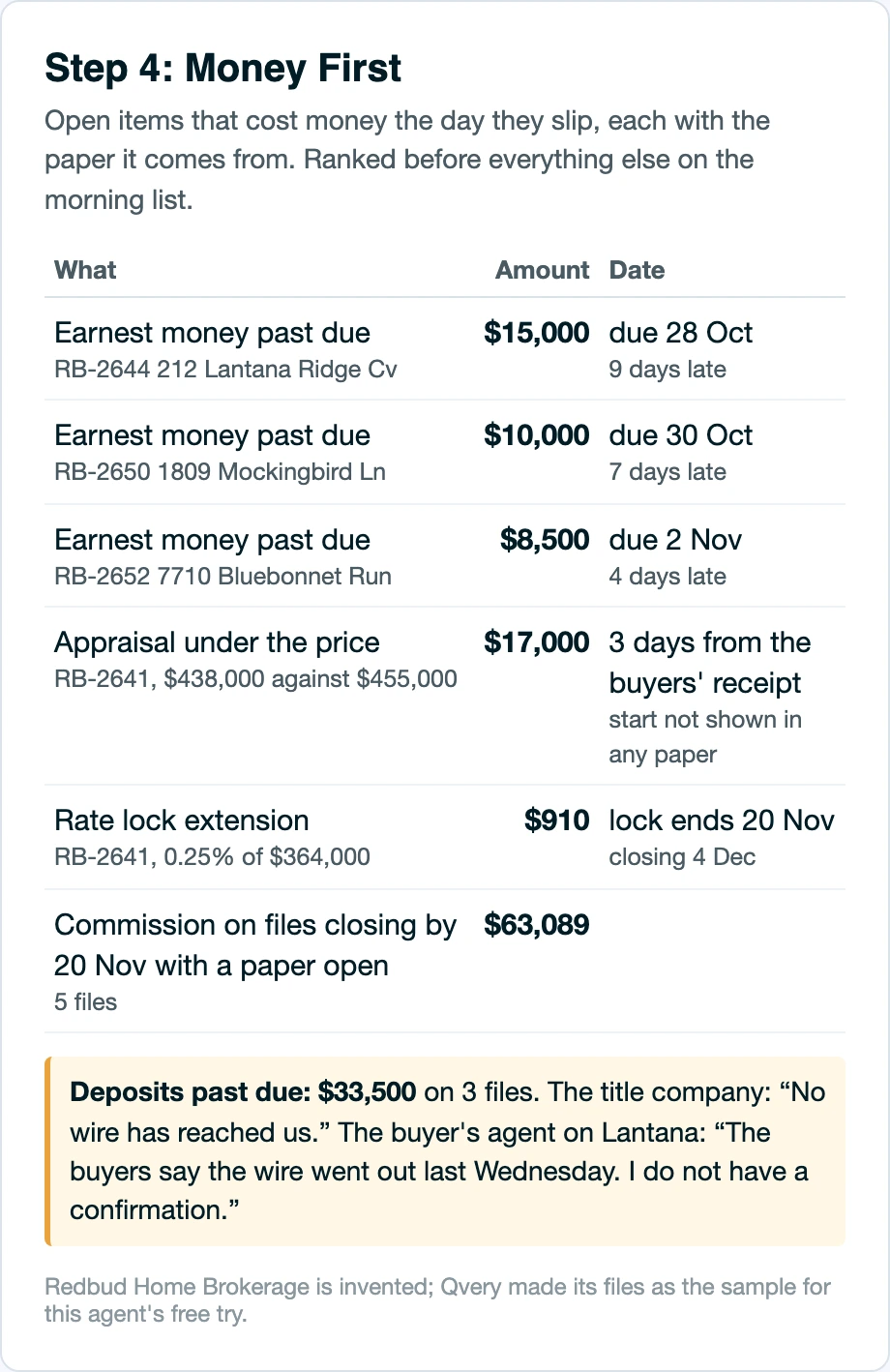
Deposits past due: $33,500
on three files: $15,000 nine days late, $10,000 seven days, $8,500 four days. The title company has no wire for any of them. The buyer's agent on the first says the buyers sent it last Wednesday and has no confirmation.
An appraisal $17,000 under the price
$438,000 against $455,000 on 4417 Juniper Hollow Dr. The buyers have 3 days from the day they received the report to ask for a lower price or walk away. No paper shows that day, so the agents say the window's start is not shown rather than count it from the lender's email.
A lock that ends before the closing
20 November against 4 December. The lender quoted 0.25% of the $364,000 loan to extend, $910. Redbud's checklist says lock extensions are not covered, so who answers the lender goes to the closing lead.
Commission waiting on open papers: $63,089
on the five files closing in the next two weeks.
None of this is a verdict. A deposit can sit at the title company under the wrong file name. The agents report what the papers show and ask.
Count What Status Updates Cost the Desk
Redbud's closing inbox took 174 messages in two working weeks, and 67 of them were status requests: someone asking where a deal stands. The coordinators logged 747 minutes answering those, 6.2 hours a week, and 10.2 hours a week replying to everything.
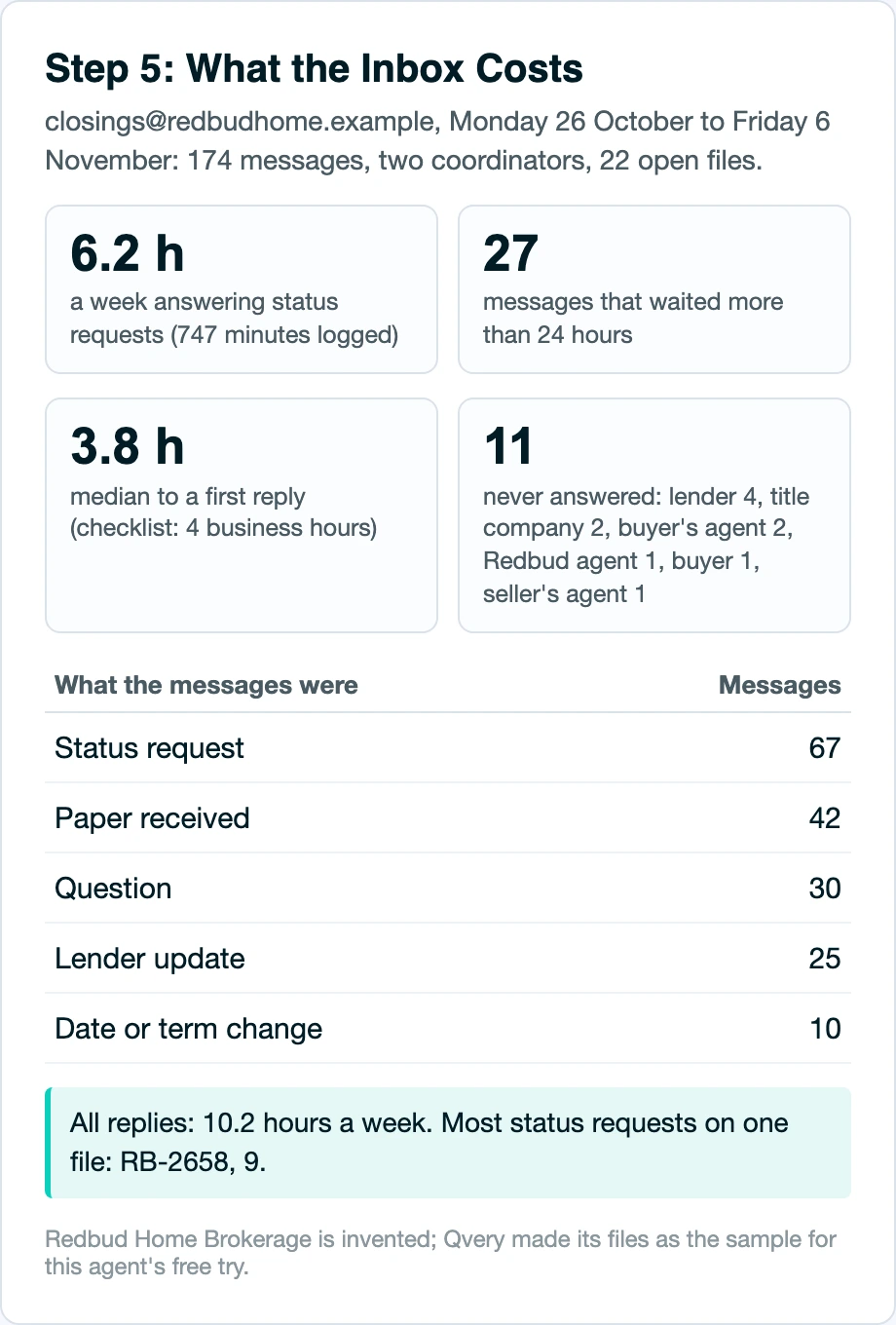
The median first reply came in 3.8 hours, inside the checklist's four business hours. The waits sit in the tail: 27 messages waited more than a day, and 11 were never answered, four of them from the lender.
Draft One Chase Per Party, and Let the Coordinator Send It
Then the agents write, one message per party per day covering every open item, which is Redbud's own rule. Each item carries its date and the paper behind it, each message ends on one question, and none carries wire instructions or an account number, so no fake payment request can start with the agents.
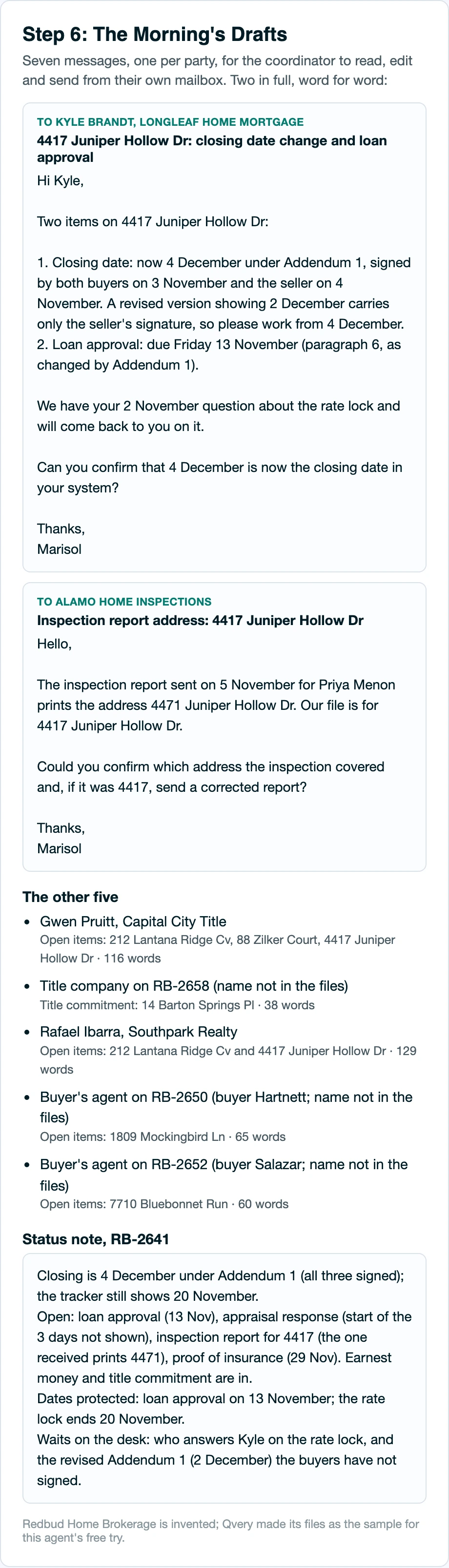
Sonnet wrote seven messages in about a minute, 38 to 129 words each. The one to the lender says the closing is now 4 December under Addendum 1, that a revised version showing 2 December carries only the seller's signature, and that the loan approval is due 13 November.
The one to the inspector asks which address the inspection covered. Haiku's first draft asked for a reissued report with the right address, which assumes a typo; the inspector may have inspected the wrong house.
Your coordinator edits what needs a personal touch and sends from their own mailbox. The buyers hear from their agent, never from the desk directly.
Our first run of this step went wrong twice, and the mistakes were ours. We grouped the open items by party in code, marked a title commitment due tomorrow as one to chase today, and split one buyer's agent into two people.
Haiku, drafting, caught both in its status note: the commitment "is tomorrow", and "the insurance line belongs in Marisol's one email to him, not a second email." We fixed the grouping and ran it again.
 Piotr BabelPartner @ Qvery
The dates decide whether the list can be trusted, so our agents read who signed a paper before they read what it says. An unsigned addendum moves nothing, however recent it is. When two signed papers disagree and neither says which replaces the other, the date stays unknown and both go to your closing lead. Code then does every count the same way each morning.
Tips from Reddit
How people who run closings keep the dates straight
I used to manage a team of 20 agents. Not all of them had transactions happening at the same time, but we had 10-15 closings a month and the best tool for me was using my email calendar and setting up auto reminders/tasks. It's a 30 min process upfront, but it helped me keep track of deadlines.
We have transaction autoplans for EVERY SCENARIO, which automatically create tasks for admin, agents and other support staff based on inputted Listing, Firm, Close, Conditional, etc dates.
I won't lie, there's a lot of hours that have gone into set up and maintaining it but we can't function without it now.
As a lender I’m always communicating with my realtor the appraisal return date, appraisal amount as soon as it comes in, submitting for clear to close and of course the actual clear to close at a minimum.
Try the same check on one of your own deals: the contract, any addenda, the papers you have so far and your checklist.
Finding and Chasing Costs About $65 a File
Closing Coordination ROI Calculator
What Each Deal File Costs Your Closing Desk, And With The Agents
Saved Per Year
$59,114
2,025 hours handed back, after $6,840 a year to run it
- Hours Handed Back
- 2,025 hours a year
- Agent Running Cost (Estimate)
- $570 a month
- Payback Per $10,000 Of Build
- 2 months
On these numbers, each file costs $28.65 instead of $65.14, the agent saves $59,114 a year after its own running cost, and every $10,000 of the build is earned back in 2 months.
The example is a brokerage of about 200 people: some 180 agents at the nine transaction sides a year the typical agent reported in NAR's 2026 Member Profile, about 135 files a month.
A coordinator at an administrative assistant's pay in real estate, $22.80 an hour on average in May 2025 by the federal wage survey, costs about $32.57 an hour with benefits.
We assume two hours a file by hand, spread over the weeks it is open: rebuilding what is out, chasing it, answering where it stands. With the agents, a coordinator spends about 45 minutes a file reading the morning list, editing and sending the drafts and making the calls the agents leave to a person.
The agents run for about $2 a file in model usage plus $300 a month for hosting, the morning run and upkeep of your checklist rules: $570 a month at this volume.
| The example, a year | By hand | With the agents |
|---|---|---|
| Coordinator hours | 3,240 | 1,215 |
| Running the agents | none | $6,840 |
| Cost | $105,527 | $46,413 |
| Per file | $65.14 | $28.65 |
That is $59,114 back a year and 2,025 coordinator hours, so each $10,000 of build pays back in 2 months. Those hours count most where the desk would otherwise hire: the same coordinators carry more files.
The calculator counts hours. It does not count the deposit nobody chased, the lock that runs out or the closing that slips a week because a report came in for the wrong address. On Redbud's desk that morning, those were $33,500 of deposits, a $910 extension and a $17,000 appraisal gap.
 Vlad ShvetsPartner @ Qvery
Most of a coordinator's morning goes to working out what to chase: which paper is out, on which file, by which date. When agents do that part, the same coordinators carry more files, and their hours go to the buyer who is about to walk and the lender who needs a call. That is the work a brokerage hired a good coordinator for in the first place.
Where Qvery's AI Agents Sit on the Closing Desk
At a brokerage, our agents work every open file each morning without anyone starting them, and again when a new paper lands in the deal's folder or the closing inbox. They read the contract and its signed addenda, your checklist, the transaction system's list and the inbox.
They set each date from signed papers, mark every paper and put the money first. The coordinator gets a ranked list, one draft per party in their Outlook or Gmail, a status note per deal and the tracker corrections to make.
A paper whose file number, address or names disagree with the deal goes on an unmatched list until a person places it.
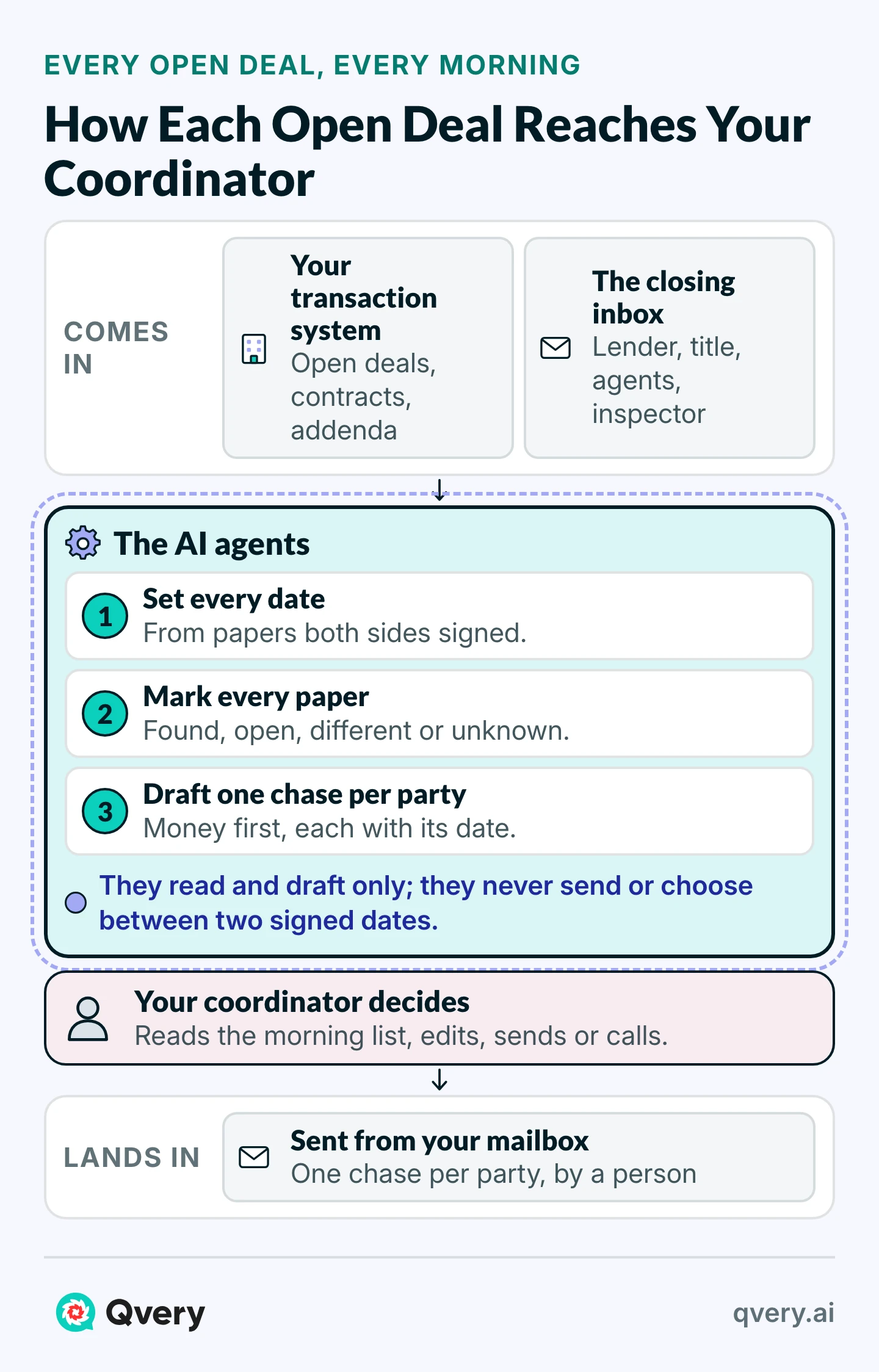
A broker's first questions are about the inbox and the money, so these are the lines the agents never cross:
- They never send, copy or reply to a message.
- They never say a deal is complete or ready to close.
- They never choose between two signed versions of a date.
- They never put wire instructions, an account number or a loan number in a draft.
- They never give legal, escrow or lending advice.
Before we connect anything, we agree in writing what the agents may read, usually the transaction system and the shared closing inbox, read only, and where the data is processed. Personal mailboxes stay closed.
Every check and every draft is logged with the paper behind it. Qvery AI OÜ signs a data processing agreement that names who on our side can open your deals and when copies are deleted.
Checking each file for its required forms before closing is a separate job we build agents for, and the two can run on the same deals.
The First Two Weeks Run on Last Month's Closed Files
We build on files that already closed, because there the right answer is known.
- Your checklist and the contract forms your agents use.
- Read access to your transaction system and the shared closing inbox.
- Last month's closed files, with what was really missing on each.
- Your closing lead's rulings in the first week, on the rules your checklist leaves open.
In the first week we turn your checklist and contracts into the agents' rules and connect the inbox. In the second, the agents work last month's closed deals and your coordinators compare their lists with what was really missing.
Then live files, every draft read and sent by a coordinator, and you decide when the morning starts from the agents' list.
Redbud's desk would open with two questions for its closing lead: calendar days or business days for the deposit, and who orders the HOA certificate. Yours will have its own, and settling them is the first week's work, before a single draft reaches a lender.
Frequently asked questions
Can AI be a transaction coordinator?
AI can do the coordinator's reading: which papers each file lacks, who owes them, which date each protects, and the chase emails that follow. It should not decide or send. Our agents leave every message, call and disputed date to your coordinator and closing lead.
What does a closing coordinator do, and what moves to the agents?
A closing coordinator runs a deal from contract to closing: tracks deadlines, collects papers, chases the lender, title company, inspector and agents, and keeps everyone told where it stands. The agents take the tracking and the first drafts; the calls, the edits and the sending stay with your coordinator.
How do transaction coordinators get paid, and how does this compare?
Whether your coordinators are on staff or bill per file, the useful number is what coordination costs you per file. In the calculator's example it is $65.14 a file by hand and $28.65 with the agents, running cost included. Type your own volume, minutes and pay over it.
Do the agents replace our transaction coordinators?
No. They take the reading and the first drafts; your coordinators keep the sending, the calls and every judgment about a date or a deposit. What changes is how many files the same people carry, which counts most when your volume grows and you would otherwise hire.
Which papers do the agents track?
Whatever your checklist names. On the sample desk that was seven: the earnest money receipt, inspection report, loan approval, appraisal, title commitment, HOA documents and proof of insurance. A paper your checklist does not cover goes to your closing lead instead of onto a list the agents invent.
Who controls the AI agents?
You do. Before the build we agree in writing what the agents may read and do, and they start with read access only. Your coordinator decides what goes out; your closing lead decides what the contract and checklist leave open. Every check and draft is logged with the paper behind it.
Which transaction systems and mailboxes do the agents read?
They read deals where they already live: Open To Close, SkySlope, dotloop, Lone Wolf or a shared drive. In email, they read only the shared closing mailbox your coordinators copy on each deal; personal mailboxes stay closed unless you choose otherwise. Drafts land in your coordinator's Outlook or Gmail.
What if our deals live in spreadsheets, not a transaction system?
That works. The free try reads an export or a spreadsheet with one row per open deal, and a build can read a shared drive. Dates still come from the contracts and signed addenda themselves, so a stale cell in the sheet is corrected, not copied.
What if a contract page is a poor scan?
A date the agents cannot read stays unknown, never guessed, and the file tells your coordinator which page could not be read. One clear copy from the agent on the deal settles it, and the file is checked again when it lands.
How is this different from the task list in our transaction system?
A task list fires from the dates someone typed in, so an addendum means typing them again. The agents set the dates from the signed papers, check each paper against its file, read the inbox and write the messages. Where your system keeps a task list, they can add each open item to it.
What if the lender or the other side's agent never replies?
The next morning the item is still open and a follow-up draft is waiting, saying when it was first asked for and which date it protects. As that date nears, the item moves up the list. Whether to call or copy the listing broker is the coordinator's decision.
Do the agents chase our own salespeople too?
Yes, for whatever they owe, such as a signed disclosure, in the same short request everyone else gets. A salesperson with several open deals can get one note covering all of them, sent by your coordinator, so your agents hear from a colleague.
How much does running the agents cost?
We agree a fixed price for a defined result before we build anything. Running them is, in our estimate, about $2 a file in model usage plus $300 a month for hosting, the morning run and upkeep of your checklist rules: about $570 a month at 135 files.
