
On this page
- Step 1: Read the Headings and Leave the Personal Columns Out
- Step 2: Turn 671 Rows Into 640 Deals
- Step 3: Match Each Name Only to Your Partner List
- Step 4: Count Partner, Other and Unknown in Every Office
- Step 5: Read the Memo, the Notes and the Invoice Against the Counts
- Step 6: Hand a Person the Decisions the Files Force
- Step 7: Give Each Office Its Repair List Before the Cutoff
- Where Qvery's AI Agents Take the Monthly Count
- Recording a Closed Deal by Hand Costs About $10
- Your Office Managers Get Their First List in About Two Weeks
- Frequently asked questions
Every partner agreement a brokerage renews comes with the same question: how many of last quarter's closings used that title company, lender or insurer?
The answer sits in the closed-deal export your transaction system already makes, and where closing records are patchy it doesn't come out clean. In the sample below, one partner is typed three ways, one office leaves the insurer blank, and a deal edited after closing shows up twice.
Until something automates it, someone rebuilds the count by hand, in a spreadsheet, before each renewal. The sample brokerage pays an outside analyst $1,650 a month for 14 hours of it, and the analyst counts every blank as another firm.
Qvery's AI agents now run that count every month, from the same export, and hand a person only the deals the files can't settle.
At Qvery, we help brokerages spend less on the partner tally, with custom AI agents that match every closed deal to your partner list and name each record to fix.
We ran the whole job on a brokerage that doesn't exist: Northfold Realty Group, 400 people in five Minneapolis offices, on Lone Wolf Transactions. Every file is invented, so no real brokerage's deals appear here, and the answer key was written before anything ran.
| File | What it holds |
|---|---|
| Closed-deal export | 671 rows with the title, lender and insurance columns |
| Partner list | Six partners and the spellings each one accepts |
| Partner memo | Four renewals on 15 December, and who owns the records |
| Export notes | Where each provider column is filled from, and its quirks |
| Analyst's invoice | The hand tally's hours, its bill and how it treats blanks |
| Operating chief's email | What leadership needs for its 3 December review |
Seven steps get from the export to that page. Code does the counting, the same way every month; a model reads the memo and the notes; a person settles what neither can. Your own export goes through the same seven.
This counts which deals used your partners. What any partnership is worth stays with your leadership.
Step 1: Read the Headings and Leave the Personal Columns Out
The export comes in as the transaction system writes it. Before reading a single value, the AI agents read the column headings and decide which ones the count needs.
Northfold's export has 11 headings. The count needs six: deal code, office, close date and the title, lender and insurance providers. The other five (property type, price, agent code, address and buyer name) are listed by name and never read, so no buyer, price or agent appears anywhere after this step.
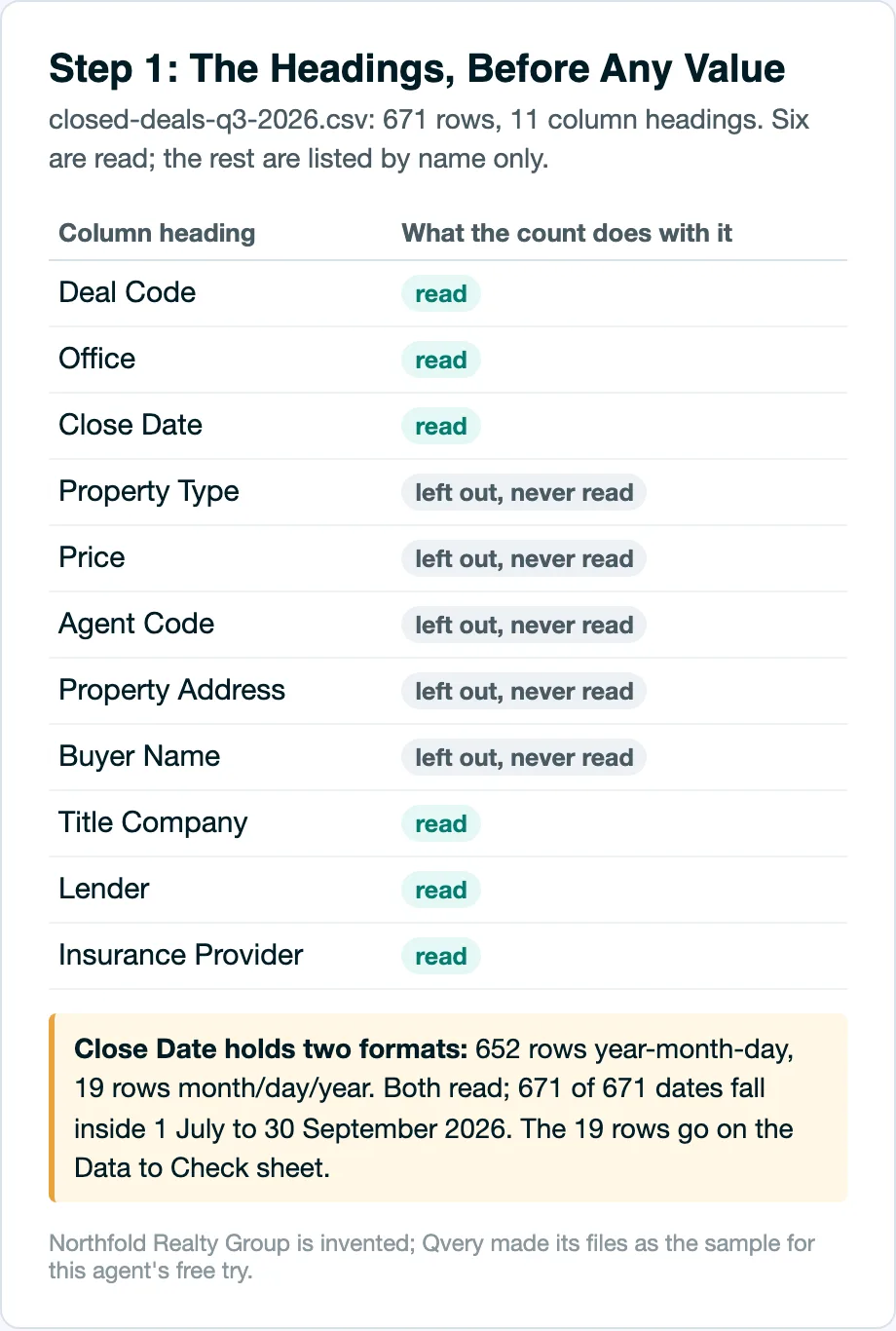
What you should see is a list of headings left out, with no value from any of them. If a buyer's name turns up later, a column was misread, and nothing after it should run.
Step 2: Turn 671 Rows Into 640 Deals
One deal is one deal code, whatever the export does with it, and each of Northfold's 671 rows lands in one of four places.
| Rows | What they are | What the count does |
|---|---|---|
| 640 | One per deal code | Counts each deal once |
| 17 | No deal code | Lists them, out of every share |
| 3 | Exact repeats | Counts the deal once |
| 11 | Second rows, other provider | Marks that service unknown |
The repeats are harmless: the export notes say a deal edited after closing can export twice. The 11 are records to fix. NF-26-3163 has Cedar Avenue Title on one row and Heartland Title on the other, so its title company is unknown, and both rows stay in front of the office that entered them.
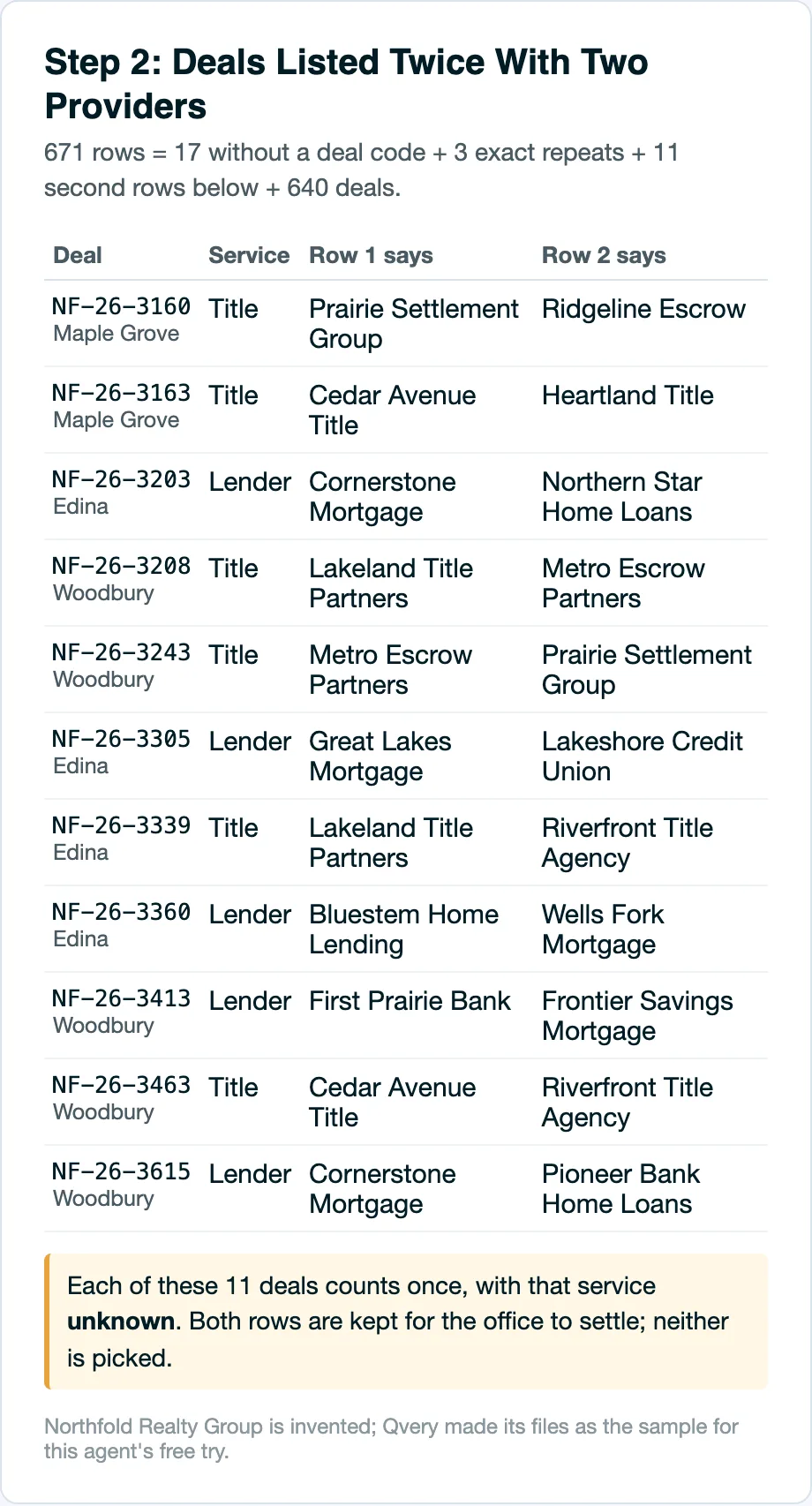
Picking one of the two rows would be a guess about who closed the deal.
Before going on, check the sum: rows without a code, plus repeats, plus second rows, plus deals, equals the rows in the file. If it is off by even one, some row was dropped or counted twice, and every share after it carries the error.
Step 3: Match Each Name Only to Your Partner List
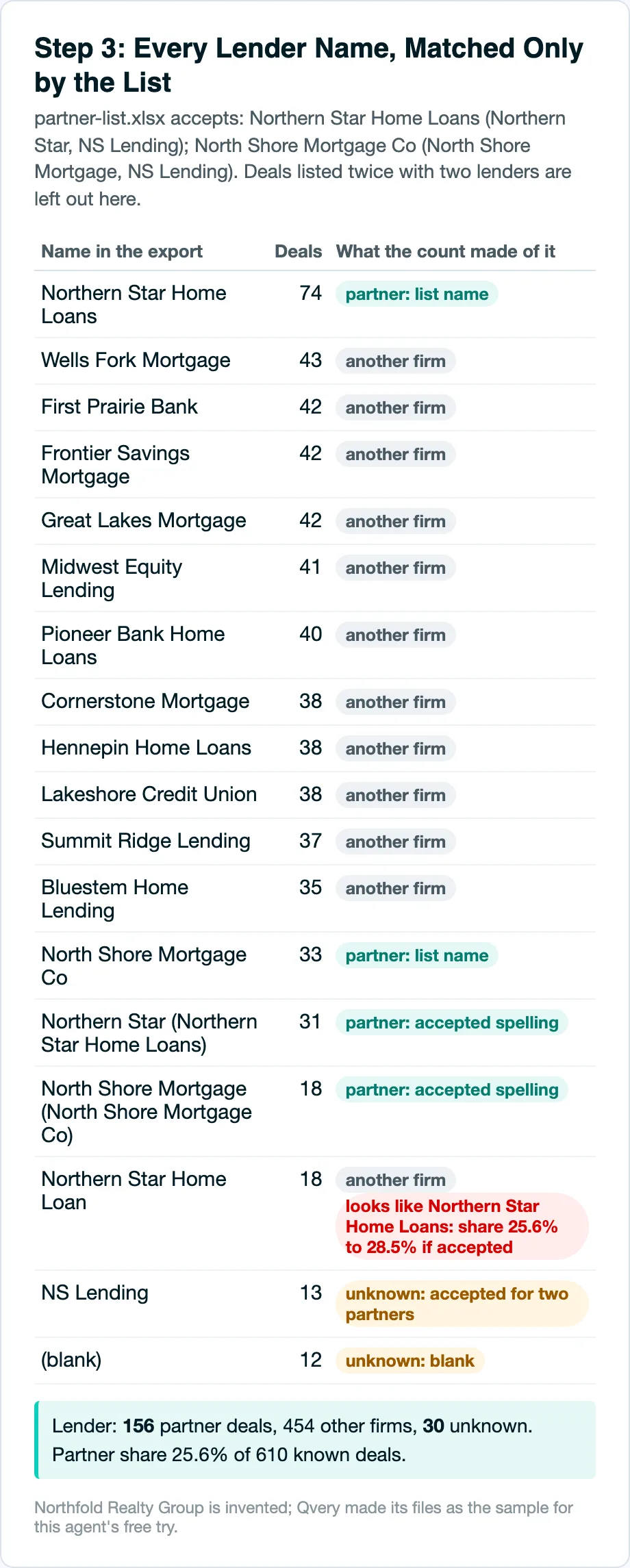
A provider counts for a partner only when the deal carries the partner's name or a spelling the partner list accepts for it. Capitals and doubled spaces are ignored; nothing else is. Northfold's lender column shows what that rule does.
Partner, by the list
Northern Star Home Loans (74 deals) and Northern Star (31), a spelling the list accepts, make 105 partner deals. North Shore Mortgage Co and the accepted North Shore Mortgage make 51.
Unknown, by the list
The list accepts NS Lending for both lenders, so on its 13 deals it can't say which one made the loan. They stay unknown until an office fixes the record.
Another firm, until someone says otherwise
Northern Star Home Loan, one letter short of a partner, is on 18 deals and not on the list. It counts as another firm and goes on a list for a person, with the share it would move: lender from 25.6% to 28.5% if accepted.
Nothing is matched because it looks close.
A similarity score loose enough to take Cedar Avenue Title & Escrow as Cedar Avenue Title would add 22 title deals that may belong to another company, and every guess like that moves a number an agreement gets renewed on. So the AI agents show the guess and the share it would move, and a person makes the call.
Tips from Reddit
How people who keep name lists straight do it
The only way I can think to do it is use the UNIQUE function in a new sheet to get a list of all the unique names in the list you have. Then in the cell next to the name write what you want the name changed to.
any new additions that don’t have a match should be apparent through a simple pivot table as they will be blank for “New Name”
It's the outliers that take the most time and not sure there is a more reliable method than a human to get it right.
Step 4: Count Partner, Other and Unknown in Every Office
With every name settled or set aside, the rest is arithmetic. For each office and each service there are partner deals, other firms, unknowns, the known total and all deals. The partner share is partner deals over known deals, and the unknown share is unknowns over all deals. Offices run alphabetically, and nothing is ranked.
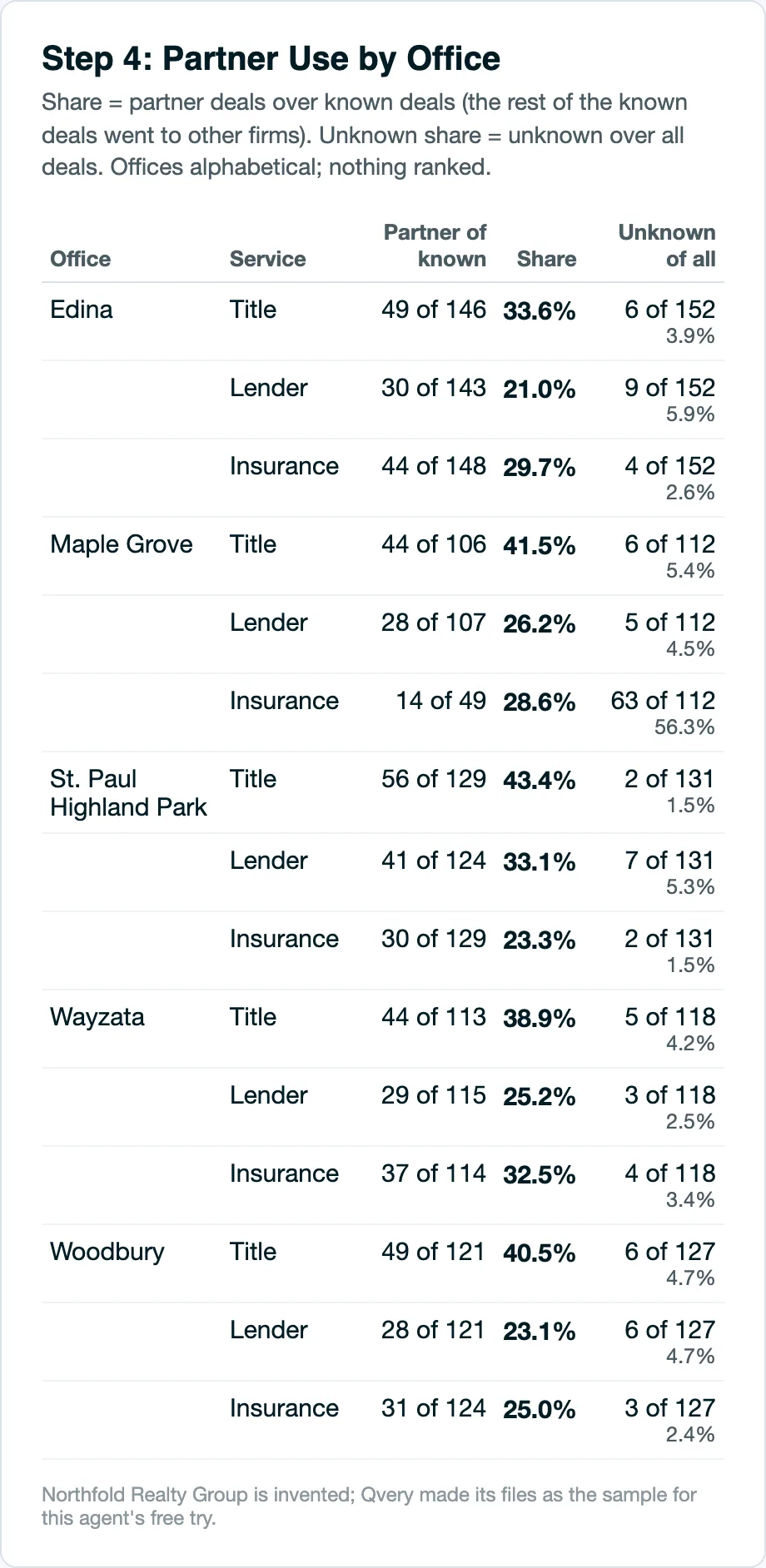
Across the quarter, the title partners have 39.3% of the 615 deals whose record names a title company, with 25 unknown. Lenders: 25.6% of 610, with 30 unknown. Insurance: 27.7% of 564, with 76 unknown.
The count has no view by agent. The AI agents never read the agent code, and a closing record says who handled the title, not what anyone told the buyer, so it can't fairly judge a person. The count stops at the office.
The free try runs this same count on your own export and partner list, or on Northfold's files if you want to see it first.
Step 5: Read the Memo, the Notes and the Invoice Against the Counts
Counting is code's job; reading the memo, the notes and the invoice is a model's. It gets the four documents and code's counts and sets one against the other under the rules below, the one instruction this page prints.
- Use only the documents and code's counts below. Every number you write must appear in them; never compute a new percentage.
- A blank provider is a missing record, never a buyer who chose another firm.
- Never rank offices, agents or partners; never recommend steering a buyer; never judge an arrangement, disclosure, license or rate; never value a partnership.
- Set every renewal date on the partner list against that partner's deal count in code's counts. When a partner shows a handful of deals against an agreement renewing soon, say it in one clause.
- When a finding names several off-list spellings, say which service's share each one moves; never write "every share".
- Never state today's date or any date the documents do not hold.
- Quote the document's own words for each finding (a short verbatim quote and which document).
With these rules, Sonnet 5.5 and Haiku 5.5 each read Northfold's files in about a minute, and both found everything the answer key holds. These are the findings only the documents could add.
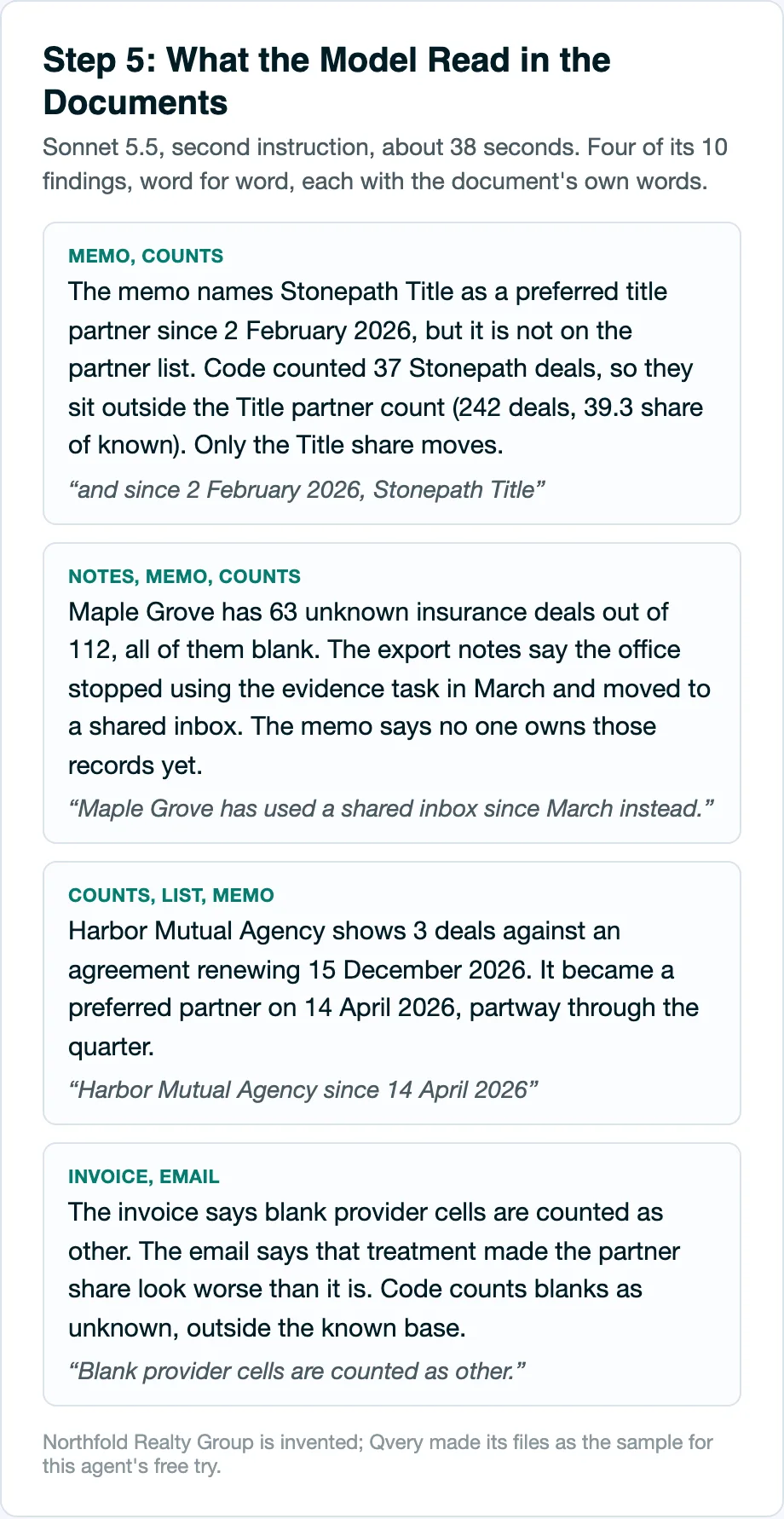
A partner the list never got
The memo names Stonepath Title a preferred title partner since 2 February. It is on 37 deals, every one counted as another firm.
A field one office stopped filling
The insurer comes from a task in Lone Wolf, and Maple Grove has used a shared inbox instead since March. The memo says nobody owns those records yet.
A renewal against a handful of deals
Harbor Mutual renews on 15 December and shows 3 insurance deals in the quarter.
The analyst's method
The invoice counts blanks as another firm, which drags every partner share down.
The second version still slipped once. Sonnet put Harbor Mutual, a partner since 14 April, "partway through the quarter", and the quarter starts 1 July.
A number check can't see a sentence like that. So a second check now holds every date a model ties to the quarter against the export's period, and it flags this one.
Step 6: Hand a Person the Decisions the Files Force
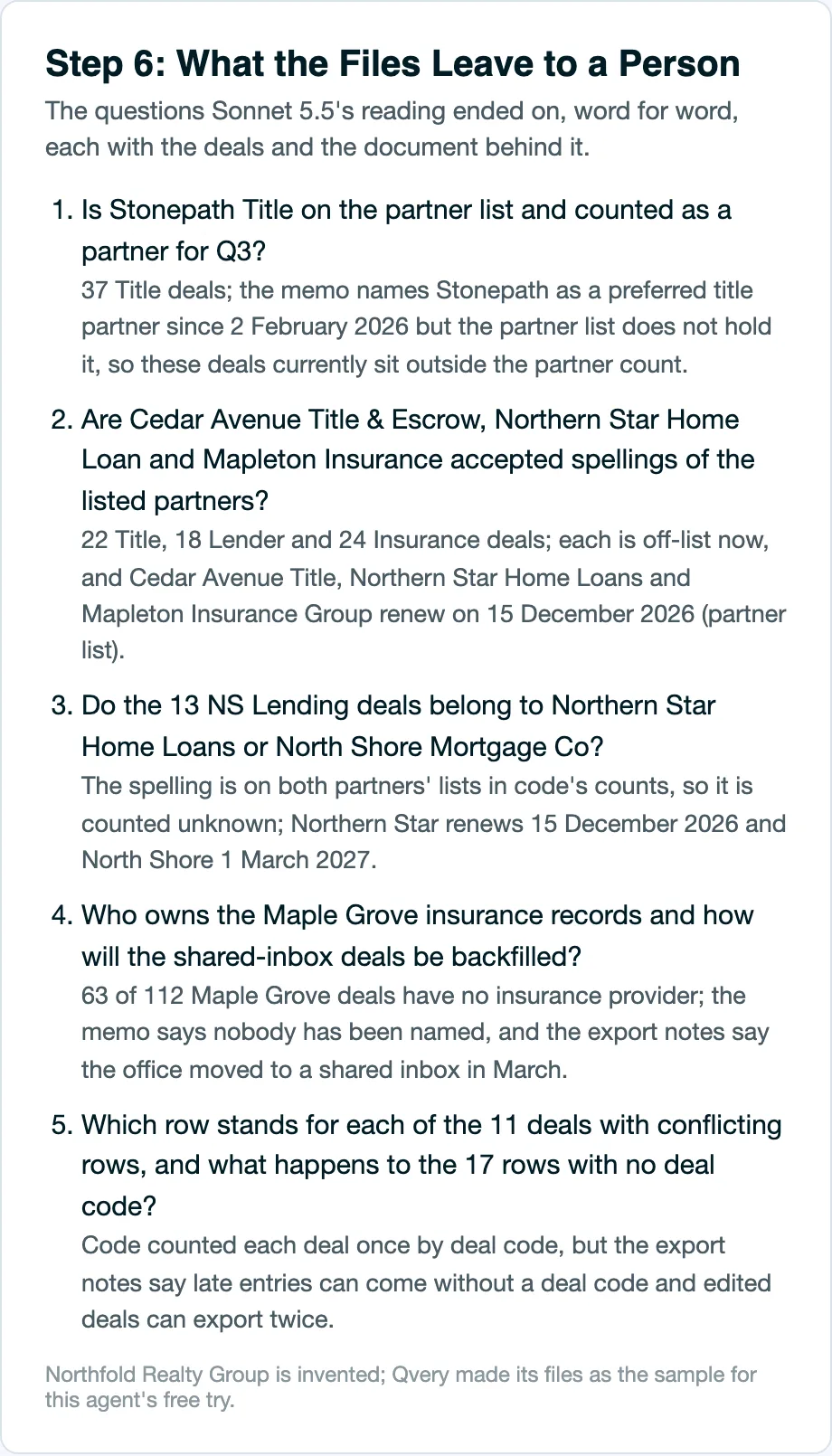
What's left after code and the model is short. Sonnet's reading ended on five questions, each a decision only Northfold can make.
Take the clearest. Say Northfold's director of operations decides Northern Star Home Loan is the partner with a letter missing, and adds it to the list. The count runs again in under a second, and the lender share moves in every office.
| Office | Before | After |
|---|---|---|
| Edina | 21.0% | 24.5% |
| Maple Grove | 26.2% | 29.9% |
| St. Paul Highland Park | 33.1% | 34.7% |
| Wayzata | 25.2% | 30.4% |
| Woodbury | 23.1% | 24.0% |
| All five offices | 25.6% | 28.5% |
Wayzata moves more than five points on one missing letter, because six of the 18 deals are Wayzata's. Compare offices before the list is right, and you're comparing how each office types.
An accepted spelling is the one fix that closes inside the count: it joins the list, and every later count uses it. Nothing in the transaction system is edited.
The rest stays with people. Cedar Avenue Title & Escrow may be another company, and Mapleton Insurance needs the same call. Stonepath is missing from the list the memo says it belongs on.
NS Lending gets settled deal by deal in each office, like the 11 deals with two records and the 17 rows without a code. Maple Grove's insurance records need an owner.
Step 7: Give Each Office Its Repair List Before the Cutoff
The last output goes to the offices. Every deal with a provider still unknown is listed by deal code, with the field at fault and what's wrong with it: a blank, two records that disagree, or a name that fits two partners.
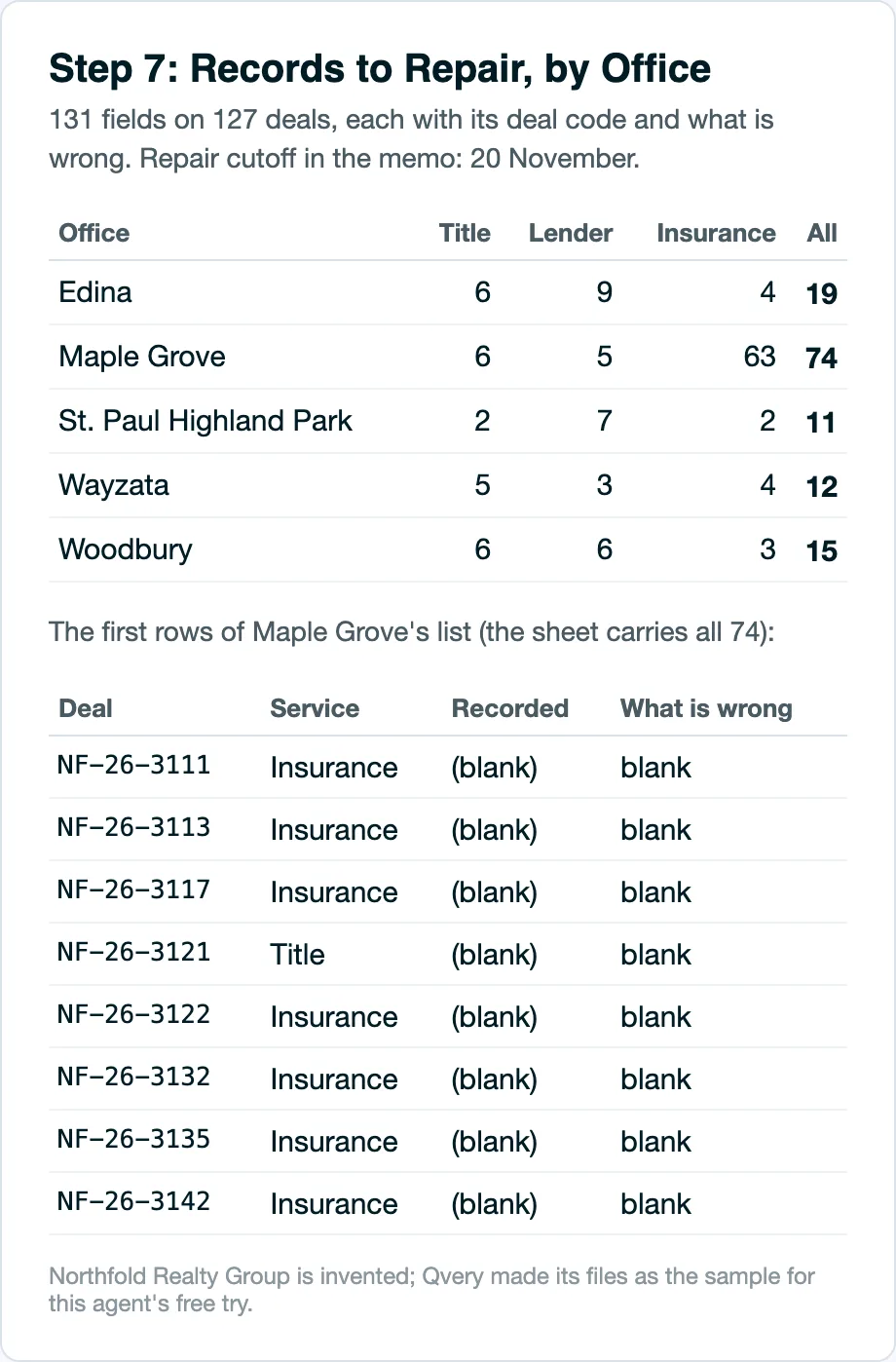
Northfold has 127 deals to fix, 131 fields in all. 74 of those fields are Maple Grove's, and 63 of them are the insurer the shared inbox never recorded. The memo gives the offices until 20 November, 13 days before leadership meets.
The workbook carries four sheets: partner use by office, partner use by partner, records to repair and data to check.
Each run is dated, so the quarter leadership decided on can be pulled again unchanged once the repairs land. The check that a repair landed is the next count: once the record names its provider, that deal leaves the list and joins a share.
Where Qvery's AI Agents Take the Monthly Count
Those seven steps are what Qvery's AI agents do every month, after your books close, without anyone rebuilding the spreadsheet.
They take the closed-deal export from your transaction system and the partner list from wherever you keep it. Code counts every deal by its code and matches names by your list, and a model reads the memos and notes you point it to.
The questions go to your team. Leadership gets the page, and each office manager gets that office's repair list.
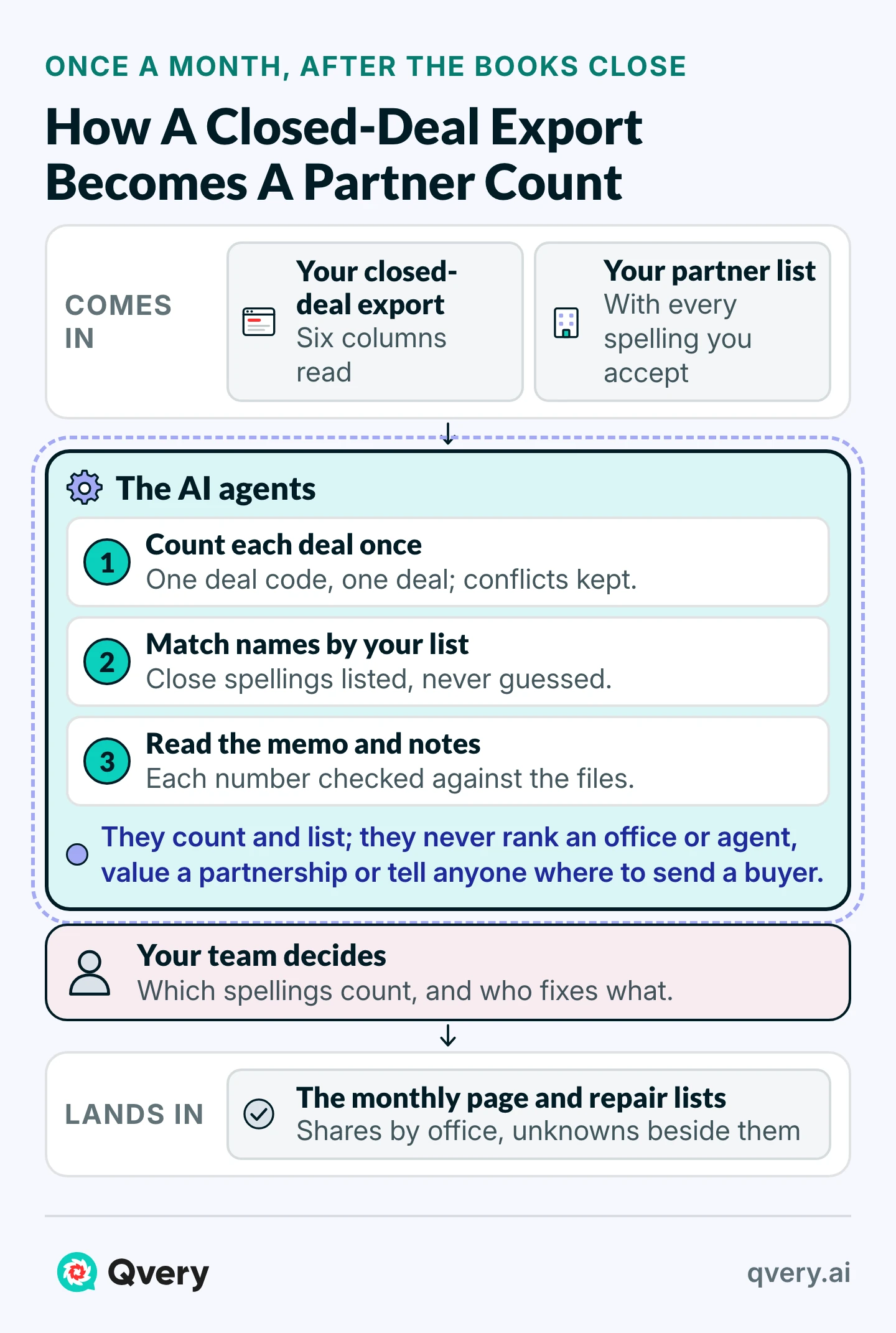
What they touch is narrow, and this job raises three questions about it.
Buyer data
They read six columns. Buyer names, addresses, prices and agent codes are listed by heading and never read, and who at Qvery may open the export, and when copies are erased, goes into the data processing agreement before the build.
What a partner sees
In your build, each partner can get a view of only its own closings, to check against its books. Whether it may is for your counsel, under the Real Estate Settlement Procedures Act (RESPA) and your own arrangements.
What the count is for
It counts what buyers chose. It never tells anyone where to send a buyer, sets no target and puts no value on a partnership; those stay with leadership.
 Piotr BabelPartner @ Qvery
Partner counts go wrong in the matching, not the arithmetic. So code matches only the names your list accepts, and anything that merely looks close goes to a person with the share it would move. The model reads the memo and the notes; in our build every number it writes is checked against the files, and every date it ties to the quarter against the export. That caught a date no file holds and one placed outside its quarter. Who counts as a partner stays your call.
Recording a Closed Deal by Hand Costs About $10
Put a price on the hand count with the calculator's example: a brokerage of about 400 people closing 250 deals a month.
Finding the three providers on a deal, matching each to the partner list and noting the blanks takes about 12 minutes by hand, our assumption for a deal whose fields are mostly filled. With the AI agents, we assume about 4 minutes a deal for a person to settle what they flag.
An office manager costs about $51.17 an hour: office supervisors in real estate earned a mean $35.82 an hour in May 2025, by federal wage data, and pay is 70% of what a private employer spends on a person.
By hand, that is 600 hours a year and $30,702, about $10.23 a deal. With the AI agents it is 200 hours plus about $400 a month to run them: $15,034 in all, or $5.01 a deal.
The difference is $15,668 a year. That pays back each $10,000 of the build in about 7.7 months.
 Vlad ShvetsPartner @ Qvery
Four of Northfold's six partner agreements renew on the same day, and whoever signs them is reading a share an analyst rebuilt by hand, with every blank counted against the partner. What an owner needs in front of them is the count, the unknowns beside it and what each office still owes, done the same way every month. Whether a partnership is worth renewing stays with leadership, decided on counted deals.
Type your own volume and pay over the example.
Partner Tracking ROI Calculator
What Each Closed Deal Costs You To Record, And With The Agents
Saved Per Year
$15,668
400 hours handed back, after $4,800 a year to run it
- Hours Handed Back
- 400 hours a year
- Agent Running Cost (Estimate)
- $400 a month
- Payback Per $10,000 Of Build
- 7.7 months
On these numbers, each deal costs $5.01 instead of $10.23, the agent saves $15,668 a year after its own running cost, and every $10,000 of the build is earned back in 7.7 months.
The calculator prices the job in staff hours. Where an outside analyst does the tally, as at Northfold, the cost arrives as a bill instead: $1,650 a month, or $19,800 a year if it runs every month.
Neither figure prices a renewal decided on a share that one accepted spelling moves by five points in one office. A count that is right every month, unknowns and all, is where a partnership with us on this job begins.
Your Office Managers Get Their First List in About Two Weeks
The build starts from files you already have.
Your closed-deal export
The last few months of closings, straight from your transaction system.
Your partner list
Every partner, its service and every spelling your offices use for it.
Whatever explains the gaps
A memo, the export notes, whoever owns each field.
We map where each provider lives in your system and load every spelling your offices use. About two weeks from kickoff, the AI agents count those months, leadership reads the first page with us, and each office gets its list of records to complete.
From then on the count runs once a month, after your books close. Every spelling your team accepts and every record an office repairs carries into the next month, and we count the hours handed back to your office managers every week.
If spreadsheets keep more than one desk at your brokerage busy, the real estate page shows the other jobs our AI agents run beside your team.
Frequently asked questions
Does it work with SkySlope, dotloop or another transaction system?
Yes, if the system exports closed deals with a deal code, the office, the close date and the title, lender and insurance providers. A spreadsheet, a CSV or a PDF print of the same table all work. During setup we map where each provider lives in your system.
Our export has no insurance column. Can it still count insurers?
Often the insurer sits only in a note or a closing paper. Where no field exists, the AI agents can read the settlement statement or the title commitment in the deal file instead. The first report shows how complete each provider field is in every office, before anyone compares numbers.
Can it show which of our agents use our partners?
No. The count stops at the office: the AI agents never read agent codes, so no view by person exists. A closing record shows who handled the title, not what anyone told the buyer, so it can't fairly judge an agent. No targets are set, and no share is shown as good or bad.
How do we know a match is right?
Each match shows the name from your export beside the partner it counted for. Only names your list accepts count; a close name that isn't listed is shown with its deal count and the share it would move. A short name that fits two partners stays unknown instead of being picked.
Why not use fuzzy matching in a spreadsheet?
Fuzzy matching scores how alike two names are and can match the closest one above a threshold you set. A threshold loose enough to take Cedar Avenue Title & Escrow as Cedar Avenue Title would count 22 deals that may belong to another company. The AI agents list each near name with its share instead, and your team decides.
Can it read our partners' own statements?
No. It reads your closed-deal export and your partner list, where your brokerage records who handled each deal. In your build, each partner can get a view of only its own closings to set against its own books, and any difference shows up there, deal by deal.
Does a blank provider count against the partner?
No. A blank is a missing record, never a buyer who chose another firm, so it stays unknown and out of the partner share. The page prints the unknown count beside every share, office by office, and the repair list names each blank by deal code so the office can fill it in.
What happens when a partner changes its name?
Your list keeps each partner's current name with its former names and short forms. Add a new name to the same entry and both count together. Months already reported stay as they were counted, with a note where the name changed. A partner added mid-year counts from the month it joins the list.
Can our title partner see its own numbers?
In your build each partner can get a view of only its own closings, never a rival's. Whether you share it is a decision for your compliance lead and counsel, under your referral and affiliated business arrangements. The AI agents count what buyers chose and recommend nothing about where a buyer goes.
Who fixes the records the AI agents flag?
Your office managers, in your transaction system. The AI agents list each deal to repair with the field at fault: a blank, two records that disagree, or a name that fits two partners. Once a record names its provider, the next count reads that deal like any other.
Will it tell us whether to renew a partner?
No. It shows how many closed deals each partner has, beside the unknowns, office by office. What a partnership is worth, whether to renew it and what to ask of it stay with leadership. The count makes sure that decision rests on counted deals instead of impressions from the offices.
What does it cost to run each month?
The calculator's example puts it at about $400 a month, nearly all of it hosting, the dated monthly page and upkeep of your partner list. Model usage for one monthly count is well under a dollar, an estimate. Our run counted Northfold's 640 deals in about a tenth of a second.
