
On this page
- The Agent Starts When the Borrower Uploads
- Your Checklist Decides What Counts
- Dates and Names Are Read From Inside Each Page
- Income and Funds Are Checked in Code
- Every Line Comes Back With Its Page
- Your Processor Sends the Borrower One Request
- The First Read Costs About $57 a File by Hand
- Qvery's Agents Read Every File Before Your Processors Do
- Partnering With Us Starts With Your Checklists
- Frequently asked questions
A loan goes to underwriting when its file agrees with the checklist for that loan. Getting it there is a processor's job: open every page the borrower uploaded, match each one to a line on the list, and ask for whatever is missing, out of date or unreadable.
Borrowers send what they have. A pay stub from six weeks ago, a phone screenshot where a statement should be, September's statement in a file named October. Each gap surfaces when a processor reaches it, so the borrower hears about one gap, then another a few days later, and the file sits in between.
In our worked example, a lender of about 200 people with 400 new files a month spends about $57 of processor time on each file's first read and the requests that follow, close to $276,000 a year.
For scale, mortgage companies made an average $973 of production profit on each loan they originated in the second quarter of 2026, by the Mortgage Bankers Association's count.
At Qvery, we help lenders spend less on each loan file and keep processors on borrowers, with custom AI agents that check every upload against your checklist and draft one request.
We ran the job on one invented file. Halden Creek Mortgage does not exist, and neither does its borrower, Morgan Tierney, whose 16 pages arrived as 11 files through the borrower portal and the processor's inbox.
The lender's checklist for a conventional purchase loan is ours too, and we wrote the answer key before any model read a page.
This is what the agent produced at the end: one email, six asks, waiting for the processor to edit and send.
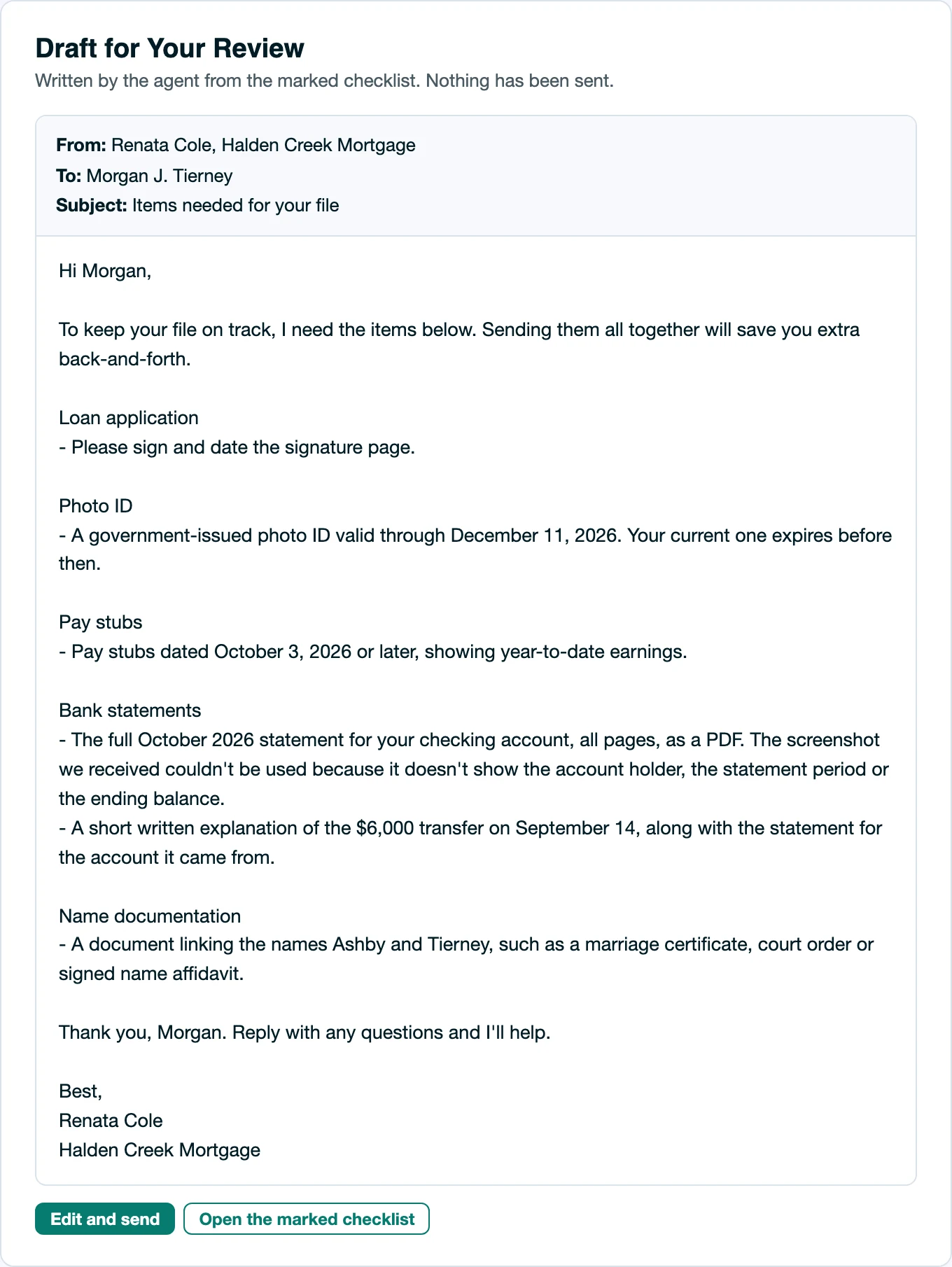
The six steps below take that file from the upload to this draft, and your own files run through the same six.
This checks documents against the checklist and drafts the request. It does not pull credit, order verifications, read the appraisal or decide anything an underwriter decides.
The Agent Starts When the Borrower Uploads
A new upload in the borrower portal, a reply in the processor's inbox or a document saved to the loan's folder in your LOS (loan origination system, the software where each loan's file lives) starts the check.
First the agent reads every page and says what it is. File names are kept as the borrower's labels and never trusted: in our sample, the file called September held August's statement, and the file called October held September's.
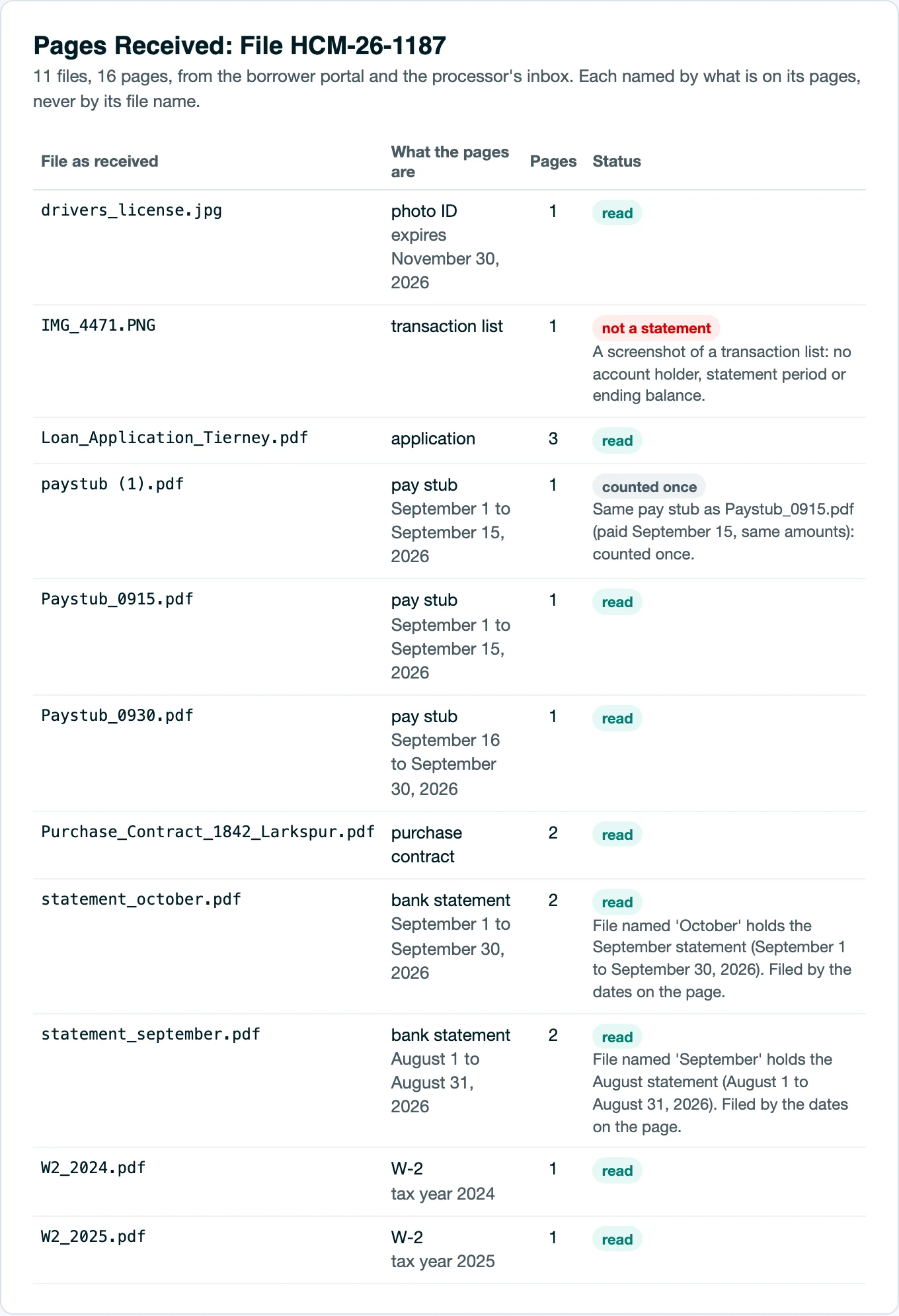
The same September 15 pay stub arrived twice, once through the portal and once by email, and is counted once.
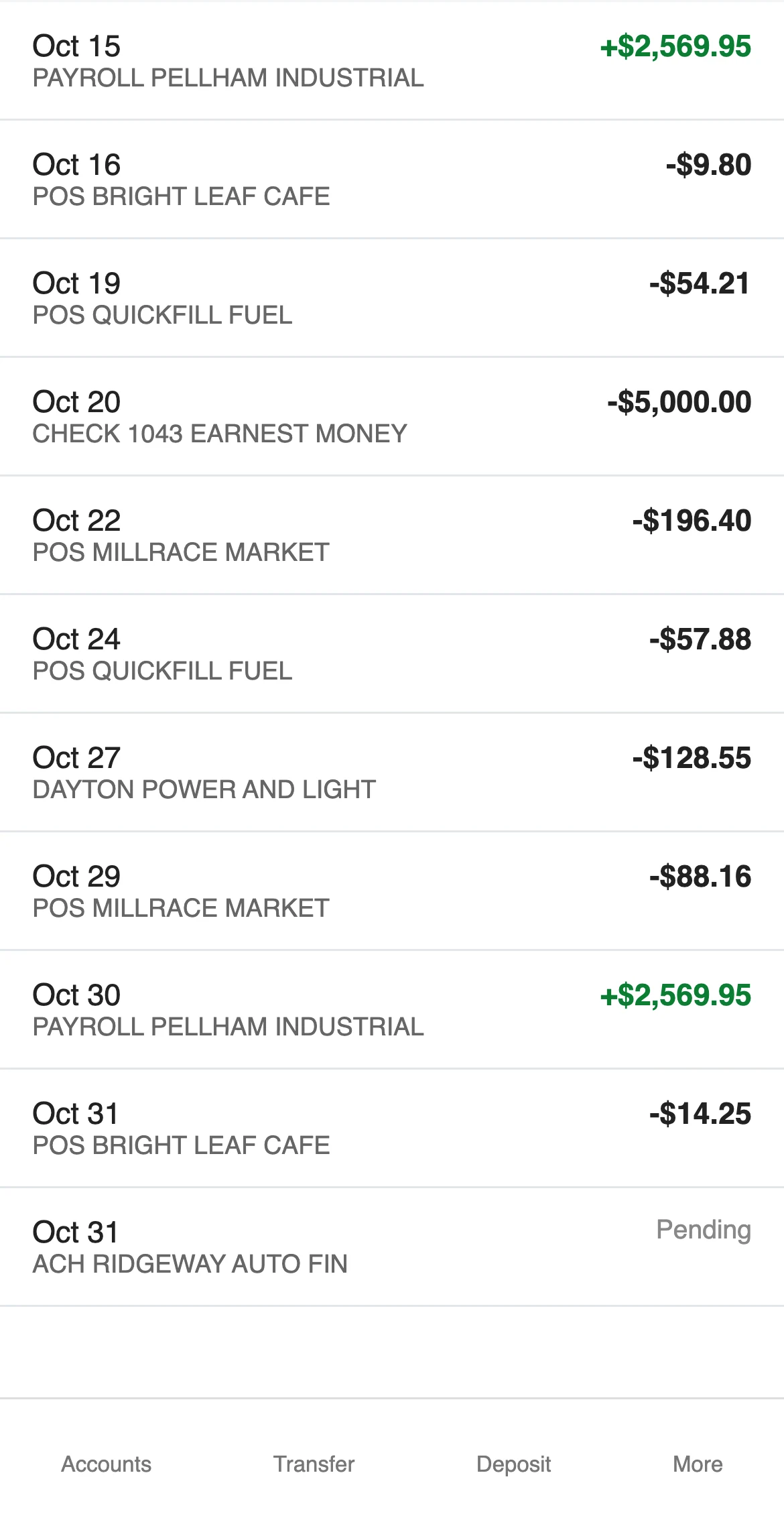
October's statement came as a phone screenshot of the banking app's transaction list. The agent reads it and does not accept it: it shows no account holder, no statement period and no ending balance, all of which Fannie Mae's guide requires on a statement and this lender's checklist repeats.
Check this screen before anything else: every page appears once, each has a document type, and anything set aside says why.
Your Checklist Decides What Counts
Next the agent reads the checklist for this loan's product, not a generic list. Halden Creek's has six items every file needs and three that apply only when something in the file calls for them.
Each conditional item is settled from the borrower's own pages, and the page that settled it is written beside it.
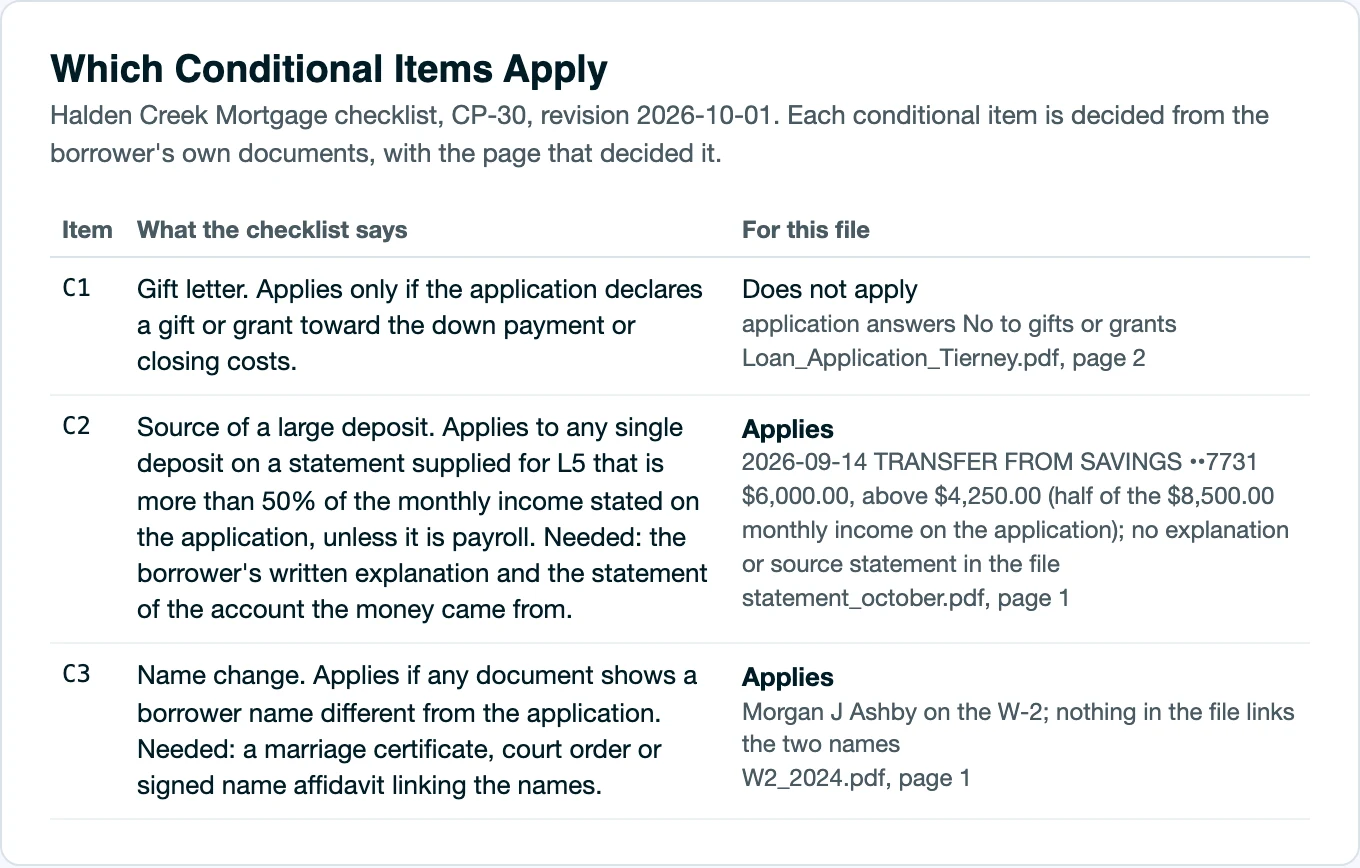
Gift letter: does not apply
The application answers No to gifts or grants on page 2, so there is nothing to ask for.
Source of a large deposit: applies
A $6,000 transfer on September 14 is above $4,250, half the $8,500 monthly income the application states. The 50% line is the checklist's, taken from Fannie Mae's definition of a large deposit.
Name change: applies
The 2024 W-2, the wage statement an employer files each year, is made out to Morgan J Ashby. Nothing else in the file links the two surnames.
The agent adds no rule the checklist does not state. If your list sets no age limit for a statement, the age is not checked, and the mark says the checklist gave no rule.
Dates and Names Are Read From Inside Each Page
The pay date on a stub, the expiry on an ID and the name on a W-2 are copied from the page and compared, in code, with the checklist's rule and the application.
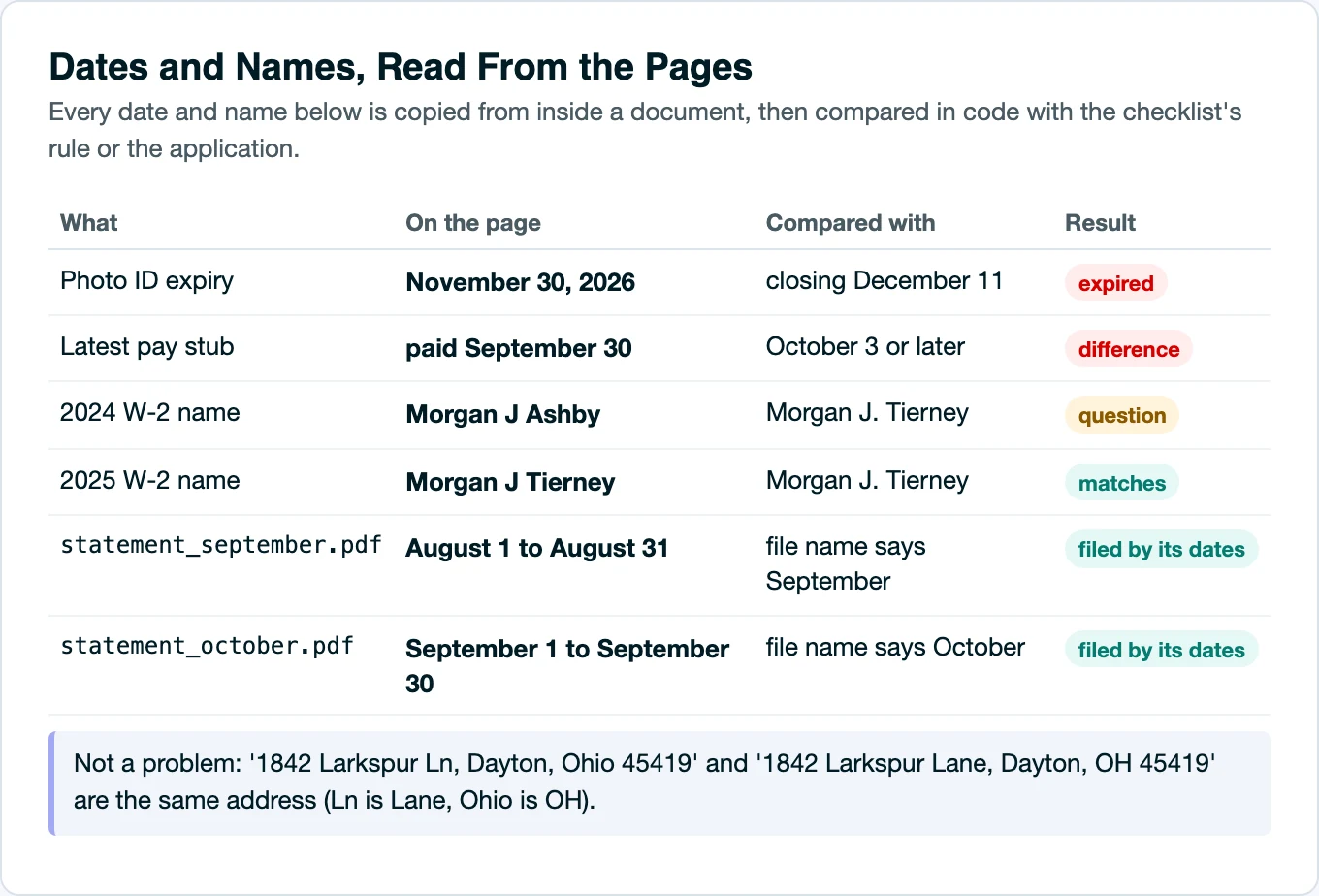
Three of them failed in our file, each fixed by asking for one document.
A pay stub from before the window
Fannie Mae wants the latest stub dated no more than 30 days before the application, with year-to-date pay. The application is dated November 2, so the cutoff is October 3, and the latest stub was paid September 30. The request asks for stubs dated October 3 or later; on the next run the new pay date clears the cutoff.
An ID that runs out before closing
The driver license is valid through November 30 and the loan closes December 11. The request asks for an ID valid through closing; the new expiry date settles it.
A W-2 under another surname
The agent does not decide that Ashby and Tierney are one person. The name-change item asks for a marriage certificate, court order or signed name affidavit, and the mark clears when a document names both.
Some of what looks wrong is fine, and a check that flags it trains processors to ignore the flags.
Underwriters and loan officers name the same problems, and how they ask borrowers to avoid them.
Tips from Reddit
1.) Phone screenshots 2.) Bank Teller Printout, without bank identifiers or teller stamp 3.) Scans of pictures taken by phone of a computer screen
you/your processor needs to be very detailed with your requests so that you cut down on the wrong things being provided. Like “2 most recent monthly statements for bank x, all pages (even if blank)”.
I always ask my clients if they think they’ll have trouble obtaining anything. If they aren’t confident then I walk them through how to provide each item they aren’t sure of - for example bank statements I let them know to log into online banking, click on w-statements, download as a .pdf to their desktop so they can attach it to an email.
Income and Funds Are Checked in Code
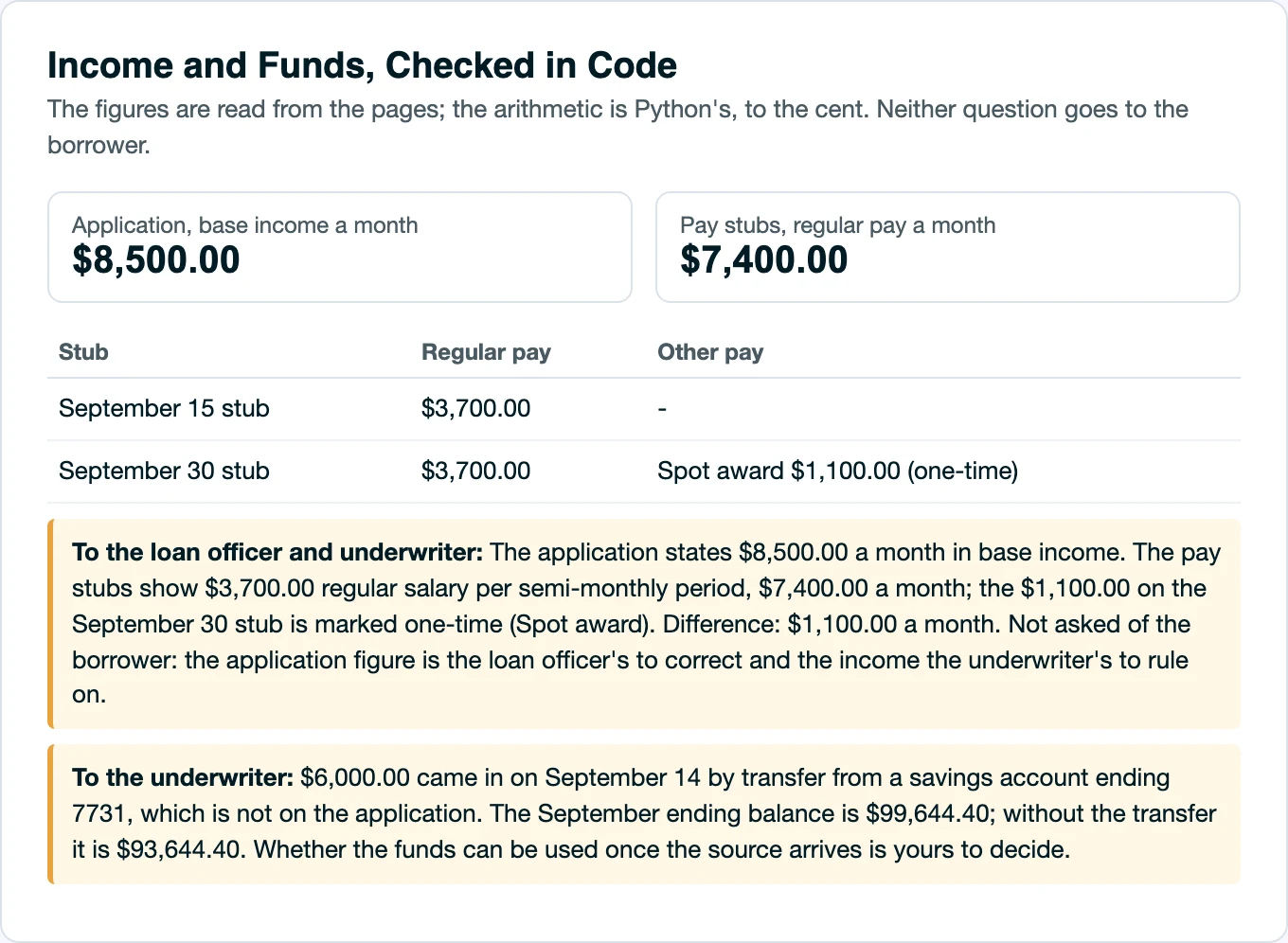
A model reads each figure off the page. Python does the arithmetic, to the cent, so the same file gives the same answer every time.
The application states $8,500 a month in base income. The stubs show $3,700 of salary twice a month, $7,400, and a $1,100 spot award on September 30 marked one-time. The $8,500 is what the salary and the award add up to.
That is not a document to ask the borrower for. The figure on the application is the loan officer's to correct, and which income counts is the underwriter's call, so it goes to them in a note with the pages.
 Piotr BabelPartner @ Qvery
A model reading a pay stub can be wrong about one digit, and you'll never see it in a paragraph. So it never does arithmetic. It copies each figure with the page it came from, Python compares them to the cent, and every mark points back to that page. When the $8,500 didn't match, the agent wrote it down for the loan officer and stopped, because which income counts is your underwriter's call, not ours.
The $6,000 transfer goes both ways. The borrower is asked where it came from; whether it counts is the underwriter's decision.
The September statement ends at $99,644.40, and $93,644.40 without the transfer. Fannie Mae leaves the lender to document where a large deposit came from and, where the paper runs thin, to use judgment, so the agent supplies the figures and leaves the judgment where it is.
Every Line Comes Back With Its Page
The result is the marked checklist, and the processor opens it before the first page of the file.
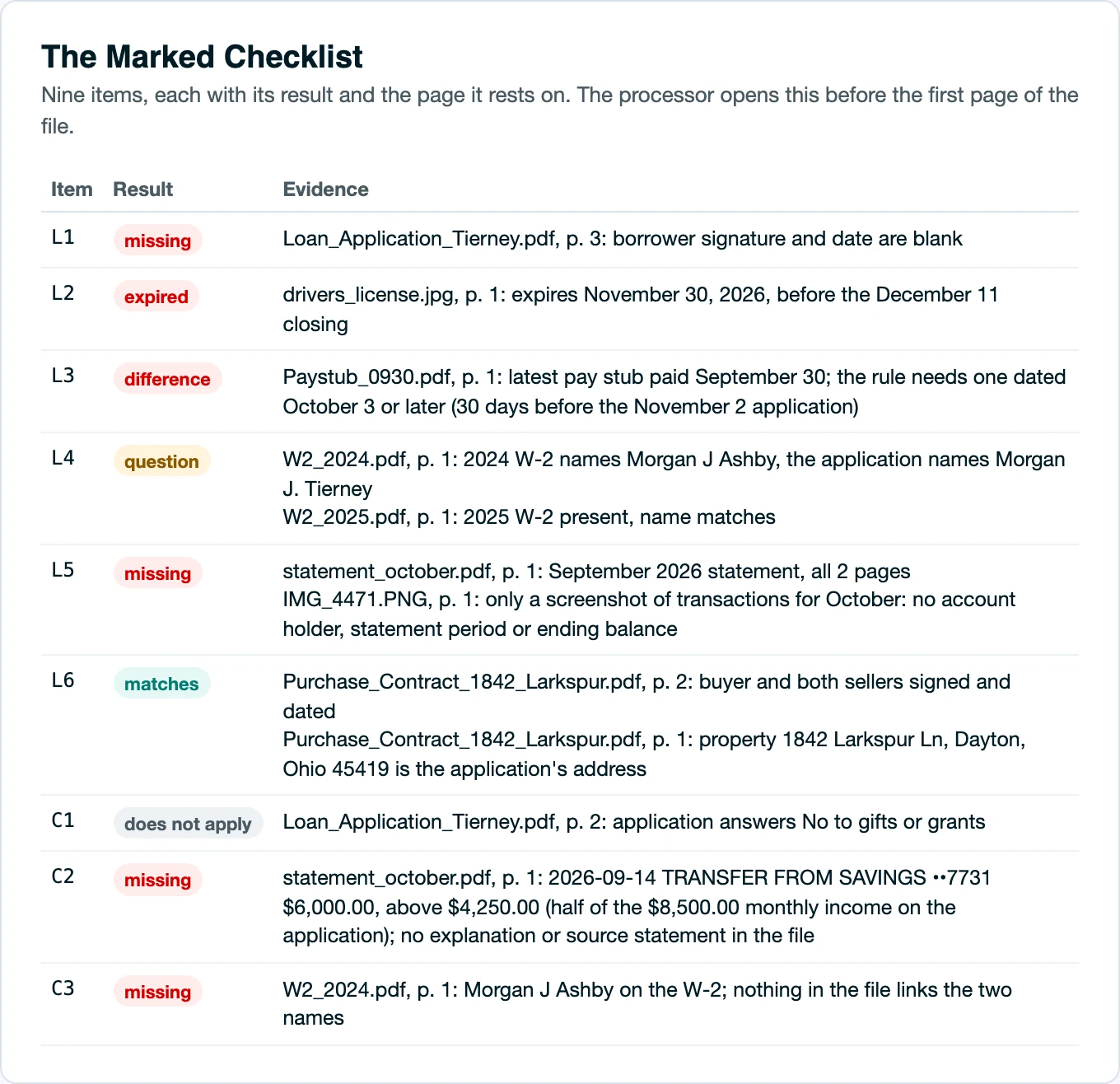
On our sample, all nine marks matched the answer key: one item matched, one did not apply, the W-2s raised a question, and six items needed something from the borrower.
A processor checks any mark by opening the page it cites. If a mark is wrong, they change it, and the change is kept beside the agent's first mark, so you can see how often it was right before you let it take the first read alone.
Your Processor Sends the Borrower One Request
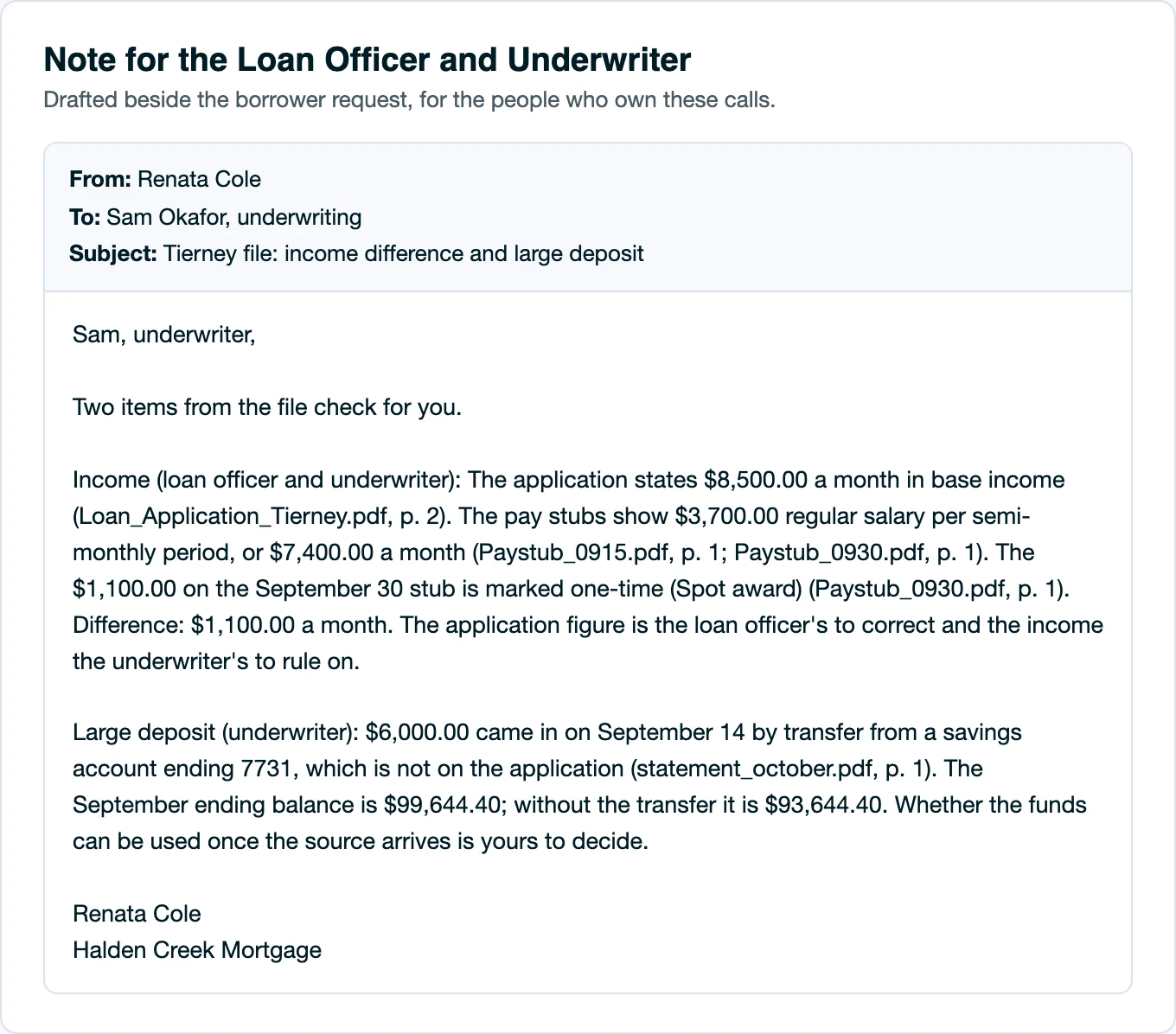
Everything the borrower has to send goes into one email, grouped by document, with the date each new one must carry. The agent wrote the 162-word draft at the top of this page.
It names the $6,000 transfer by its amount and date, and it carries no account, ID or tax numbers and nothing about rates or terms.
That boundary is the processor's own. The federal law that licenses loan officers, the SAFE Act, describes a processor's work as collecting the file's information and asking the borrower for it, without offering or negotiating rates or terms. The draft stays inside that line, and your processor reads it and sends it.
The two questions the borrower cannot answer go to the people who own them, in a note drafted beside the request.
When the borrower replies, only the new pages are read, the open items are checked again, and the next draft asks for nothing that has since arrived.
Try the same check on one of your own files, with the checklist for its loan type.
The First Read Costs About $57 a File by Hand
Federal wage data counts loan processors with loan interviewers and clerks, and at lenders and other credit companies they earned a mean $52,280 in May 2025. Benefits are 30% of what private employers spend on their people, so a processor costs about $74,700 a year, $35.91 an hour.
Say 400 new files a month and 96 minutes of processor time on each: reading uploads against the checklist, writing requests, chasing the gaps. The minutes are our estimate, about eight document requests a file at twelve minutes each. That comes to 7,680 hours and $275,789 a year, $57.46 a file.
With the agents, the processor's part drops to about 48 minutes: reading the marked checklist, editing and sending the one request, handling the replies and the exceptions. That is an assumption too, and a cautious one beside our sample.
Running the agents costs about $1,100 a month at that volume. Our 16-page sample used 21 cents of model time, about $1.30 for a 100-page file; we budget $2 a file to cover the re-reads, plus $300 a month for hosting and upkeep.
On those numbers the agents save $124,694 a year after their own running cost and hand back 3,840 processor hours, and every $10,000 of build is earned back in about a month.
Type your own lender's figures over the example, starting with the files you open in a month:
Loan File Review ROI Calculator
What Each Loan File Costs You To Check And Chase, And With The Agents
Saved Per Year
$124,694
3,840 hours handed back, after $13,200 a year to run it
- Hours Handed Back
- 3,840 hours a year
- Agent Running Cost (Estimate)
- $1,100 a month
- Payback Per $10,000 Of Build
- 1 month
On these numbers, each file costs $31.48 instead of $57.46, the agent saves $124,694 a year after its own running cost, and every $10,000 of the build is earned back in 1 month.
It counts processor hours only. The week a file waits for its second request, the rate lock extended because a statement came late and the closing that slips are left out.
 Vlad ShvetsPartner @ Qvery
Lending runs on thin margins, and a processor rereading a file to find the third missing page is margin you pay for twice: once in their hours and again in the days the loan sits still. I want those hours on borrowers and on the files that really need a person. The checklist is already written down, so let the agents hold every file to it from the first upload.
Qvery's Agents Read Every File Before Your Processors Do
The agents we build for a lending team sit where your files arrive: the borrower portal, the processors' inbox and the loan's folder in your LOS. Each upload is read, sorted by what is on its pages, held to the checklist for its product and marked.
A draft request waits in the processor's inbox before they open the file.
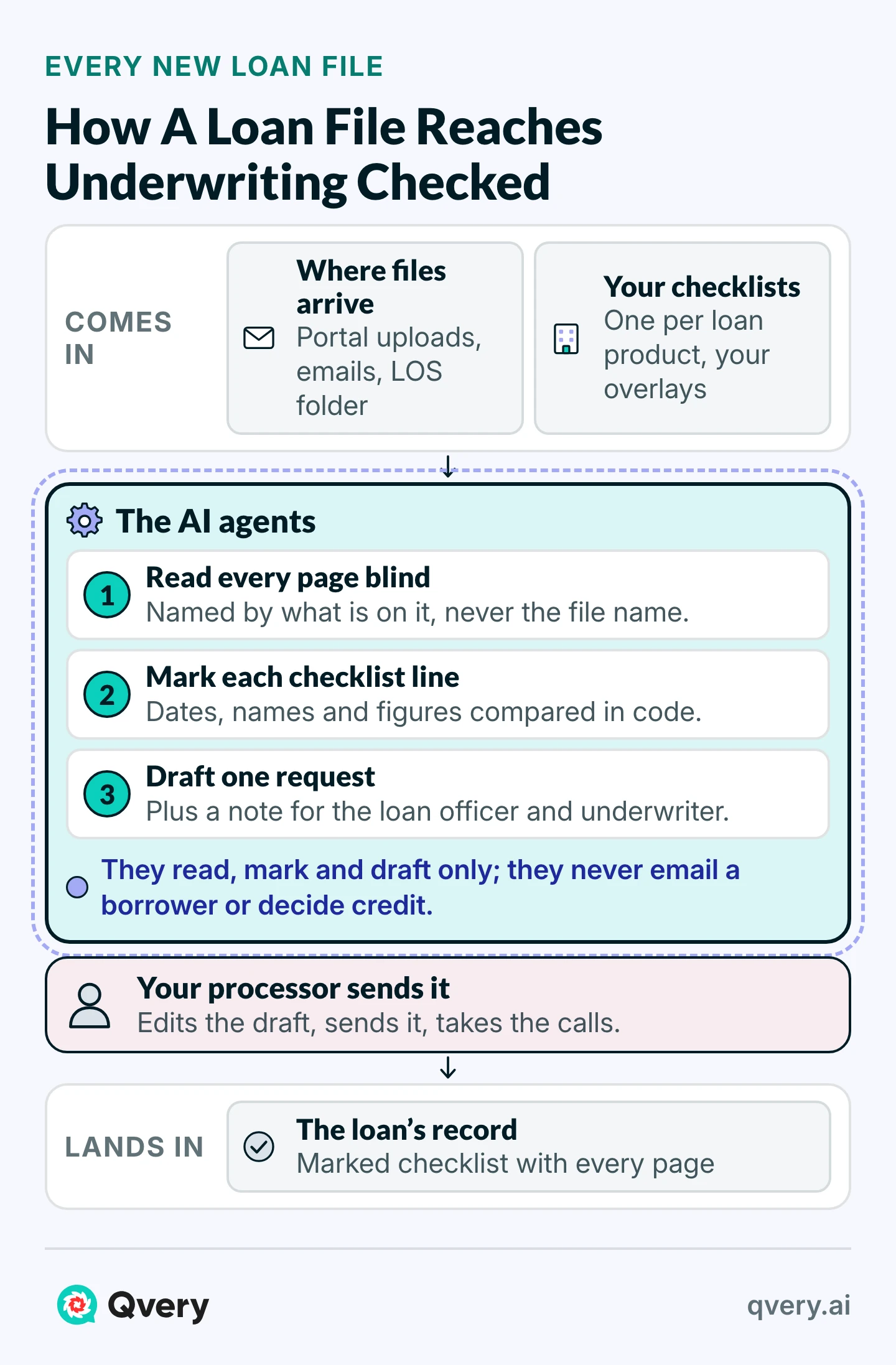
They run on your checklists, one per loan product, with your own overlays on top of the investor rules.
Before they read a single file, we agree in writing what they may open and where the data is processed, and they start with only the folders this job needs. Every page they open and every draft they write is logged for your auditors and examiners.
| The agents | Your people |
|---|---|
| Read every page and name what it is | Send every request from their own inbox |
| Mark each checklist line with its page | Correct the application with the borrower |
| Draft one request and a note for the team | Decide credit, exceptions and which income counts |
| Keep ID and account numbers out of every draft | Submit the file to underwriting |
If your processors still find a file's gaps one email at a time, that first read is the job we take off them.
Partnering With Us Starts With Your Checklists
Your checklists are the agents' rules, so they come first. This is what we ask a lending team for:
- Your checklists: one per loan product, with your overlays
- Closed files: a month of them, to run the agents on and compare with your processors' work
- Access: read access to wherever new files land
- Time: your processing lead's, in the first weeks
We run the agents on last month's files and compare every mark with what your processors found. From the second week with access, they check live files beside your processors, who decide when the agents take the first read alone.
The Finance Playbook prices this job for a lender of about 200 people, beside spreading business financials and answering borrower letters on a legal clock.
After that, each week we count the hours your processors got back and the files that reached underwriting after a single request.
Frequently asked questions
Does it work with our loan origination system?
It reads from wherever new files land: your LOS, a document folder or a shared inbox. Where your system allows it, the marked checklist and the draft are saved to the loan as notes or tasks; where it allows no outside access, the agents work from a shared folder.
Can it tell a doctored bank statement from a real one?
It is not a fraud check, and it does not call the bank. It flags what disagrees inside the file: a name, period or account that disagrees with the rest of the file, a page missing from a statement that says how many it has. Anything that looks wrong goes to your underwriter with the page.
What happens when the borrower sends the documents?
The new pages are read as they arrive and only the open items are checked again. A document that meets its line clears the mark, the next draft drops what has arrived, and a wrong one gets its own line in the next request. Nothing goes back to the borrower until your processor sends it.
Does it handle FHA, VA and business loans?
Yes, when you have a checklist for them. Each product gets its own, and the agent applies the one that matches the loan. A business loan brings entity papers, several years of returns and the owners' statements; each is read for its names, dates and periods like any other document.
Will it tell us a file is ready for underwriting?
No. It never calls a file complete or approved and never scores a borrower. It shows what matches your checklist and what does not, with the pages. Whether a gap can wait, such as a renewed ID that is on its way, is your underwriter's decision, and so is any exception to the checklist.
Who sees our borrowers' tax returns and IDs?
The agents, and the people we name together in writing before the build. They open only the folders this job needs, every page they read is logged, and ID and account numbers stay out of the requests they draft. No borrower's documents are used to train a model that serves anyone else.
What if it marks a document wrongly?
Every mark shows the page it relied on, so your processor confirms or changes it in seconds. In the first weeks we go through those corrections with you and adjust how the agents read your documents. A date that could read two ways stays a question for a person, never a guess.
What does the agent cost to run?
On our sample, reading a 16-page file and drafting the request used 21 cents of model time. A real file is longer, so we budget about $2 a file, including the re-reads when the borrower sends more, plus hosting and upkeep of about $300 a month. At 400 files a month that is about $1,100.
Can it read scans and phone photos?
Yes. It reads every page as an image, so a scan, a phone photo of a letter or a PDF export all work. A page too faint, cropped or blurred to read is named with its page, and the draft asks for a clearer copy instead of guessing at a figure.
What if our checklist contradicts itself?
The agent does not choose between them. Two instructions for the same item, or a limit the checklist leaves blank, become a question for whoever owns the checklist, with the lines quoted. A checklist without a revision date is marked as such, so nobody checks a file against last year's list without knowing it.
Can loan officers see the check before processing starts?
Yes. The check runs on the first upload, so a loan officer can open the marked checklist while the borrower is still sending documents and fix the application before the file reaches a processor. The request is still drafted for the processor, who sends it, so the borrower hears from one person.
Do our processors still talk to borrowers?
More than before. The agents draft; your processors decide what goes out, send it and take the calls. Their time moves from finding gaps to the conversations that need a person: the borrower who cannot find a statement, a letter of explanation, an exception your policy allows.
How long before it runs on our files?
A first working result comes in under two weeks from the day we get access, built on your own checklists. For the first weeks the agents run on live files beside your processors, who compare every marked checklist with their own. Checklists for new products are added as you launch them.
