
On this page
A processor on your payroll is a salary that runs whether this month's files close or not. A contract processor is a fee per file, paid only when the loan closes and often billed to the borrower at closing. When volume moves, you decide which of the two gets the next file, and the fee looks like the safer bet.
At a lender your size, it isn't. Hancock Processing, a contract shop with more than a hundred processors, charges $995 a closed loan to take a file from submission to closing.
A processor on your payroll, at the job's mean pay plus benefits, costs about $519 a closed loan at the 12 loans a month processors closed in 2019, in the industry's own benchmark.
My verdict: keep processing on your payroll and take the document reading off your processors. The fee pays someone else to run the chase your own processor runs, at nearly twice the price, and it does not get cheaper when the work does.
Give that reading and the requests to AI agents, so each processor has room for more loans, and send out only the files your team can't carry.
The claim thins in two places: a shop whose processors close fewer than about six loans a month each, at a $995 fee, and one whose files arrive in bursts with long gaps between. There the fee is the cheaper route, and it stays that way.
At Qvery, we help lenders lower what each loan costs to process, with custom AI agents that read every upload against your checklist and draft the borrower's request.
A Processor on Your Payroll Costs About Half the Fee
The arithmetic is short enough to redo with your own numbers.
Loan interviewers and clerks, the occupation the government counts loan processors under, earned a mean $52,280 at lenders in May 2025, by the Labor Department's wage survey. That mean includes production bonuses. Wages are 70% of what private employers spend on their people and benefits the other 30%, so one processor costs about $74,700 a year.
Divide that by the loans each processor closes. The Mortgage Bankers Association benchmarks lenders' retail teams every year with STRATMOR, an advisory firm, retail meaning loan officers on the lender's own payroll.
Processors in that benchmark closed 23 loans a month in 2003, 9 in 2018, 12 in 2019 and 13 in 2021. The association suggests 2017 to 2019 are the most meaningful yardstick once a refinancing boom has passed.
Processing Cost per Closed Loan: Payroll Against a Contract Fee
$ per closed loan
View the data
| Label | Value |
|---|---|
| Payroll, 2018 workload (9 a month) | $692 |
| Payroll, 2019 workload (12 a month) | $519 |
| Payroll, 2020 workload (15 a month) | $415 |
| Payroll, 2021 workload (13 a month) | $479 |
| Contract fee, submission to closing | $995 |
| Contract fee, disclosures to closing | $1,195 |
At today's pay, even 2018's nine loans a month come to about $692 a closed loan, still under the fee. At $995 a file, the fee only wins when a processor closes fewer than about six loans a month.
The comparison flatters the fee, if anything. Hancock's $995 package starts at submission, so the first round of documents stays with you; the package that starts at disclosures, closer to what your own processor does, is $1,195.
Pay and benefits are not the whole cost either. A processor needs a seat in your loan system and someone to manage them, and the fee carries the contractor's version of both. Those would have to add $300 to $500 a closed loan before the fee comes out ahead.
The Fee's Best Argument Is the Slow Year
The case for the fee is real, and the people who sell it make it well.
For a small broker whose files come in bursts, that is the right answer, and I would take it.
For a lender with twenty processors, it is the wrong trade. Even at the nine loans a month processors closed in 2018, one at today's pay costs less than the fee, which only wins below about six.
Volume has to fall further than it did then before the fee wins on cost. Staff for the slow year and send the peak out, and you use the fee for the one thing it does well.
Billing the borrower doesn't make it free, either. The Consumer Financial Protection Bureau tells borrowers to compare Loan Estimates, the cost sheet every applicant gets, from several lenders, and it puts processing fees and the third-party services a lender picks in the totals to compare. A $995 line is part of the price your borrower shops.
Brokers who pay one or the other put the trade in their own words.
What Reddit says
Contract Processor: $995 per file. They don’t get paid unless the deal funds and I’ve never had any issues.
I pay $895 to two different companies. It's borrower paid, so it only matters in the sense that it is close enough to industry average that my clients aren't going to shop me for having higher fees.
Processor is in house and a part of my team. Company pays them.
Willow Processing, which also sells contract processing, concedes as much on its own blog: with "very high, steady volume," a shop "may see better unit economics" from a busy in-house team.
Both Routes Pay Someone to Chase the Same Paper
Look at what the fee buys. Someone reads each upload, matches it to the checklist for the loan, asks the borrower for what is missing, reads what comes back and asks again. Then the underwriter's conditions arrive, the list of what must still be shown before the loan can close, and the loop runs once more.
The contractor runs that loop for you. wemlo lists it among its selling points: "We handle borrower and lender follow-up." Hancock's $995 package picks the file up at submission and clears the underwriter's conditions from there.
Each file takes more of a processor's year than it used to. Processors closed 23 loans a month in 2003 and 12 or 13 in 2019 and 2021, and the association lists regulation and compliance, investors' requirements and lenders' own extra rules among the possible reasons, beside staffing and turnover.
A flat fee prices today's chase into every file. If the reading gets faster, the saving belongs to the contractor. Your own processors' hours are the one part of the cost of processing you can shrink, and reading the files is where to start.
If you want that chase priced for a whole lender rather than per file, our Finance Playbook does it for one of about 200 people.
Where Qvery's Agents Take Over the File Reading
Reading the files is the job our agents take. They start when a new file lands in your LOS (loan origination system, the software that holds each loan) or in a shared folder. They split the file into its documents and read every page against your checklist for that loan type.
Each checklist line comes back matching, missing, expired or different, with the document and page behind it. A pay stub the borrower sends twice is recognized as one. A joint applicant's pay never counts toward the borrower's income, and a lapsed insurance certificate is marked expired.
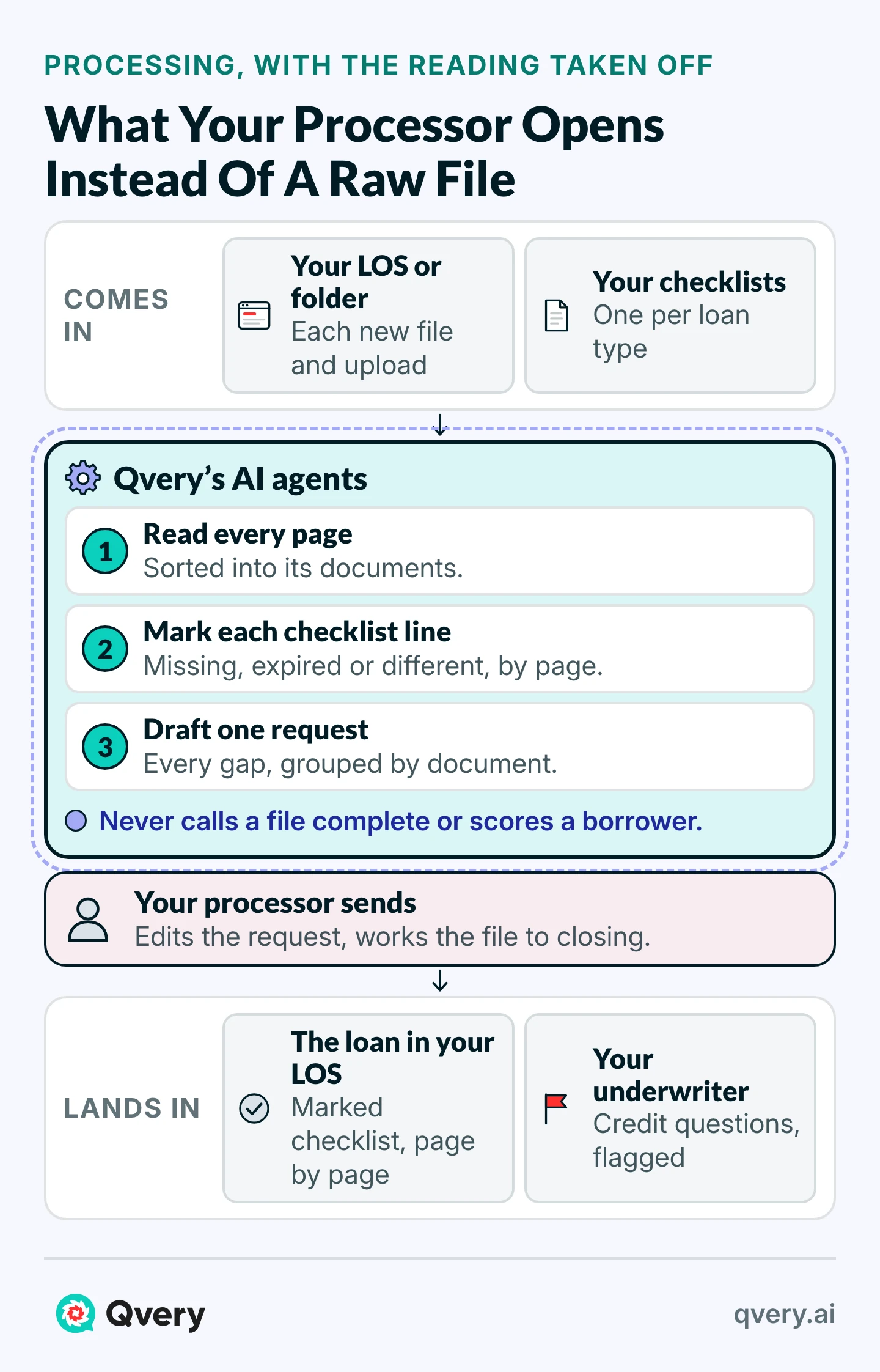
Then the agents draft one request for everything still open, grouped by document, and your processor edits it and sends it from their own inbox.
A second upload is read only for its new pages, and whatever has since arrived comes off the next request. A deposit nobody has explained, or anything else that needs a credit view, is flagged for your underwriter.
The agents never call a file complete or score a borrower. That stays with your people, and so does every conversation with the borrower.
Send one loan file and your checklist for its loan type, and you get back the checklist marked line by line and the request drafted for your processor to send.
 Piotr BabelPartner @ Qvery
We split a processor's file work into reading and deciding. Our agents take the reading: every page against the checklist, every gap named with the page it came from, one request drafted. The deciding stays with your processor, who edits what reaches the borrower, and with your underwriter. A mark that looks wrong is one click from its page, so it gets checked in seconds instead of argued about.
Put your own processors' numbers in. The example is our assumption: 20 processors closing 240 loans a month, 12 each, so a closed loan carries about 867 minutes of processor time at $35.91 an hour. The agents take 48 of those minutes, half of the 96 our Finance Playbook estimates for the document requests on a loan.
Loan Processing Cost ROI Calculator
What Each Closed Loan Costs You In Processor Time, And With The Agents
Saved Per Year
$70,497
2,304 hours handed back, after $12,240 a year to run it
- Hours Handed Back
- 2,304 hours a year
- Agent Running Cost (Estimate)
- $1,020 a month
- Payback Per $10,000 Of Build
- 1.7 months
On these numbers, each closed loan costs $494 instead of $519, the agent saves $70,497 a year after its own running cost, and every $10,000 of the build is earned back in 1.7 months.
On the example, the agents hand back 2,304 hours a year and save $70,497 after about $1,020 a month to run them. Each $10,000 of build pays back in 1.7 months. Per closed loan, the cost falls from about $519 to about $494, the agents' running cost included.
The hours matter more than the per-loan saving. On paper they make room for about 13 more closed loans a month on the same team, so the next busy stretch fills your own processors' desks before a file goes out at $995.
The files hold tax returns, bank statements and IDs, so access is settled before the build. We put in writing which loan types and folders the agents may open, they open nothing else, and a log keeps every page read and every request drafted where your auditors and examiners can see it.
Outsource the Peak, Not the Pipeline
Which route wins comes down to how many loans each processor closes a month, and how steady that number is.
| Your Situation | The Route | Why |
|---|---|---|
| Steady volume; each processor closes more than about six loans a month | Processors on payroll, with agents doing the reading | About $519 a closed loan against $995, and each processor carries more |
| A new branch or a thin pipeline; fewer than six loans a processor | A contract processor, paid per closed loan | Below the break-even the fee is cheaper, and it stays cheaper |
| The months above what your own team carries | A contract processor for the overflow | You pay the fee only on files you could not have closed |
 Vlad ShvetsPartner @ Qvery
Outsourcing processing looks like a cost decision. At a lender your size it is mostly a decision to pay twice for the same chase. Keep the people who know your files, take the reading off them, and count what each one closes in a month. Above that line, a contract processor earns the fee. Below it, you are paying a markup on work your own processor already does.
We begin with what your processors already work from: the checklist for each loan type, a month of closed files and access to your loan system.
About two weeks after that access, the agents read every new file of one loan type beside your processors, who check each marked checklist against their own. Every week we count the processor minutes a closed loan takes, and the next loan type follows once the first holds.
Frequently asked questions
How much does a contract loan processor charge per file?
One published price list runs from $695 to $1,495. Hancock Processing charges $695 for a government rate-reduction refinance, $995 from submission to closing, $1,195 from disclosures to closing and $1,495 when it also gathers income and assets. It is paid only when the loan closes, and the fee is billed to the borrower.
Who pays the third-party processing fee?
Most often the borrower, at closing. Hancock collects its fee through the title company and wemlo at the closing table, itemized in Section B of the Closing Disclosure, the part listing services the lender chose. The broker or lender pays nothing directly, but the fee also sits on the Loan Estimate the borrower uses to compare lenders.
How much does an in-house loan processor cost a year?
About $74,700 at the national mean. Loan interviewers and clerks, the occupation loan processors are counted under, earned a mean $52,280 at lenders in May 2025, production bonuses included, and benefits make up about 30% of total pay. Per closed loan it depends on workload: about $519 at 12 loans a month, about $692 at 9.
How many loans should a processor close a month?
Retail processors closed 12 a month in 2019 and 13 in 2021 in the benchmark the Mortgage Bankers Association runs with STRATMOR, down from 23 in 2003. Owners tend to guess high: at two STRATMOR workshops, operations leaders put their processors at over 38 applications a month when their own data said fewer than 28.
When is outsourcing mortgage processing worth it?
When a processor on your payroll would close fewer than about six loans a month against a $995 fee, or about nine against a $695 one, the fee is cheaper. That describes a new branch, a small broker or a pipeline that arrives in bursts. It also pays for the overflow above what your own team carries in a busy month.
What does a broker still do when a contract processor takes the file?
It depends on the package. On Hancock Processing's $995 package, which runs from submission to closing, the broker takes the application, the purchase contract and the signed initial disclosures with their supporting documents. The $1,195 package starts at disclosures and gathers the documents itself, and the $1,495 one also gathers income and assets, calculates income and runs the automated underwriting.
How much processor time does a closed loan take?
Divide a processor's paid year by the loans they close. At 12 closed loans a month, the 2019 level in the industry benchmark, that is about 14 and a half hours a closed loan; at 9, the 2018 level, about 19. The hours include every file that withdrew or was declined along the way, which is why counting closed loans, not applications, gives the real figure.
Why do processors close fewer loans than they did in 2003?
The Mortgage Bankers Association names several possible reasons besides volume: regulation and compliance, changing investor requirements and lenders' own extra rules, fear of having to buy loans back, staffing difficulties and high turnover, and appraisal problems. Several of them add documents or checks to each file, and someone has to read each one.
Can an AI agent replace a loan processor?
No. Our agents take the reading and the writing: every upload checked against your checklist and one drafted request for what is missing. Your processor still decides what to ask, talks to the borrower, works the underwriter's conditions, orders title and the appraisal, and gets the loan to closing. The agents make each file lighter for the person working it.
Will our processors trust the marked checklist?
Not on day one, and they shouldn't. For the first weeks the agents run on live files beside your processors, who compare each marked checklist with their own. Every mark shows the page it relied on, so a disagreement takes seconds to settle, and the agents take the first pass alone only when your processors decide they can.
How much of the cost of a loan is processing?
Less than most owners think. In the 2025 benchmark, independent mortgage companies spent $12,209 to originate a retail loan and banks and other depositories $16,320. Processing, underwriting and closing together were 20% of it: $2,412 and $3,303. Sales took the largest share at both: $7,276 and $6,844.
What do the agents cost to run each month?
On the example lender's 240 closed loans a month, about $1,020: roughly $3 of model usage per closed loan, which covers reading each file, every later upload and the files that never close, plus $300 of hosting and upkeep. It is our estimate, and it moves with the files you start, so a slow month costs less.
What happens to our borrowers' documents?
The agents open only the loan types and folders agreed in writing, and every page they read is logged. Account and ID numbers stay out of the requests they draft. No borrower's tax return or ID is used to teach a model that serves another company, and results are deleted on the schedule you set.
