
On this page
- Three in Four Banks Approve a Typical Small Business Loan Within Two Weeks
- Complex Borrowers and Unusual Financials Slow Reviews at Nine Banks in Ten
- Banks Under $10 Billion Read the Financials Even on a $25,000 Loan
- Larger Loans Climb to Executives and Directors at Smaller Banks
- One Small Business Applicant in Five Asks for $25,000 or Less
- Small Banks Fully Approved 57% of Their Small Business Applicants
- Credit Analyst Jobs Are Projected to Fall 4.3% by 2035
- Qvery's Agents Spread the File Before Your Analyst Reads It
- 91.5% of the Fed's Surveyed Banks Kept Small-Firm Standards Unchanged
- Frequently asked questions
At a community bank or a commercial lender with a few hundred employees, a small business loan arrives as a stack of documents: the business's tax returns, interim financial statements, bank statements and a personal financial statement for each owner who promises personally to repay the loan. A credit analyst spreads them, copying each figure into the bank's standard format so the ratios can be worked out, and writes the credit memo, the document the people who approve the loan read before they sign.
A $25,000 line of credit gets much of that reading. In the Federal Deposit Insurance Corporation's (FDIC) survey of about 1,300 banks,1 78% read the borrower's financial statements for most or all of their $25,000 loans.2 The people who do the reading, credit analysts at banks and other lenders, earned $98,210 a year on average in May 2025.3
| What the bank reads | $25,000 loan | $250,000 loan | $1 million or $3 million loan |
|---|---|---|---|
| The owner's personal promise to repay | 88%2 | 94% | 97% |
| Personal credit score | 87%2 | 91% | 93% |
| Collateral | 83%2 | 95% | 98% |
| The loan officer's own assessment | 80%2 | 91% | 95% |
| Financial statements, not audited | 78%2 | 94% | 93% |
| The owner's experience | 70%2 | 88% | 95% |
| A business plan | 19%2 | 40% | 64% |
| Audited financial statements | 8%2 | 15% | 41% |
Every figure on this page comes from a regulator, a central bank or a statistical agency, with the year it measures and who was asked. Read together, they show most banks your size reading the financial statements on their small loans and approving more of their applicants than large banks do, while the Bureau of Labor Statistics (BLS) projects fewer credit analyst jobs to do that reading.
Three in Four Banks Approve a Typical Small Business Loan Within Two Weeks
The FDIC asked banks how long approval takes for their main small business product, leaving out credit cards and government-backed loans. Three in four approve their typical loan within ten business days.1 14% do it in two business days or less, 34% in three to five and 29% in six to ten, while 10% need 11 to 15 days and 13% need 16 or more.2
A small, simple loan goes faster: 3 in 10 banks can approve one within a business day, and 3 in 4 within five.1 Large banks lead only at the one-day mark, where 51% of them approve a small, simple loan against 29% of small banks; within a week the two are close, at 81% and 76%.2 In the FDIC's survey a small bank is one with less than $10 billion in assets, and a large bank one with $10 billion or more.1
The slow case is the large, complex loan that needs exceptions to credit policy. For that one, 27% of banks report 21 to 30 business days and 13% more than 30, which the FDIC puts at four to six weeks.2
A Large, Complex Small Business Loan Can Take Four to Six Weeks
share of banks
View the data
Complex Borrowers and Unusual Financials Slow Reviews at Nine Banks in Ten
91% of banks say a complex loan or borrower makes review take longer and 89% say unusual financial characteristics do, delays the FDIC puts at about 90 percent of banks.2 Complex collateral follows at 86%, an industry the bank has not lent to at 85% and a borrower outside the bank's lending area at 74%.2 A larger loan comes eighth, at 66%.2
Complex Borrowers Slow More Bank Reviews Than Larger Loans Do
share of banks
View the data
History helps. A good prior loan relationship shortens review at 73% of banks, and a good deposit relationship at 52%.2
The paperwork itself grows with the loan. A study the FDIC cites found that loans above $50,000 or $100,000 required more detailed financial information, and that applicants preferred to borrow just under the line rather than supply it.2 Karen Mills, who ran the US Small Business Administration, and Brayden McCarthy wrote in 2016 that assessing a $100,000 loan takes about the same effort as a $1 million one, perhaps more.6
Banks Under $10 Billion Read the Financials Even on a $25,000 Loan
Small and large banks underwrite a small loan in two different ways. 79% of small banks read the borrower's financial statements for most or all of their $25,000 loans, against 42% of large banks.2 At $250,000 the gap narrows to 95% and 84%.2
Large banks lean on the credit bureau instead. For a small loan, 59% of large banks rank credit bureau information as the most important part of the application, against 11% of small banks, where 74% put the business's financial position first.2 46% of large banks use a credit-scoring model for small business loans and 28% can approve a $25,000 loan automatically; among small banks it is 9% and 2%.2 At $1 million, automatic approval all but disappears: 1% of large banks and none of the small ones.2
Small banks hold more of this lending than their size would suggest. At the end of 2023, small banks held nearly 42% of the small commercial and industrial (C&I) and commercial real estate (CRE) loans to businesses, with 15% of the industry's assets.7 They also ask more of the borrower and meet more of them: 81% often or always require collateral on a $25,000 loan, against 55% of large banks,2 and a decision-maker meets the applicant at 89% of small banks, against 39% of large ones.2
Small Banks Lean on Financial Statements Where Large Banks Lean on Scores
share of banks
View the data
The people who do the reading describe the same file from both sides of the desk.
What Reddit says
Commercial bankers on who spreads the file and writes the memo
We spread the financials, complete the cash flows and global analysis, build the debt schedule, outline the collateral, and basically underwrite the deal ourselves.
lenders gather financials but I do all of the memos and spreads.
credit is 100% responsible for noting strengths and weaknesses in your primary, secondary and tertiary sources of repayment on an 8-20 page memo (highly dependent on exposure).
Larger Loans Climb to Executives and Directors at Smaller Banks
For a small, simple loan, most banks need one level of approval: 79% report a minimum of one level, or an automated decision.2 Levels stack up on the large, complex loan. 41% of banks can require three levels for it, 20% four and 12% five or more, so 73% can require three or more.2
The FDIC's own summary says nearly three in four banks have at most three levels,1 but its figure puts 5% at one level, 22% at two and 41% at three, and the figure is the one to use.2
Loan size adds levels at 80% of banks, weak debt service coverage (the business's cash flow against its loan payments) at 67%, a borrower outside the lending area at 57% and an unfamiliar industry at 53%.2 A repeat customer rarely lowers the count: 26% of banks drop a level for a past lending relationship and 21% for a deposit relationship,2 even though that history speeds the review itself at most banks.2
A first-level lender can sign a $25,000 loan at 89% of small banks and 85% of large ones, but a $1 million loan at only 12% of small banks against 32% of large.2 At 47% of small banks a $1 million loan needs the third level of approval or above, and at 70% a $3 million loan does.2
A First-Level Lender Can Sign a $1 Million Loan at One Small Bank in Eight
share of banks
View the data
76% of small banks have an executive approve some of their small business loans and 62% a board member or the full board, against 42% and 9% of large banks.2 The smaller the bank, the likelier its decision-makers meet the borrower: 95% of banks under $500 million in assets do, 75% of banks between $1 billion and $3 billion, and 24% of banks over $50 billion.2
One Small Business Applicant in Five Asks for $25,000 or Less
The borrowers' side comes from the Federal Reserve Banks' Small Business Credit Survey of 6,525 employer firms with up to 499 employees, run in the fall of 2025.8 60% of the firms applied for financing of some kind in the previous 12 months, and 38% applied for a loan, a line of credit or a merchant cash advance, a share that has stayed between 37% and 40% in every survey since 2022.4 The low points were the pandemic surveys: 28% in 2020 and 25% in 2021.4
21% of applicants sought $25,000 or less, 16% between $25,001 and $50,000 and 22% between $50,001 and $100,000, while 8% sought more than $1 million.4
One Small Business Applicant in Five Asked for $25,000 or Less
share of applicants
View the data
Applicants sought financing to meet operating expenses (56%) or to pursue an expansion or new opportunity (46%).8 Among those who applied for a loan, line of credit or cash advance, 43% applied for a business line of credit, 32% for a business loan and 20% for a loan or line backed by the US Small Business Administration (SBA).4
Most firms with debt put the owner's name behind it. Of firms with debt, 59% backed it with the owner's personal promise to repay and 51% pledged business assets, and 31% of all firms had no debt, up from 21% in the 2020 survey.8 Of the firms that did not apply, 63% said they did not need to and 10% expected to be turned down.4
Small Banks Fully Approved 57% of Their Small Business Applicants
In 2025, 52% of applicants for a loan, line or cash advance were fully approved, 29% partly and 19% denied, below the 62% full approval of the 2019 survey.4 Small banks fully approved the largest share of their applicants, 57%, against 43% at large banks; the chart shows every kind of lender, community development financial institutions (CDFIs) among them.4
Small Banks Fully Approved the Largest Share of Small Business Applicants
share of applicants fully approved
View the data
The product mattered as much as the lender. A line of credit was fully approved for 45% of applicants, a business loan for 37% and an SBA loan for 32%, with 40% of SBA applicants denied.4 Applicants turned down for some or all of what they sought most often said lender requirements were too strict (46%), they already carried too much debt (37%) or their credit score was low (30%).4
Applications are moving toward online lenders, which drew 29% of applicants in 2025, up from 17% in the 2020 survey; large banks drew 41% and small banks 28%.4 64% of online lender applicants chose the lender for the speed of its decision or funding, while bank applicants chose theirs for an existing relationship, 61% at large banks and 62% at small ones.4
Online borrowers were also the most likely to find their borrowing cost higher than they expected: 60%, against 37% at small banks and 32% at large banks.4
Banks fare worse on the process itself. Applicants named a difficult application and a long wait for a decision more often at banks than at online lenders.
| Challenge | Small bank | Large bank | Online lender |
|---|---|---|---|
| Difficult application process | 18%4 | 26% | 11% |
| Long wait for a credit decision or funding | 16%4 | 21% | 8% |
| Unclear criteria for approval | 17%4 | 24% | 11% |
| High interest rate | 30%4 | 28% | 61% |
| No challenges | 49%4 | 44% | 30% |
Satisfaction still favors the banks: 65% of approved applicants at small banks and 64% at large banks were satisfied with the lender, against 35% at online lenders.4 Small banks' lead has narrowed, though. Their net satisfaction, the satisfied minus the dissatisfied, fell from 74 in 2023 to 59 in 2025, while large banks' rose from 53 to 56.4
 Vlad ShvetsPartner @ Qvery
I read the online lenders' gains as a speed problem more than a credit problem: their applicants chose them for the decision time, and most found the cost higher than they expected. A bank that keeps reading the file and takes the waiting out of it gives those borrowers a reason to stay. If I ran one, I would start by asking how long a complete file sits before anyone opens it.
Credit Analyst Jobs Are Projected to Fall 4.3% by 2035
The reading falls to credit analysts. In May 2025, 40,370 of the country's 64,390 credit analysts worked at banks and other lenders, at a mean of $98,210 a year, or $47.22 an hour, before benefits.3 Loan officers at lenders numbered 222,090, at a mean of $85,840.3
The BLS projects credit analyst jobs to fall from 64,700 in 2025 to 61,900 in 2035, with about 3,100 openings a year.5 Its stated reason is that companies raise each analyst's productivity "by using more data and machine learning in the credit risk analyses process."9 For loan officers at lenders it gives the same kind of reason: automated systems that do the data processing let fewer officers complete the applications.9
The banks are fewer as well. The number of small banks fell almost 46% between 2008 and 2023.7 Bank branches fell 12% between 2017 and 2022, with large banks cutting their networks by about 20% while small banks kept theirs roughly stable.7
Set beside the FDIC's figures, the reading that banks your size do on most files falls to an occupation the BLS projects to shrink by 2035.
Qvery's Agents Spread the File Before Your Analyst Reads It
None of these surveys times the hours inside a file: how long an analyst spends turning three years of returns into a spread, or a spread into a memo an approver can sign. They do show where those hours sit. At banks your size, 79% read the financial statements on most or all of their $25,000 loans, and 2% can approve one automatically.2 That reading is the work we build agents for at Qvery.
At Qvery, we help community lenders spend less on each loan file, with custom AI agents that spread the tax returns and draft the credit memo.
When a file is complete in your loan origination system or shared folder, our agents read the business tax returns, the interim statements and the bank statements, and fill your spread template line by line, each figure with the page it came from. They work out the ratios your credit policy names, debt service coverage first, and set the documents against each other: revenue on the return against deposits in the statements, debts in the statements against the schedule the borrower gave you.
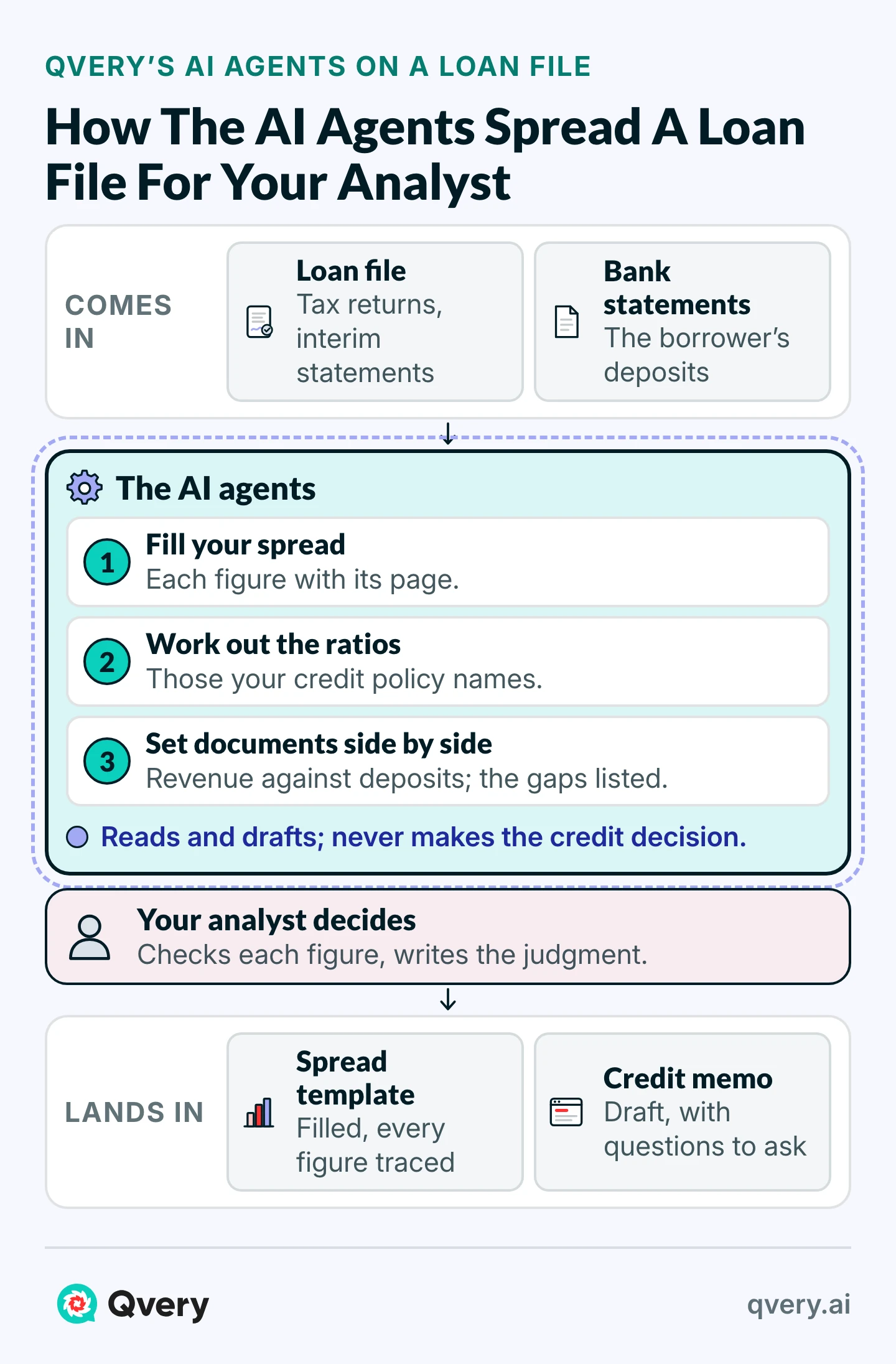
Your analyst starts from a filled spread and a drafted memo, checks the figures against their pages, and writes the judgment. The agents never make the credit decision. Before they touch a file we agree in writing what they may read and where its data is processed, every figure they enter is logged, and at first nothing they write leaves the bank until your analyst has read it.
Once we have access, the first agents are working on your own files inside two weeks. From then on we count each week the hours your analysts got back and the figures the agents flagged that did not match.
 Piotr BabelPartner @ Qvery
The figures that don't agree are where an analyst's judgment is needed. So our agents set the tax return against the bank statements, and where revenue and deposits sit far apart, the draft memo shows both numbers with their pages and leaves the call to your analyst. We set that comparison to your own credit policy first, on files your bank has already decided, so the questions it raises are the ones your credit officer would ask.
Try it on a file of your own: upload a business tax return and its bank statements, or run it on our sample borrower.
91.5% of the Fed's Surveyed Banks Kept Small-Firm Standards Unchanged
The Federal Reserve's Senior Loan Officer Opinion Survey of October 2026 asked 61 domestic banks, drawn from the largest in each Federal Reserve district, about the third quarter.10 Of the 59 that answered on small firms (annual sales under $50 million), 91.5% left their standards for C&I loans unchanged, 6.8% tightened them somewhat and 1.7% eased; among the banks with less than $100 billion in assets, 10.5% tightened.10
15.3% saw weaker demand from small firms and 3.4% stronger.10 The Fed reads the quarter as tighter standards for small firms, weaker demand from firms of all sizes and tighter standards for every kind of commercial real estate loan.11
These are large and regional banks, so a community bank's quarter can differ from theirs.
If your analysts' week goes into spreading rather than judgment, that is the part of the file we take on first.
For your own bank, two FDIC numbers make the benchmark: three banks in four approve a typical small business loan within ten business days,1 and 79% of small banks read the financial statements on most or all of their $25,000 loans.2 If your files clear the first and your analysts still work late, look at how much of their week goes into the reading: that is the part an agent can take.
Frequently asked questions
How long does commercial loan underwriting take?
Within two weeks at most banks, for a typical small business loan. In the FDIC's 2022 survey, three in four banks approved their typical loan within ten business days, and three in ten could approve a small, simple loan within one business day.1 A large, complex loan with exceptions to policy is slower: 27% of banks said 21 to 30 business days and 13% more than 30.2
What do banks look at when underwriting a small business loan?
The owner's credit score, the owner's personal promise to repay, collateral and the business's financial statements. Most banks read them for most or all of their small loans, and 91% to 95% do for a $250,000 loan.2 Small banks rank the business's financial position as the most important part of the application, 79% of them at $250,000, while large banks lean more on credit bureau information for small loans.2
What is financial spreading?
Spreading is copying a borrower's financial statements and tax returns into the lender's standard format, line by line, so that years and businesses can be compared and ratios such as debt service coverage worked out. The spread feeds the credit memo, which the people approving the loan read. At small banks it happens even on small loans: 79% read the financial statements for most or all $25,000 loans.2
What share of small business loan applications get approved?
In the Federal Reserve Banks' 2025 survey, 52% of applicants for a loan, line of credit or cash advance were fully approved, 29% partly and 19% denied.4 Small banks fully approved 57% of their applicants and large banks 43%.4 SBA loans were the hardest to get, at 32% fully approved and 40% denied.4
How much do credit analysts make?
In May 2025, credit analysts at banks and other lenders earned a mean of $98,210 a year, or $47.22 an hour, and a median of $82,240, before benefits.3 Across all industries the median was $83,510.5 Loan officers at lenders averaged $85,840.3
Is demand for credit analysts growing?
No. The BLS projects credit analyst jobs to fall 4.3%, from 64,700 in 2025 to 61,900 in 2035,5 and says the share is falling as companies raise each analyst's productivity with more data and machine learning.9 Loan officer jobs are projected to grow 1.1%.5
Can AI underwrite a commercial loan?
It can prepare one, and a person should decide it. Automatic approval of small business loans is rare at banks under $10 billion: 2% can approve a $25,000 loan automatically and none a $1 million loan.2 The agents Qvery builds spread the returns and statements, work out the ratios and draft the memo with every figure traced to its page, and the credit decision stays with the bank's approvers.
How many approvals does a small business loan need?
For a small, simple loan, usually one: 79% of banks need only one level of approval or an automated decision.2 A large, complex loan with exceptions to policy can need more, and 73% of banks can require three levels or more for it.2 Small banks add levels as the loan grows: a $1 million loan needs the third level or higher at 47% of them, against 12% of large banks.2
Why do larger loans take longer at small banks?
Small banks send them further up. Within a week, 76% of small banks and 81% of large banks can approve a small, simple loan.2 A $1 million loan needs the third level of approval or higher at 47% of small banks against 12% of large ones, and 62% of small banks have a board member or the full board approve some small business loans.2
Are banks tightening small business lending standards in 2026?
Slightly, among the largest banks. In the Federal Reserve's October 2026 survey, 6.8% of the banks that answered tightened their standards for commercial and industrial loans to small firms over the third quarter, 91.5% left them unchanged and 1.7% eased.10 15.3% saw weaker demand from small firms.10
Sources
- Federal Deposit Insurance Corporation (FDIC): Small Business Lending Survey 2024: Executive Summary (2024)
- Federal Deposit Insurance Corporation (FDIC): Small Business Lending Survey 2024: Section 3, Loan Underwriting and Approval (2024)
- U.S. Bureau of Labor Statistics (BLS): Occupational Employment and Wage Statistics, May 2025: credit analysts, loan officers, loan interviewers and clerks (national and NAICS 522) (2026)
- Federal Reserve Banks: 2026 Report on Employer Firms: Findings from the 2025 Small Business Credit Survey (2026)
- U.S. Bureau of Labor Statistics (BLS): Employment Projections: Occupational projections and worker characteristics, 2025 to 2035 (2026)
- Harvard Business School (Karen Gordon Mills and Brayden McCarthy): The State of Small Business Lending: Innovation and Technology and the Implications for Regulation, Working Paper 17-042 (2016)
- Federal Deposit Insurance Corporation (FDIC): Small Business Lending Survey 2024: Section 1, Introduction (2024)
- Federal Reserve Banks: 2026 Report on Employer Firms: Findings from the 2025 Small Business Credit Survey (summary page) (2026)
- U.S. Bureau of Labor Statistics (BLS): Employment Projections: Factors affecting occupational utilization (2026)
- Board of Governors of the Federal Reserve System: The October 2026 Senior Loan Officer Opinion Survey on Bank Lending Practices, Table 1 (2026)
- Board of Governors of the Federal Reserve System: The October 2026 Senior Loan Officer Opinion Survey on Bank Lending Practices (2026)
