
On this page
Your loan officers are paid to bring in loans, and your processors are paid to get each file to underwriting. Between the two sits the work of asking a borrower, again, for the bank statement with all of its pages.
On paper that is the processor's job. In most shops it keeps landing back on the loan officer, and the hours come out of the time they would spend on new applications and on the realtors who refer them.
Say a tenth of a loan officer's week goes to it. Loan officers at lenders earned a mean $85,840 in May 2025, by the Labor Department's wage survey; with benefits that is about $122,600 a year each. At a lender with 40 of them, the chase costs about $490,400 a year of selling time you are paying for.
At Qvery, we help lenders put loan officers back on selling, with custom AI agents that read every upload against the checklist and draft the one request their processor sends.
The usual fix is to redraw the two jobs. The law drew them years ago and the chase drifted anyway, which says the line between the desks is not where the problem sits.
The Law Already Gives the Chase to the Processor
The SAFE Act, the federal law under which every loan officer is licensed or registered, defines both jobs. A loan officer takes the application and offers or negotiates its terms.
A processor does clerical and support work at the direction of a licensed loan officer and under their supervision, and the law lists that work: collecting and analyzing the file's information, and communicating with the borrower to get what processing or underwriting needs.
The one line it draws is around money. A processor may not offer or negotiate rates or terms, or counsel a borrower about them. Everything else in the chase is processor work by statute.
An independent contract processor needs a state loan originator license and a registration with NMLS, the national registry for mortgage licensing; a processor on your payroll, working under your loan officers, generally does not.
| The Step | Loan Officer | Processor |
|---|---|---|
| Take the application | Yes, licensed for it | No |
| Quote, lock or explain the rate and terms | Only the loan officer | Never |
| Ask the borrower for documents | The first round, often | Yes, named in the law |
| Clear the underwriter's conditions | Steps in when a file stalls | Yes |
| Work with title, insurance and the appraiser | Rarely | Yes |
Conditions are the underwriter's list of what must still be shown before a loan can close: a newer pay stub, a letter explaining a deposit, the missing page of a statement. Most of the chase is conditions, and conditions keep arriving after the file is submitted.
Why the Chase Comes Back to Your Loan Officers
Shops where loan officers never chase have the same law as everyone else. What they have is a processor who reads each upload as it lands, asks once, and calls when an email gets no answer. Where the chase comes back to the loan officer, it comes back for reasons that survive even a good processor.
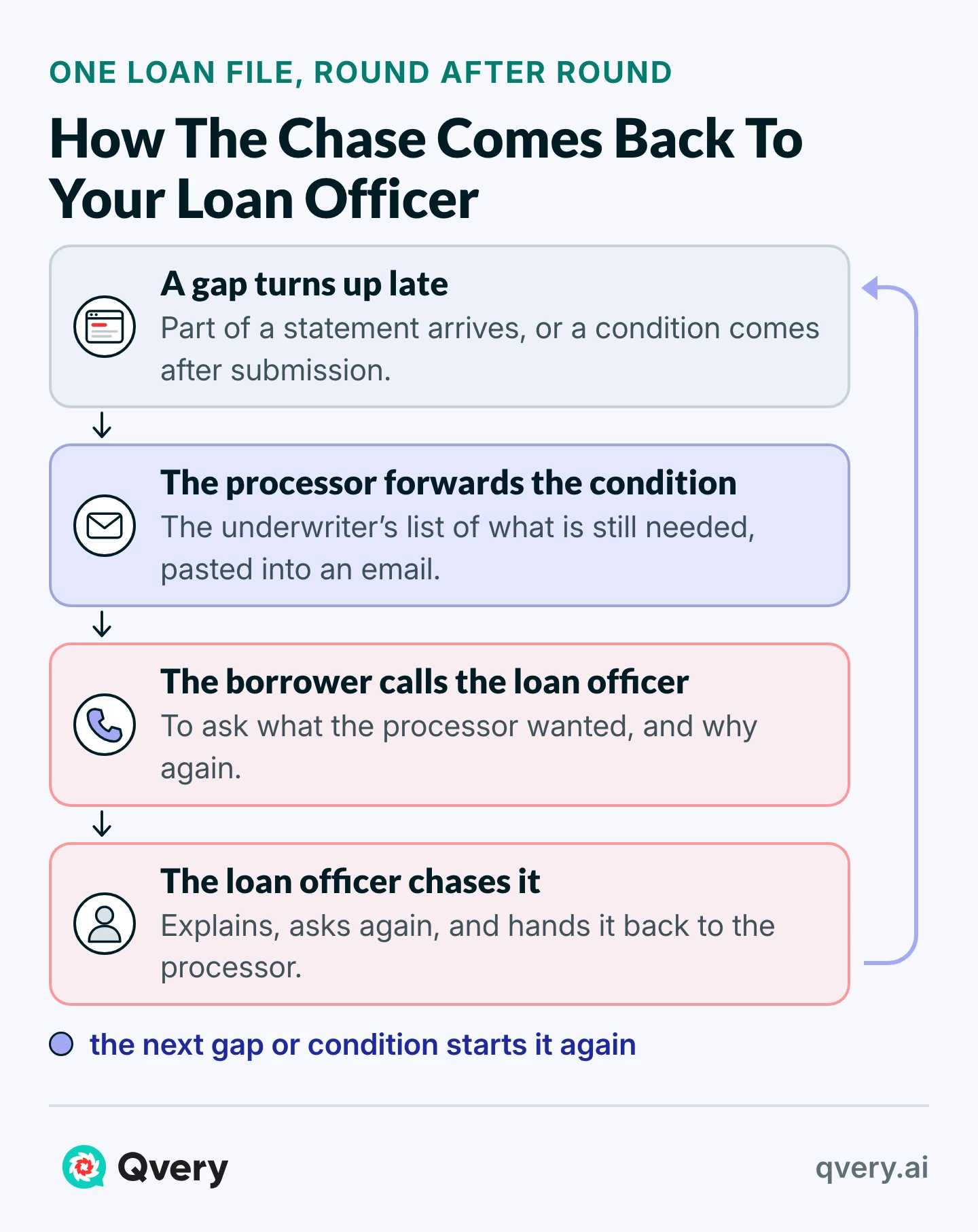
- Gaps arrive one at a time. A borrower uploads pages 3 and 7 of a statement, the conditions come after submission, and each new gap becomes a new request a few days after the last.
- The request is written for the underwriter. A condition pasted into an email means little to most borrowers, so they call the person who sold them the loan to ask what it is.
- The borrower answers the loan officer. They met the loan officer and have their cell number; a request from a name in operations they have never heard waits.
- The closing date is the loan officer's. Their pay and their realtor relationships ride on it, so when a file stalls they pick up the phone themselves.
- A flat fee buys a scope. Contract processors are paid per file, and some decide that collecting conditions from borrowers is outside what the fee covers.
None of these is fixed by a clearer job description. Each one turns on when a gap is found and how the request reads when it reaches the borrower.
What the Chase Costs a Lender Your Size
No processing report shows this cost, because it sits in the loan officers' week. Take an example lender of about 200 people with 40 loan officers, our assumption for a retail lender this size. At the mean pay above, with benefits at 30% of what employers spend on their people, each loan officer costs about $122,600 a year.
Suppose a tenth of each week, about four hours, goes to the chase: asking again, rereading what came back, translating a condition. That share is our assumption.
Loan officers describe a couple of hours a file over its life spent herding documents, and even those with in-house processors spend time on borrowers' questions about conditions. Across 40 people the chase takes 8,320 hours a year.
Half of it is reading and writing an agent can do: checking each upload against the list, writing the request in plain words, rereading what comes back. The other half stays with the loan officer: the borrower who goes quiet, the question about rate or terms, the call before closing.
Change the four numbers to your own loan officers and your own guess at the chase.
Loan Officer Document Chasing ROI Calculator
What Chasing Borrowers For Documents And Conditions Costs You, And What An Agent Saves
Saved Per Year
$235,600
4,160 hours handed back, after $9,600 a year to run it
- Hours Handed Back
- 4,160 hours a year
- Agent Running Cost (Estimate)
- $800 a month
- Payback Per $10,000 Of Build
- 0.5 months
On these numbers, the agent saves $235,600 a year after its own running cost, and every $10,000 of the build is earned back in 0.5 months.
On the example, the agents hand back 4,160 hours a year and save $235,600 after about $800 a month to run them. Each $10,000 of build pays back in 0.5 months of that saving.
Your payroll does not shrink by that amount. Loan officers are paid mostly on what closes, so the figure is selling time you already pay for, handed back to the people who bring in the next loan. What they do with two more hours a week is the decision that matters.
The processors' own share of the same reading is a separate saving, priced per file in our walk through checking every loan file against its checklist.
 Vlad ShvetsPartner @ Qvery
Whether the processor or the loan officer owns the chase sounds like an org chart question, and the law settled it years ago. It still lands on the person you pay to sell. So look at a normal week of your loan officers. If a tenth of it goes to asking borrowers for paperwork, that is selling time you can buy back without a single new hire, and it starts with your own checklist.
Documents a borrower still owes are the first of three paperwork costs our Finance Playbook works out for a lender this size, next to spreading business financials and answering borrower letters.
Redrawing the Roles Moves the Chase to Another Desk
Owners who notice this usually try one of four fixes, and none of them changes when the gaps are found.
| What Owners Try | Where the Chase Goes |
|---|---|
| Ask for every document up front | Back again with the conditions added after submission |
| Hire a loan officer assistant | To a cheaper desk, still a person rereading each upload |
| Write a stricter processor job description | To the processor, until a borrower stops answering |
| Merge the processor into the underwriter | To the underwriter, who now collects documents and calls borrowers |
Up front is right for what can be known on day one: pay stubs, W-2s (the wage statement an employer files each year), bank statements, an ID.
Some loan officers ask for everything at once and some for the bare minimum, because a ten-item list scares some borrowers off. Neither settles it, because the conditions do not exist until an underwriter has read the file.
United Wholesale Mortgage, which calls itself the nation's largest mortgage lender, took the fourth route on September 23. Its Underwriting+, which brokers can choose loan by loan, hands its underwriters the processing too: in the company's words, the underwriter "works directly with borrowers and third parties, helps secure missing documentation" and clears the conditions.
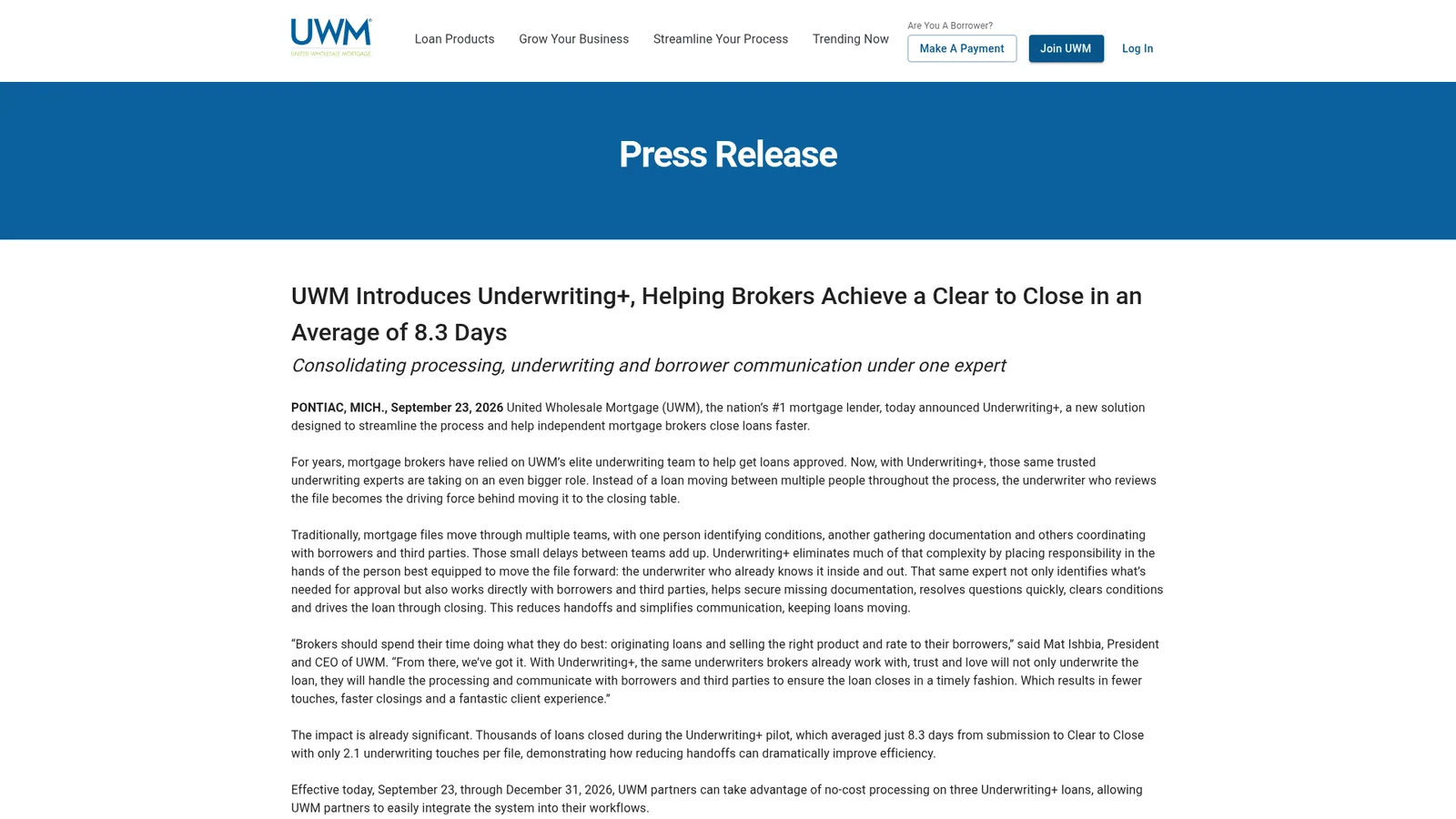
The chase moved to the person who also writes the conditions, and loan officers asked, as soon as word of it spread, who would push back when an underwriter asks for too much.
Loan teams that keep the chase off their loan officers say how in a few words.
Tips from Reddit
Processing will reach out to whoever needs it and chase down whatever docs are needed. We get the LO involved when we get push back, but normally, we handle it.
Borrowers hate piece mail and always asking for documents. One list to get to approval and one list to get to closing.
Your processor should have the same hype/excitement/connection with your borrower so it’s a seamless handoff, your borrower remains happy, they don’t need to bug you, and they will give you a good review after they close.
My view is to keep the two jobs where the law puts them and change the chase itself. A processor keeps it gladly when it is one clear request per file instead of six emails, and a loan officer stays out of it when the borrower understands what was asked.
Where Qvery's Agents Take the Chase
This is the part we build. Our agents start when a file lands in your LOS (loan origination system, the software that holds each loan's file) or arrives through the borrower portal. They read every page the borrower sent against your checklist for that loan type and the conditions already on the file.
Each line of the checklist comes back matching, missing, expired, different or unreadable, with the document and the page it relies on. A statement saved as September that covers August is caught by the dates printed on it, not by its name. A cropped phone shot of a bank page is marked unreadable and asked for again as the full statement.
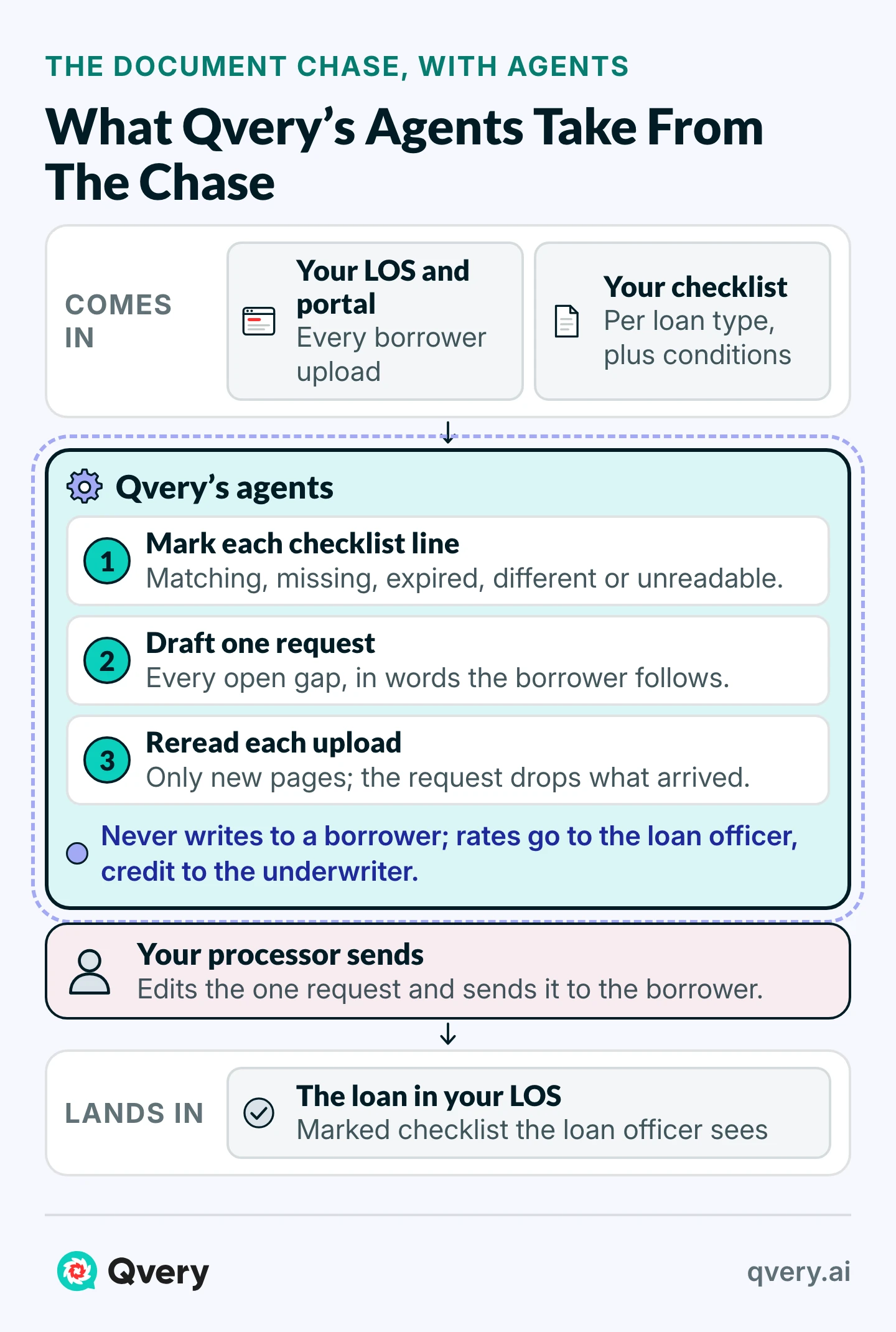
Then the agents draft one request for everything still open, grouped by document and written for the borrower: what to send and why, in words a person who has never seen a condition sheet understands. Your processor reads it, edits it and sends it from their own inbox.
When the borrower uploads again, only the new pages are read, and the next request leaves out whatever has arrived.
The marked checklist and the request are saved to the loan, so the loan officer sees what the file still needs without asking anyone.
The agents never answer a question about the rate or terms; that stays with the loan officer, the only person licensed to answer it. Anything that needs a credit view, such as a deposit nobody has explained, is flagged for the underwriter.
The same first read runs on a loan file you choose and your checklist for its loan type, and comes back as the marked checklist and the request.
 Piotr BabelPartner @ Qvery
The agents compare what each page says with what your checklist asks, so the checklist decides how far you can trust them. If your checklist for a refinance lives in one processor's head, we write it down with them before anything runs. Every mark points to the page it relied on, so when a date is read wrong, your processor sees it in seconds and we fix how that document is read.
Borrowers' tax returns, pay stubs and IDs raise the obvious question of who sees them. The agents read only the files this job needs, with the access we agree in writing before the build, and every page they open and every request they draft is logged for your auditors and examiners.
On the example lender, that is two hours a week back for each of 40 loan officers, with every file's open gaps asked for in a single request.
Your Checklists and One Loan Type Come First
We start by learning how your shop splits a file now: where the processor's work begins, which requests loan officers still send themselves, and where the checklist for each loan type lives. You bring those checklists, a month of underwriter conditions and access to your LOS and the borrower portal.
The first working result arrives within two weeks once access is in place: the agents reading every new file of one loan type beside your processors, who compare the marked checklists with their own until they trust them.
Each week we count the hours your loan officers no longer spend chasing and how many files went out with a single request. The next loan type follows when the first one holds.
Frequently asked questions
What is the difference between a loan processor and a loan officer?
The loan officer takes the application, structures the loan and is the only one who may quote, negotiate or explain its rate and terms; the SAFE Act requires them to be licensed or registered. The processor puts the file together for underwriting: collecting and checking documents, asking the borrower for what is missing, clearing conditions and working with title, insurance and the appraiser.
Can a loan processor talk to borrowers?
Yes. The SAFE Act names communicating with a borrower to get the information processing or underwriting needs as part of a processor's work. What a processor may not do is offer or negotiate rates or terms, or counsel the borrower about them. That conversation belongs to the licensed loan officer.
Does a loan processor need a license?
A processor employed by a lender or broker and working under a licensed or registered loan officer generally does not. An independent contract processor does: Regulation H requires them to register with NMLS and hold a state loan originator license. Some states add their own rules, so check the states you lend in.
What are conditions on a mortgage?
Conditions are what the underwriter needs before the loan can close: a newer pay stub, a statement page that was missing, a letter explaining a large deposit, proof that a debt was paid. Clearing them is usually the processor's job.
Should the loan officer collect documents before submitting the file?
For what can be known at application, yes: pay stubs, W-2s, bank statements and an ID, so the pre-approval is real. What cannot be known yet is the underwriter's conditions. Those arrive after submission, and chasing them is where processors earn their fee.
What does a loan officer assistant do that a processor does not?
A loan officer assistant (LOA) works for one loan officer or a small team: setting up files, sending disclosures, collecting the first documents and handling the loan officer's follow-up. A processor works the file from submission to closing. Many lenders have both, and the chase can drift to either.
Do the agents replace our processors?
No. They take the reading and writing out of the chase: the check of each upload against the checklist and the first draft of every request. Your processors decide what is asked, send it, take the borrower's calls and push back on conditions they think are wrong. Their week moves from rereading to working the files that need a person.
Is it legal for an AI agent to ask a borrower for documents?
Asking a borrower for the documents a file needs is clerical work under the SAFE Act, the same work a processor does. Our agents draft the request and your processor sends it, so a person stays on every message. They never offer, explain or negotiate rates or terms, which only a licensed loan officer may do.
Do the agents work with contract processors?
Yes, as long as the contract processor works in your LOS or a shared folder you control. The marked checklist and the drafted request wait there for whoever owns the file, staff or contract. The checklist stays yours either way, so a change of processor does not change what each file is checked against.
What happens when a borrower asks about their rate?
The agents never answer it: they write to no borrower on their own and never discuss rates or terms. Your processor passes the question to the loan officer, the only person licensed to answer it, and the marked checklist saved to the loan shows them what the file still needs while they take the call.
Does it work with Encompass, Arive or Blend?
It reads from wherever new files land: the LOS, the borrower portal or a document folder. Where the system lets it write, the marked checklist and the request are saved to the loan as a note or a task. Where it allows no outside access, the agents work from a shared folder instead, and the route is settled on the first call.
How much do the agents cost to run each month?
On the example lender, about $800 a month: roughly $2 of model usage per file for reading every page and rereading later uploads, at about 250 new files a month, plus hosting and upkeep. That is our estimate, and it moves with the number of files you start, not with the number of loan officers.
What if the agents misread a document?
Every mark shows the page it relied on, so your processor can check or change it in seconds before anything goes to the borrower. In the first weeks we go through those corrections with your team and change how that kind of document is read. A date that can be read two ways stays a question for a person.
