
On this page
A spread is the standard layout of a borrower's numbers your credit team reads ratios from, and building one still means keying tax returns and statements into it. Two questions separate the software for that job: where the finished spread lives, and what catches a return that tells a different story from the bank statements.
The seven below are ranked on those two questions for community banks and credit unions. Our agents come first as our own pick; every tool after them is placed by its own pages and its users' words. None of the six puts a price on its own site.
Custom AI agents by Qvery
Your Own Workbook, Every Document Checked Against the Others
We build these agents on the spread your analysts already sign: your Excel workbook, the ratio formulas in your credit policy and the loan folders your files sit in. When a file is marked ready for spreading, they read its tax returns, financial statements and bank statements, scans included.
They fill a copy of your workbook with its formulas intact, and each figure keeps its label, its period and the page it came from.
Then they set the documents against each other: sales on the return against the statements, debt on Schedule L (the return's balance sheet) against the borrower's debt schedule and the loan payments leaving its bank account.
Every bank statement is re-added from its opening balance. A gap shows both figures and both pages, listed once, at the line where it starts.
Your analyst opens a filled spread with the differences on top. Add-backs (one-time costs an analyst adds back to income), the memo's story and the credit decision stay with them. The agents never score a borrower, and a smudged digit is marked unreadable, with a request for a clean copy, rather than guessed.
- Fills a copy of your own workbook, formulas intact
- Every figure with its document, period and page
- The return, the statements and the bank statements set against each other
- Each bank statement month re-added from its opening balance
- Your policy's ratios with the arithmetic shown, worked both ways where the sources differ
- A drafted request for missing or unreadable records
Pros
- Your own workbook and ratio formulas
- The borrower's documents checked against each other
- Every figure tied to its page
Cons
- A few weeks of build before it spreads live files
- Needs your template, your policy and a few signed spreads to start
- A layout it has not seen goes to an analyst until the build covers it
Abrigo
Spreading, Agents and the Loan System From One Vendor
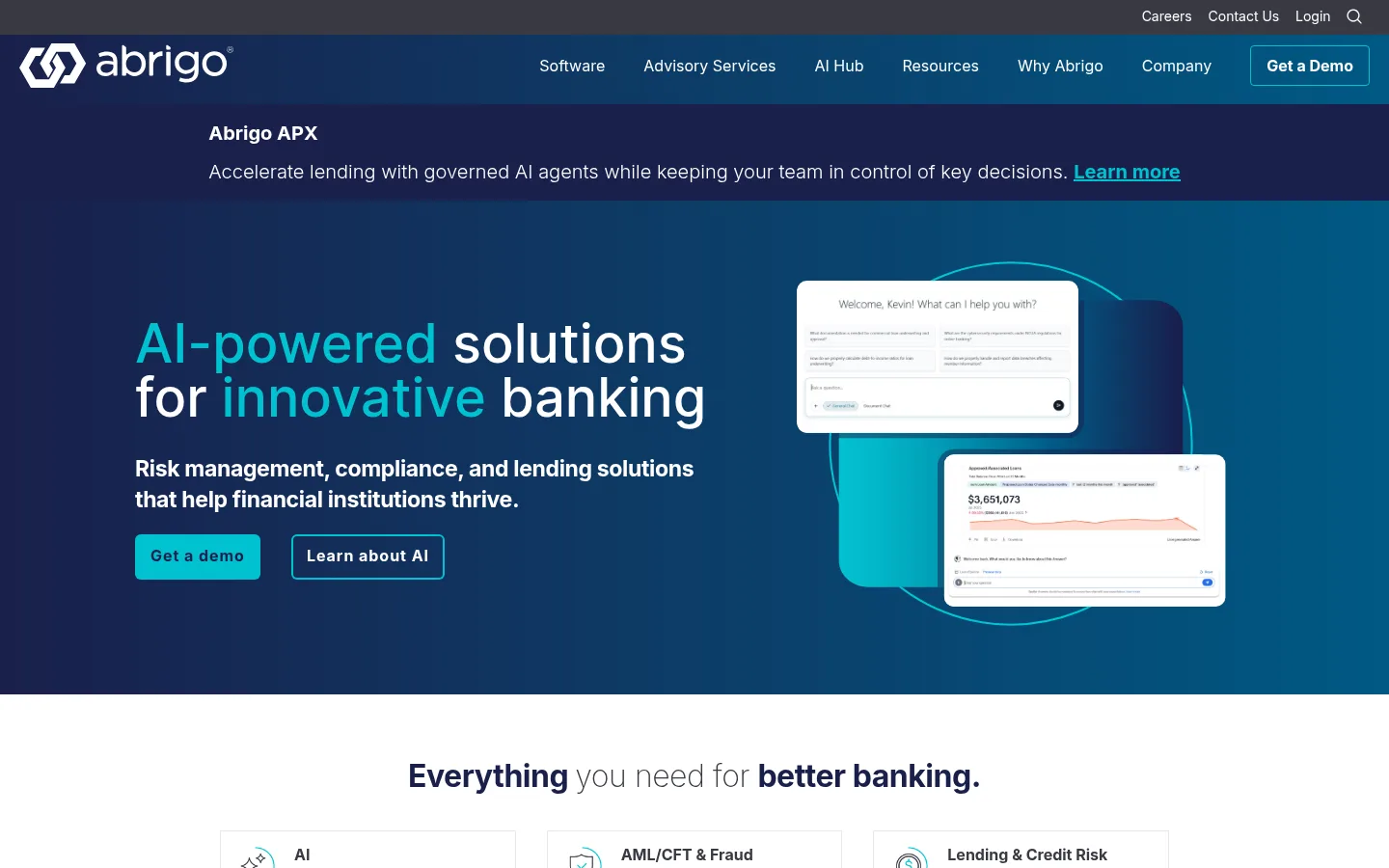
Abrigo sells community banks and credit unions software for lending, risk and financial crime, and Sageworks Credit Analysis is its spreading tool: global cash flow across a borrower's businesses and owners, ratios, benchmarks, what-if scenarios and a credit memo (the document approvers read) drawn from the spread.
Its Auto-Spreading reads tax returns with AI and text recognition (optical character recognition, or OCR), and by Abrigo's account produces spreads in minutes.
Inside Abrigo's loan system, its Lending Assistant drafts editable credit narratives, validates documents and pulls data out of unstructured files. Abrigo APX runs governed AI agents through multi-step lending work, checking files against your institution's own policies and flagging the exceptions, and Abrigo puts the saving at 40% or more of manual work.
It suits a bank or credit union that wants spreading, the loan system and agricultural lending from one vendor. The spread lives in Abrigo's templates inside Sageworks, and no Abrigo page we read describes comparing a return with the borrower's bank account.
- Tax return Auto-Spreading with AI and OCR
- Global cash flow, ratios, benchmarks and what-if scenarios
- Credit memos built from the spread
- APX agents that check files against your own policies
- An agricultural lending option
What Reddit says
Nine opinions from analysts and lenders in three threads, too few to score
Man, I have used about every credit spreading software out there and IMHO Sageworks is the best. Its been a while since I used it but it had the automatic tax return reader all the way back in like 2015.
We use Sageworks and I find it to be very cumbersome to use and clunky.
Sageworks/Abrigo recently added a automation and decisioning engin built on camunda. Its a game changer and can eliminate a lot of the clicks we've found. Takes some setup and testing to get up and running though..
Pros
- Spreading, credit memo and loan system in one place
- Tax return reading built in
- Agents that check files against your policies
Cons
- The spread lives in Abrigo's templates, not your workbook
- Several Reddit users find it tedious to work in
- No published price
FlashSpread
Every Value Shown Beside the Page It Came From
FlashSpread, from the lending software company BeSmartee, reads business and personal tax returns: Form 1040 and its schedules, S corporation and partnership returns, K-1s (each partner's share of a business), nonprofit Form 990s, and balance sheets and income statements. Bank statements, personal financial statements and rent rolls go through its newer AI extraction.
After the read, a reviewer can trace each value back to its source document, and Finastra, which sells it inside its own spreading software, shows the original file next to each value during corrections. Finastra's page says only 18% of tax returns need a person to step in after extraction.
It sends standardized spreads, global cash flow and ratio reports into the loan systems it supports, Baker Hill's among them, so it suits a lender that wants the typing gone without changing systems. A return that disagrees with the bank account is still the analyst's to find, by its pages.
- Tax returns, schedules, K-1s and Form 990 read automatically
- Bank statements, personal financial statements and rent rolls through AI extraction
- Every value traceable to its source page
- Global cash flow and ratio reports
- AskFlash AI for credit policy questions, answered with their sources
No review site we checked lists FlashSpread, and Reddit's credit analysts have not discussed it in any thread we found.
Pros
- Each value traceable to its page
- Wide tax form coverage
- Works inside several loan systems
Cons
- Spreads follow its standard layout
- No check of the return against the bank account on its pages
- No published price or independent reviews
nCino
For Banks That Run Their Lending on nCino
nCino's loan platform, which it says more than 2,700 financial institutions use, reads tax returns, audits, company-prepared statements and public filings with OCR, reconciles them line by line and flags fields it cannot read clearly. It learns from previous data mappings to speed up later spreads.
The spread lands in Spreads, nCino's analysis tool, with flexible templates, debt schedules and a credit memo template set for your institution.
At its May 2026 conference nCino said five of its AI agents are in production; WaFd Bank uses the Analyst one for loan document review and covenant work its team used to key into spreadsheets.
It is built for a bank that runs, or is moving, its whole commercial lending onto nCino, with documents filed in nCino's own document manager. On Reddit, the two bank staff who mention it both describe a hard first year after the move.
- OCR on returns, audits, company statements and filings
- Line-by-line reconciliation, with unclear fields flagged
- Learns from previous mappings
- Credit memo in a template set for your institution
- An Analyst agent for document review and covenants
Pros
- Spreading inside a full lending platform
- Learns from previous spreads
- AI agents already in production for document review
Cons
- Pays off only if your lending moves onto nCino
- Its page doesn't say its reconciliation sets one document against another
- Reddit users describe a hard first year
Moody's Lending Suite
Spreading Beside Your Own Risk Models
Moody's sells its Lending Suite as packages (spreading and scoring, underwriting, or the full loan origination system) or as stand-alone modules, for commercial and industrial, commercial real estate, agricultural and small business loans.
Its automated spreading pairs machine learning with an analyst's review. AI and data feeds extract, validate and map financial data into Moody's origination system, an audit trail logs every action and input, and a bank can run its own rating models beside Moody's.
It fits a bank whose commercial book is large enough to want risk rating, scoring and spreading in one place, and a bank that wants only spreading and scoring can buy that package without the rest. Its page describes mapping each statement into Moody's system, not checking one document against another.
- Machine learning extraction with an analyst's review
- Financial data mapped into Moody's origination system
- An audit trail of every action and input
- Your own rating models beside Moody's
- Packages or stand-alone modules
We found no user reviews of Moody's lending products on G2, Capterra or Reddit.
Pros
- Your own models beside Moody's
- Every action logged for examiners
- Spreading and scoring sold without the rest
Cons
- Built around Moody's own system
- No comparison across documents on its page
- No published price or user reviews
Baker Hill UN/FY
Tax Spreads Pre-Filled in the Loan System
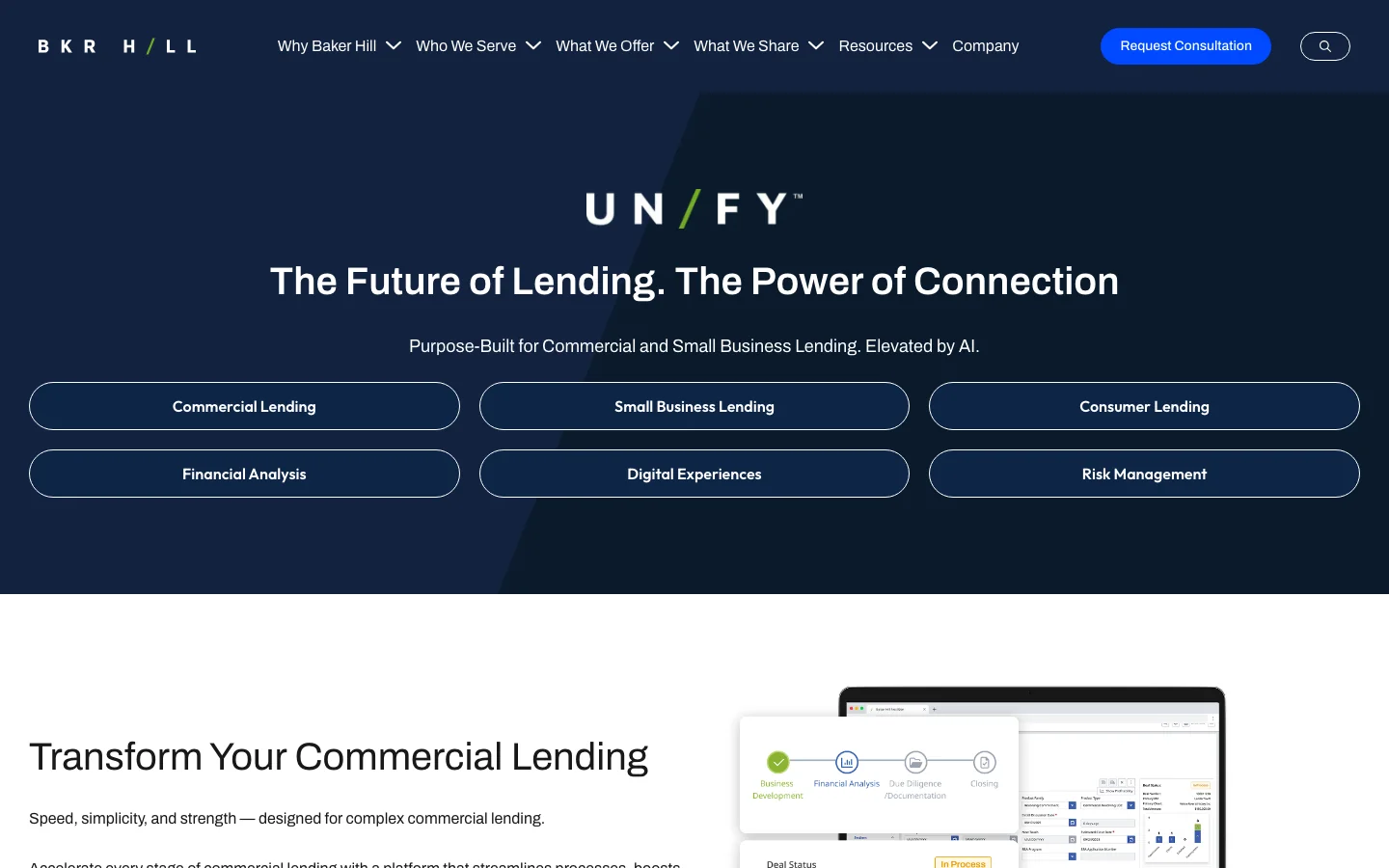
UN/FY is Baker Hill's loan origination system for commercial and small business lending, built on its older NextGen and sold to banks and credit unions. Its Intelligent Documents & Data reads US business and personal tax returns with models Baker Hill trained itself and pre-fills the tax spreads; support varies by form.
UN/FY also fetches tax returns, payroll records and bank statements through connections to ADP, QuickBooks and TurboTax. Its AI runs in a private Microsoft Azure environment with each institution's data kept apart, and Baker Hill holds SOC 2 Type II and ISO 27001 certifications.
Opportunity Insights, a second AI read of a deal's financials, is still in development. It suits a lender already on Baker Hill or choosing a new loan system. Its document page lists tax forms only, and comparing a return with the borrower's statements and bank account stays with your analysts, by its pages.
- AI models of its own that pre-fill tax spreads
- Business and personal returns, with schedules and K-1s
- Returns, payroll and bank statements fetched from ADP, QuickBooks and TurboTax
- A private Azure environment, SOC 2 Type II and ISO 27001
- FlashSpread available as a partner
TrustRadius lists Baker Hill NextGen with no reviews, and the one Reddit comment we found is a bank asking others what it is like.
Pros
- Tax spreads pre-filled inside the loan system
- Data kept apart per institution
- Documents fetched from the borrower's own accounts
Cons
- Works only inside Baker Hill's system
- Support varies by tax form
- Its deal analysis AI is still in development
FISCAL
Spreading That Stays on Your Own Servers
FISCAL, from a third-generation family company in Charleston, South Carolina, is spreading and exception tracking software built for community banks and credit unions; the company says nearly 500 have used it. FISCAL Forward, released in 2023, is its seventh generation.
Its tax templates follow IRS forms line by line, and the most common returns import automatically; company-prepared statements are keyed into business, personal and commercial real estate templates.
It pulls borrowers and relationships from your core system, fills a credit memo from the spread, offers more than 50 ratios it can set against industry benchmarks, and keeps every report traceable to the spread entered.
It runs in your own environment, behind your firewall, and installs in about an hour of IT time by its own account. It suits a smaller bank or credit union leaving Excel without buying a loan system. Its pages describe no AI, so statements are still typed in.
- Tax templates mapped line by line to IRS forms, with import
- Business, personal and commercial real estate templates
- Core import for borrowers and relationships
- More than 50 ratios, with industry benchmarks
- Runs on your own servers
We found no Reddit thread that mentions it. Its Capterra reviews date from 2020 and 2021; in one, a bank that left Moody's for it wrote: "We did not want to pay for other functions that we did not need."
Pros
- Borrower data on your own servers
- Built for community banks and credit unions
- About an hour to install
Cons
- No AI reading of statements on its pages
- Financial statements keyed by hand
- Its own templates, not your workbook
Where Each One Keeps the Spread
| Route | Where the spread lives | Pick it if |
|---|---|---|
| An Excel spread on a shared drive | Your own workbook, keyed by an analyst | You spread a handful of business loans a month |
| Custom AI agents by Qvery | A copy of your workbook, every figure with its page | Your borrowers' documents rarely agree, and every gap should surface before the memo |
| Abrigo | Abrigo's spreads, inside Sageworks | You want spreading, the loan system and farm lending from one vendor |
| FlashSpread | Standard spreads, sent to a supported loan system | You keep your loan system and want the tax returns read for you |
| nCino | Spreads, inside nCino's platform | Your commercial lending runs on nCino or is moving there |
| Moody's Lending Suite | Moody's origination system, beside your own models | You want risk ratings and spreading in one place |
| Baker Hill UN/FY | Pre-filled tax spreads, inside UN/FY | You run Baker Hill or are choosing it |
| FISCAL | FISCAL's templates, on your servers | You are leaving Excel and want the data behind your firewall |
For most community banks the loan system they already run decides the shortlist. If it is Abrigo, nCino or Baker Hill, their spreading is already in reach, and FlashSpread brings tax return reading into several systems without a move.
Loan mix matters more than asset size. Small business loans mean tax returns, which every tool here reads. Commercial real estate brings rent rolls and operating statements: FlashSpread reads rent rolls, nCino and Moody's have real estate analysis, and FISCAL has a real estate template.
Two things tell you the spread has outgrown the place it is kept: analysts rebuilding the template for each new kind of borrower, and a loan committee asking which document a ratio came from. Reading the return faster fixes neither.
Qvery's Agents Check That a Borrower's Documents Agree
Every tool above reads a return. None of their pages describes setting the return against the statements and the bank account, so that comparison, and finding which gap moves the ratio your policy limits, stays with your analysts.
At Qvery, we help banks and credit unions spend less on every loan file, with custom AI agents that spread the borrower's documents and check that they agree.
The sample file on our agent page is a made-up Omaha bank's $2.4 million equipment loan that we built for the purpose.
On it, the agents found the borrower's debt service coverage (the cash it earns for each dollar of loan payments due) at 1.76 times on its statements and 0.99 on its 2025 tax return, against a policy limit of 1.25.
The return carried $502,000 more debt than the borrower's own debt schedule, and its bank statements showed twelve monthly payments of $18,640 to an equipment lender the schedule left out. Each gap came with both pages.
 Piotr BabelPartner @ Qvery
A spread is only as trustworthy as the quickest way to check one number in it. So every figure our agents write carries its page, and when two documents give different figures, both go into the spread as a question instead of one quietly winning. A digit the agent can't read cleanly stays blank, with a request for a better copy.
A borrower's returns carry account numbers and tax IDs, so the agents read only the loan folders you grant, through your systems' own permissions, and change nothing in them.
Their drafted requests leave those numbers out, and every figure pulled and page opened is logged where an examiner can follow it. Only your credit team and the Qvery builders named in our agreement see the files.
Send the agent one borrower's returns and statements, with your ratio formulas if you have them, or run it on that sample; the differences come back first.
Six Analysts Spend About $215,000 a Year on Spreading
Take the typical lender in our calculator, not a client: a commercial lender or community bank of about 200 people whose six credit analysts prepare about 60 loan files a month and give 30% of their week to spreading, at $119,400 a year each with benefits and taxes.
The agents take 60% of that work and run for about $400 a month, bringing the year's cost to $90,768, running cost included. Each $10,000 of the build's price is matched by a little under a month of that return. The hours become money when they absorb growth you would otherwise hire an analyst for.
Working with us starts from three loan files your analysts have already spread and signed, plus your template and your credit policy. Within about two weeks the agents spread those same files on your workbook, and your analysts compare each figure with their own before a live deal reaches them.
 Vlad ShvetsPartner @ Qvery
Most of these tools read a tax return well now, so I wouldn't choose on that. I'd choose on what happens when the return and the bank statements disagree, because that is where a credit file goes wrong and where an analyst's hours go. If the software can't show you that gap with both pages, your analysts still hunt for it by hand, page by page, before the memo can go to committee.
After that, the agents spread live files beside your analysts for a few weeks, and then pick up each new file the moment it is marked ready for spreading.
Your analysts keep working in the workbook they already know, and the files reach them spread and checked.
Frequently asked questions
What is financial spreading software?
Software that turns a borrower's tax returns and statements into a spread, the layout a credit team reads ratios and cash flow from. Abrigo, FlashSpread, nCino, Moody's and Baker Hill read the documents for you; FISCAL imports common tax forms into templates. Qvery's custom agents fill your own workbook.
How is spreading different from underwriting?
Spreading puts the borrower's numbers into one comparable layout. Underwriting is the judgment made on them: whether the cash covers the payments and whether to lend. None of these tools says it makes that call, and Abrigo, Moody's and Baker Hill say plainly that it stays with your people.
Can software spread business tax returns automatically?
Yes. Abrigo, FlashSpread, nCino and Baker Hill read business and personal returns with AI and OCR, and FISCAL imports the most common forms into its templates. Coverage differs by form: Baker Hill says its support varies by form and section, and our agents start with the returns your borrowers send most.
How accurate is AI financial spreading?
Vendors rarely publish a figure you can test. Finastra's page says only 18% of returns need a person after FlashSpread's extraction. We measure ours on spreads your analysts already signed and show you the miss rate on your own files before anyone relies on it.
Is Sageworks the same as Abrigo?
Sageworks Credit Analysis is Abrigo's spreading tool, and users on Reddit still call it by either name. It sits inside Abrigo's loan system beside Auto-Spreading, the Lending Assistant and the APX agents.
How long does it take to spread a loan file?
Reading the return is the fast part: Abrigo says Auto-Spreading produces spreads in minutes. The statements, the bank statements and the checks between them take longer. On the agents we build, the measure we hold ourselves to is under three hours of analyst time per file.
Does spreading software handle global cash flow?
Abrigo, FlashSpread and FISCAL all produce global cash flow, which adds up the cash across a borrower's businesses and owners against all their debt. Our agents work it out with the formulas in your credit policy.
Will AI spreading replace credit analysts?
Not on any of these products' own terms. Abrigo keeps decisions and exceptions with lenders, Moody's pairs its extraction with an analyst's review, and Qvery's agents never score a borrower or write the memo's story.
Can we keep our own Excel spread template?
With Qvery's agents, yes: they fill a copy of your workbook with its formulas intact. The other tools spread into their own templates, and FISCAL is built to replace an Excel spread.
Does spreading software connect to our core system?
Some do. FISCAL imports borrowers and relationships from your core, Baker Hill's UN/FY pulls verified customer and business data from it, and the suites keep the spread inside their own loan systems. Our agents read the loan folders you grant and save the filled workbook back to the loan's folder.
Does spreading software work for commercial real estate loans?
Several do. FlashSpread reads rent rolls, nCino and Moody's have real estate analysis, and FISCAL has a real estate template. For our agents we add the rent roll and operating statement layouts to the build, and the appraisal stays with your underwriter.
What does financial spreading software cost?
None of the six puts a price on its own site, though nCino's G2 listing shows a $175 monthly Basic plan without saying what it covers. Qvery agrees a fixed price for the build before work starts, with the monthly running cost estimated at your file volume.
Which spreading software do credit unions use?
Abrigo, FISCAL, BeSmartee's FlashSpread and Baker Hill all name credit unions among the lenders they serve, and Baker Hill and BeSmartee each give business lending at credit unions its own page.
Can ChatGPT spread financial statements?
OpenAI's help pages say ChatGPT can analyze the PDFs and spreadsheets you attach. A chat on its own does not know your template or your policy's formulas, keeps no log an examiner can follow, and checks nothing against the bank statements unless asked each time. That is the work a built agent adds.
Is a borrower's data safe with an AI spreading tool?
That depends on where the tool runs and who can see the files. FISCAL runs on your own servers; Baker Hill keeps each institution's data apart in a private Azure environment; Moody's logs every action. Our agents read only the folders you grant and log every page they open.
What is debt service coverage?
The cash a business earns for each dollar of loan payments due in the same period. Lenders set a minimum in their credit policy, and a spread built from two documents can give two answers, as in the sample on our agent page: 1.76 times on the statements, 0.99 on the return.
