On this page
A business loan spends most of its life with a credit analyst before anyone decides it.
Someone chases the last three years of business returns and the interim statements, types them into the spread (the lender's standard sheet for a borrower's returns and statements), and works out debt service coverage, whether the borrower's cash covers the loan payments, and the cash flow across the owners' other companies.
Then they check the liens, other lenders' claims on the borrower's assets, and the policy limits, and write the credit memo.
The loan committee then decides in a meeting. A figure misread in week two becomes a covenant, a condition the borrower must keep to under the loan, set on the wrong number.
At 25 business loans a month and some 12 analyst hours a file, that preparation takes two credit analysts about 85% of their week, on our assumption: about $244,970 a year at the Bureau of Labor Statistics’ mean pay for credit analysts, with benefits.
Who Does Each Step of a Business Loan
| Step | The agents | Your team |
|---|---|---|
| Documents | Requests and checks every item | Follows up when a borrower stalls |
| Spread (the returns entered into your standard sheet) | Drafts it, each figure tied to a page | Approves it; reads complex ones line by line |
| Checks | Policy limits, screening, liens | Settles the exceptions |
| Credit memo | Writes the first draft | Finishes it |
| Decision | Hands over the factors | Decides, or a validated model does |
| Decline notice | Words the reasons given | The decider signs |
The AI agents that read a file never decide it. They hand the factors to the person or the model that does.
What the Preparation Costs
Say 8 of a file's 12 hours go to chasing, typing and arithmetic. At about $69 an hour, credit analysts’ mean pay with benefits, those 8 hours cost about $554 a file, and at 25 business loans a month they come to 200 hours. If checking the agents' drafts takes 2 of the 8 hours, about 150 hours a month go back to analysis.
The calculator prices the whole preparation: two credit analysts at about $144,100 a year each, about 85% of their week, about $244,970 a year.
With the agents taking about half of it, at about $500 a month to run (model use for each loan file, hosting and upkeep), it costs about $128,485, saving about $116,485 a year and 1,768 hours; $10,000 of build pays back in about a month. The share of the week, the share the agents take and the running cost are our assumptions, to replace with your own.
Business Loan File Preparation ROI Calculator
What Chasing A Business Borrower's Documents, Entering The Returns And Statements Into Your Standard Sheet And Drafting The Credit Memo Costs You, And What An Agent Saves
Saved Per Year
$116,485
1,768 hours handed back, after $6,000 a year to run it
- Hours Handed Back
- 1,768 hours a year
- Agent Running Cost (Estimate)
- $500 a month
- Payback Per $10,000 Of Build
- 1 month
On these numbers, the agent saves $116,485 a year after its own running cost, and every $10,000 of the build is earned back in 1 month.
It leaves out the cost of a covenant set on a misread figure.
One Borrower's File, From Upload to Committee
The borrower uploads to your portal on a Friday night. The agents we build check the upload against your checklist for the loan type and ask the borrower for each missing item: the third year of business returns, the interim statement, the owner's personal return.
They enter each return and statement into your spread template, every figure tied to its source page, with debt service coverage and the cash flow across the owners' companies run as formulas, never as numbers the language model writes itself.
They run your policy limits, the checks of the business and its owners against identity records and sanctions lists, the lien search and the insurance certificate, and draft the memo in your template, every number in the text matching the spread.
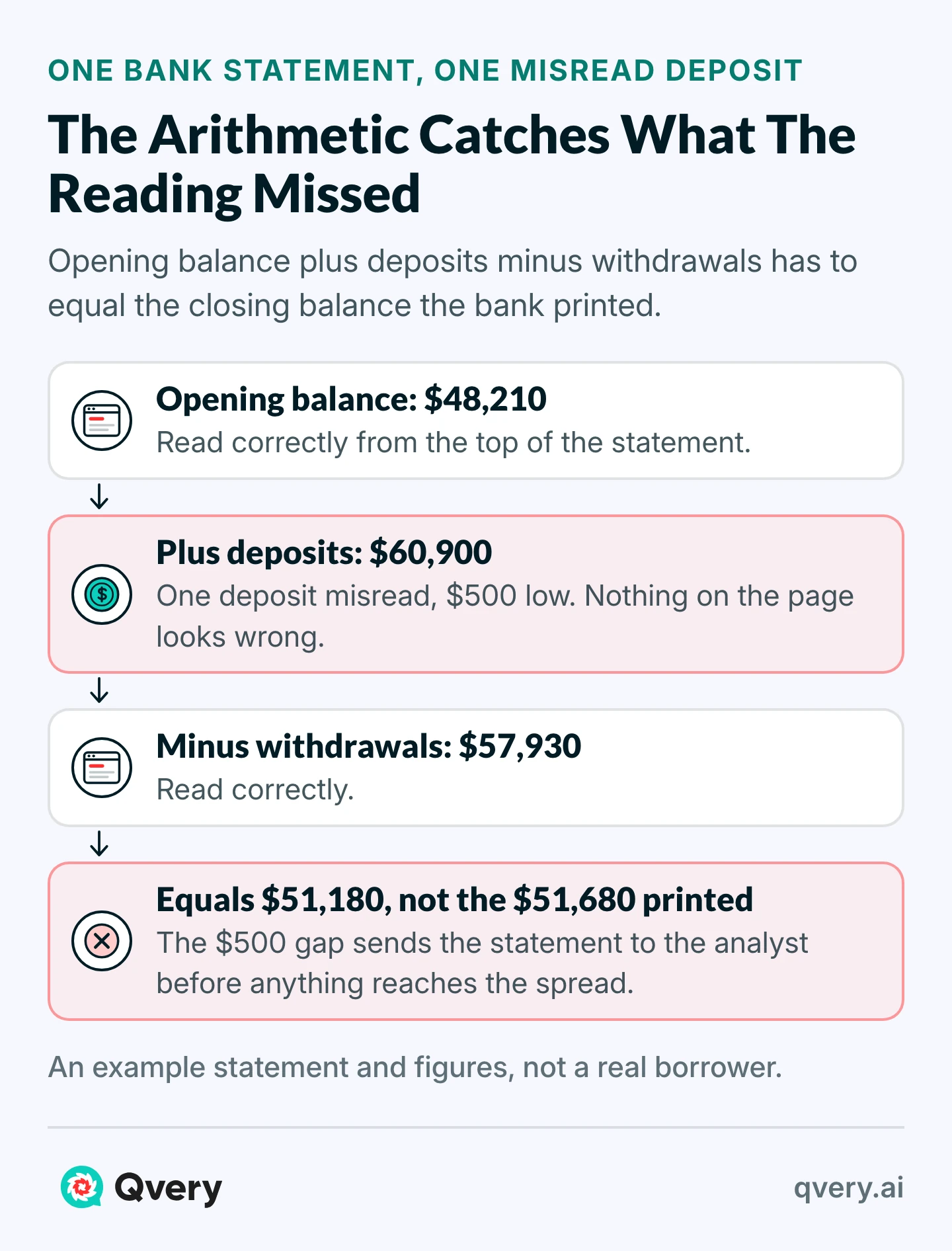
Arithmetic is the safety net. A bank statement's opening balance plus deposits minus withdrawals has to land on its closing balance: $48,210 plus $60,900 minus $57,930 is $51,180, $500 short of the printed $51,680, so that statement goes to the analyst with its source page open.
On a borrower with several entities or partnership income, a person reads every line of the spread; on a simple one, the exceptions. Arithmetic will not catch a figure filed under the wrong year or the wrong company, so on simple files the analyst also opens a few drafts that raised nothing, picked at random.
The agents keep the record as they work: each figure with its page, the policy rule each check applied, what was missing and when it arrived, the model's score and version where a model scored the loan, and the committee's note. If the loan is declined, whoever decides picks the reasons from that record and signs the notice; the agents never approve or decline a loan.
What the agents may read and do is set in a written agreement, your data is processed where that agreement says, and every action the agents take is logged.
Bring Us Last Year's Business Loan Files
Bring a handful of last year's business loan files and your spread template. First the agents prepare last year's files beside what your analysts produced, starting with annual renewals, where the borrower is known and last year's spread sits beside this year's; they run within two weeks once access is in place.
Frequently asked questions
Which loan processing tasks should go to AI first?
The document chase and the spread on annual renewals, where the borrower is known and last year's spread is the check. Then the first draft of the credit memo. Leave decisions for last, and only to a model built and validated to make them, never to the agents that prepared the file.
Can AI read messy scanned bank statements and tax returns?
Mostly, and the agents will misread some. Borrowers send phone photos, faxed pages and statements in many layouts. The statements tie out by arithmetic, with balances that reconcile and totals that match the return, and an analyst checks every line on complex borrowers with several entities.
Will AI take over our credit analysts' work?
The agents take over the typing, the arithmetic and the document chase. The analysis, the conversation with the borrower and the judgment on a file stay with the analyst.
What is the difference between spreading and underwriting?
Spreading puts a borrower's tax returns and financial statements into the lender's standard format so years and borrowers can be compared. Underwriting judges whether the borrower can repay, on what terms and with what collateral. The agents can draft the spread; the underwriting judgment stays with your analysts, and the decision with a person or a model built and validated to make it.
How do we know a spread the AI drafted is right?
Every figure points to its source page, the statements tie out by arithmetic, and the analyst reviews every exception the agents flag. On renewals, compare the draft with last year's spread; a line that moved for no reason in the business is the first one to open.
How long until AI agents work on our own loan files?
Within two weeks once access is in place, the agents prepare real files from your portal and inbox beside your analysts, who approve every spread. From there they take on more loan types as your team checks their work.
Can the agents decide a loan?
No. They prepare the file and keep the record of factors; a person or a model built and validated to decide makes the decision, and the person who decides signs any decline.
Do the agents work with our loan system?
Yes. They read your application portal and the inbox where borrowers send documents, and write the spread and the memo into the templates and folders your analysts already use.
What happens when a borrower never sends a document?
The agents keep asking and show the analyst which item is still missing and since when, so a stalled file is visible before it reaches committee.
What does an analyst still do on every file?
Reads the exceptions, talks to the borrower, judges the risk and finishes the memo. On a borrower with several entities or partnership income, the analyst reads every line of the spread.
Do the agents work nights and weekends?
Yes. They start on each upload without anyone prompting them, nights and weekends included, and the analyst finds the file's missing-items requests and draft spread waiting.
Do the agents change our credit policy?
No. They apply your credit policy and your spread template; when either changes, the agents' rules change with it, under a sign-off by someone you name.
How do the agents handle a renewal?
They put last year's spread beside this year's and flag the lines that moved, so the analyst starts from the differences instead of re-keying the file.
What do we see each week?
How many analyst hours each file took and which errors the agents stopped before committee: a misread figure, a missing document, a policy limit breached.
Can the agents read the owner's personal return?
Yes. The owner's personal return goes into the spread like the business returns, so the cash flow across the owner's companies runs from the same record.