On this page
Every call from a customer or member who doesn't recognize a debit card charge starts a federal clock.
Regulation E, the rule for electronic payments out of a consumer's account, gives your institution 10 business days to decide whether there was an error. If it needs longer, it has to put the money back provisionally within those 10 days and finish within 45 days, or 90 for a debit card purchase.
Inside that window, someone on your team opens the claim, pulls the transactions, posts the provisional credit, files the chargeback that asks the merchant's bank for the money back, and writes the letters the rule requires, each on its own deadline.
When I worked in a manual environment, I had two full time employees who processed claims pretty much all day.
Take a bank or credit union of about 250 people working 400 card disputes a month, our example. At 40 minutes a claim, that's 3,200 hours a year, about two people's working year, and $109,760 of their time at what a dispute specialist costs with benefits.
That's before the small claims your desk pays out of pocket because working them costs more than they're worth.
Most of a Claim's 40 Minutes Is Paperwork Around One Decision
Here is what one claim asks of your desk, on the regulation's own clock:
The claim arrives
By phone or in writing. The account holder has 60 days from the statement that first showed the charge.
Within 10 business days
Your desk decides, or credits the amount provisionally (it may hold back up to $50 on an unauthorized charge) and tells the account holder within 2 business days of the credit.
Before the card network's window closes
The chargeback goes in. Visa's rules give 120 days from the transaction for a fraud claim on an online purchase.
Within 45 days
The investigation is finished, or within 90 for a debit card purchase or a new account.
Within 3 business days of finishing
The result goes to the account holder. A "no" needs a written explanation and the right to see the documents; reversing the credit needs its own notice and five business days of honoring the account holder's checks.
One step in that list is a judgment: whether there was an error. The rest is reading, typing and watching dates, and that's where claims go wrong.
A claim typed wrong at intake takes the wrong path. If the account holder handed their card to someone, the charge isn't unauthorized under the regulation, however badly it went; a charge for the wrong amount is a different claim again, with a different chargeback.
Final credit posted on a charge that still had chargeback rights, and no chargeback filed, is the institution's own loss. A desk that falls behind turns its open claims into losses and into exam findings.
Then there's the threshold. Plenty of institutions credit any claim under a set amount, commonly $25 to $50, and never file the chargeback, because an hour of a specialist costs more than the claim.
Tips from Reddit
Bank and credit union staff on where dispute claims go wrong
Most Financials don't actually submit claims below a certain threshold to the card processor, they just eat it. My current FI is $50 or less but bigger FIs will have higher thresholds.
They threw a fit when I first transferred bc the entire team quit and all of these disputes were losses bc they were past due or not done right.
Your only recourse would have been to claim you were charged more than you agreed to. Reporting it as fraud was incorrect.
Start With Card Disputes, Not the Chatbot
Most AI pitches to an institution your size start with a chatbot for members or with lending. Both can come later.
The first agents should run on a rule that's already written down, use data you already hold, beat a clock your people struggle with, and leave the decision with a person, so you learn what agents can do while the risk stays small.
| First job | What it runs on | Who decides each case | Why it is or isn't first |
|---|---|---|---|
| A chatbot answering members | Your website and policies, plus judgment about tone | The bot, in front of the member | Every answer is public, and it's judged on manner as much as accuracy |
| Lending files | Your credit policy and the borrower's documents | An underwriter or a committee | Pays well, but files wait on borrowers, and a credit decision takes longest to trust |
| Anti-money-laundering alert review | Your monitoring rules and the account history | An analyst, whose judgment is the whole job | The analyst's call is the product, and it gets the heaviest scrutiny |
| Card disputes | Regulation E, the card networks' rules, and the account and card records you already hold | A dispute specialist, every claim | Written rule, data in-house, a hard clock, and a person already decides |
Card disputes are the only row where the rule, the data and the clock are all in place and a person still makes every call, so the agents take the work around a decision your people already make.
It's also where examiners look. In 2025 FDIC examiners cited 136 violations of Regulation E, second only to Truth in Lending, and 74% of those citations were about investigating and answering errors. The NCUA, which supervises credit unions, put Regulation E error resolution on its exam list the same year.
Where Qvery's Agents Take the Casework
The agents we build for a dispute desk start where the claim starts: the call notes or the online form.
Within minutes they've read what the account holder says happened, pulled the disputed charge and the ones around it from your core system (the software that holds your accounts) and from your card processor's records, and proposed what kind of claim it is: a charge they never made, a wrong amount, a duplicate, something never delivered.
If the account holder says they gave someone the card, the agents flag the claim for a person, because that changes what the regulation covers.
Then the dates. The agents work out every deadline on that claim (the 10 business days, the 45 or 90 days, the network's chargeback window) and keep them on the case.
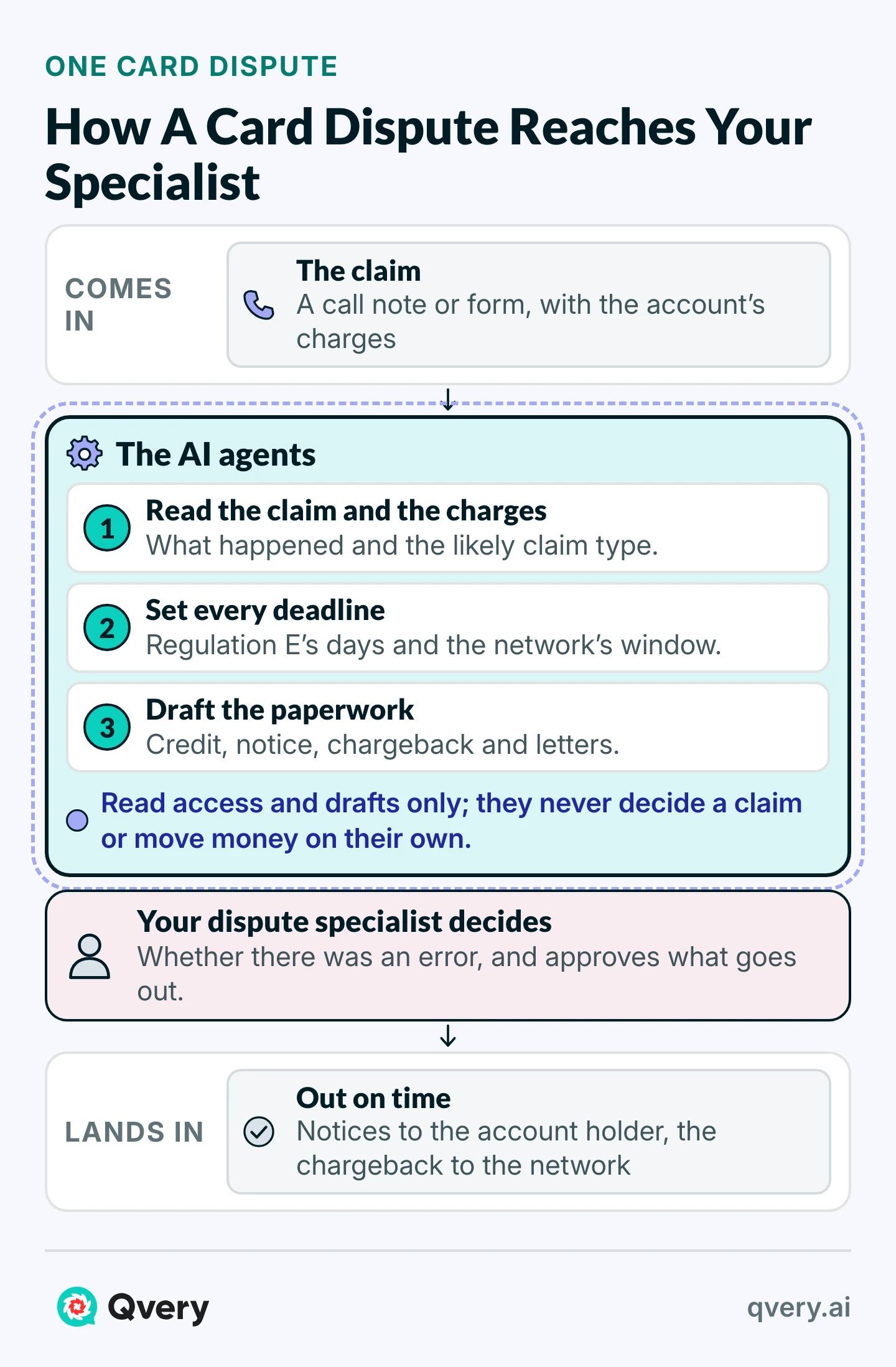
They draft the provisional credit and its notice, assemble the chargeback with the evidence and the reason code (the network's label for why the money is being claimed back) its rules ask for, and draft the letters.
What reaches your dispute specialist is a prepared case: the account holder's story, the transactions, the proposed claim type, the dates, and every document drafted. The specialist decides whether there was an error and approves what goes out, in about 12 minutes a case in our example, against 40 by hand.
If you already run dispute software that tracks the Regulation E timers, the agents work alongside it. The software keeps the clock; the agents do the reading and drafting it leaves to your people.
The Desk Gets Back 2,240 Hours a Year
In our example the desk spends 3,200 hours and $109,760 a year on claims, $22.87 a claim. With the agents preparing each case and a specialist deciding it in 12 minutes, it spends 960 hours and $37,848, the agents' running cost included: $7.89 a claim.
That's $71,912 a year and 2,240 hours handed back, and every $10,000 of the build is earned back in about 1.7 months.
Put your own desk's numbers in: the claims you work a month, the minutes each takes, the minutes a specialist would spend on a prepared case, and what an hour of their time costs.
Card Dispute ROI Calculator
What Each Card Dispute Costs You To Work, And With The Agents
Saved Per Year
$71,912
2,240 hours handed back, after $4,920 a year to run it
- Hours Handed Back
- 2,240 hours a year
- Agent Running Cost (Estimate)
- $410 a month
- Payback Per $10,000 Of Build
- 1.7 months
On these numbers, each dispute costs $7.89 instead of $22.87, the agent saves $71,912 a year after its own running cost, and every $10,000 of the build is earned back in 1.7 months.
Two things sit outside the calculator. The first is the threshold: if a quarter of the example's 400 claims fall under $50 at about $25 each, your institution pays $30,000 a year without asking any merchant for it. When preparing a chargeback costs minutes instead of most of an hour, the threshold can come down.
The second is the deadline your desk stops missing, which is the thing examiners wrote up most under this rule.
The hours are worth the most when they go to work you'd otherwise hire for: the scam claims that need a long conversation, and the fraud patterns nobody on the desk has time to look at.
What the Agents Never Decide
A dispute desk touches account holders' money and their personal data, and an examiner will read how it works. So what the agents may touch is settled before they touch anything:
Before the agents open a single claim, we agree in writing what they may read and do, and where the data is processed. Qvery AI OÜ is an EU company and signs a data processing agreement.
At first nothing reaches an account holder until a person has seen it. Later you decide which steps, if any, the agents complete on their own. I'd hand over posting the provisional credit on a plain card-fraud claim first.
For a bank, we're a third party under the federal agencies' guidance on third-party relationships, which every bank applies in proportion to its size and the risk.
For a credit union, the NCUA's 2026 exam priorities name vendor management around payments. Either way, the written scope, the data processing agreement and the log of every action are what you show the examiner.
What We Need From Your Dispute Desk to Begin
Bring us a month of closed card disputes with their letters, your written dispute procedure, and read access to the systems your desk opens today.
We learn how your specialists work a claim, agree what the agents may read and do, and two weeks after we have access the agents are preparing your own claims. From then on we count, every week, the hours handed back and the deadlines met.
Frequently asked questions
We already have dispute software. Does this still help?
Yes, if it's a case tracker. Software that keeps the Regulation E clock and stores the letters still leaves a person reading the call notes, pulling the transactions and filling in the forms. The agents do that work and put the result into your software, where your examiner already looks.
Does it handle other electronic transfers, not only cards?
Yes. The same regulation covers ACH debits (bank transfers that billers and lenders pull from an account), ATM transactions and transfers made by phone, on the same clock. The paperwork differs, so we start with card disputes, the channel most fraud attempts target, and add the rest once the first agents run.
What about scams where the account holder sent the money themselves?
Those are the hardest claims and they stay with a person. Whether the regulation covers one depends on the facts, starting with whether the account holder handed over the card or made the payment themselves. The agents capture the full story at intake and flag the claim, so your specialist decides on the whole account.
Can the agents do credit card disputes too?
Credit card billing disputes run under a different rule, Regulation Z: the bank that issued the card has two billing cycles, and no more than 90 days, to resolve them. The casework is similar, so if you issue credit cards in-house, the same agents can take those claims once the debit desk runs.
Our card processor handles chargebacks for us. Is there still work to take?
Usually most of it. The processor files the chargeback, but your institution still takes the claim, decides on provisional credit, tracks the Regulation E deadlines and writes to the account holder. The agents prepare all of that and hand the processor a complete chargeback request.
Will our examiner accept AI in the dispute process?
A person still decides every claim, and every step the agents take is logged with its source, a better record than a spreadsheet of dates. What examiners cite most under this rule is the investigation and the answer: deadlines missed and letters that say too little. Those are the parts the agents track and draft.
What access do the agents need?
Read access to where claims arrive (the call notes, the online form or the shared inbox), to the transaction history in your core system, and to your card processor's records. To start, they write only drafts into a queue your specialists approve. Anything more is your decision, made later and in writing.
Does member or customer data leave the institution?
We agree in writing where it's processed before the agents read anything, and Qvery AI OÜ signs a data processing agreement. The agents get the least access the job needs, and every read is logged.
Should we lower our write-off threshold once the agents run?
That's your call, and it's a numbers question. Once preparing a chargeback takes a few minutes of a specialist's time, the claims under your threshold may be worth filing. We show you, from your own claims, how many fall under it and what they add up to.
What does it cost to run?
In our example, about 40 cents a claim in model use plus $250 a month for hosting and upkeep, $410 a month at 400 claims. The build is a fixed price for a defined result, agreed before we start.
Can account holders ask the agents where their claim stands?
They can be built to answer status questions from the case record, but we don't start there. The first agents work behind the desk; anything that talks to an account holder comes after your team trusts the case files.
How soon do the agents work our own claims?
Two weeks after we have access, the agents are preparing your live claims. For those first weeks they only draft: your specialists see every case the agents assemble beside the claim as it arrived, so they can check the agents' reading before anything changes in how the desk works.
What happens when the agents get a claim wrong?
Your specialist catches it at review, because a person reads every prepared case before anything goes out. Each correction is logged, and we use the corrections to adjust how the agents read your claims. A claim type they keep missing stays with your people until they stop missing it.
What should come after disputes?
Lending is usually next: most of loan processing is assembling the file, which agents do well, and the underwriter keeps the decision. The dispute desk teaches your team how working beside agents feels, on a job where every output is already checked.