On this page
Cash application is the accounts receivable (AR) job of matching each customer payment to the invoices it pays. The money arrives by bank transfer (ACH) or check.
The note that says what it covers, the remittance, arrives on its own: a PDF in the AR inbox, a spreadsheet from the customer's payables system, a line in an email.
What Reddit says
What AR clerks say about remittances
Honestly we just wing it in Excel half the time. If the remittance has invoice numbers, cool, 2 min job. If not, I'm emailing the customer asking what the heck they actually paid for.
I get my fair share of smaller remittances that I don't mind reconciling manually every now and then. Its more when I get the ones that are several pages long and i have multiple in queue.
The automation was a customization we did to our ERP and it had to be tailored for each customer we would use it on.
With two people spending half their week on it, that is about $73,000 a year, and every payment applied to the wrong invoice comes back as a customer chased for money they already paid.
Four Remittances Your ERP's Rules Can't Read
Your ERP's matching rules apply a payment when the bank memo carries the invoice number and the amount is exact. These four wait for a person:
One payment, six invoices
a single deposit that settles half a statement, listed on page two of a PDF.
A short-pay with a reason
one invoice paid $340 short, and "damaged pallet" written in the email, not the remittance.
Their number, not yours
a remittance that names the customer's purchase order instead of your invoice.
A late remittance
the money on Monday, the PDF on Thursday.
Rules cannot read an email, so these are the payments that eat the week.
One Deposit, From the Bank Feed to the Ledger
A deposit of $48,210 lands in your bank feed. The agent finds the customer's remittance in the AR inbox, reads its six invoice numbers and checks them against your open invoices: five add up exactly, and one is $340 short.
It prepares the receipt for the five, with the remittance attached, and puts the sixth in your AR lead's queue with the customer's email about the damaged pallet beside it. Where no remittance arrives, it drafts the request to the customer after the time you set.
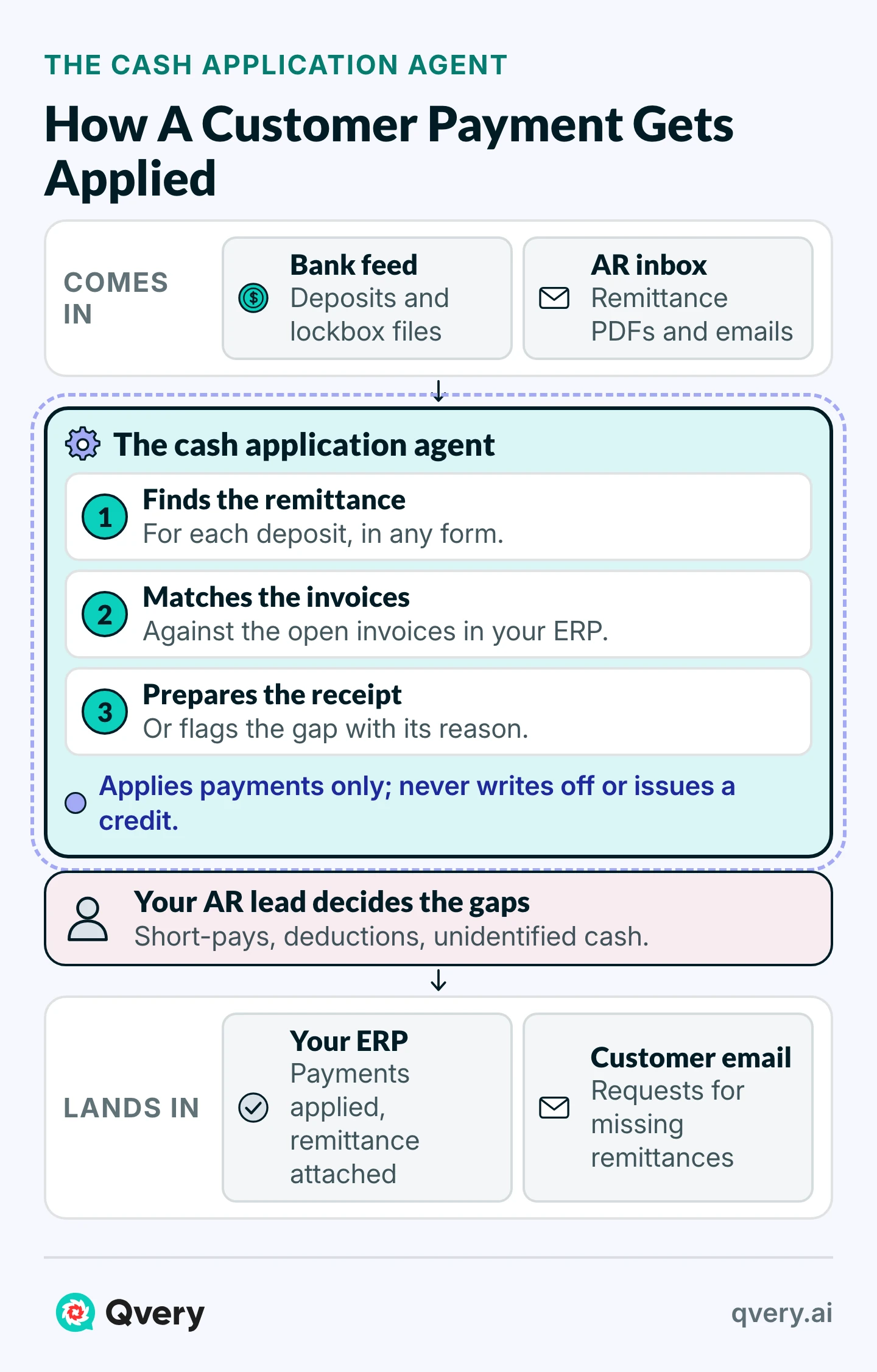
It works through an ERP user that can apply payments and nothing else, so it never writes off a balance, issues a credit or changes a customer's terms.
Every action is logged with the remittance behind it, and for the first weeks every receipt waits for your AR lead to post it. Before it touches anything, we agree in writing what it may read and where its data is processed.
What Two Clerks' Half-Weeks Add Up To
Take a company of about 250 people with two AR clerks spending half their week on cash application. Billing and posting clerks, the Bureau of Labor Statistics' category for this work, earned a mean $51,070 in May 2025, and with benefits at 30% of what private employers spend, each costs about $73,000.
Type in your own team. The calculator opens on that example, with AI agents applying 80% of the payments: the ones whose remittance names invoices that add up.
Cash Application ROI Calculator
What Applying Customer Payments Costs You, And What An Agent Saves
Saved Per Year
$52,400
1,664 hours handed back, after $6,000 a year to run it
- Hours Handed Back
- 1,664 hours a year
- Agent Running Cost (Estimate)
- $500 a month
- Payback Per $10,000 Of Build
- 2.3 months
On these numbers, the agent saves $52,400 a year after its own running cost, and every $10,000 of the build is earned back in 2.3 months.
On the example, the job falls from $73,000 to $20,600 a year with the agents' running cost of about $500 a month included: $52,400 a year and 1,664 hours your clerks spend on collections and disputes instead. Every $10,000 of the build is earned back in about 2.3 months.
How the First Month With Us Goes
We learn how your team reads each large customer's remittances, connect the agent to the AR inbox, the bank feed and your ERP, and run it on your real payments. Two weeks after access is in place, it is preparing receipts and your AR lead is posting them.
From then on we report every week the payments it applied, the hours it handed back and the misapplications it stopped. The build price is fixed and agreed before we start.
Frequently asked questions
Can the agent read remittances from customer portals?
Where the portal's terms allow automated access, yes, the same way it reads an email. Where they do not, someone on your team exports the remittance and the agent takes it from there.
What about check payments and lockbox files?
A lockbox file and a scanned check stub are just another form of remittance. The agent reads them alongside the deposit in your bank feed and applies the payment the same way.
Does it work with our ERP?
It applies payments the way your ERP already accepts them from software, through an API or an import file. We confirm which in the first conversation, and the agent works with either.
Can it apply one payment across a parent company and its subsidiaries?
Yes, when the remittance names the invoices: the agent matches them across the related accounts you have linked in your ERP. When it does not name them, the payment goes to your team with the accounts it could belong to.
What happens if the agent applies a payment to the wrong invoice?
Your AR lead reverses it in the ERP as they would today. The log shows which remittance and which match the agent used, and we adjust how it reads that customer's remittances so the same mistake does not repeat.
Will it replace our AR clerks?
It takes the matching, not the people. Your team keeps collections, disputes and the customer conversations, which is where the hours are worth the most: in cash collected sooner.
What does the agent cost to run?
At about 300 payments a week, expect a few hundred dollars a month: model usage of a few cents per payment, plus hosting and upkeep. The build is a fixed price, agreed before any work starts.
Can the same agent chase overdue invoices?
Chasing is a different job with different rules, so we build it as a second agent once the first is running. Both work from the same inbox and the same open invoices.
What happens to cash nobody can place?
The agent lists the deposit with the customers it could belong to and the open amounts that would fit, so your AR lead starts from a short list instead of a blank search. Nothing is applied until a person picks.
How long until it reads our big customers' remittances?
It learns each customer's format from the month of remittances you bring before the build. A new customer's format is added in a short setup, and their payments wait for your AR lead until the agent has matched them correctly.
Who sees our customers' payment data?
Only the systems and people agreed in writing before the build, together with the data processing agreement. Qvery is an EU company, the agent gets the least access the job needs, and every action it takes is logged.
What is cash application in accounts receivable?
Matching each customer payment to the invoices it pays. The money arrives by bank transfer or check, and the remittance that says what it covers arrives separately: a PDF in the AR inbox, a spreadsheet, or a line in an email.
Why can't ERP matching rules apply every payment?
They apply a payment only when the bank memo carries the invoice number and the amount is exact. One payment covering six invoices, a short-pay explained in an email, or a remittance on page two of a PDF waits for a person.
What does cash application cost a company of 250 people?
In this post's example, two AR clerks spending half their week on it cost about $73,000 a year. With agents applying 80% of the payments, it falls to $20,600, about $500 a month of running cost included: $52,400 and 1,664 hours back.
What do misapplied payments cost?
$27,000 a year on top of the matching, on a planning figure: 15 payments a month that land on the wrong invoice or sit unapplied long enough to need research, at $150 per payment for the research and the customer call together.
How do AI agents handle a short payment?
Agents prepare receipts for matching invoices and send short-pays to the accounts receivable lead. In the example, a $48,210 deposit covers six invoices: five add up exactly, and one is $340 short. The receipt includes the remittance; the short-pay goes to the lead with the damaged-pallet email.
Can a cash application agent write off a balance?
No. It works through an ERP user that can apply payments and nothing else, so it never writes off a balance, issues a credit or changes a customer's terms. For the first weeks every receipt waits for your AR lead to post it.
What if a remittance names the customer's purchase order instead of our invoice?
A purchase order reference leaves the payment waiting for a person. Remittances naming customer purchase orders instead of invoice numbers are among four cases the accounting system rules cannot read.
What if the payment arrives before the remittance?
Late remittances are among the cases the accounting system rules cannot handle. Money arrives Monday and the PDF arrives Thursday in the example. If no remittance arrives, agents draft a customer request after the time you set.