
On this page
- Read Every Scan Word for Word
- Date Each Piece by Your Own Record
- Split Each Message Into Requests by What It Asks
- Count Every Deadline From Your Own Calendar
- Hand Each Request to Its Team With a Drafted Reply
- Your Compliance Officer Confirms Every Type
- Sorting 2,000 Pieces a Month Costs $114,912 a Year
- Where Qvery's Agents Sit on Your Servicing Desk
- Working With Qvery Starts From Your Desk Procedure
- Frequently asked questions
Borrower mail reaches a mortgage servicer through four doors: the mailroom scans letters, the servicing inbox takes email, the borrower portal takes messages, and the call center types a note after every call.
A clerk opens each piece, works out what it asks, finds the loan, logs the day it came in and hands it to whoever answers it.
Some of those pieces start a clock. Regulation X, the federal rule for mortgage servicing, covers two kinds of letter: a notice of error, a borrower's written claim that you got something wrong on the loan, and an information request, a written ask for something about the loan.
Each must be acknowledged within five days, not counting weekends and legal public holidays, and most must be answered within 30. The count starts the day the letter reaches you, not the day someone reads it.
A letter headed qualified written request (QWR) is one or the other, judged by what it says.
In our worked example, a servicer of about 200 people gets about 2,000 pieces a month, and at eight minutes each the sorting costs $114,912 a year of clerks' time.
At Qvery, we help mortgage servicers cut what borrower mail costs and keep their clerks on the answers, with custom AI agents that sort every letter and count its deadlines.
We ran the job on two invented weeks: fourteen pieces of mail to Fernmoor Loan Servicing, a servicer that does not exist, from Monday November 9 to Friday November 20, 2026, across Veterans Day and into Thanksgiving week.
The mailbox came with its own loan records, desk procedure, holiday calendar and acknowledgment template. We wrote the answer key before any model read a page.
The six steps below take that mail from the mailroom to a confirmed list, and your own mail runs through the same six.
This sorts, dates and routes the mail and drafts the acknowledgment. It does not decide whether an error happened, write the answer or run a loss-mitigation review.
Read Every Scan Word for Word
Email, portal messages and call notes arrive as text. Letters arrive as scans, so the first job is reading them: every word copied as written, every stamp copied on its own, and anything the reader cannot make out marked instead of filled in.
The hardest page in the sample is a handwritten letter from Harold Penhallow, 81, whose homeowners insurance stopped being paid when his loan moved to Fernmoor. An ink mark covers his policy number.
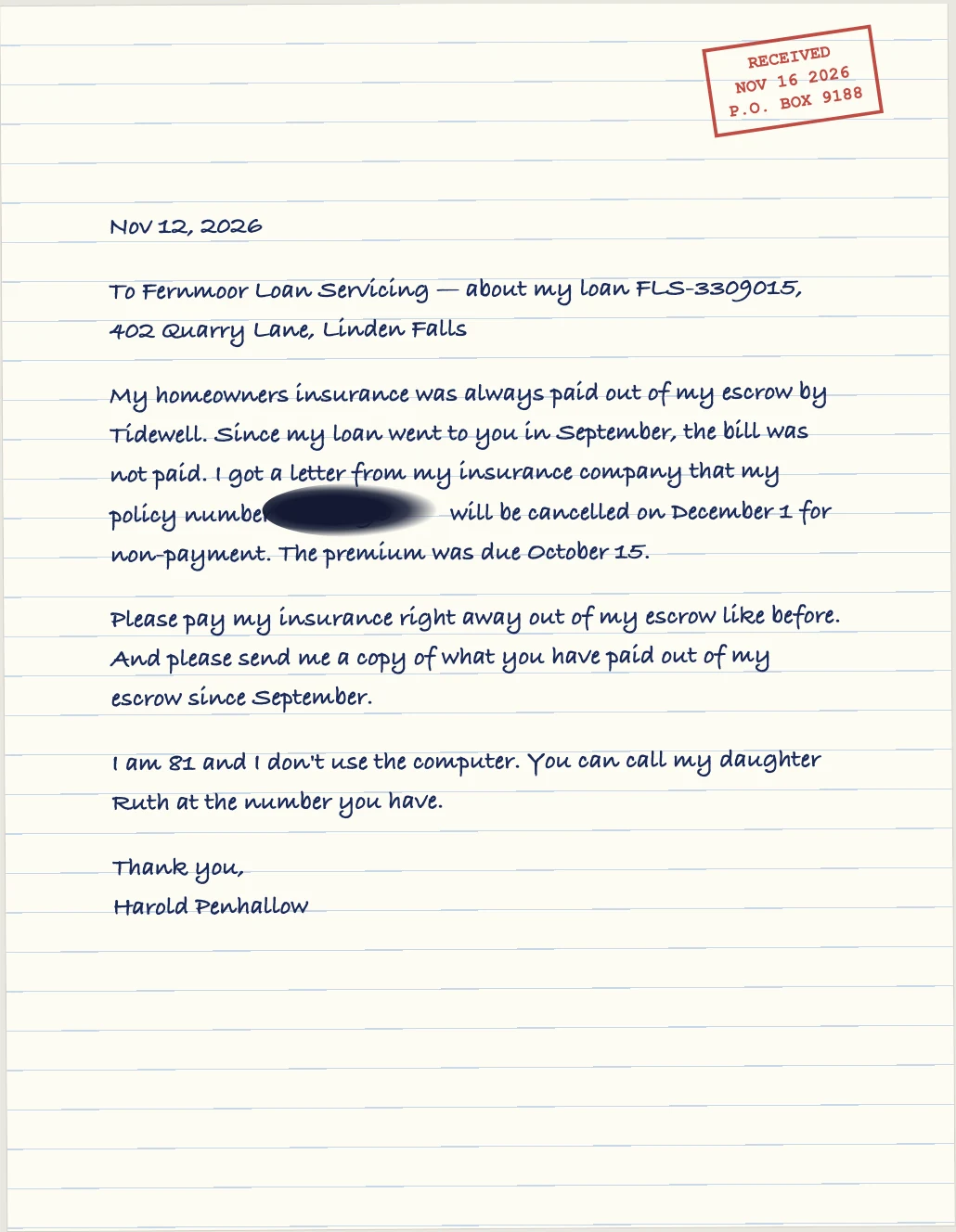
Gemini 3.8 Flash read it word for word, copied the received stamp, and wrote the policy number as unreadable, with where it sits on the line:
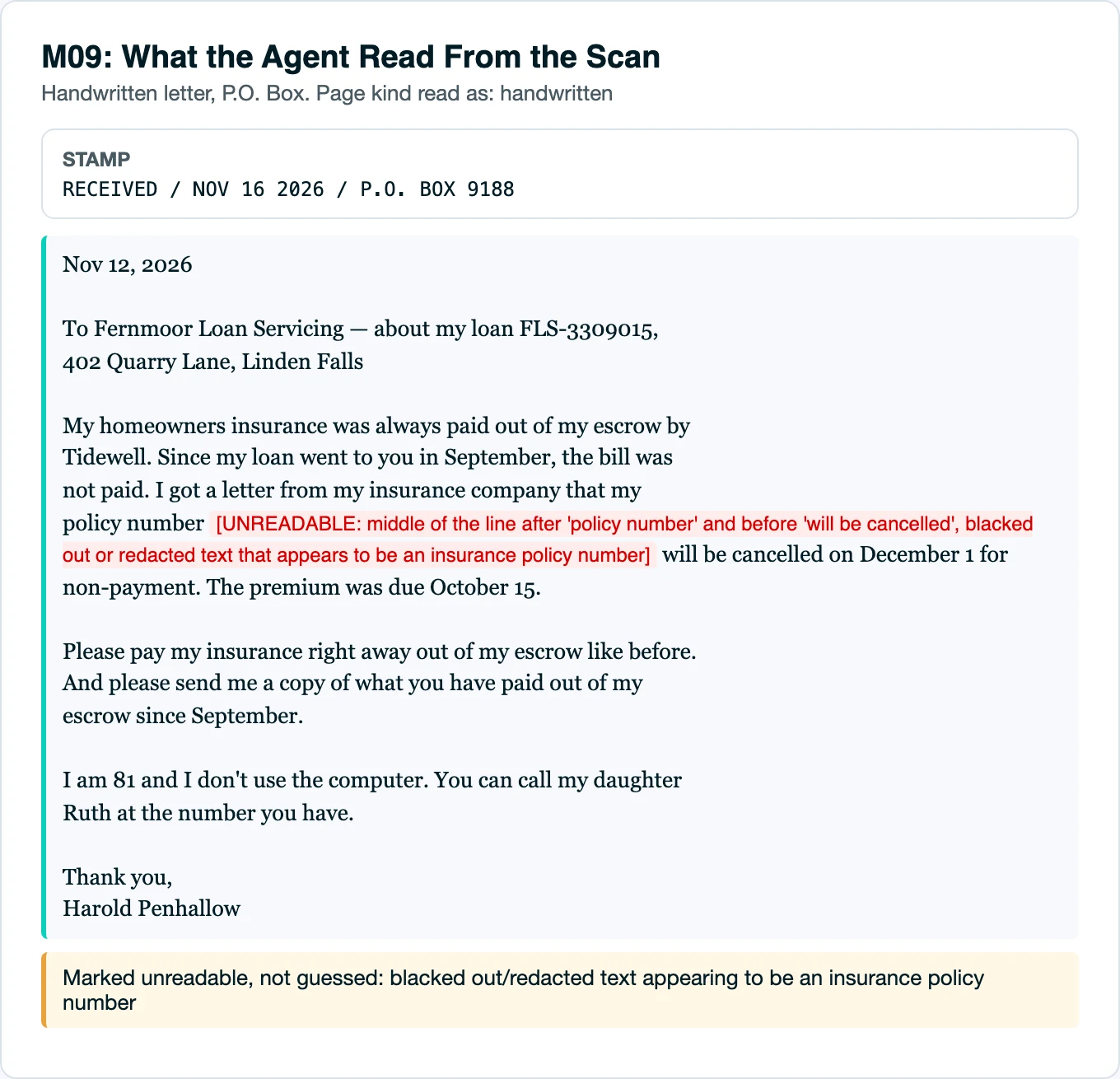
A read that filled the gap with a likely number would hand your escrow team a policy that does not exist. The marker sends whoever answers back to the page.
On the payment coupon, the borrower's handwriting runs over the printed mailing address, and the read marked that printed line unreadable too. That one is harmless: the address is your own.
Date Each Piece by Your Own Record
The arrival date is the earliest record any of your offices made: the received stamp on a scan, an email's received time, the portal's submitted time, the time of the call.
The date the borrower wrote never sets the clock. Dana Whitcombe's letter is dated October 30; the mailroom stamped it Monday November 9, and November 9 is day 0.
Where a letter is sent matters too. A servicer may name one address borrowers must use for these letters; without one, a letter that reaches any office counts. Fernmoor's own procedure treats every office as covered, so the next letter dates from a branch.
A housing counselor wrote to the Linden Falls branch for Gloria Mendez-Strand. The branch stamped it Tuesday November 10 and forwarded it, and the correspondence desk scanned it Friday November 13, with two of the five days to acknowledge it already gone. The acknowledgment was due the next Wednesday, November 18.
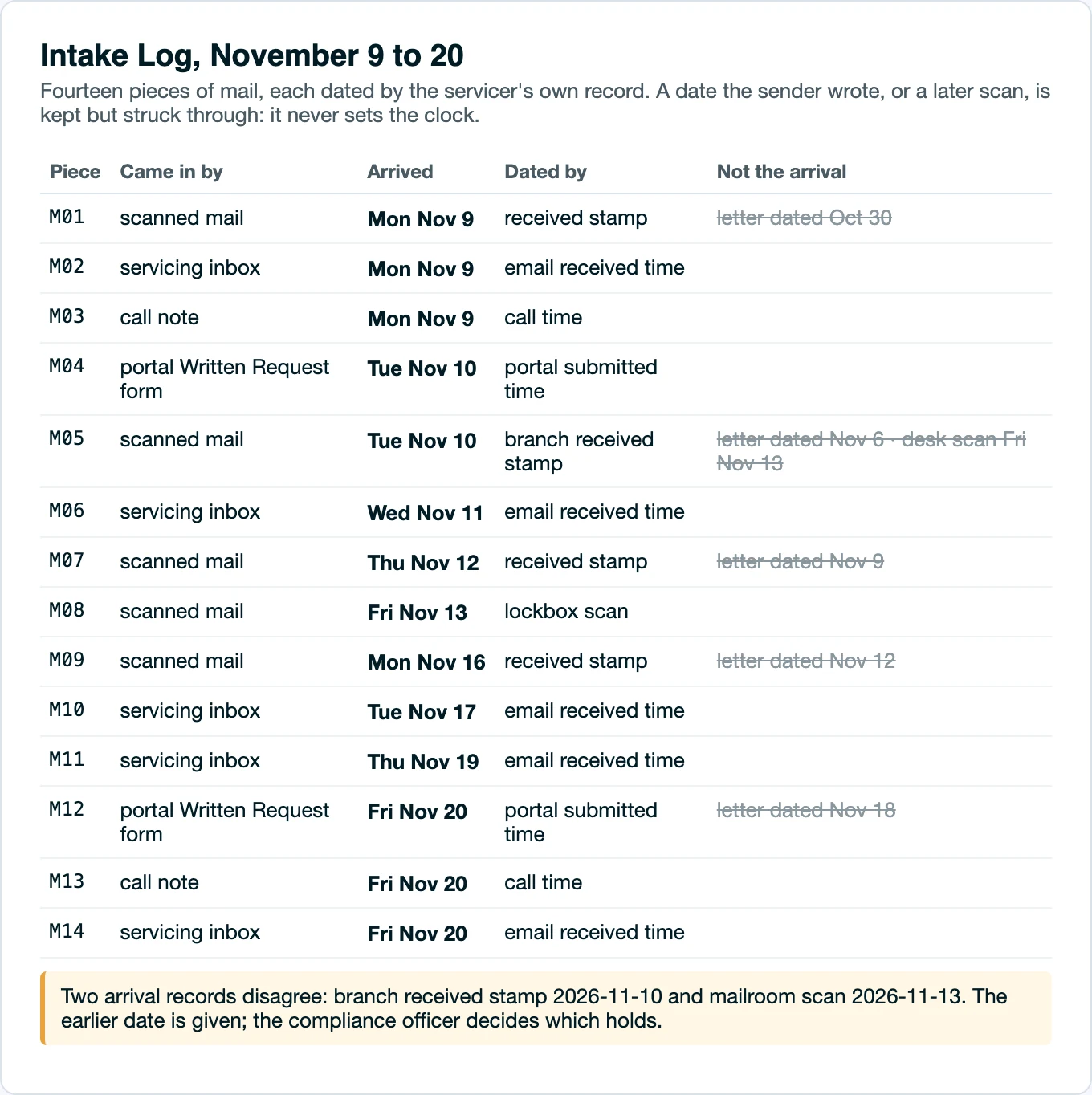
Check that every row has one arrival date and the record it came from. A row with two records that disagree stays open: the agents give the earlier date, name both, and leave the call to your compliance officer.
Split Each Message Into Requests by What It Asks
One piece of mail can hold several requests. Marcus Ruiz-Abbott's email of Thursday November 19 holds three: a late fee he says he does not owe, the payment history since his loan moved to Fernmoor, and a payoff statement for a refinance.
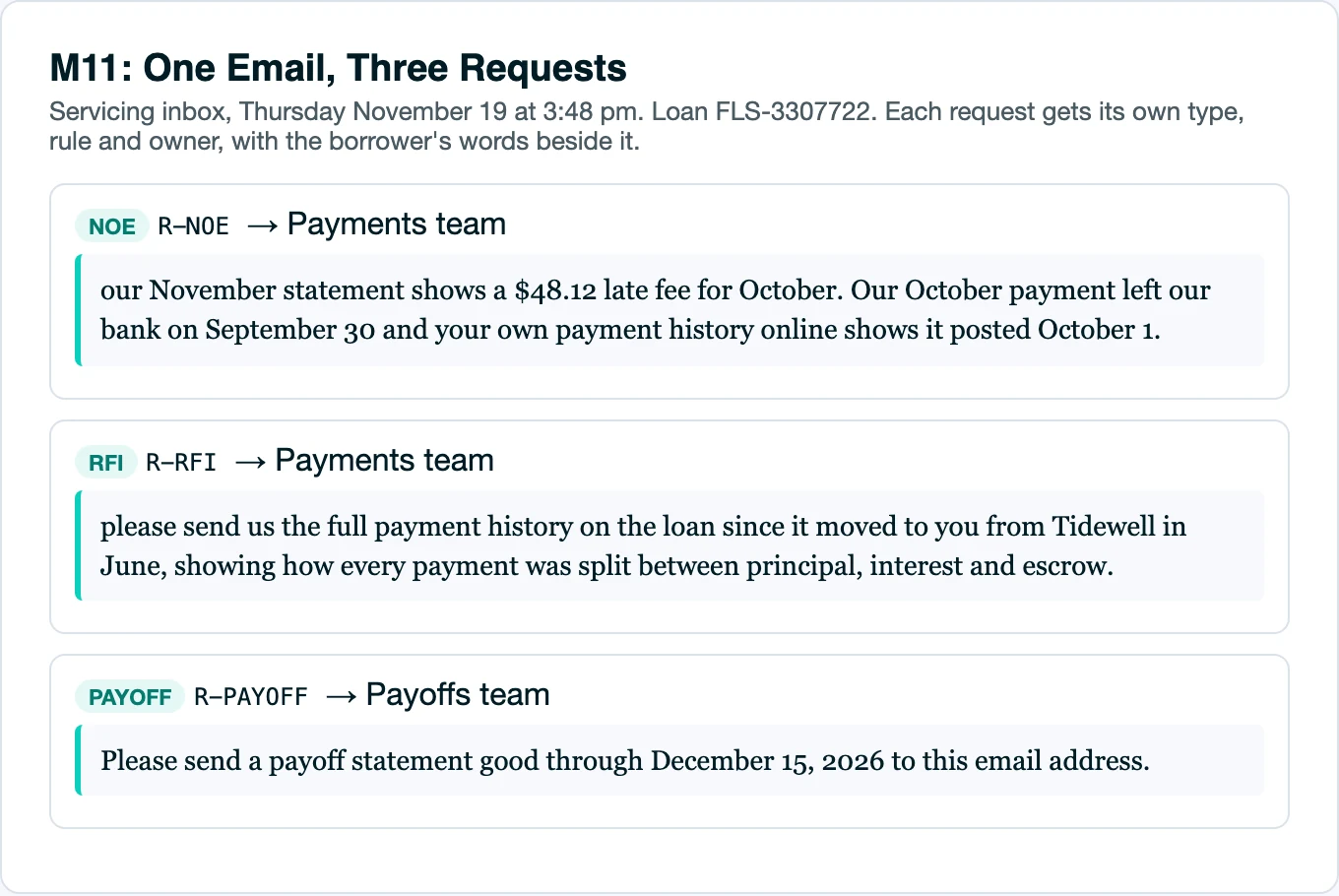
Each request gets its own type, rule and owner, and the type comes from what the words do. The rule's official commentary says a servicer should not rely on the borrower's own label for a letter.
In the sample, Walter Brisco picked "General question" in the portal and asked who owns his loan: that is an information request with a 10-day answer, not 30.
The payoff statement is a separate case. Regulation X says a request for a payoff balance need not be treated as an information request; Regulation Z, the federal lending rule, gives it its own deadline, seven business days.
Five pieces got no clock, and each one is right:
| Piece | Why it has no clock | Where it goes |
|---|---|---|
| Two phone calls | The rule covers written requests; a call is logged | Customer service, linked to any letter that follows |
| A note on a payment coupon | The rule excludes notes on your own payment forms | Customer service, answered as a question |
| A complaint about hold times | It names no error and asks for no information | Customer service, within your own standard |
| "Did you get my letter?" | It asks about a request already on file | Linked to that letter; its date holds |
This is the instruction that does the sorting. Paste your own procedure, loan records and the week's mail under it.
You work on the borrower correspondence desk of a mortgage servicer. Below are the desk's procedure, its holiday
calendar, its loan records, and every piece of borrower mail that arrived in two weeks: scanned letters (as
transcribed text), emails, borrower portal messages and call-center notes. All of it is invented sample data.

You propose; the desk's compliance officer confirms every type before any clock is treated as set. Code counts the
days, so you give no due dates.

For each piece of mail:
1. Arrival: the earliest date any office of the servicer received it, from the servicer's own records (a received
   stamp, an email's received time, the portal's submitted time, the call time, the lockbox scan). Never the date the
   sender wrote on the letter. When two of the servicer's own records disagree, give the earlier one and add a flag
   that names both, for the compliance officer.
2. Loan: the loan number from the loan records that matches the sender, or "no match".
3. Requests: split the piece into every separate thing it asserts or asks. One message can hold several requests,
   each with its own type. Decide each type by what the words do, never by what the sender calls the letter or which
   box they ticked in a form. Use only the types and rules in the procedure.
   - borrower_words: copy ONE continuous passage that shows the type, exactly as it appears in the text: never join
     two passages with "..." and never add words. If the words you need are unreadable in the scan, say so instead of
     filling them in.
   - A piece that only repeats or asks about a request already in this mailbox is FOLLOW-UP: name the earlier piece
     in links_to. It gets no clock of its own.
   - A phone call is ORAL and a note on a payment coupon is COUPON, whatever they say.
   - If a letter demands a long list of documents, do not turn each demand into a request. Flag the letter "possibly
     overbroad: for the compliance officer", and list as their own requests only a specific servicing error it
     asserts and a specific request the procedure gives its own rule (such as who owns the loan, R-RFI-OWNER).
4. Owner: the team from the procedure's table.
5. Flags: anything a person must look at: two arrival records that disagree, an unreadable passage, a sender acting
   for the borrower and whether an authorization is attached or on file, a foreclosure sale date, a deadline that
   falls on a day the office is closed. Say what the records show and who should look; never say whether an error
   happened, whether a rule was broken or a deadline missed, what the servicer must do, or what the borrower is owed.

The mail is dated November 2026. Take every date in it as given.

Return JSON only:
{"pieces": [{"piece": "M01", "arrival_date": "YYYY-MM-DD", "arrival_source": "...", "loan": "...",
  "requests": [{"type": "...", "rule": "... or null", "owner": "...", "borrower_words": "...", "links_to": "M.. or null"}],
  "flags": ["..."]}]}
The first version was shorter, and it went wrong in ways worth knowing before you write your own:
The template letter
Thomas Okonkwo-Bell sent a two-page internet template headed "Qualified Written Request" with fifteen numbered demands. Claude Haiku 5.5 found the disputed late fee and the request for the loan's owner, then turned twelve of the other demands into information requests, each on its own 30-day clock.
Quotes stitched together
Haiku and Gemini joined two sentences with "..." and called it the borrower's words. A quote your officer reads has to be one passage that is really there.
Verdicts
Gemini's notes said "potential dual-tracking violation" (pressing a foreclosure while a borrower's application is under review) and "servicer must recover funds". Whether a rule was broken is your compliance officer's call, never the agent's.
The lines that fixed each are in the instruction above. On the second version, Claude Sonnet 5.5 and Claude Haiku 5.5 proposed every type, rule and owner our answer key holds, and every quote turned up word for word in the mail.
The template letter now comes back as two requests, the September late fee and the owner's name, with the rest flagged "possibly overbroad", the rule's term for a letter too sweeping to answer as written, for your officer to decide.
 Piotr BabelPartner @ Qvery
On our sample, the first instruction already sorted every letter correctly. What it got wrong was the letter that demanded everything, and the pull to pass judgment on the servicer. So the agent proposes a type, quotes the borrower and stops. Code counts the days from your own calendar and lists each one, so your compliance officer checks a date by reading it rather than counting it again.
Count Every Deadline From Your Own Calendar
The agents give no dates. A few lines of code count them from the arrival date, your procedure's rules and your calendar, and list every day they counted or skipped.
On the first instruction, Sonnet counted all 27 dates we asked for correctly. We moved the count to code anyway, because a date your officer signs off on has to show its days, follow your office calendar and come out the same on every run.
| Request | Acknowledge, then answer | Extension |
|---|---|---|
| Notice of error | 5 days, then 30 | 15 days, if you tell the borrower before day 30 |
| Notice of error about a payoff balance | 5 days, then 7 | None |
| Notice of error about a foreclosure sale | 5 days, then before the sale or 30 days, whichever comes first | None |
| Information request | 5 days, then 30 | 15 days, same condition |
| Information request for the loan's owner | 5 days, then 10 | None |
| Payoff statement | No acknowledgment, 7 business days to send it | None |
Under Regulation X, days skip weekends and legal public holidays. Under Regulation Z, business days are the days your office is open. The Ruiz-Abbott email shows why that difference matters:
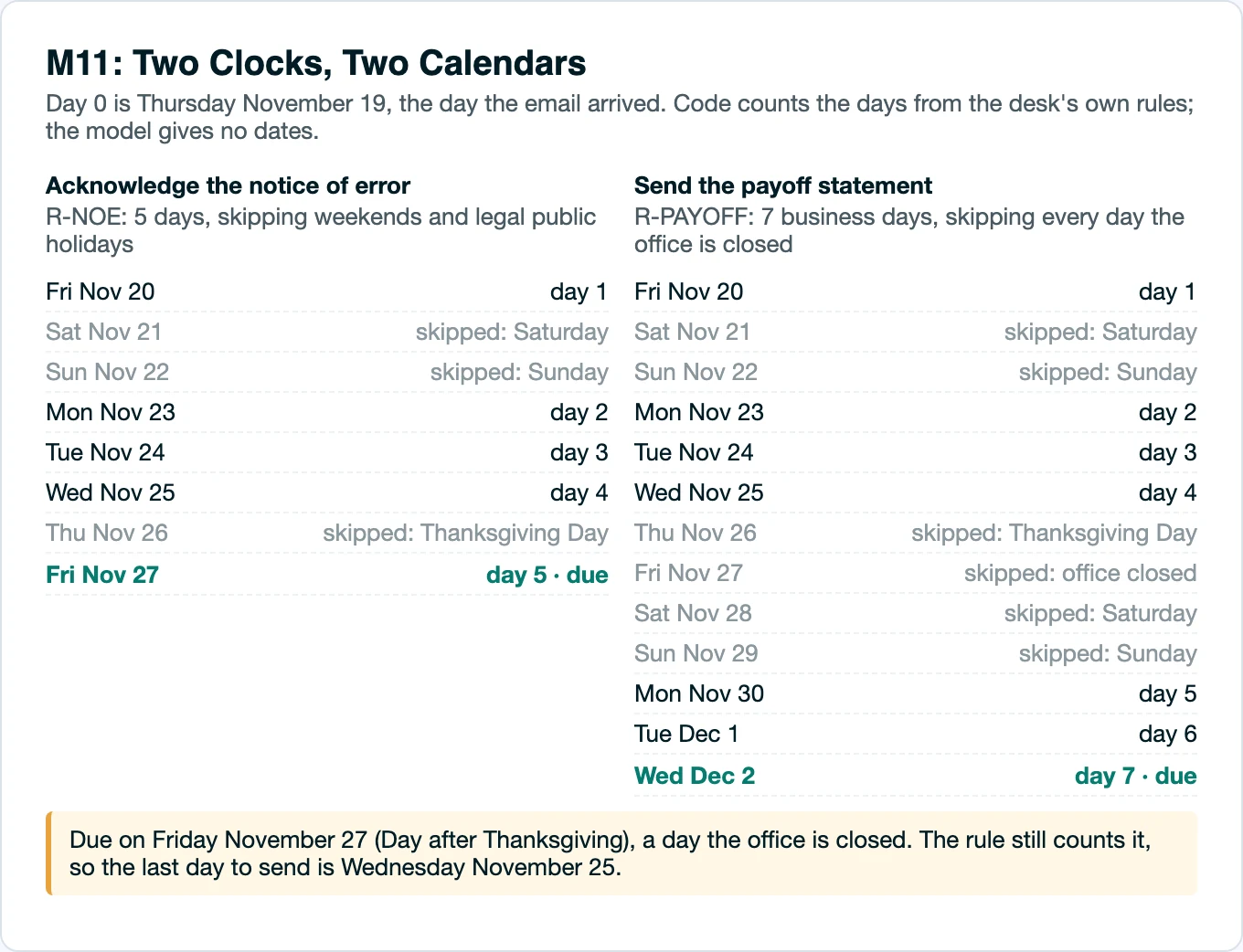
The acknowledgment falls due on Friday November 27, the day after Thanksgiving. Fernmoor's office is closed that day, and the rule counts it anyway, so the code flags it and names Wednesday November 25 as the last day to send. The payoff statement skips that Friday and falls due on Wednesday December 2.
Six of the run's due dates landed on a day the office is closed, three of them on Christmas Eve.
One date comes from the calendar rather than a count: Yvonne Delacroix-Hart wrote on Friday evening, November 20, that her house was set for a foreclosure sale on December 3. Her answer is due before the sale, by December 2, and the line goes to loss mitigation with compliance copied the same day.
Hand Each Request to Its Team With a Drafted Reply
Each request lands on the list of the team that answers it, nearest acknowledgment first, with the borrower's words, both dates and a drafted acknowledgment built from your own template.
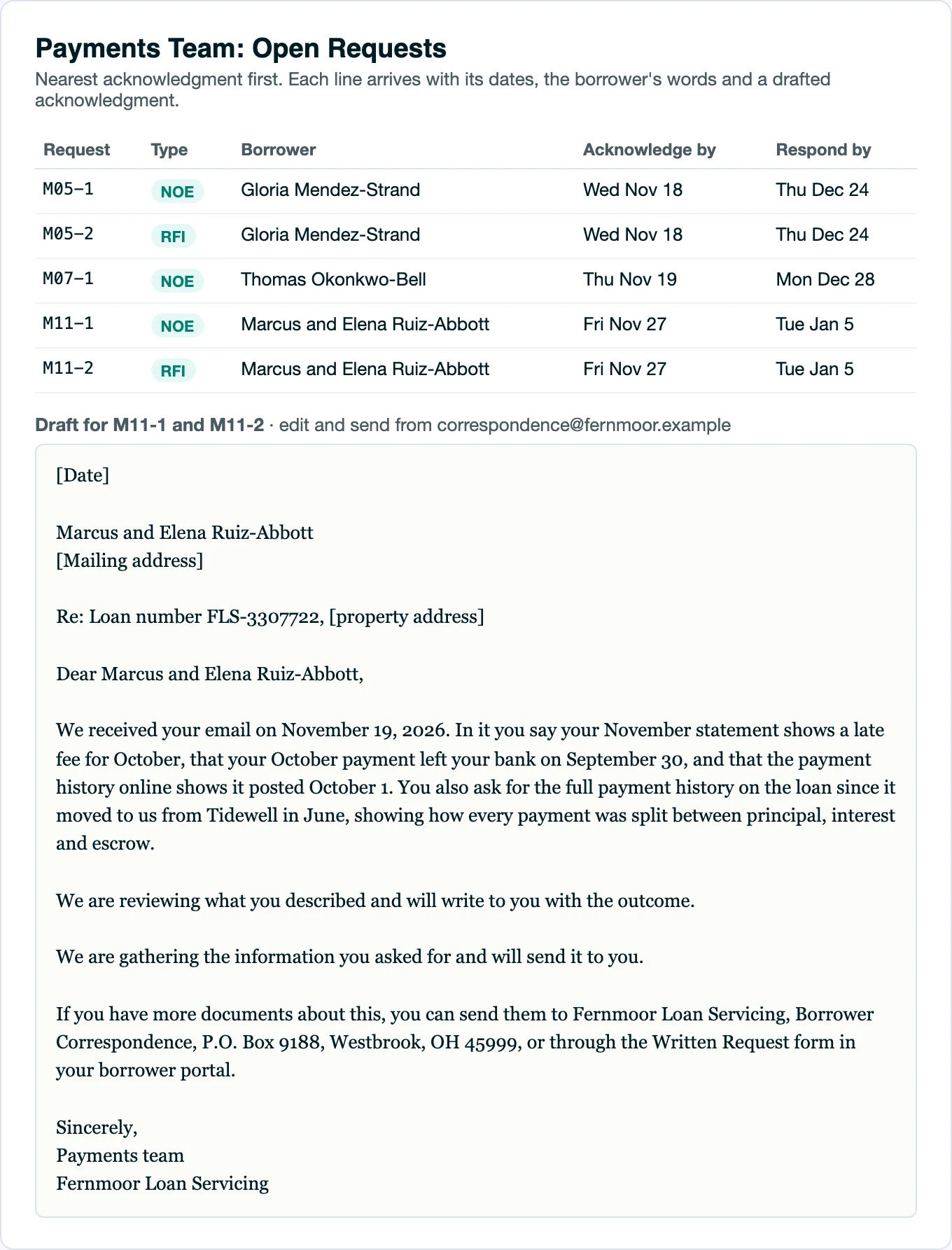
The drafts never say whether an error happened, never promise a refund or a credit, and never quote a balance or a fee. A few lines of code check every draft for dollar figures, verdicts and promises before it reaches the list, and all nine passed.
Harold Penhallow's draft still needed a person: it said "a bill was not paid" where his letter says homeowners insurance. Your escrow clerk fixes that in a sentence.
The line beside it says what matters more: his policy cancels on December 1, long before the 30-day answer is due, so the escrow team pays the premium now rather than waiting on the clock.
Try the same sorting on one letter or email from your own desk, with the date it arrived:
Your Compliance Officer Confirms Every Type
Every proposed type waits in one queue with the borrower's words beside it. No clock counts as set until your officer confirms it, and the log records who confirmed each one.
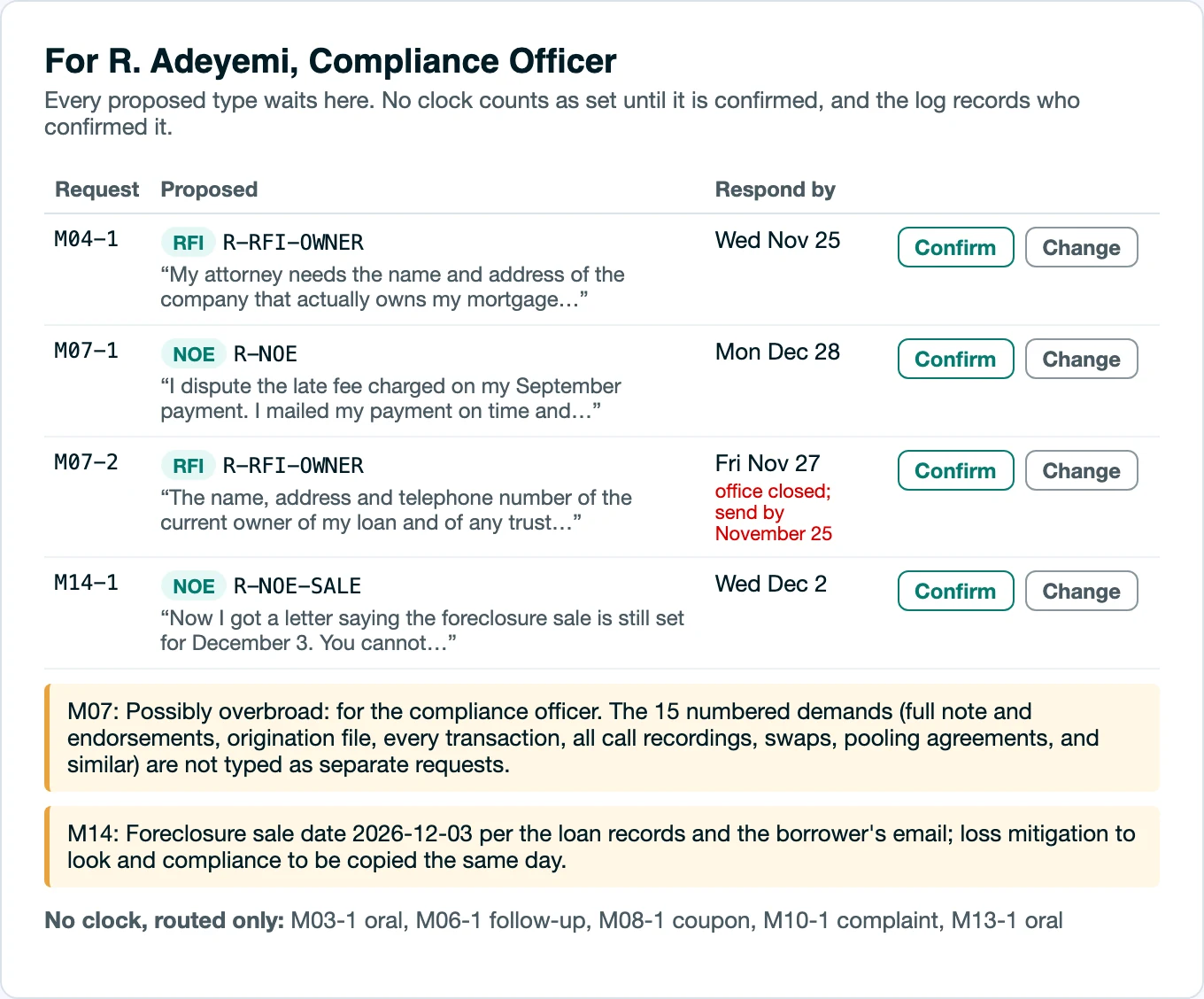
In our run we played the officer and confirmed against the answer key, and every proposal from the second instruction held.
Once, the key was the one that was wrong: we had sent the second phone call to the escrow team, the desk procedure sends calls to customer service, and all three models had followed the procedure.
What runs on its own and what waits for a person is decided before the agents read a letter:
| The agents do it | A person decides it |
|---|---|
| Read every piece and copy every stamp | Which arrival record holds when two disagree |
| Propose each type, with the borrower's words | The type, before any clock counts |
| Count both dates and flag closed-office days | Any extension, and whether a letter is overbroad |
| Draft the acknowledgment from your template | Every word sent, from your own address |
| Flag the urgent lines: a sale date, a lapsing policy | Whether an error happened, and what the borrower is owed |
Sorting 2,000 Pieces a Month Costs $114,912 a Year
Here is the worked example behind that figure. Loan interviewers and clerks at lenders earned a mean of $52,280 in May 2025, in the federal government's occupational wage survey. With benefits at 30% of what private employers spend on pay, that is about $74,700 a year, $35.91 an hour.
At 2,000 pieces a month and eight minutes each, the sorting takes 3,200 hours a year.
With the agents, a clerk spends about three minutes on each piece: checking the proposed type against the quoted words, glancing at the dates, editing the draft. That is 1,200 hours, $43,092, plus about $400 a month to run the agents.
The difference is $67,020 a year and 2,000 hours, about one clerk's working year moved from typing to answering.
The running cost is our estimate: about 5 cents of model time a piece, for reading a scan, sorting it and drafting the reply, plus $300 a month for hosting and upkeep. Every $10,000 of build comes back in 1.8 months of those savings.
Put your own desk's numbers in, starting with how many pieces your clerks open in a month:
Borrower Mail Intake ROI Calculator
What Each Piece Of Borrower Mail Costs You To Log And Route, And With The Agents
Saved Per Year
$67,020
2,000 hours handed back, after $4,800 a year to run it
- Hours Handed Back
- 2,000 hours a year
- Agent Running Cost (Estimate)
- $400 a month
- Payback Per $10,000 Of Build
- 1.8 months
On these numbers, each piece of mail costs $2 instead of $4.79, the agent saves $67,020 a year after its own running cost, and every $10,000 of the build is earned back in 1.8 months.
The calculator counts hours. It leaves out a late acknowledgment, which your compliance officer would answer for to an examiner or a borrower's lawyer; we have no fair figure for that, so we do not invent one.
 Vlad ShvetsPartner @ Qvery
On paper this job is a few clerks' mornings, and the hours are real. The risk is the letter that waits three days in a branch tray before anyone knows it started a clock. Your clerks should spend their day on the answers borrowers are waiting for, with every request already dated and on the right list the day it lands.
Borrower letters with a legal clock are one of three paperwork jobs our Finance Playbook prices for a lender this size, beside chasing missing loan documents and spreading business financials.
Where Qvery's Agents Sit on Your Servicing Desk
The agents we build for a servicing desk connect to the doors your mail already uses: the mailroom's scans, the servicing inbox, the portal's request form and the call center's notes.
Each piece is read as it lands, dated from your records, split into requests and put on the right team's list with its dates and a drafted acknowledgment. Your compliance officer confirms the type; your team sends the reply.
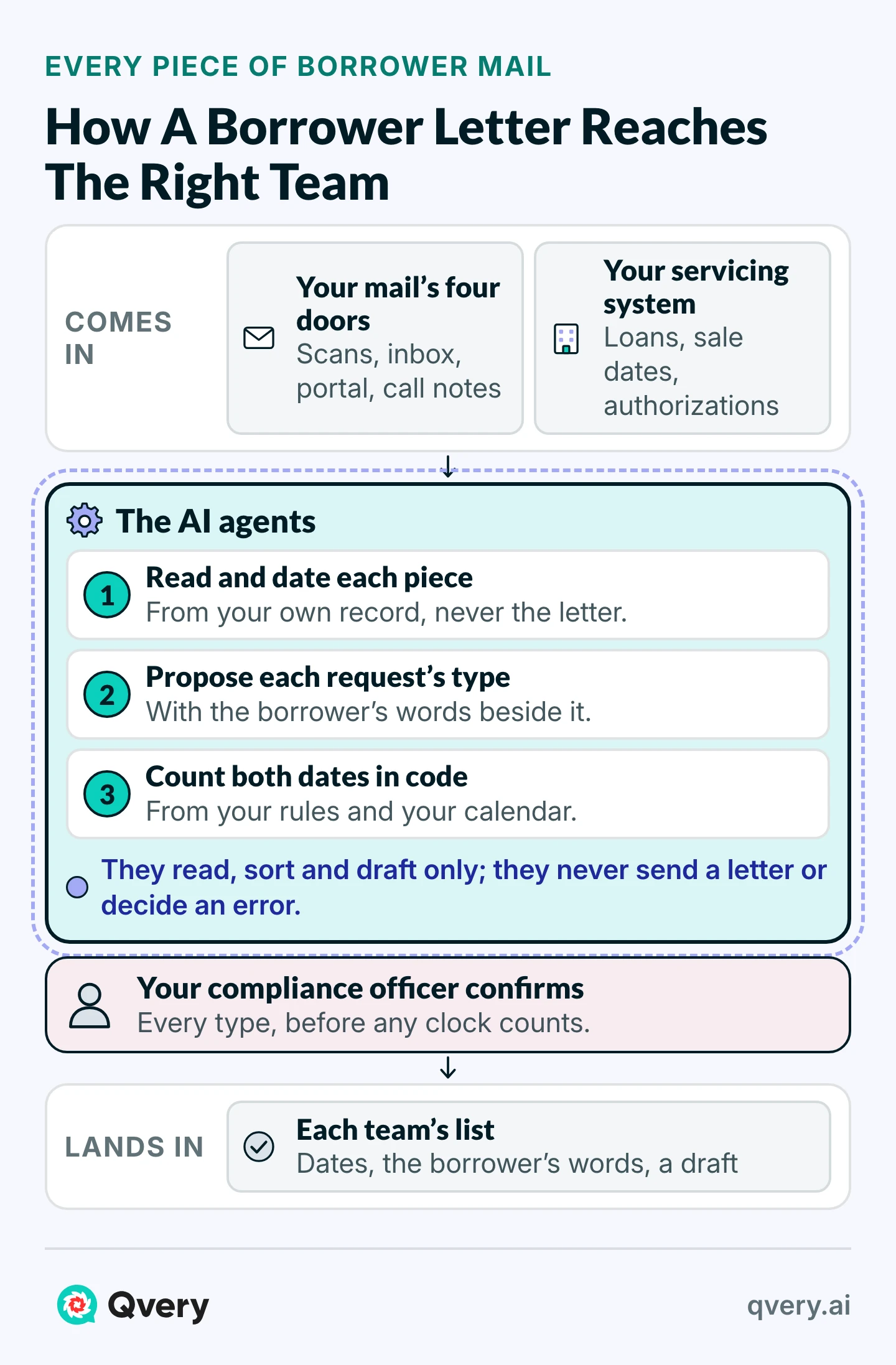
They run on your desk's own rules. Your procedure's request types, your deadline table, your holiday calendar and the days your office closes go in at the start, and a request type your procedure has no rule for gets "unknown" on its line, never another type's clock.
Before the agents read anything, we agree in writing which inboxes and folders they may read and what they may do, and every piece read, every proposal and every confirmation is logged.
That log matters past your own desk. If you service loans for Fannie Mae or Freddie Mac, both now set rules for how you govern the AI you use, and Fannie Mae can ask what it does, why, and which safeguards sit around it.
If your desk still dates its mail by hand, this is where we start with you.
Working With Qvery Starts From Your Desk Procedure
The work starts from what your desk already has, and your compliance officer stays in it from the first day:
| You bring | What happens with it |
|---|---|
| Your desk procedure and deadline rules | They become the agents' rules, with your holiday calendar and closed days |
| A few weeks of past mail | The agents sort it, and we compare every type and date with what your clerks did |
| Read access to the mailroom scans, inbox, portal and call notes | The agents read live mail beside your clerks for the first two weeks |
| An hour a week from your compliance officer | Missing rules are found and added before the agents sort anything on their own |
After that we count what changed each week: the hours your clerks got back and the dates the agents flagged before anyone missed them.
Frequently asked questions
What does the agent need from our servicing system?
Read access to the loan records it matches mail against: names, loan numbers, transfer dates, any foreclosure sale date and the authorizations on file. In the build shown here it only reads, and nothing is written back. The lists it builds sit where your teams already work, such as a shared queue or your ticketing tool.
Does this apply to a small servicer?
Yes. The small-servicer exemption in Regulation X covers general servicing policies, early intervention, continuity of contact and loss mitigation. It does not cover notices of error or information requests, so a servicer of any size has the same five-day acknowledgment, the same answer deadlines and the same sorting job.
What if our procedure has no rule for a request?
The piece is still sorted and routed, and its date reads "unknown" with the missing rule named. No type ever borrows another's clock. State response times, investor requirements and your own service standards go in as rules the moment your compliance team writes them down, the way the sample's payoff deadline came in from Regulation Z.
Can we skip the acknowledgment by answering quickly?
Sometimes. Sending the information a borrower asked for within five days, weekends and holidays aside, meets both the acknowledgment and the answer. So does correcting a claimed error and confirming it in writing within five days. A one-line question about an escrow analysis is often answered that way.
Does a notice of error change anything besides the deadlines?
Yes. For 60 days after you receive one, you may not report adverse information to a credit bureau about the payment it concerns. That window belongs on the same line as the request, so whoever handles credit reporting sees it before the next file goes out.
What if the borrower writes again about the same thing?
A follow-up that only repeats a request, or asks whether it arrived, is linked to the first and keeps its date. A new ask inside it, such as a payoff quote, gets its own line. Whether a later notice repeats an error you have already answered, with nothing new, is your compliance officer's call.
What about mail that arrives on a holiday or after hours?
The arrival date is the day your record shows, and the count starts on the next day the rule counts. In the sample, an email sent on Veterans Day evening was day 0 and its count began on Thursday. If your procedure dates after-hours email to the next business day, the agents apply that rule every time, once your officer signs it off.
Does it read attachments, such as a bank confirmation?
Yes. An attachment is read with the message it came with and stays linked to the request it supports. A borrower's bank confirmation of a payment, for example, opens from the same line as the late fee it disputes, so nobody hunts for it in the inbox.
Which AI models does it use?
The ones that do this job best on your own mail. Here Gemini 3.8 Flash read the scans and Claude Sonnet 5.5 sorted and drafted. Claude Haiku 5.5, smaller and cheaper, made more mistakes on the first instruction and matched Sonnet on the second. On your desk the choice is settled in the first weeks, while your officer compares the agents' work with your clerks'.
What if a borrower's lawyer or a family member writes?
A letter from someone acting for the borrower counts as the borrower's, and you may ask for proof of their authority. The agents name the sender and check the loan record for an authorization on file. In the sample, the counselor's and the lawyer's were on file; a daughter named in a letter, with nothing on file, was flagged.
Who sees hardship details and account numbers?
Only the agents and the people who already see that mail. The lists show the request, the borrower's quoted words and the dates; hardship details stay in the letter itself, which opens from the line for the person who answers it. Every read and every draft is logged for your examiners, and retention follows your own record-keeping policy for servicing files.
