On this page
- Buyers Still Hire Agents, and Half Hire the First One They Contact
- Most Inquiries Wait a Day, and Many Never Reach an Agent
- What the Unanswered Inquiries Cost a Brokerage Like Yours
- Where Qvery's AI Agents Take the First Reply
- What the AI Agents Never Say to a Buyer or Seller
- Working With Us Starts at Your Lead Sources
- Frequently asked questions
Your brokerage pays for every buyer and seller inquiry it gets: the leads from the big listing websites (the portals), your own website, the sign calls, the ads.
Each one waits in your CRM (the customer records system your agents work in) for whoever is next in the rotation to call back, and you'll recognize where some of them go:
- A portal inquiry sent late in the evening gets its first call the next morning.
- A call to the number on a yard sign rings an agent who's in the middle of a showing.
- A website form lands in a shared inbox nobody reads at the weekend.
- The agent next in the rotation calls twice, leaves a voicemail and moves on.
So no, AI isn't taking your agents' jobs: buyers hire them at a forty-year high, and half the buyers who contact an agent hire the first one they reach.
The part of the job AI does faster than any person is that first reply. In our example brokerage, the inquiries nobody reaches in time cost 36 closed deals a year, about $108,000 of what the brokerage keeps.
At Qvery, we help brokerages turn the money they spend on leads into closed deals and keep their agents on clients, with custom AI agents that answer every buyer and seller inquiry within a minute, ask the first questions and book the appointment with a licensed agent.
Buyers Still Hire Agents, and Half Hire the First One They Contact
The National Association of Realtors surveyed people who bought or sold between July 2025 and June 2026: 90% of buyers bought through an agent or broker, the highest share in four decades, and 92% of sellers used one, an all-time high. Selling without an agent stayed at a historic low of 5%.
That window opens almost a year after the 2024 settlement changed how buyer agents get paid. Whatever the settlement did to commissions, it didn't send buyers or sellers away from agents.
What decides which agent gets the client is mostly who reaches them first.
In Zillow's 2025 surveys, half of buyers who contacted an agent contacted only that one before hiring them, and 62% of sellers did the same. So the speed of the first answer decides who gets a large share of the clients a brokerage pays to find.
That first answer is the part of the job AI does well today: a reply in the minute the inquiry lands, with the facts of the listing, and a booked time with a licensed agent. The rest of the agent's week changes more slowly, and the judgment doesn't move at all.
| The work | With AI agents | With the licensed agent |
|---|---|---|
| The first reply to a new inquiry | Answered at once, the questions asked, the showing booked | Takes the client from the booked appointment |
| Listing descriptions and marketing copy | Drafted from the listing data | Checks and approves every word that goes out |
| Notes and follow-up after a showing | The CRM note written, the follow-up drafted | Decides what to say next |
| Deadlines from contract to closing | Dates tracked, signatures and documents chased | Handles what the dates turn up |
| Review of each transaction file | Every document checked as it lands, gaps chased | The managing broker signs off |
| Pricing, offers and negotiation | Nothing | All of it |
| Showing the home, the hard phone call | Nothing | All of it |
The first row comes first, because it's where a brokerage loses money it has already spent. For the deadlines and the file review further down, our real estate page shows how the AI agents we build for brokerages coordinate closings and check every deal file.
Most Inquiries Wait a Day, and Many Never Reach an Agent
In June and July 2026, Pied Piper, a firm that measures how businesses handle customer inquiries, sent 2,198 test inquiries by phone and website to local offices of 21 large brokerage brands, each one asking to talk to an agent.
The website forms fared worst: only 18% heard from an agent within the day, 10% within the hour, and almost one form in ten didn't work at all. Nearly every call reached the office; most callers just never reached an agent.
Those are offices of the largest brands, and a brokerage your size may do better.
The reasons rarely depend on the brand: your agents earn on closings, they're at showings and closings while inquiries keep arriving, and the routing hands each new one to whoever is next. Between the form and the callback, nobody owns the inquiry.
Pied Piper's own reading of its numbers is the cost: a slow callback gives the buyer time to connect with another agent before the brokerage knows it lost one. Agents say the same thing about their own leads:
What Reddit says
Agents on what happens to an inquiry nobody answers in time
They saw a kitchen they liked at 11pm and hit the blue button. By morning they forgot they did it.
With your team if the first person doesn't answer and it goes to the next person, and then they don't answer, it goes to the next, etc. that's a great way to lose a potential buyer. Buyers are fickle and they won't wait too long for someone to pick up the phone.
On the other hand, if I left three messages and never heard back and somebody else got them on the phone… I guess I missed out.
What the Unanswered Inquiries Cost a Brokerage Like Yours
Take a brokerage of about 200 agents and staff that gets 500 new buyer and seller inquiries a month from the portals, its website, sign calls and ads: our example. Say 40% of them are missed or answered too late today, well under the large brands' numbers above.
Many inquiries are early, a buyer who liked a kitchen and tapped the button. So assume only 1.5% of the inquiries answered at once become a closed deal with the brokerage.
One closed deal is worth about $3,000 to the brokerage.
One side of the commission on a home at the September 2026 median price of $417,500, at the 2.42% Redfin measured as the average buyer's agent commission late in 2025, is about $10,100, and the brokerage keeps about 30% of it on an inquiry it paid to generate. The 30% is our assumption; your split decides it.
On those numbers, answering every inquiry at once closes 90 deals a year where the brokerage closes 54 today: 36 more, worth $108,000. By our estimate the AI agents cost about $500 a month to run at that volume, so the brokerage keeps $102,000 a year, and every $10,000 of the build is earned back in about 1.2 months.
Type your brokerage's figures over the example: the inquiries you get a month, the share nobody reaches in time, how many of the ones answered at once you close, and what one closed deal is worth to the brokerage after the agent's split.
Brokerage Inquiry Response ROI Calculator
What Unanswered Inquiries Cost You, And What The AI Agents Win Back
Won Per Year
$102,000
36 more closed deals a year, after $6,000 to run the agent
- New Closed Deals A Year
- 36
- Agent Running Cost (Estimate)
- $500 a month
- Payback Per $10,000 Of Build
- 1.2 months
On these numbers, answering every inquiry at once wins 36 more closed deals a year, worth $108,000, $102,000 after the agent's running cost, and every $10,000 of the build is earned back in 1.2 months.
The calculator leaves two savings out. Your agents stop spending evenings calling back inquiries that went cold hours ago.
And you finally learn which lead sources are worth their price: when every inquiry gets the same reply in the same minute, the difference between two sources is the leads, not which agent happened to be next.
Where Qvery's AI Agents Take the First Reply
The AI agents we build for a brokerage treat every inquiry the same way, whichever door it came through: the portal lead, the website form, the text to the number on a sign.
Within a minute of one landing, they've looked the person up in your CRM (a past client, someone already working with one of your agents) and replied in the channel the person used, as your brokerage's AI assistant.
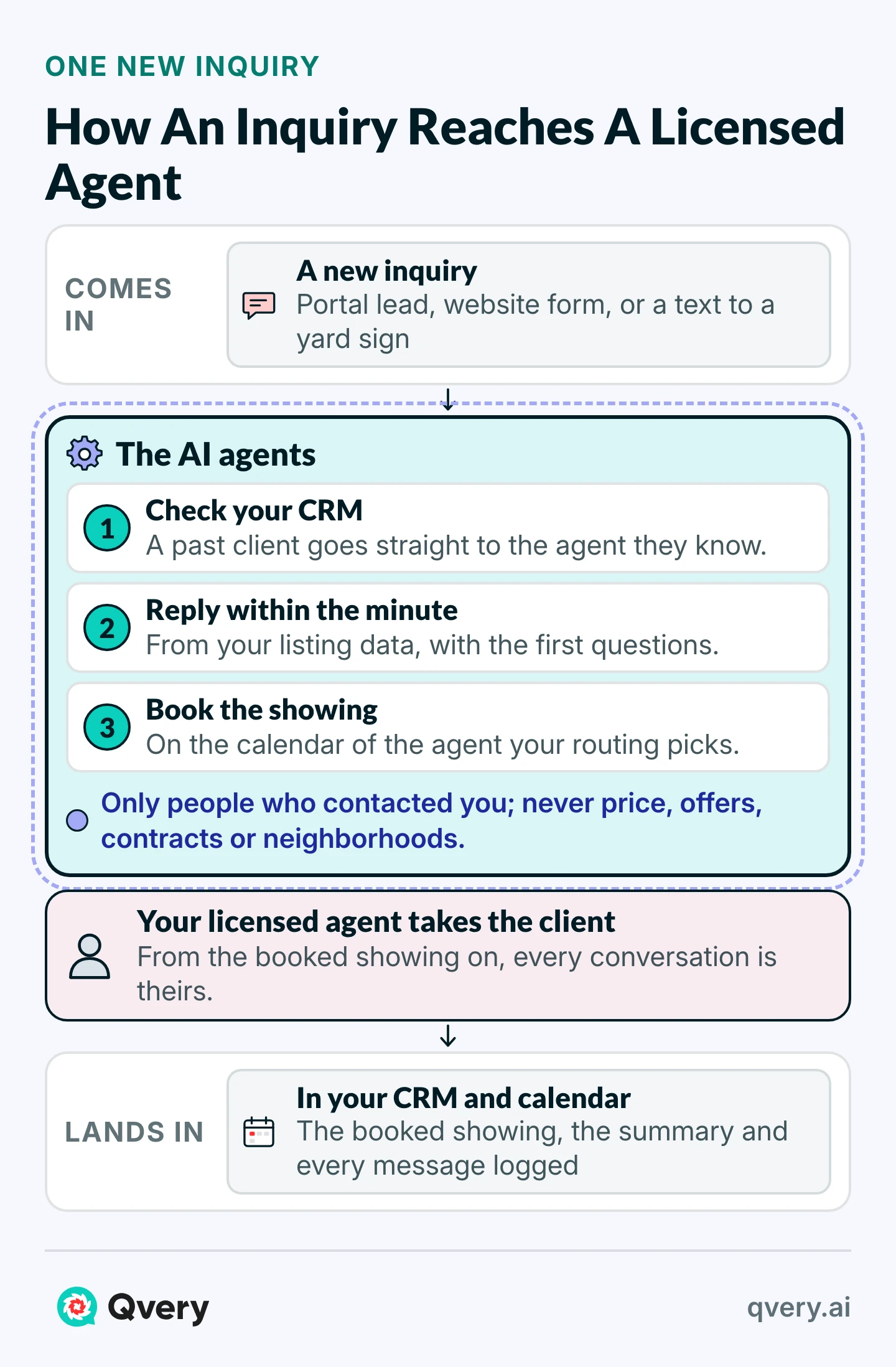
The first reply answers the question asked, from your own listing data: the square footage, the taxes, the date of the open house. Then it asks what your best agents ask first: are you looking to buy soon, have you talked to a lender, do you have a home to sell.
If the buyer wants to see the house, the AI agents offer times from the calendar of the agent your routing picks and book one. That agent gets a text with the summary: who, which listing, the timeline, the financing, and the buyer's own words.
From the booked showing on, the conversation belongs to the licensed agent.
Some inquiries aren't routine, and those go to a person at once: a buyer who already has an agent, a past client of one of yours (straight to that agent), a reply that's angry or confused, any question about price, an offer, a contract or what a neighborhood is like. The AI agents hand over the thread and say who will follow up.
If you run inside sales agents (ISAs: staff who call new leads to qualify them and set appointments), they stop dialing inquiries that went cold and take the conversations that need a voice: the appointments the AI agents book and the follow-ups a person should make. Those hours are worth the most where you'd otherwise hire another ISA.
I'd start with the website forms and the portal leads, because no phone rings for them, and add the phones once your agents trust the summaries.
What the AI Agents Never Say to a Buyer or Seller
A reply sent in your brokerage's name is a statement made under your broker's license, so the line is drawn before the AI agents send a single one:
| They may | They never |
|---|---|
| Answer people who contacted the brokerage first | Call or text anyone who didn't ask to hear from you |
| Confirm what the listing already advertises | Describe a neighborhood by who lives there, or steer a buyer toward or away from one |
| Ask about timing, financing and a home to sell | Give an opinion on price, an offer or a contract |
| Book a showing for the licensed agent who'll open the door | Show a property, or discuss commission and the agreement a buyer signs with their agent |
| Say they're the brokerage's AI assistant | Pretend to be a person |
| Log every message in your CRM | Send wording nobody has approved, in the first weeks |
Each line has a rule behind it.
Federal fair housing rules make any written or spoken statement in a home sale that signals a preference for or against a protected group unlawful. A text counts as a call under the federal telemarketing law, which allows $500 in damages for each unlawful one. California makes a bot that hides what it is unlawful when it's selling.
On licensing, the rules for unlicensed assistants are the closest guide. Texas lets one confirm what a listing advertises and arrange a showing for the agent who'll show it, but not call around to find buyers. Utah lets one book appointments only when the prospect made the first contact. Your managing broker writes the script inside your state's rules.
Nothing gets connected until the scope is on paper: what the AI agents may read, what they may send, and where the data is processed. Qvery AI OÜ, the EU company that builds them, signs a data processing agreement with you. The AI agents get only the access a first reply needs, and every message they send is logged.
For the first weeks, the AI agents send only replies built from wording your managing broker has approved, and anything they'd write fresh waits for a person to read it. Then you decide which replies go out on their own.
Working With Us Starts at Your Lead Sources
What we need from your side is short:
- A month of inquiries from your lead sources, as they arrived.
- Read access to your CRM and your agents' calendars.
- Your routing rules, including who owns a lead once it's booked.
- The questions your best agents ask a new buyer or seller first.
We map how an inquiry is handled today, settle with your managing broker what the AI agents may say, and connect them.
Within two weeks of getting access, with the rules settled, they're answering your own inquiries. Each week after that, you get the count: inquiries answered, appointments booked, evenings your agents got back.
Frequently asked questions
Will AI replace real estate agents?
Not on the evidence. In NAR's 2026 survey, 90% of buyers used an agent, the most in four decades, and 92% of sellers did, an all-time high. Nobody knows what the job looks like in ten years. What has changed is how fast a buyer expects an answer, and that first answer is work AI does well.
Do buyers trust a reply from AI?
They trust a fast, correct answer from the brokerage, and say so with their choices: half of buyers hire the first agent they contact. The AI agents say plainly that they're the brokerage's AI assistant, answer from your listing data, and hand the buyer to a person by name. What loses buyers is silence, not a labeled assistant.
Will our agents resent the AI agents?
What changes for them is the work they get: a booked appointment with a summary instead of a cold name to call back. The AI agents never take over a conversation an agent is already having, and they follow your routing rules, so the agent next in turn still gets the client.
Does it answer phone calls too?
It can, with a voice that says it's the brokerage's AI assistant and books the same appointments. We start with forms, portal leads and texts, because no phone rings for them, and website inquiries were the ones the large brands' offices answered worst. Calls come next, once your agents trust the summaries.
What about a call nobody picks up?
Until the AI agents answer calls, a missed call to your office or a sign still gets a text from the brokerage within the minute. The caller hears back while they're still looking at the listing, not from a voicemail box the next morning, and the text offers a time to talk.
What if a buyer asks about schools?
The AI agents give the facts the listing carries, like the school district, and hand anything about what a school or a neighborhood is like to a licensed agent. They never describe an area by who lives there: that is a fair housing violation whether a person or software says it.
Can it text a lead from a portal?
It replies to people who asked the brokerage to contact them, in the channel they used, and only about what they asked. A text counts as a call under federal telemarketing law, so consent is checked before the first message. Where a lead source can't show it, the reply goes by email.
What if someone replies STOP?
The thread ends at once, the opt-out is logged in your CRM, and no AI agent or automation of yours texts that number again. Nobody is added to marketing texts they didn't agree to. Your agents can still call the person if they asked to hear from you by phone.
Which systems does it work with?
The ones your brokerage already uses: the CRM your agents work in, your website forms, the lead emails or feeds from the portals, and your agents' calendars. Before anything is connected, the scope is written down: what the AI agents may read and write in each system, and nothing beyond what a first reply needs.
Do agents' private contacts stay private?
Yes. If your agents keep their own CRMs or phone contacts, the AI agents work only in the brokerage's system and never read the agents' private books. A past client an agent brought to the brokerage is routed back to that agent, so nobody loses a relationship to the routing.
What happens to our ISAs?
They stop dialing inquiries that went cold and spend their time on the people who answered: the appointments the AI agents booked and the warm leads that need a voice. We train them to work beside the AI agents. If your inquiries grow, that's the desk you no longer need to hire for.
Does it handle seller inquiries?
Yes. A homeowner who asks what their house is worth gets an answer within the minute, a few questions about timing and the home, and a booked listing appointment with a licensed agent. The AI agents never give a price opinion: the comparison of recent sales and the recommendation stay with your agent.
Why answer sellers first?
Sellers shop around less than buyers before choosing. In Zillow's 2025 surveys, 62% of sellers who used an agent contacted only one before hiring, against half of buyers. A homeowner asking what their house is worth is telling you they're thinking of selling, and the first brokerage to answer usually books the listing appointment.
What does it cost to run?
In our example, about 40 cents an inquiry in model use and messages plus $300 a month for hosting and upkeep, so about $500 a month at 500 inquiries. Calls cost more to answer than texts, and we estimate that for your call volume first. The build is a fixed price for a defined result, agreed before we start.
How soon does it answer our inquiries?
Within two weeks of getting access, once your routing rules are settled. For those first weeks every reply is built from wording your managing broker approved, so you know exactly what buyers and sellers will read. After that you decide which replies go out on their own.