On this page
- Step 1: Write the Facts Down Before You Open ChatGPT
- Step 2: Paste the Sheet Under Five Rules
- Step 3: Check the Draft Against the Same Sheet
- Step 4: Strike Every Word About Who Should Live There
- Step 5: Save Both Prompts in One Shared Project
- How Qvery Builds the AI Agent That Writes and Checks Every Listing
- Ask the Seller the Missing List at the Listing Appointment
- Frequently asked questions
Every listing your brokerage takes needs public remarks, written by one of your agents and sent under your name to every site your MLS feeds.
A claim the house cannot back is a misrepresentation; a word about who should live there is a fair-housing problem. California's real estate regulator said this winter who answers when an AI tool writes either: the licensee and their responsible broker, not the technology provider.
By hand, the agent writes from memory or edits the last similar listing. In NAR's 2025 technology survey, 46% of Realtors said they use AI-generated content, listing descriptions among it, and ChatGPT writes the remarks in seconds.
We tested it on one house we made up for this page, 2318 N Wrenfield Ct in Boise (there is no Wrenfield Court in Boise), and sent ChatGPT the same listing three ways on November 1, 2026: typed from memory, with a fact sheet pasted in, and with the fact sheet plus five rules.
ChatGPT invented no number.
It filled every gap the prompt left with a plausible sentence about the home's condition, its street or its buyer.
That stops when it writes from a fact sheet and checks its draft against the same sheet. It is one house on one day: read the counts as what to look for, not as rates.
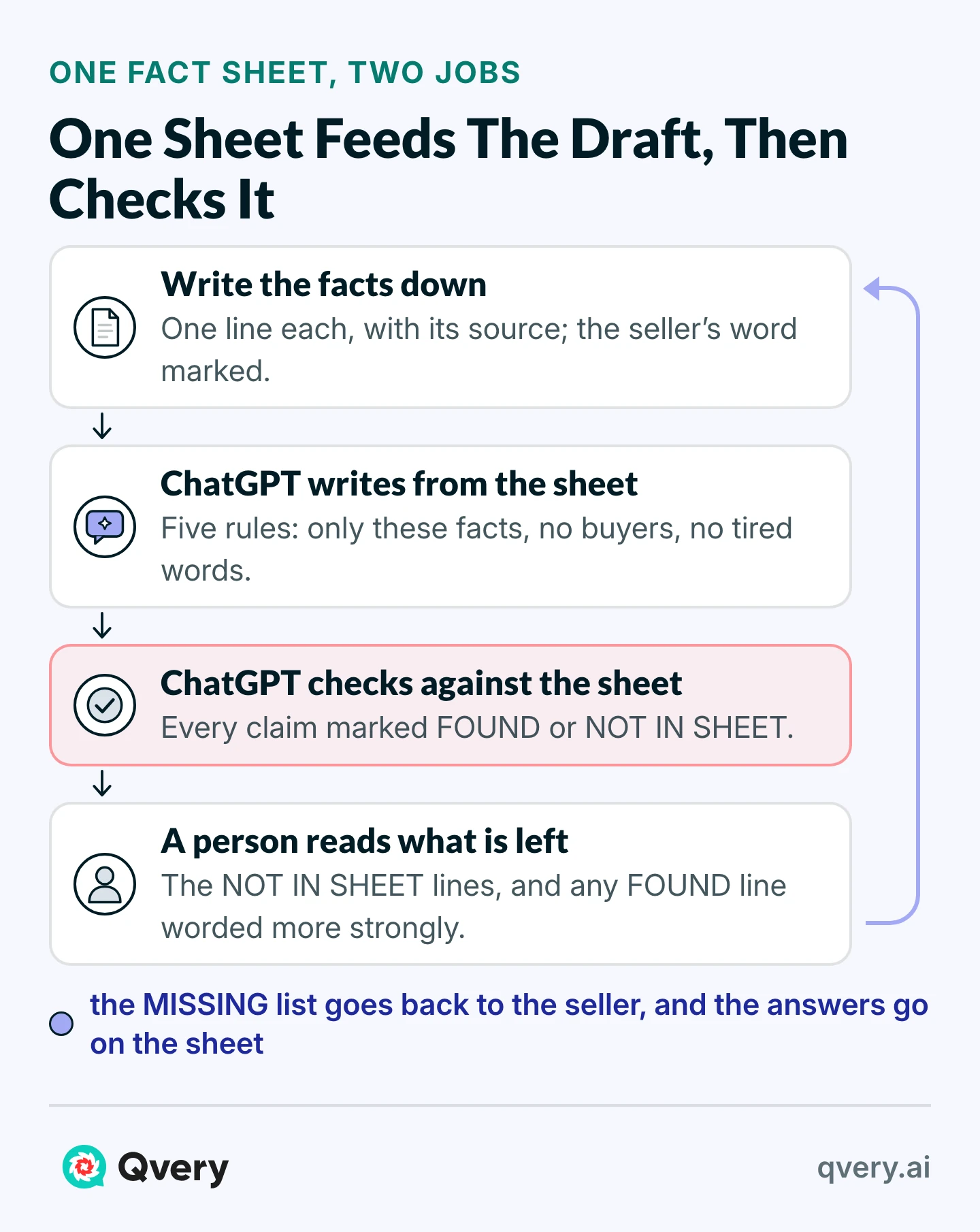
Run the five steps below on your next listing. After them comes the AI agent Qvery builds to do the same on every listing, on autopilot.
This writes and checks the public remarks. It does not measure the house, replace the seller's disclosure, or stand in for your broker's fair-housing review.
Step 1: Write the Facts Down Before You Open ChatGPT
List what you know about the home, one fact per line, with the source beside any fact a buyer could dispute. The sheet does two jobs: ChatGPT writes from it, and you check the draft against it.
Here is the sheet for the invented house, exactly as we pasted it. Three kinds of line carry most of the work:
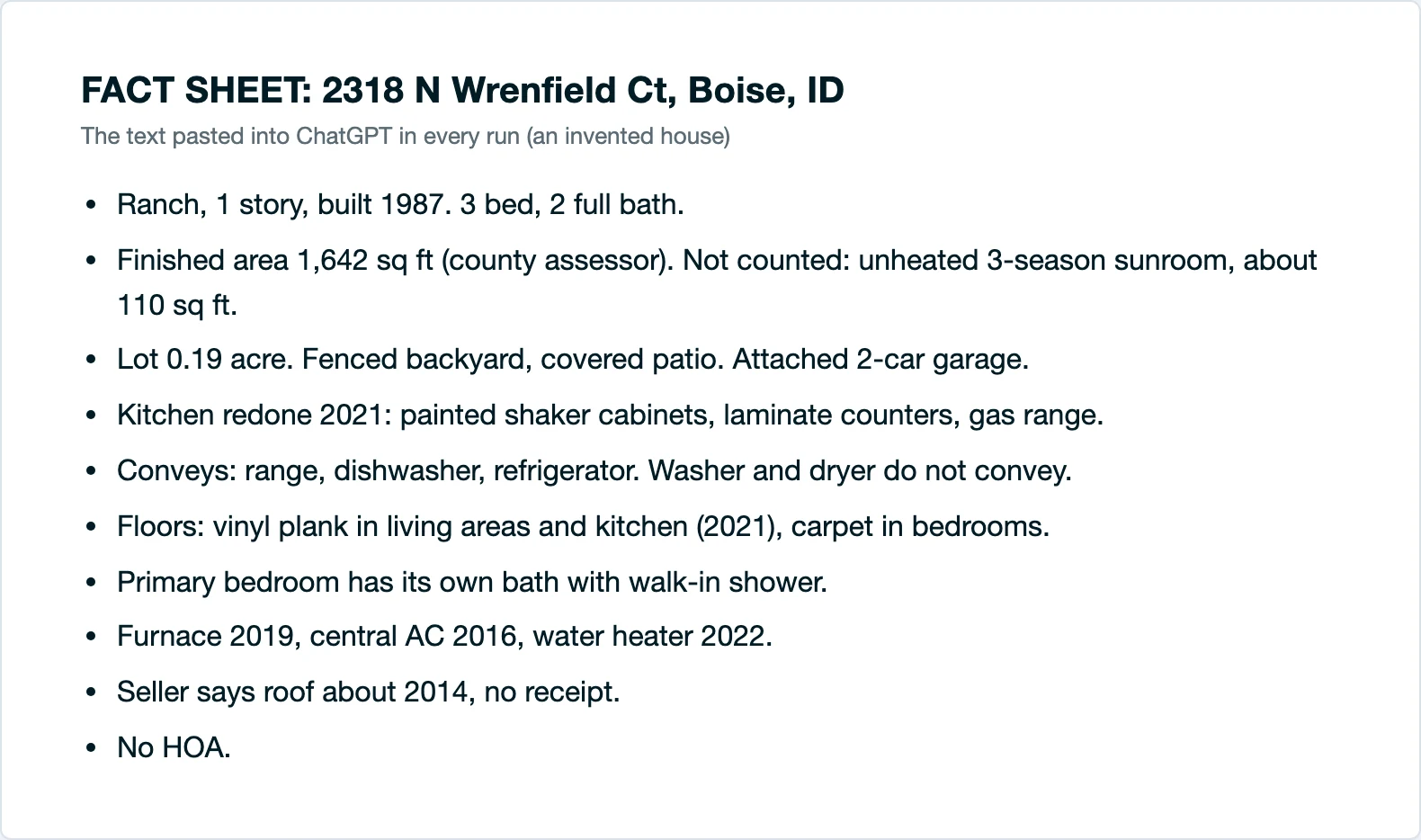
The finished area, with its source.
Fannie Mae has appraisers measure with the ANSI standard, which counts only area suitable for year-round use, so the unheated sunroom gets its own line.
The seller's word, marked as such.
"Seller says roof about 2014, no receipt" keeps the roof's age out until someone shows a receipt.
What conveys and what does not.
The washer and dryer stay with the seller, and the sheet says so.
Schools, distances and the neighborhood go on the sheet only with a source beside them. Whatever the sheet leaves out is a gap, and Step 2 shows what ChatGPT puts in one.
Step 2: Paste the Sheet Under Five Rules
Typed from memory, the prompt asked for about 150 words and named the address, the beds and baths, the year, an updated kitchen, a fenced backyard and a two-car garage. Across three drafts, ChatGPT filled the rest:
| Left open | What ChatGPT wrote |
|---|---|
| Condition | "well-maintained property", in two drafts of three |
| Size | "spacious living areas" |
| The fence | "fully fenced backyard", where the prompt said fenced |
| The garage | "additional storage", in all three |
| The baths | "two full bathrooms", a primary "private bathroom": guesses that matched the house |
| The buyer | "first-time homebuyer", "looking to downsize", "family", in all three |
Asked to highlight the neighborhood and the schools too, it searched the web and named no school. It still wrote "convenient access to local shopping, dining, parks", placed the house in the Boise School District and began a sentence "Families will appreciate".
None of it is a number, so none of it trips an agent who checks only numbers.
Start a new chat, paste this prompt, and paste your fact sheet over the last line:
Write the public remarks for this MLS listing from the fact sheet below.
Rules:
1. Use only facts written in the fact sheet. Do not add any feature, material, measurement, school, distance, view or neighborhood detail that is not there.
2. Leave out anything the sheet marks "seller says".
3. Describe the home, never the kind of person who should live in it.
4. Do not use: stunning, nestled, boasts, oasis, dream home, must-see, charming.
5. About 150 words, plain sentences, no exclamation marks.
After the remarks, under the heading MISSING, list what a buyer would expect to read that the sheet does not say.

<paste your fact sheet here>
Change rule 4 to your brokerage's own list of tired words and rule 5 to your MLS's length limit. The first draft under these rules began:
Here is the same house under each prompt, three drafts apiece:
| Prompt | Claims nobody supplied | Words about the buyer |
|---|---|---|
| Typed from memory | 11 | 8 |
| Fact sheet pasted in | 3 ("luxury" vinyl plank, "well-maintained" twice) | 0 |
| Fact sheet and five rules | 0 | 0 |
The fact sheet did most of the work; the rules matter most once the seller has been talking (Step 4).
Every draft under the rules also ended with a list headed MISSING: roof documentation, laundry location, utilities, schools.
Don't ask ChatGPT to fill it. Each line is a question for the seller.
Step 3: Check the Draft Against the Same Sheet
Open a new chat and paste the check prompt, then the sheet, then the draft:
Check these listing remarks against the fact sheet.
1. List every factual claim in the remarks, one per line.
2. Mark each FOUND (quote the sheet line) or NOT IN SHEET.
3. List any words about who should live in the home rather than the home itself.
Do not rewrite the remarks.

<paste your fact sheet here>

REMARKS:
<paste the draft here>
A good check reads like a ledger: every claim on its own line, FOUND with the sheet's words beside it, or NOT IN SHEET. Part of what came back for one typed-from-memory draft:
| Claim | Result |
|---|---|
| The property is well-maintained. | NOT IN SHEET |
| The home has spacious living areas. | NOT IN SHEET |
| The backyard is fully fenced. | FOUND "Fenced backyard, covered patio." |
| The garage provides additional storage. | NOT IN SHEET |
| The property is suitable for first-time homebuyers. | NOT IN SHEET |
Read the third line twice.
In both checks where it came up, ChatGPT marked "fully fenced" FOUND because the sheet says fenced.
A word that strengthens the sheet's fact reads to it as the fact, so reopen every FOUND line worded more strongly than the sheet.
Asked to check a draft with nothing to compare against, ChatGPT listed 20 statements to verify, the bedroom count and the year built among them: without the sheet, the check becomes a list of everything.
Tips from Reddit
Agents on keeping AI listing copy honest
Just a point to note, asking AI not to hallucinate does not prevent hallucination in my experience.
I only add things that aren't in the data fields.
The real test I always raise with our agents: would the description be different if you wrote it yourself for that same property?
Step 4: Strike Every Word About Who Should Live There
The Fair Housing Act bars any ad for a home that indicates a preference based on race, color, religion, sex, handicap, familial status or national origin. HUD's word-by-word reading is a 1995 memo: describe the property, not the residents.
HUD has since taken the memo off its website without replacing it, and Oregon REALTORS advises treating such guidance as valid until HUD says otherwise.
Sellers talk about who they picture buying, so we added the kind of note an agent hears: "perfect for a young family or empty nesters, quiet street, short walk to St. Mark's Church."
From the sheet alone, both drafts wrote in the church, the walk to it and the quiet street. One turned the young family into "growing households" and "those looking to simplify", the same preference in other words.
Under the five rules, neither draft used any of the note.
| Rewrite | Fine as written |
|---|---|
| "Perfect for a young family", "growing households": familial status, however worded | "Family room", "two bedroom", "cozy": the memo's own property examples |
| "Empty nesters", "adults", "couples", "singles": a preference the memo names | "Quiet street": a neighborhood description to the memo, but still a claim to check |
| A church as a selling point: a religious reference; the memo is silent on landmarks | "Master bedroom": the memo says it is not a violation |
| "First-time buyers", "downsizers": not protected, but remarks describe the home | "Walk-in closets", "great view": the memo's own examples |
State and local laws add protected classes, one MLS's rules allow only the property and its vicinity in the remarks, and a landmark is a judgment call. Your broker reads the flagged words against your rules before anything goes to the MLS.
Step 5: Save Both Prompts in One Shared Project
In ChatGPT, create a project for listing remarks. From its more-options menu choose Project settings and paste the five rules as instructions. Add a blank fact sheet as a file, and keep the check prompt in the project's first chat.
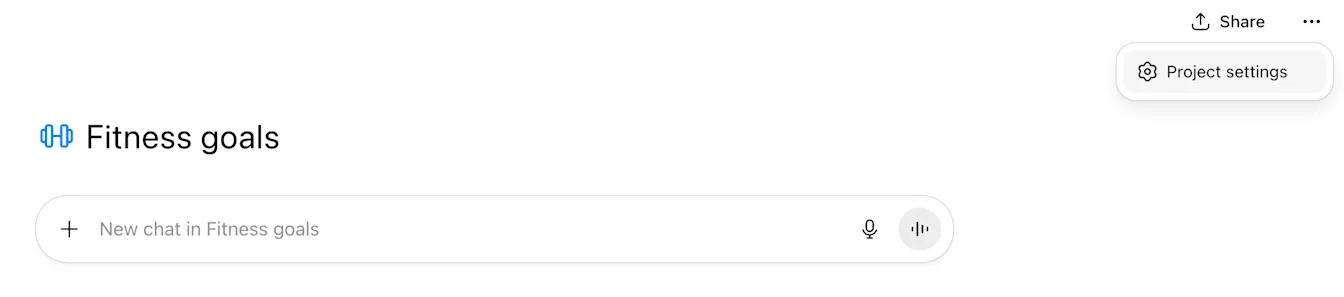
Project instructions apply only inside the project and override each agent's own custom instructions, so personal instructions stay out of the remarks.
Share it with your agents with chat access, so only people with edit access can change the rules. OpenAI's help center, which these steps follow, lists sharing on every plan, Free included.
Our real estate playbook carries this routine as one of its use cases, listing drafts checked against the record, beside the rest of the inbox work a property makes from listing to move-out.
How Qvery Builds the AI Agent That Writes and Checks Every Listing
We build the AI agent that does this for one brokerage, as each listing is entered, so nobody on your team fills in a sheet or runs a prompt. It does the job end to end:
- It reads the listing input where your team already keeps it.
- It drafts the remarks in your brokerage's voice, under your rules.
- It checks every claim against that input and holds back every word about buyers.
- It hands the listing agent the draft, the lines it could not trace and the questions for the seller.
The listing agent still sends the remarks to the MLS; the AI agent runs on its own, on autopilot, beside the people who own the listing.
We start by learning how your listings get written today: who fills in the input, which fields your MLS requires, which phrases your broker has already struck. A first working version runs within two weeks, and we train the agents and coordinators who read its drafts.
Every week it runs, we count the minutes each listing's remarks take from input to MLS and the claims it stopped before the MLS saw them.
Say your agents write 40 listings a month at 30 minutes each, an assumption to swap for your own: that is 20 hours a month, brought down to the minutes it takes to read a draft and its flagged lines.
Ask the Seller the Missing List at the Listing Appointment
The MISSING list is the most useful thing ChatGPT wrote. Take it to the next listing appointment and ask the seller each line: the sheet starts complete, and the remarks have nothing left to guess.
The same habit, facts first and a person on every line the AI cannot trace, fits most of the paperwork a brokerage sends out under its name.
Frequently asked questions
Will ChatGPT make up square footage in a listing description?
In our runs on November 1, 2026, it invented no square footage, countertop or school name, even from a one-line prompt. It added claims nobody supplied instead: "well-maintained", "spacious", "fully fenced". A fact sheet with the area and its source, under a rule to use only the sheet, keeps both out.
What words make a listing description non-compliant?
Under the Fair Housing Act, any word that indicates a preference based on race, color, religion, sex, handicap, familial status or national origin. HUD's 1995 guidance adds examples: no preference for adults, couples or singles. State and local laws add classes, so your broker reads flagged words against yours.
How long should a listing description be?
As long as your MLS allows and no longer than your facts. Limits differ by MLS: MLSListings in Northern California caps public remarks at 1,300 characters, spaces included. Put your MLS's limit in rule 5 of the prompt. Asked for about 150 words, our drafts came to about 900 characters.
Should my brokerage use one shared prompt for listing descriptions?
Yes, if every listing should meet the same rules. A shared ChatGPT project holds the rules as its instructions, and inside the project they override each agent's own custom instructions. Give your agents chat access, so only the people with edit access can change the rules.
Is it legal to use ChatGPT to write real estate listings?
We found nothing that bars it. California's real estate regulator says AI output should be reviewed for accuracy and approved by the licensee before consumers rely on it, and that responsibility for misleading advertising rests with the licensee and the responsible broker. Check your own state's regulator.
Does ChatGPT know which schools a house is zoned for?
Not reliably, and it said so. Asked to highlight the nearby schools, it searched the web, named none and told us to confirm the assigned schools. It still placed the house in a school district. Put a school on the fact sheet only after the district confirms it.
Is "master bedroom" a fair-housing problem?
HUD's 1995 guidance says the term does not violate the Fair Housing Act. Our sheet said "primary bedroom", and ChatGPT followed the sheet; use whichever term your brokerage prefers and put it on the sheet.
Can a listing say "quiet street"?
HUD's guidance treats "quiet streets" as a description of the neighborhood, not a preference. It is still a claim about the street, so it goes on the sheet only if someone has checked it.
Can I mention a nearby church in the remarks?
HUD's guidance says a religious reference standing alone may indicate a religious preference, and says nothing about churches as landmarks. It is also a distance nobody measured. From the sheet alone, ChatGPT wrote the seller's church into both drafts; under the rules it left it out. Ask your broker first.
Can I paste the seller's name and details into ChatGPT?
The remarks never need them. Leave names, phone numbers and showing instructions off the sheet: public remarks describe the home, and MLS rules such as Rhode Island's bar contact information of any kind from them.
Does a sunroom count in the square footage?
Under the ANSI standard that Fannie Mae requires for appraisals, finished area is area suitable for year-round use, and an unheated three-season room is not. List it on its own line with its size, as our sheet did, so the remarks can say it is not included.
Why not let ChatGPT check its own draft without the fact sheet?
Without something to compare against, it cannot tell a true line from a false one. Without the sheet it gave us 20 statements to verify, the bedroom count and the year built among them. With the sheet, it marked each claim FOUND or NOT IN SHEET.
What should I do with the MISSING list ChatGPT returns?
Ask the seller. Each item, from roof documentation to the laundry's location, is a fact a buyer would expect that your sheet does not hold. Add each answer to the sheet with its source and run the prompt again; never ask ChatGPT to fill the list.
How is an AI agent different from a saved prompt?
A saved prompt waits for someone to fill in a sheet and paste it. An AI agent reads the listing input where your team already keeps it, writes and checks the remarks itself, and hands the listing agent the draft and its flagged lines to approve.