On this page
Most of your agents already use AI. They write listing descriptions and follow-up emails with ChatGPT, and a few draft addenda with it. Ask them what it has done for the business, though:
Nearly Half of Realtors Say AI Has Not Changed Their Business
share of Realtors
View the data
| Label | Value |
|---|---|
| Significantly positive | 17% |
| Moderately positive | 33% |
| Neutral or no noticeable impact | 46% |
| Moderately negative | 2% |
| Significantly negative | 2% |
Each agent buys AI for themselves and saves time on a listing or an email, while the brokerage's own work stays as it was. AI pays when it takes one repeated job off a whole team, and in a brokerage that job is the review of every file.
Every closed deal produces a file that someone on your compliance staff reads document by document: the form, every signature and initial, every date, every disclosure. For a brokerage of 300 agents that is about 2,700 files a year and close to an hour each, some $84,600 a year in two reviewers' time.
At Qvery, we help brokerages cut what file review costs and keep their reviewers on the files that need a decision, with custom AI agents that read every document as it lands in a transaction file, check it against your checklist and chase the fixes.
The duty to supervise stays with your broker, and the AI agents never approve a file.
Whatever an Agent Drafts, the Broker Answers For
An agent can draft an addendum in a chatbot in a minute. The addendum then lands in the transaction file, and the file is the broker's.
California's rule is one example: the responsible broker must have systems to review transactions and every document that can change a party's rights, advertising included, and may hand the reviewing to associates without handing over the responsibility. Your state words its rule its own way.
The review asks five things of every document:
- The right form, in the version your state and your brokerage use now.
- Every signature, initial and date, from every party.
- Every deadline inside the window the contract sets.
- Every disclosure this property calls for, delivered before the buyer is bound. For most homes built before 1978 that includes the federal lead-paint disclosure, which each agent on the deal must make sure the seller gave; the civil penalty runs up to $22,263 per violation.
- The same names, address and price on every page.
Your transaction platform already handles part of this. SkySlope says its Smart Assist uses AI to pre-approve forms that carry every signature and to flag the ones that do not, and the platforms track which documents a file is still missing.
Deciding whether a document that is there passes is still a person's call. That is how Empower Transactions, a firm that sells file review to brokerages, read SkySlope's, Dotloop's and Paperless Pipeline's descriptions of their own products.
What Reddit says
Who catches the mistakes in a transaction file
You and your broker are responsible. Better make sure you are covered by your E&O policy. Full contracts? I would not be comfortable with that.
People forget signatures all the time and that’s what they have compliance and transaction coordinators for. To catch stuff so you can go back and fix it.
Most of the time, I’m drowning under “doc approvals” and don’t have much time to reach out to other brokers
Now we are implementing AI checks to make sure the right version and no edits via AI.
What an Hour a File Adds Up To
The same firm clocked its own reviewers in July 2026: 0.97 hours per compliance file across 3,816 files, or 0.79 without one timesheet it called implausible. The reading is not where the hour goes.
A file holds about six documents, and the hour goes to chasing: the missing page, the wrong-year form, the agent who says it is coming. About two-thirds of the documents on that firm's state lists apply only when something else in the file is true, so somebody works out which ones this file needs before checking any of them.
Take a brokerage of 300 agents as the example. The typical Realtor closed nine transaction sides in 2025, by NAR's count, so that is about 2,700 files a year, each side its own file. At close to an hour a file, two reviewers spend about 60% of their week on it.
BLS puts the mean pay of an administrative assistant at $49,350, and benefits are 30% of what private employers spend per hour, so each costs about $70,500 a year. The review comes to $84,600 a year and 2,496 hours.
Put your own brokerage in. The calculator opens on that example, with AI agents taking 70% of the review: working out which documents apply, the checks and the chasing.
Transaction File Review ROI Calculator
What Reviewing Transaction Files Costs You, And What An Agent Saves
Saved Per Year
$52,020
1,747 hours handed back, after $7,200 a year to run it
- Hours Handed Back
- 1,747 hours a year
- Agent Running Cost (Estimate)
- $600 a month
- Payback Per $10,000 Of Build
- 2.3 months
On these numbers, the agent saves $52,020 a year after its own running cost, and every $10,000 of the build is earned back in 2.3 months.
On the example, the review falls from $84,600 to $32,580 a year, the AI agents' running cost of about $600 a month included. That is $52,020 a year and 1,747 hours handed back, so every $10,000 of the build is earned back in about 2.3 months.
The hours are worth the most when they go to work you would otherwise hire for, such as the files of the next office you open.
What the AI Agents Do With Each Document
Every document added to a file starts them, amendments and extensions included. They read the document beside the rest of the file, the listing record and your checklist with your state's current forms.
From those they work out which documents this file needs, given the property, the price and the parties, and check each one on the five questions above.
A document that passes gets a note. One that fails goes back to the agent on the deal with the exact fix (the page, the field, the party) and a reminder until it comes back.
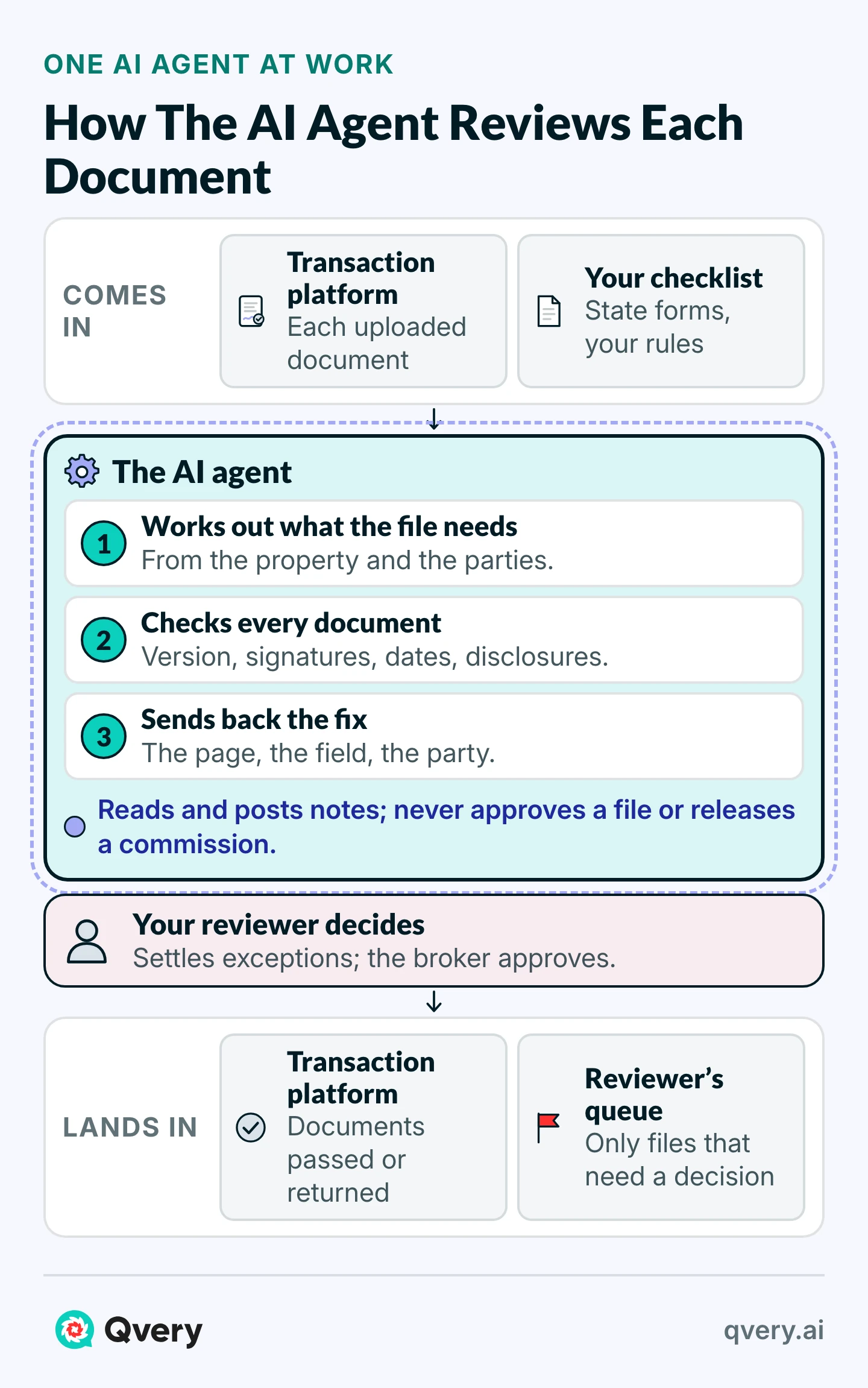
Your reviewer gets the exceptions with the reason attached, settles any dispute with the agent and approves the file, and your broker keeps the signature. The AI agents never approve a file, release a commission or write to a client.
A transaction file holds your clients' names, finances and signatures, so before they touch your platform we agree in writing what they may read and do and where their data is processed.
They start with the least they need (reading files, posting notes, returning documents), log every check with who, what and when, and at first nothing they write reaches an agent until your reviewer has seen it. Qvery is an EU company and signs a data processing agreement.
Working With Us, One Office at a Time
We start with one office and one kind of file, usually residential resales. The AI agents read last month's closed files first, beside your reviewers, so you see what they catch and what they miss before they touch a live file.
Two weeks after we have access, it reviews new files as they arrive. From then on we count the hours it hands back and the defects it stops, week by week, and the price is fixed for that result before any build.
Frequently asked questions
Do the AI agents work with SkySlope, Dotloop or Lone Wolf?
They work inside the platform your agents already upload to, reading files and posting notes and returned documents where the platform allows that access. What they can reach depends on the access each platform offers, and we check that before we build, so nobody changes how they submit a file and you keep the platform you pay for.
We operate in more than one state. Does that work?
Yes. Each state gets its own list of required forms and its own versions, and every file is checked against the list for the state the property sits in. A brokerage in three states runs three lists through the same AI agents, and adding a state means adding its list, not building again.
Do they know our state's forms?
We load your state's current forms, the versions your brokerage accepts and your own checklist, including the documents that apply only to some properties, such as the lead-paint disclosure for older homes. When a form is revised, the version the AI agents check against changes with it, and a file signed on the old version is flagged.
Can they approve a file or release a commission?
No. They pass documents, return them with a reason and list the exceptions. Approving the file and releasing the commission stay with your reviewer and your broker, and the log shows which documents the AI agents passed and which your reviewer decided.
What happens to our compliance reviewers?
They spend their week on the files that need judgment: the disputed document, the agent who keeps sending the wrong form, the deal that changed late. How their roles change stays your decision, and the AI agents are built around it.
Our agents already draft with ChatGPT. Should we stop them?
That is your policy call. Whatever you allow, every document still lands in the file, and the AI agents read each one the same way, whoever or whatever drafted it. A brokerage that lets agents draft with AI gains the most from a review that never gets tired.
What do they cost to run?
The cost moves with the number of files you close. Model usage runs under a dollar a file, and hosting and upkeep stay flat; at 225 files a month that comes to about $600. The build itself is a fixed price for a defined result, agreed before we start.
Do they handle leases and commercial deals?
The same approach covers them, each with its own checklist. We start with one kind of file so the first two weeks prove something, then add leases, new construction or commercial files one checklist at a time.
Do they replace the broker's duty to supervise?
No. California lets the broker use others to help with the review and keeps the responsibility with the broker; the AI agents are among those helpers. Their log shows what they checked on every file, which makes the broker's supervision easier to show, not optional.
Will our agents take notes from AI agents?
They take notes from your reviewers now, and the AI agents' notes are more specific: the page, the field and the party who has to sign. At first nothing they write reaches an agent until your reviewer has seen it, and a disputed note goes to your reviewer, as it does today.
Can they check last year's closed files before a regulator does?
Yes. They read a closed file the same way they read a live one and list what is missing, unsigned or on the wrong form. That is how we start anyway, with last month's closed files, and the same run over a longer stretch gives you the list before anyone else asks for it.
What if they miss something?
Your reviewer still approves every file. Each miss your reviewer catches becomes a check the AI agents run from then on, and we count misses every week alongside the hours, so you see the rate fall instead of taking it on trust.
Do they check listing ads for fair housing?
Not these. Advertising is its own item on the broker's list, and listing copy is a different job with different rules, so it gets its own AI agents and its own checklist when you want them.