On this page
- On Our File, AI Read the Clauses People Say It Misses
- The Wrong Numbers Are in the Abstracts You Already Have
- AI Catches a Wrong Abstract but Writes Around a Missing Amendment
- Qvery's Agents Read Every Lease Against Its Abstract and Its Bills
- The First List of Differences Comes Two Weeks After Access
- Frequently asked questions
Your tenants are billed from an abstract, not from their lease.
The abstract is the summary a lease administrator types into the lease system: the rent and its steps, the share of the center's operating costs and the cap on them, the dates and the rights. Billing reads from it, and so do the budget and the calendar of critical dates.
Each abstract was typed when its lease was signed, often years ago, and updated by hand with every amendment since.
Take a landlord with 300 tenants where one bill in 25 runs from an abstract that no longer matches the lease, $500 short a month. That's $72,000 a year billed wrong, and with a quarter of it found and billed later, $54,000 never collected.
Vendors now quote 95% accuracy or better for AI lease abstraction on standard fields such as dates and base rent. The question an owner asks is which clauses that number covers.
We scored it clause by clause on a lease file of our own: the reading held up, and the risk sits in the abstracts already in your lease system.
On Our File, AI Read the Clauses People Say It Misses
The usual warning is that AI handles dates and rent but drops the qualifiers that carry the money: the carve-outs in an exclusive (the landlord's promise not to lease to a competing store), the transfers that need no consent, the costs left out of a cap.
We had six abstracts to test that on. They come from our lease abstraction tutorial, where Gemini Flash, Claude Haiku and Claude Sonnet each abstracted one invented shopping-center lease file twice, once asked plainly and once with a field list. All six got the twelve terms we scored there right, scan included.
This time we scored the clauses that tutorial left alone, qualifier by qualifier, against an answer key written before we read them. Across twelve clause families the six abstracts stated 247 qualifiers (the plain requests left some out), and 245 were what the lease says.
| Clause | What the lease says | Qualifiers stated right |
|---|---|---|
| Exclusive use | A rival over 15% housewares; three carve-outs; only while the tenant is open | 33 of 33 |
| Assignment | Consent not unreasonably withheld; none for an affiliate or a $15 million successor | 29 of 29 |
| Operating cost exclusions | Six costs the tenant never pays, from capital work to the anchor's own | 12 of 12 |
| Renewal conditions | No default, open in the whole space, time of the essence | 13 of 13 |
| Cap on operating costs | 105% of the prior year, on controllable costs only, non-cumulative | 23 of 24 |
| Co-tenancy | Half rent after 90 days without the grocer or 65% occupancy; an exit after a year | 39 of 40 |
The two misses were small and visible. One abstract wrote the cap as rising "at most 105%" a year, which would let costs more than double, though it stated the cap correctly further down. Another read the co-tenancy exit as 90 days' notice, where the lease gives 90 days to send it.
One more abstract said the improvement allowance had been paid, which nothing in the file shows. And all six gave the exclusive's remedy, half the minimum rent until the landlord cures it, which our own answer key had missed.
This is one invented file, written clearly, with one run per model, and harder files still break the reading. An independent 2026 benchmark of professional PDFs, leases among them, kept only questions that at least two frontier models failed, and its recurring causes included skipped exclusions, poor scans and amendments that override earlier text.
The Wrong Numbers Are in the Abstracts You Already Have
An abstract is typed once for each document. Billing repeats whatever it says every month, and it is seldom read against the lease again before a tenant disputes a bill, an auditor checks a reconciliation or a renewal comes up.
The public record shows what that costs a landlord with its own lease office.
When the City of Toronto's Auditor General reviewed 45 of the city's leases in 2018, the city had not calculated, billed or collected the additional rents and recoveries on 22 of them: the operating costs (CAM, for common area maintenance, in most leases), taxes and other charges a lease passes to the tenant.
A city is not a private owner, and much of Toronto's gap sat with tenants on below-market rents.
It happens on the other side of the lease too. GSA's Inspector General found the federal government's lease office for the Washington region paying a landlord for tenant improvements two years past the eight that a supplemental lease agreement had set: $1,107,981.
We found no study that measures this for private portfolios. The people who run them describe the same thing:
What Reddit says
Landlords and tenants on bills that drift from the lease
I've seen more than a few owners (and their managers) inadvertently charge tenants incorrectly for CAMs, etc. And sometimes this went on for years.
Landlords often do not reconcile properly, leading to a sudden unexpected "catch up" when they realize they have not been charging tenants for their CAM costs per the lease.
I don't like to agree to 180, because it always takes our shop longer than 180 to complete all of our properties' prior-year recs.
None of these errors needs a clause read wrong. They come from an update nobody made or a keystroke nobody checked.
A rent step goes in on the wrong month. A share of operating costs stays at the old floor area after an expansion. A cap gets applied to costs the lease leaves uncapped, and a right an amendment deleted stays on the calendar.
Each one bills wrong every month, and not all of the past can be billed back. Some leases set a deadline for the year's operating cost statement, and a landlord who misses it may lose that year. So the month an error is found matters more than how much of it can be billed back.
AI Catches a Wrong Abstract but Writes Around a Missing Amendment
So we tested the check itself. We gave each model the same lease file and an abstract dated November 1, 2026 with ten errors of exactly those kinds, beside eighteen rows we meant to be right, and asked it to check the abstract against the documents.
Sonnet and Haiku caught all ten. Gemini caught nine: it listed the assignment row as verified, then added the missing transfer terms in its own corrected table. 29 of 30 planted errors found, and none of the three called a correct row wrong.
| The abstract said | The lease file says | What it bills or misses |
|---|---|---|
| Share of operating costs: 4.09% | 5.30% since the expansion | The new suite's costs never billed |
| Next rent step: September 1, 2027 | August 1, 2027 | $1,715.84 under-billed that month |
| Operating costs capped at 5% a year | Only controllable costs are capped | Insurance and utilities under-billed |
| Tenant may terminate after year seven | Deleted by the first amendment | A right that no longer exists |
| Renewal notice by October 31, 2033 | By July 31, 2033 | The renewal answer due three months earlier |
Both Claude models also flagged two gaps we had not planted: the radius row had lost "a similar name" and the tenant's affiliates, and the renewal row had lost its conditions. Both were true of the abstract as we wrote it.
Then we took the first amendment out of the folder and asked each model to abstract the file.
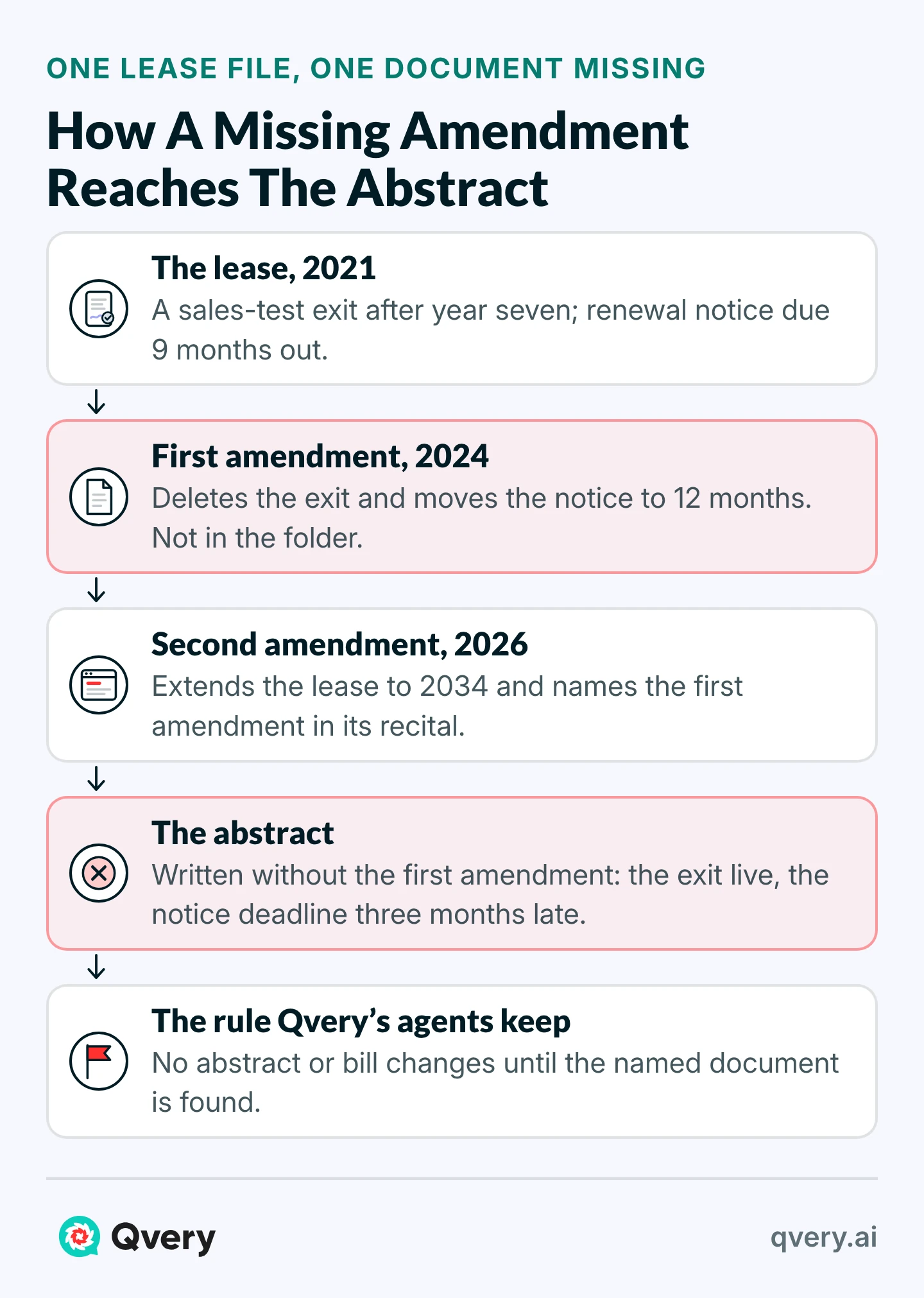
On our file, a model that noticed the gap did not stop because of it. The rule has to sit outside the reading: no abstract and no bill changes while a document the file names is missing.
Qvery's Agents Read Every Lease Against Its Abstract and Its Bills
That check is what Qvery's agents run, on every lease, every month. They start with a first pass over the whole portfolio, then run again before each bill run and whenever a signed document reaches the lease folder.
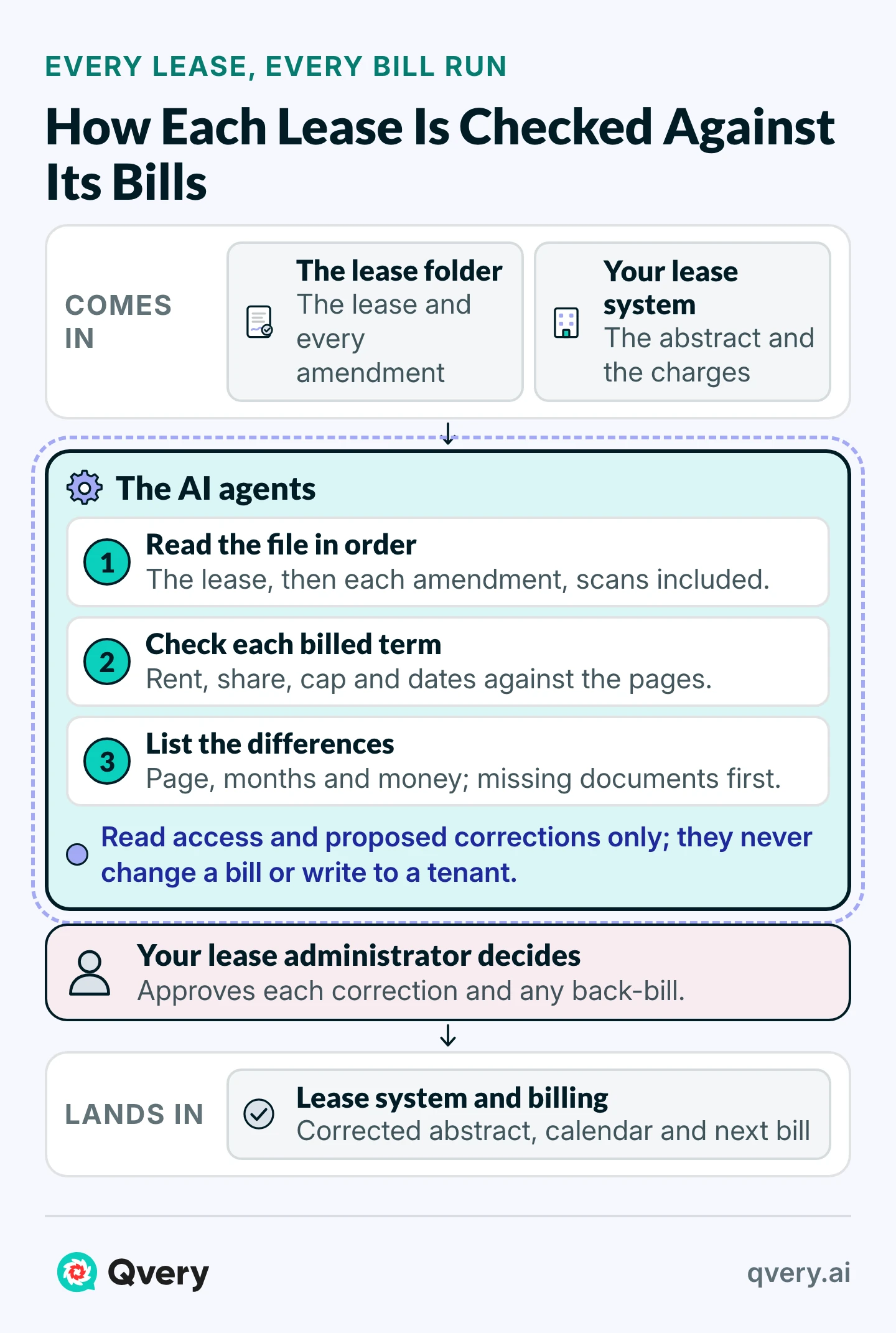
For each tenant they read the lease file in order, from the lease to the latest amendment, the abstract in your lease system and the charges in billing. They check each billed term against the documents, and every document the file names against what the folder holds.
What reaches your lease administrator is a short list ranked by money: the field, what the system says, what the lease says, the page and its words, the months it affected and whether the lease still lets you bill them back. A missing document comes first, before any figure that depends on it.
Once your administrator approves a correction, the agents write it to the abstract, move the date on the calendar and leave the note for billing. The back-bill, the letter to the tenant and the reading of an unclear clause stay with your people.
Some of this exists off the shelf. On a residential portfolio in Yardi Voyager 8, Yardi's property management system, Yardi's own Lease Audit Agent compares leases with Voyager's records, and Prophia, a lease abstraction service, checks the lease data it abstracts against a client's Yardi accounting.
What custom agents add is the check run on your systems and your rules, the chase for missing documents, and the money and the deadline on every difference.
The first pass goes where the money is: the largest tenants, the leases with the most amendments, the files nobody has opened since they were signed.
Take the landlord from the top: 300 tenant bills a month, one in 25 wrong by $500. That's 144 billing errors a year. Catching a quarter of them later, as a tenant's question or a year-end reconciliation does today, leaves $54,000 a year lost. With the agents catching 70%, it's $21,600.
That's $32,400 more caught a year. Take out the agents' running cost, about $400 a month, and the landlord keeps $27,600; it takes 4.3 months to earn back each $10,000 of the build. Put your own tenants and your own error rate in:
Lease Billing Errors ROI Calculator
What Bills That Miss The Lease Cost You, And What The Agents Catch
Recovered Per Year
$27,600
$32,400 more caught a year, after $4,800 to run the agent
- Billing Errors A Year
- 144
- Agent Running Cost (Estimate)
- $400 a month
- Payback Per $10,000 Of Build
- 4.3 months
On these numbers, the agent stops $32,400 a year from slipping through, $27,600 after its own running cost, and every $10,000 of the build is earned back in 4.3 months.
Your own error rate is the one number this example can't supply, and a first pass over your largest tenants is what measures it.
The First List of Differences Comes Two Weeks After Access
You bring the lease folder, read access to the lease system and a year of tenant charges. We sit with whoever keeps the abstracts today, learn which fields billing reads, and put in writing which folders and systems the agents may open.
Two weeks after the access is in place, your administrator has the first list: the differences in your largest tenants' abstracts, each with its page and the money on it, and the documents the folder is missing.
After that the agents check every bill run. Each week we count the differences found, the corrections approved and the money billed right.
Frequently asked questions
What is lease abstraction?
It's turning a lease and every document that changed it into a short record of the terms your business runs on: rent and its steps, the share of operating costs, caps, dates, options and the clauses that limit what either side may do. Billing and the critical-date calendar read that record, not the lease.
How accurate is AI lease abstraction?
On our invented file, current models stated 245 of 247 clause qualifiers right, and in our tutorial every page they cited was right. That's one clean file. Old drafting, a fax of a fax and a side letter in someone's inbox are harder. That's why the check runs against the documents every time.
Which clauses still need a person?
Those whose answer is a judgment, not a reading: a cap that may or may not grow with a larger store, a clause two sides read differently, whether a late statement can still be billed. The agents mark each one, quote the sentence that leaves it open and leave the call to your administrator.
Can the agents check abstracts we typed years ago?
That's the first pass. Each file is read from the lease to its last amendment and set against today's abstract. What turns up is either an update nobody made or an abstract that was wrong from the day it was typed, and both bill the same way until someone fixes them.
What if a lease file is missing documents?
The agents list every document the file refers to and the folder doesn't hold, and they change nothing that depends on it until someone finds it. In our test, a missing amendment led every model to write a deleted right into the abstract.
Do we have to replace Yardi or MRI?
No. The agents read the abstract and the charges where they already live, through the access your system gives your team: an export, a report or its own connection. Corrections go back the same way once your administrator approves them.
Can the agents send the back-bill to the tenant?
No. They show the months affected, the amount, and what the lease says about billing back. Whether to bill, how to word the letter and when to send it stay with your people, who know the tenant.
Does this help with the year-end operating cost reconciliation?
Yes. A wrong share, a cap applied to the wrong costs or a missing exclusion changes every tenant's reconciliation. The agents check those terms against the lease before the statements go out, while the lease still lets you bill the year.
Is it safe to send tenant leases to AI?
Not to a tool someone signed up for alone. Which systems our agents open, and where the documents are processed, is written down before the first file. They start read-only and log everything they do. Qvery AI OÜ is in the EU, and a data processing agreement comes with the contract.
How is this different from a lease audit?
A lease audit checks a set of leases against their bills once, looking back over the years its scope allows. The agents run the same comparison on every bill run, so a wrong step or share is found the month it starts, while most of the money is still billable.
Which abstract errors cost a landlord the most?
The ones that repeat on every bill: a rent step that never posted, a share of operating costs left at the old floor area, a cap applied to costs the lease passes through in full. A wrong date costs once; a wrong share costs every month until someone reads the lease.
What if our lease administrator disagrees with the agents?
Then the abstract stays as it is, and the reason goes into the log beside the difference. A disagreement usually means a document the agents haven't seen or a reading your team settled long ago, and both become part of what the agents read the next time.
What do the agents cost to run?
On the example above, about 50 cents a tenant each month for the model, and $250 a month to host, monitor and log the agents: some $400 a month for 300 tenants, an estimate. The build is priced once, for the result we agree on before we start.
Does it work for office and industrial leases?
Yes. Each kind of lease bills on its own terms, so the fields the agents check change with it. The check itself doesn't: each billed term against the documents, in order, with the page behind it.
How do we know the agents are right?
Every difference arrives with the page and the words it comes from, so your administrator confirms it by reading one paragraph, not the lease. A difference the lease doesn't support never reaches billing.
When do the agents start on our portfolio?
The first working result comes two weeks after the access is in place: the first pass on your largest tenants. The rest of the portfolio follows file by file, and from then on the agents check every bill run.