On this page
- Give the AI Agents the Whole File, Scans Included
- Ask for Every Field With the Page and the Words Behind It
- Check the Values Against the Words, Not the Lease
- Send the Clauses That Need a Judgment to a Person
- Read the File Again the Day an Amendment Is Signed
- Qvery's AI Agents Read Every Lease Document the Day It Is Signed
- Frequently asked questions
A commercial lease keeps changing after it is signed. A commencement letter fixes the dates the lease could only estimate. An amendment adds a suite; another extends the term and takes away an option.
Billing, the critical-date calendar and the budget run on the lease abstract, the short summary of each lease's rent, dates, space and rights, never on the lease itself. So every time a document is signed, a lease administrator re-reads the file and updates the abstract.
For a landlord with a few hundred tenants, we assume about 60 documents a month. At an assumed 75 minutes each, that is 900 hours a year, about $43,000 of an administrator's time. Miss one amendment and the abstract keeps billing the old terms.
AI agents now do the reading.
To show the work, we built one tenant's lease file at an invented shopping center: the lease signed in 2021, its commencement letter, an amendment from 2024 and a second from 2026 that exists only as a scan.
Every name and figure in it is invented, and we wrote down the right answers before any AI read a page. Here is what the three later documents changed:
| Term | As signed | Today |
|---|---|---|
| Rent on November 1, 2026 | $13,433.33 a month | $17,158.33 a month |
| Lease ends | May 31, 2032 (an estimate) | July 31, 2034 |
| Space, and share of the center's costs | 6,200 sq ft, 4.19% | 7,850 sq ft, 5.30% |
| Security deposit | $24,000 | $30,900 |
| Renewal options | Two | One |
| Tenant's early exit after year seven | Yes, if sales fell short | Deleted |
We expected the models to trip on those changes. None did. Asked plainly to abstract the lease, Claude Sonnet, Claude Haiku and Gemini Flash each got every one of them right on this file, scan included, and so did every other run we made.
On this file, the reading was not where the abstract could go wrong. Below is the job as AI agents do it on that file, in five moves, then what Qvery builds so it runs on every lease you sign. The moves run as written on your own files.
This abstracts one retail lease. Office and industrial leases take the same reading with their own fields, and your lease accounting is built from the abstract, not here.
Give the AI Agents the Whole File, Scans Included
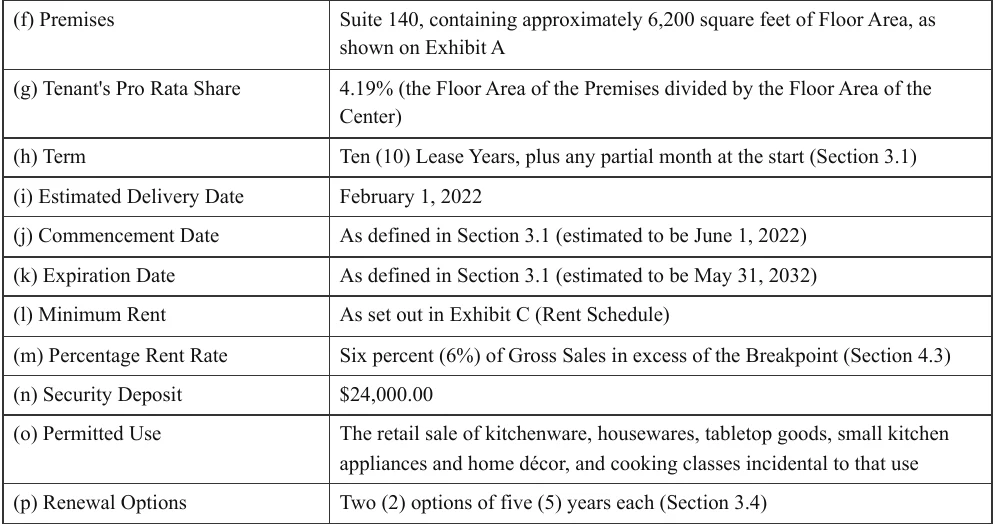
Upload every document in the file at once: the lease, its exhibits, the commencement letter and each amendment. The lease alone is wrong in each row of the table above, and its own summary page says so in small print:
Asked for the field list below, every run began with the documents it found, oldest first, and what each one changed. That list is the first thing to read, because a document missing from it is a document the abstract never saw:
The second amendment has no text layer: a tool that only reads text sees three blank pages. Every run read it, because these models read the page as an image.
A fax of a fax is another matter, so the prompt asks for every page the model could not read clearly. If one comes back on that list, get a better copy before anyone checks the abstract.
Ask for Every Field With the Page and the Words Behind It
This is the one prompt the job needs. Change the date to today's and the field list to the fields your lease system holds; the rest runs as written.
Attached is the complete file for one tenant's lease: the lease with its exhibits and every later document that changed it. Abstract the lease as it stands on November 1, 2026.

1. First list every document in the file, oldest first, with its date, its title and one line on what it changes. A later signed document overrides an earlier one only for the terms it changes. Work every date from the commencement date the parties confirmed, never from an estimate.

2. Then return one table with these columns: field, value, document, section, page, the words on the page that support the value, and sure or check. The fields: landlord; tenant; guarantor; premises; floor area; tenant's pro rata share; commencement date; rent commencement date; expiration date; minimum rent schedule (each period with its annual and monthly amount); monthly minimum rent on November 1, 2026; next rent change (date and new monthly amount); percentage rent; operating costs (share, and any cap with what it covers); management fee cap; real estate taxes; security deposit; renewal options (how many remain, length, rent); renewal notice window (earliest and latest date); early termination rights; co-tenancy; exclusive use; radius restriction; relocation; assignment and subletting; permitted use; holdover; estoppel deadline.

3. When a value comes from a later document, cite the later document and name the earlier value it replaced. When you worked a date out, show the arithmetic in one line. If the file does not support a field, write "not in file"; never fill it from what leases usually say.

4. Last, list every clause where a person has to decide something or watch for a condition, and every page you could not read clearly.
The plain request, "Please abstract the lease", got the same terms right. What came back was a memo:
| Request | What came back | Checking a value means |
|---|---|---|
| "Please abstract the lease" | 100 to 157 lines, in three layouts from three models, with no page numbers | finding it again in 24 pages |
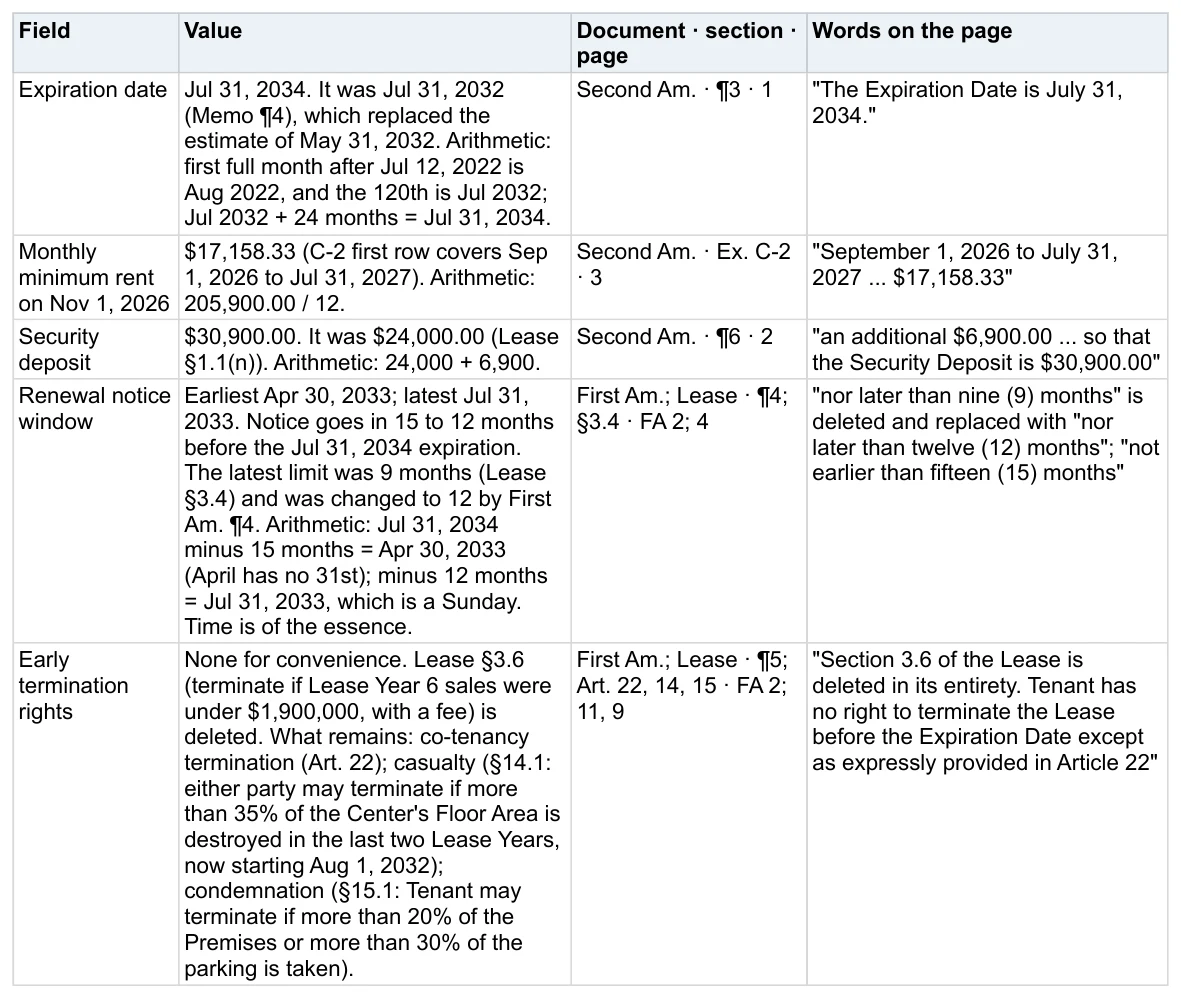
| The field list above | the same table from all three: each value with its page and the words on it | reading the quoted words |
Here are five rows of Claude Sonnet's table, copied into a sheet:
People who abstract leases for a living say what the reading costs them, and what they fear from AI:
Tips from Reddit
People who abstract leases, on the hours and on AI
6 hours for a newbie, 2-3 for someone more experienced.
I ask why it did that and it says it had just thrown in the market standard in the summary rather than what was stated in the contract.
I think I’d get fired if I put any of my clients’ leases into this due to security concerns.
The line in the prompt that answers that fear is the last sentence of point 3. On this file no run filled a field from what leases usually say.
Check the Values Against the Words, Not the Lease
The check runs down the table row by row: does the quoted text say the value beside it? The page is opened only where the words do not settle it.
Take the rent row. It says $17,158.33, cites the second amendment's Exhibit C-2 on page 3, and quotes "September 1, 2026 to July 31, 2027 ... $17,158.33". Page 3 of the scan:
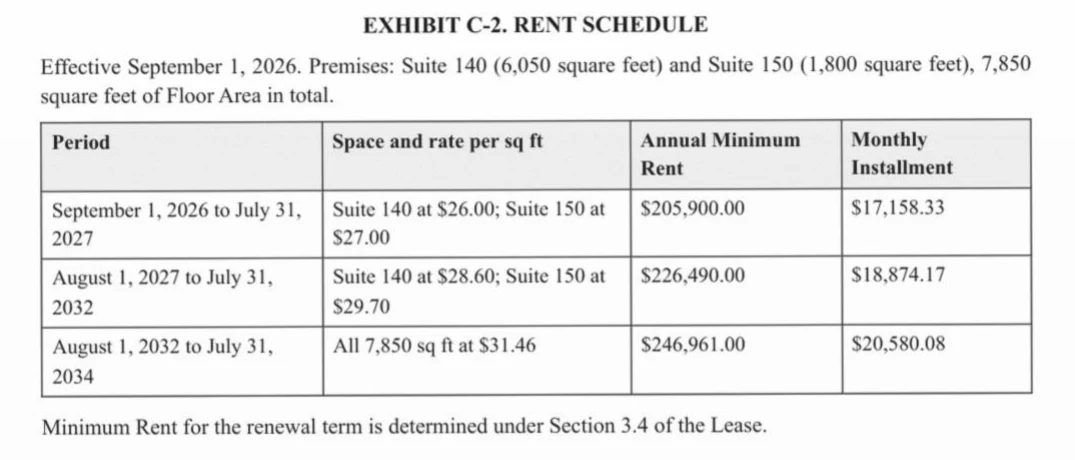
On this file, all 36 of 36 pages the three runs cited for the terms we tested were the right pages. The Claude runs' quotes were word for word; Gemini twice rebuilt a table row in its own words, the right figure on the right page but nothing you could search for.
A row whose quoted words are not on the cited page is the row to stop at: the run either misread the page or cited the wrong document, and in both cases the value is unproven until someone opens the file. Asking for the words is what makes that visible.
Send the Clauses That Need a Judgment to a Person
Here the runs stopped agreeing. Every run got the terms right; they differed on what a person should look at.
| Question | Raised by |
|---|---|
| The 5% cap on operating costs is counted in dollars, and the tenant's share rose about 30% | 4 of 6 runs |
| The first amendment may have ended the tenant's right to leave after a fire or a taking | 4 of 6 runs |
| Nothing in the file shows the extra deposit or the expansion allowance was paid | 4 of 6 runs |
| The last day for renewal notice, July 31, 2033, is a Sunday | 1 of 6 runs |
The cap question is the one with money in it:
One run of six noticed that the tenant's renewal deadline falls on a Sunday, in a lease where time is of the essence.
It is the tenant's deadline and your planning date: the day you learn whether the space comes back in a year. Put the Friday before it in the calendar and ask counsel whether a Monday notice would count.
Some flags are not problems, and an abstract that files them as faults teaches your team to ignore its list:
- Blank initials lines at the foot of every page. Every signature block is signed.
- A late remeasurement. It was agreed after the lease's 12-month window, but both parties signed the amendment that fixed 6,050 square feet, so the amendment, not the window, sets the area.
- Routine obligations listed as watch items. One run returned 22 of them (opening hours, late fees, insurance). They belong in the lease system, not in front of a person every month.
Read the File Again the Day an Amendment Is Signed
An abstract is current only until the next document. So we tested the moment that keeps it current: we handed each model the abstract as it stood on March 1, 2026 and the new second amendment, and asked for an update.
All three changed the ten fields the amendment names. All three also changed five it never mentions, because they move with the new expiration date or the new rent.
Those five are the renewal notice window, the landlord's right to move the tenant, the window to end the lease after a fire late in the term, the half rent owed if the center's grocery store closes, and the rent if the tenant stays past the end. Claude Sonnet's update, beside the March abstract:
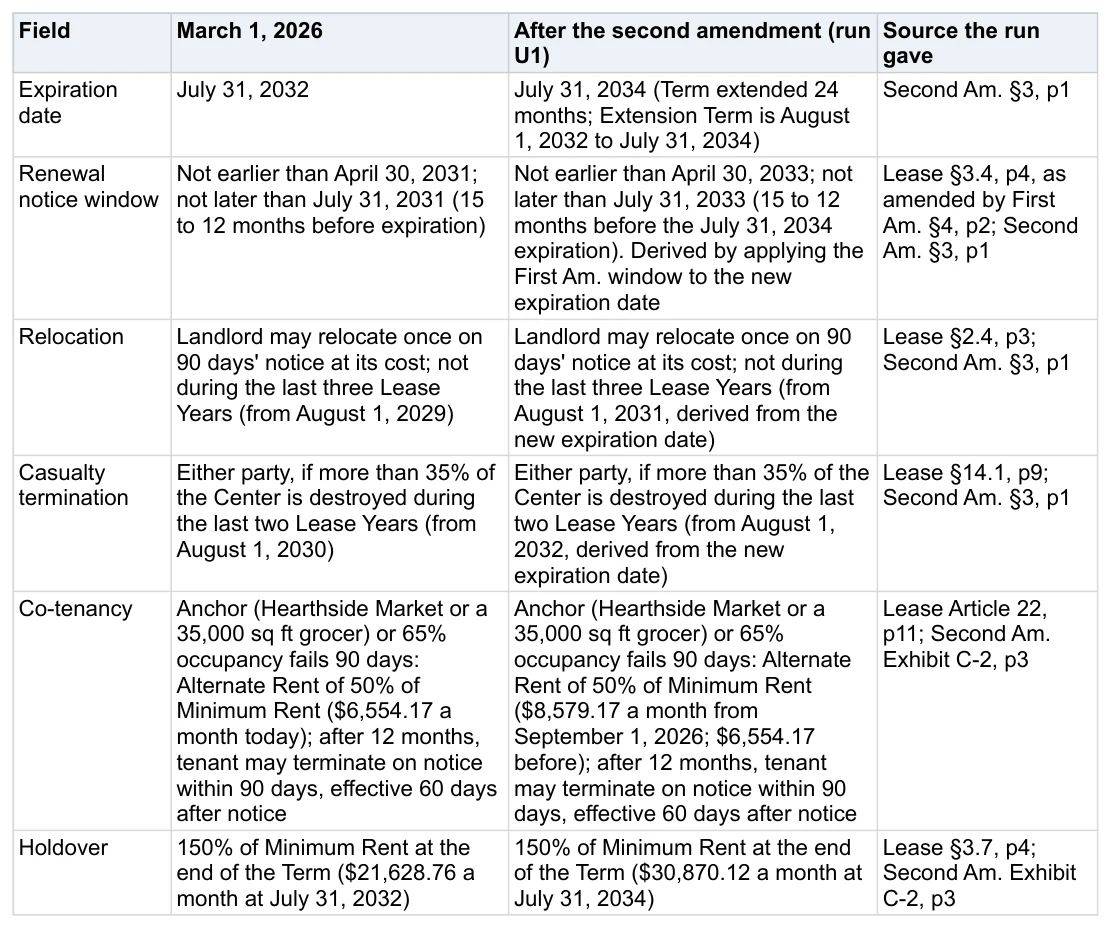
Two of the three marked those five as worked out rather than read, and asked a person to confirm them. One recorded the extra $6,900 deposit as already paid; the amendment says it is due on signing.
The risk that remains is the amendment that never reaches whoever updates the abstract.
On our file, an abstract that missed the second amendment would bill $13,108.33 a month from September 1 instead of $17,158.33: $4,050 a month, $48,600 a year, the whole rent of the new suite. It would also charge operating costs and taxes at 4.09% instead of 5.30%.
Let the AI agents draft the update; keep the approval. At first they change nothing on their own: they write the update with its sources, and a lease administrator approves it before billing, the calendar or anything a tenant sees changes.
Qvery's AI Agents Read Every Lease Document the Day It Is Signed
These five moves are what Qvery's AI agents run, on every new lease and every document that changes one. The first run on your own files comes two weeks after we can reach the folder where signed documents land and your lease system.
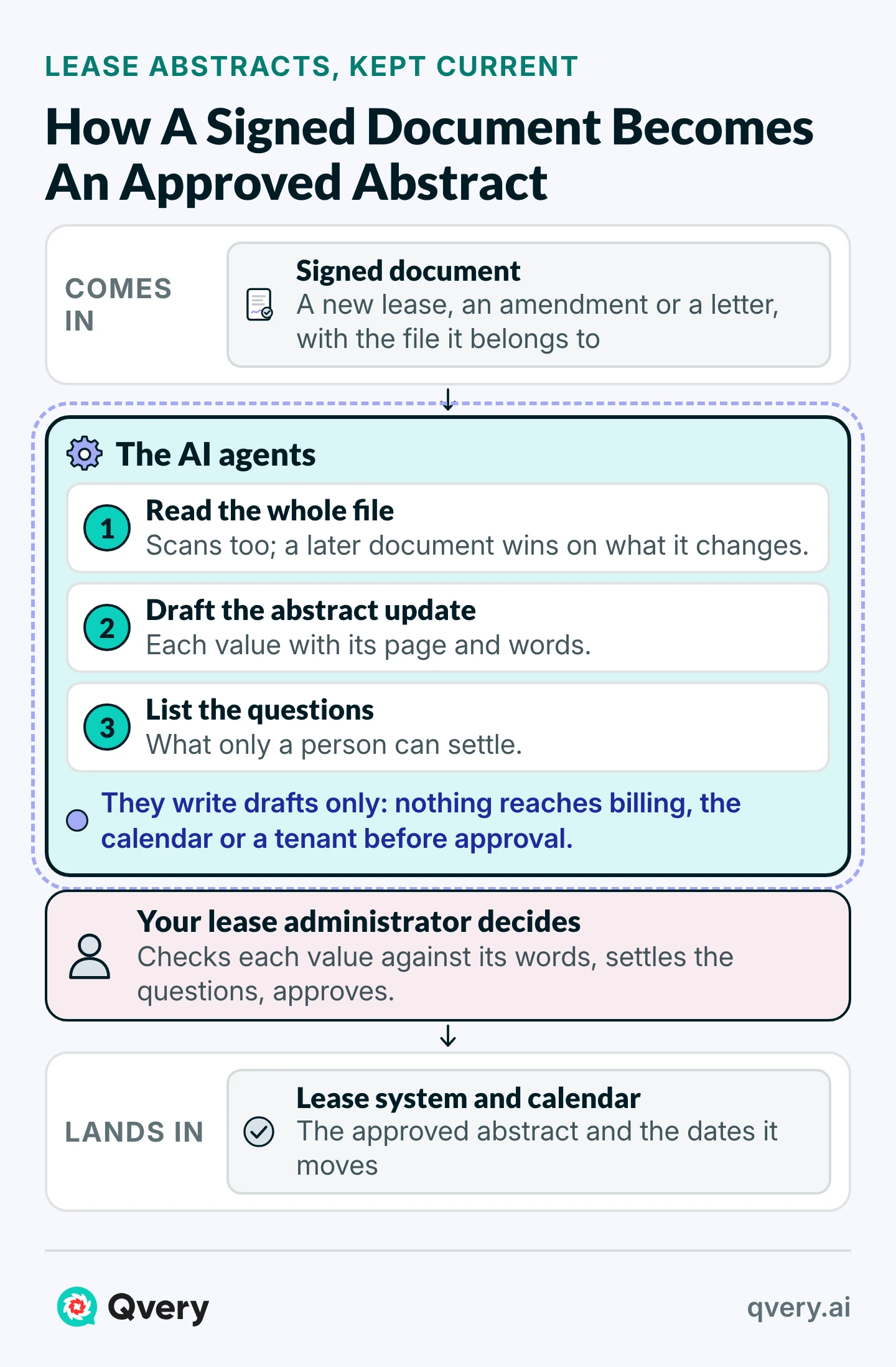
When a signed amendment, letter or new lease reaches the lease folder or the legal inbox, the AI agents read the whole file it belongs to, scans included, and draft the abstract update: every changed value with its document, page and words, and the dates that move with it.
They put the update and its questions in front of your lease administrator: the values to confirm, the clauses that need a decision, the deadlines that fall on a weekend. Once approved, the update goes into your lease system and the new dates into the calendar.
Take the example of a landlord with 60 documents a month, 75 minutes each by hand and 20 with the AI agents. A lease administrator costs $48.07 an hour (the federal median for property and real estate managers, the nearest occupation, plus benefits). The job costs $43,263 a year today, $60.09 a document.
With the AI agents it costs $14,969, $20.79 a document, including about $3,432 a year to run them. That is $28,294 saved and 660 administrator hours a year, and each $10,000 of the build pays for itself in 4.2 months. Put your own numbers in:
Cost Per Lease Abstract ROI Calculator
What Each Lease Document Costs You To Abstract, And With The Agents
Saved Per Year
$28,294
660 hours handed back, after $3,432 a year to run it
- Hours Handed Back
- 660 hours a year
- Agent Running Cost (Estimate)
- $286 a month
- Payback Per $10,000 Of Build
- 4.2 months
On these numbers, each document costs $20.79 instead of $60.09, the agent saves $28,294 a year after its own running cost, and every $10,000 of the build is earned back in 4.2 months.
The calculator counts hours. Those hours go back to tenants and renewals, the work a growing portfolio otherwise hires another administrator for. The larger number is the amendment nobody passed along: on one tenant in our file, $48,600 a year of rent never billed.
Bring us three lease files with their amendments and the abstracts your system holds for them. We sit with how your administrators abstract today, map the fields your lease system and calendar use, and settle in writing which folders the AI agents may open.
Two weeks from the day the access is in place, the next signed document goes through them. From then on you get a weekly count: documents read, updates approved, questions raised and the hours your administrators got back.
Frequently asked questions
Can AI abstract a scanned lease?
Yes, when the scan is readable. The second amendment in our sample was a scan with no text layer, and every run read it as an image. A copy of a copy, a fax or a handwritten change is harder: ask for the pages the model could not read, and get better copies of those.
How accurate is AI lease abstraction?
On our invented file, every run got all twelve terms we tested right, and every page cited for them was right. That is one clean file, not your portfolio. Measure it on yours: run ten past files whose abstracts you trust, and compare the results field by field before anything goes live.
Will the AI make up terms that are not in the lease?
A model asked to summarize can fill a gap with what leases usually say. The prompt forbids that and asks for the words behind every value, so an invented term has no quote to stand on. No run invented a clause on our file.
Is it safe to put tenant leases into an AI tool?
Not into a tool someone picked up on their own. Before Qvery's AI agents open a lease, we put in writing which folders they may read and where the documents are processed. They get the least access the job needs and log every action. Qvery AI OÜ is an EU company, and we sign a data processing agreement with you.
Does it work with the lease system we already use?
The AI agents work with what your system already gives your team: an import, an export, a folder. Where the system lets an agent write, the approved update goes straight in; where it does not, the update arrives as a file your administrator imports. We check what your system allows before we build anything.
Can the abstract support lease accounting under ASC 842?
The abstract carries what accountants start from: the commencement date, the term, the rent schedule and the options. Under ASC 842, the US lease accounting standard, a landlord spreads operating lease income evenly over the term, so an amendment that changes rent changes that schedule. Whether added space counts as a separate lease is your accountants' call.
What about leases with amendments signed years ago?
Run the whole file once, oldest document first, and compare the result with the abstract your system holds today. The differences are either old updates nobody made or old abstracts that were wrong, and both are worth knowing before the next renewal season. After that, each new document is a short update.
Does this work for office and industrial leases?
Yes, with their own fields. Each kind of lease has terms the others do not, so the field list changes and your lease administrator decides what goes on it. The reading, the sources and the check stay the same, and so do the questions about what a person settles.
Who decides when a clause is unclear?
A person, always. The AI agents put the unclear clause in front of your lease administrator with the words that make it unclear and what each reading would mean for the abstract. Your administrator or counsel decides, and the abstract records which reading applies and who chose it.
What do the AI agents cost to run?
On the example above, about 60 cents of model use a document plus $250 a month of hosting and upkeep, an estimate: $3,432 a year at 60 documents a month. The build itself is a fixed price, set before any work starts, for a result defined up front. The calculator shows how fast each $10,000 of it pays back.
Can the AI agents remind us before a deadline?
They put each date in the calendar your team already reads, with the clause it comes from: renewal windows, rent steps, the operating-cost statement and the dates an amendment moves. A weekend deadline gets the working day before it. Who acts on a date stays with your people.
How long does one lease file take?
In our runs, the reading took between one and four minutes for a 24-page file. The time that counts is the check, which depends on how much changed and how many questions the AI agents raise. A new lease takes longer to check than a commencement letter that changes two dates.