On this page
- Every Tool You Added to Answer Faster Runs on Its Own Clock
- What Tangled Follow-Up Costs a Brokerage Your Size
- One Opt-Out Has to Stop Every Sender
- Where Qvery's AI Agents Take Over the Follow-Up
- What the AI Agents May Touch
- The Work Starts With a List of Everything That Can Text a Lead
- Frequently asked questions
Your brokerage fixed slow follow-up by adding things that send messages. The portals (the big listing sites, such as Zillow) send their own auto-reply. Your CRM, the customer records system your agents work in, starts a drip: a timed series of texts and emails.
Your inside sales desk, the staff who call new leads, has a dialer that places calls in bulk. Then the agent next in the rotation gets an alert and reaches for their own phone. Each of those is fast, and each stops for a different reason:
| Sender | What starts it | What stops it |
|---|---|---|
| The portal's auto-reply | The inquiry | Nothing: it sends once |
| Your CRM's drip | The lead landing in the CRM | A reply or a call the CRM can see |
| The dialer and its texts | The number going on a call list | Its own opt-out list |
| A texting bot from another vendor | A lead feed | Its own conversation |
| The agent next in the rotation | An alert on their phone | Their memory |
So a buyer who asks about one house can hear from four senders in a morning, get asked the same questions twice, and still be texted after they've said they found someone.
In our example brokerage that tangle costs 42 closed deals a year, about $126,000 of what the brokerage keeps, and the legal exposure comes on top.
At Qvery, we help brokerages waste less of what they spend on leads and keep their agents on real conversations, with custom AI agents that answer every new lead within a minute, keep every other sender quiet and hand the conversation to one licensed agent.
Every Tool You Added to Answer Faster Runs on Its Own Clock
Speed still counts. In Zillow's 2025 survey, half of the buyers who contacted an agent contacted only that one before hiring them. The first reply decides a lot, and almost every tool in that table was bought to make it faster. What none of them fixes is what happens after the first message.
CRMs handle their own side well. Follow Up Boss can pause an action plan, its name for a drip, when the lead replies by email or text, or after a call of more than 2.5 minutes logged through its own calling. Sierra's automated plans pause on a text, an email, a call or a form.
That pause covers the CRM's own messages. The dialer is a separate product with its own opt-out list, and PhoneBurner, to take one, reports a text STOP through an automatic notice that someone has to connect to your other systems. A text from an agent's personal phone is invisible to all of them.
Even inside one CRM the edges show: in Follow Up Boss, a contact who unsubscribes from the drip can still get one-to-one emails from an agent.
If you run everything inside one CRM, with one texting number and no outside dialer, you may not have this problem. Turn off the extras and enforce the rule.
The trouble starts when team leads have bought their own tools, because that's where a lead ends up with no owner: the rotation assigned an agent, the drip is still running, and the number is on today's call list.
What Reddit says
Agents on what repeated contact does to a lead
In today's environment, leads are often recycled or distributed to multiple agents simultaneously, resulting in a high volume of outreach directed at the same consumer.
We call that rapport building by harassment. Just so you know any quote you see about the average conversion takes 12 attempts or whatever is false information passed from one coach to the next.
I would hang up if the AI Chatbot called me and asked everything again that I just filled out. It's the same for a human caller.
The mortgage side already ran this experiment at scale. When credit bureaus sold applicants' details to competing lenders, the Government Accountability Office found homebuyers "could receive dozens of mortgage solicitations by phone or text in a short period", and that many were overwhelmed, annoyed and unsure who was writing.
No more than 3.5% of homebuyers may have taken a loan from those offers, and Congress restricted the practice from March 2026.
Your leads asked to hear from someone, which makes the first message welcome. It says nothing about the fifth.
What Tangled Follow-Up Costs a Brokerage Your Size
Our example is a brokerage of about 300 agents and staff that gets 700 paid leads a month. These are the assumptions, and you can replace each one:
- 25% of leads are lost today to a late, repeated or tangled first contact.
- 2% of leads handled well become a closed deal with the brokerage.
- $3,000 is what one closed deal leaves the brokerage.
Leads die for plenty of other reasons: a price, a loan, a buyer who was never serious. The 25% counts only the ones a clean, quick contact would have kept, and it's well under the 68% of website inquiries that got no reply within a day when Pied Piper tested offices of 21 large brands in 2026.
Most portal leads are early, so the close rate is low. The deal value starts from one side of the commission on a home at the September 2026 median of $417,500, at the 2.42% Redfin measured as the average buyer's agent commission in the third quarter of 2025: about $10,100, of which we assume the brokerage keeps 30% on a lead it paid for.
On those numbers, handling every lead well closes 168 deals a year where the brokerage closes 126 today: 42 more, worth $126,000.
By our estimate the AI agents cost about $650 a month to run at that volume, so the brokerage keeps $118,200 a year, and every $10,000 of the build is earned back in about a month.
Put your own numbers in: the paid leads you get a month, the share that goes cold after a late or tangled contact, how many of the ones handled well you close, and what one closed deal is worth after the agent's split.
Real Estate Lead Follow-Up ROI Calculator
What Tangled Follow-Up Costs You, And What The AI Agents Win Back
Won Per Year
$118,200
42 more closed deals a year, after $7,800 to run the agent
- New Closed Deals A Year
- 42
- Agent Running Cost (Estimate)
- $650 a month
- Payback Per $10,000 Of Build
- 1 month
On these numbers, answering every inquiry at once wins 42 more closed deals a year, worth $126,000, $118,200 after the agent's running cost, and every $10,000 of the build is earned back in 1 month.
Two costs sit outside the calculator: the inside sales hours spent dialing people who are already talking to an agent, and the legal exposure in the next section, which isn't a number you can type.
One Opt-Out Has to Stop Every Sender
On November 25, 2026, a revised federal rule takes effect: an opt-out made in reply to a marketing call or text revokes consent to all future marketing calls and texts from that caller.
The caller has up to 10 business days to honor it, and the Federal Communications Commission is asking whether that should drop to seven. A text counts as a call under the federal telemarketing law, and a person can sue for $500 per violation, up to three times that if it's willful. Three brokerage companies have settled suits under that law:
National Mortgage News, on court filings in the Anywhere Real Estate case (2025)
Those suits were about people who never asked to hear from the agent, so they aren't your inbound leads. They do show who ends up paying: the brokerage, for tools its agents picked. The Anywhere case concerned calls Coldwell Banker agents allegedly made with dialers such as Mojo and PhoneBurner.
In March 2026 a federal court refused to dismiss a class action against eXp over an agent's voicemails and texts, pointing to allegations that the brokerage displayed the agent on its website and took a share of the commission.
That's a ruling at the pleading stage, not a finding of liability, but the agent being an independent contractor didn't end the case.
Now look at the table again. A lead who replies STOP to the dialer's text is still in the drip and still on the agent's phone, unless someone connected them.
Whether a given message falls under the rule depends on how it's sent, and that's a question for your lawyer. One opt-out list, read by everything that can write to a lead, doesn't wait for the answer.
Permission also runs out:
- On a number listed on the Do Not Call Registry, an inquiry gives you what the rules call an established business relationship for three months.
- A do-not-call request ends that relationship sooner.
- Zillow's contact form has people agree that real estate professionals may call or text them "about your inquiry".
Some agents run drips for nine months, so that date has to sit on the lead itself.
An AI voice counts as an artificial voice under the federal rules, so those calls need the person's prior express consent. And states can go further: Florida has its own statute that covers text solicitations.
Where Qvery's AI Agents Take Over the Follow-Up
Take a portal lead that lands at 8:10 on a Saturday night, asking whether the basement is finished.
Within a minute, the AI agents we build for your brokerage have looked the person up in your CRM: a past client, someone already assigned, someone on the opt-out list. They check what consent that lead source passed along and what time it is where the person is.
Then they reply in the channel the person used, as your brokerage's AI assistant, with the answer from your listing data and the first question a good agent asks.
In that same minute they place a hold on the lead. Your CRM's drip pauses, the dialer drops the number from its list, and the agent next in the rotation gets a note saying who is handling it.
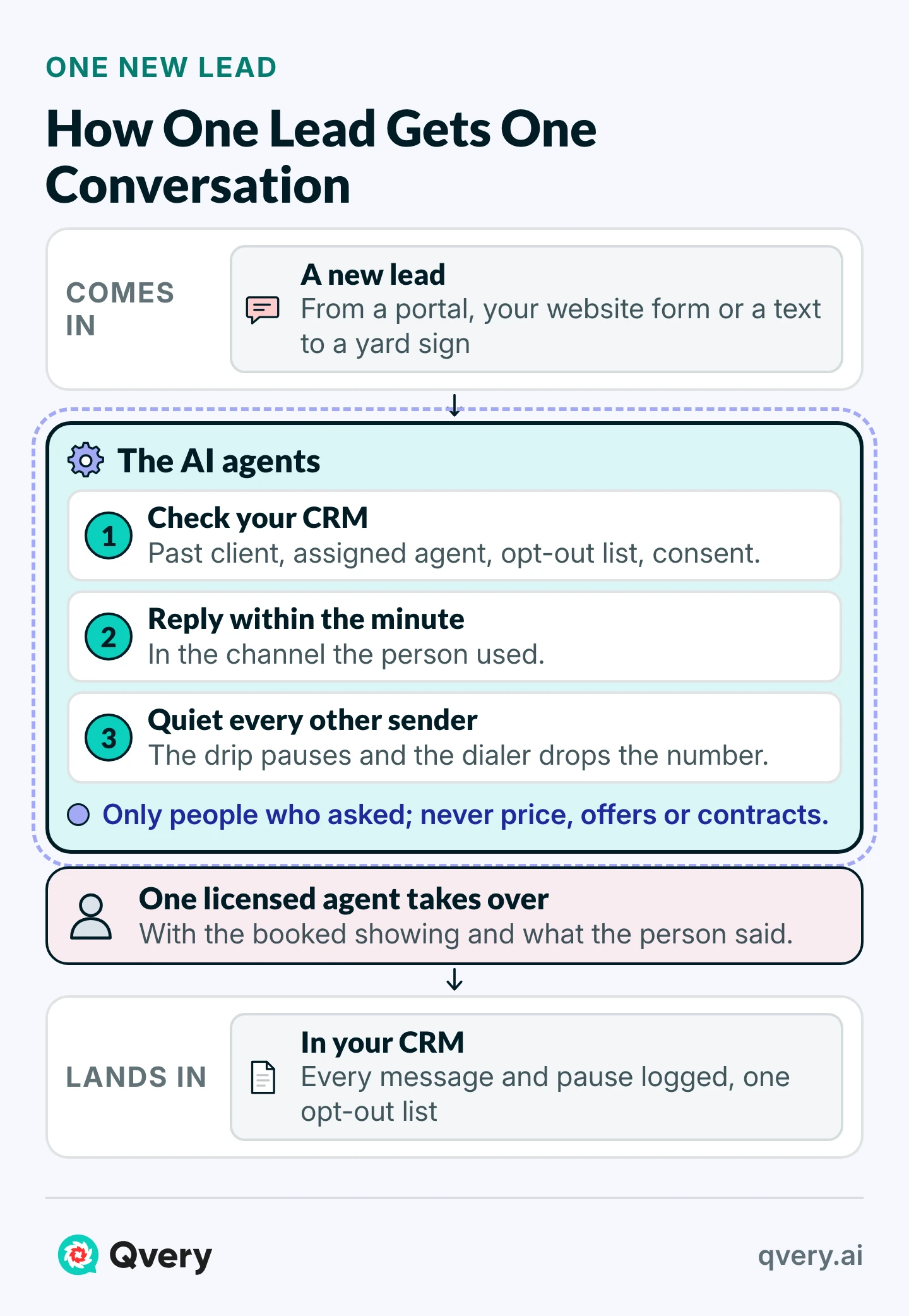
The hold is the hard part of this job, and it's most of what we build. We connect it to every tool that can take an instruction. A tool that can't gets taken off new leads. Nobody can hold an agent's personal phone, so that rule goes in writing: new leads get worked from the brokerage's number.
From there, each event has one answer and one owner:
| When this happens | What the AI agents do | Who holds the lead next |
|---|---|---|
| The person replies | Answer from your listing data, ask about timing and financing, keep the others on hold | The AI agents |
| They want to see the house | Book a time with the agent your routing picks and send that agent the summary | The licensed agent |
| That agent doesn't pick it up in the window you set | Route it to the next agent and tell the first one | The next licensed agent |
| They reply STOP or say they're not interested | End the thread and add the number to the one opt-out list every tool reads | Nobody |
| They already have an agent | Thank them and close the thread | Nobody |
| They're angry or confused, or ask about price, an offer or a contract | Hand over the thread at once, with what was said | The person your managing broker names |
| Silence | A short approved schedule tied to what they asked, then a monthly note with an end date | The AI agents, until the end date |
If you run inside sales agents (ISAs: staff who call new leads to qualify them), they stop dialing people already in a conversation and take the calls a person should make. Those hours are worth the most where you'd otherwise hire another ISA.
If several tools can write to the same lead in your brokerage today, that's the job to hand over first.
What the AI Agents May Touch
These AI agents hold personal data and write in your brokerage's name, so the limits are set before the first message goes out:
Your managing broker signs off on the script against your state's rules. Qvery AI OÜ, the EU company that builds these AI agents, signs a data processing agreement with you.
The Work Starts With a List of Everything That Can Text a Lead
We'll ask you for:
- Every tool and person that can contact a lead today, including what your team leads bought themselves.
- A month of leads, with what happened to each one.
- Access to your CRM, your dialer and your agents' calendars.
- Your routing rules, and who owns a lead once a showing is booked.
The first job is the map of who writes to a new lead today. Your managing broker approves the script, we connect the tools, and within two weeks of getting access the AI agents are running the follow-up on your own leads.
Then we report every week on what changed: leads answered, showings booked, duplicate contacts stopped and the hours your inside sales desk got back.
Frequently asked questions
How fast should a brokerage answer a lead?
Within a minute if software is answering, and within the hour if a person is. The bar is low: when Pied Piper tested offices of large brands in 2026, 68% of website inquiries got no reply within a day. Fast only pays if the second and third messages know about the first.
Should AI text or call first?
Reply in the channel the person used. Buyers who used an agent preferred texting (39%) to phone calls (33%) in Zillow's 2025 survey, so a form or a text usually gets a text. A call is for the licensed agent, once the person has said they'd like one.
How many follow-ups is too many?
There's no agreed number. Agents report anything from a handful of touches to 21 in the first week, and I haven't seen a public study that settles it for real estate. We build a short schedule you approve, with a reason for each message, that stops the moment the person replies.
Do we still need our CRM's drip?
For the long game, yes, if it pauses while a conversation is live and reads the opt-out list. An email for someone who asked to see new listings is useful. What goes is the text drip running alongside an agent who's already talking to the person.
Can it work with our dialer?
Yes, if the dialer can take an instruction from another system, through a connection it offers. Where it can't, we take new leads off it and leave it for the lists your desk works on its own. Either way, the opt-out list reaches the dialer first.
What about agents texting from their phones?
Neither the AI agents nor your CRM can see a personal phone. So the rule goes in your agent agreement: new leads get worked from the brokerage's number. A STOP that lands on an agent's own phone still has to reach the one opt-out list, and agents need one easy way to send it there.
What if two agents claim the same lead?
Your routing decides and the AI agents apply it. Everyone can see who holds the lead, and a past client goes back to the agent who sold them their last home. A dispute goes to your managing broker with the whole message log in front of them.
How long can we keep messaging a lead?
As long as you have permission and a reason. For a number on the Do Not Call Registry, an inquiry gives you three months under federal rules. Your lawyer sets the line for your states, and we put that date on every lead so the follow-up ends by itself.
Does a portal's consent cover our texts?
Partly. Zillow's form has people agree that real estate professionals may call or text them about their inquiry, by automated means too. That reads as permission to talk about that inquiry, not to market to them for a year. We record what each lead source's wording covers.
Does this protect us from lawsuits?
No system can promise that. It won't undo past sends, and it can't see what agents do outside it. It gives you one opt-out list, one record of who wrote to whom and a follow-up that ends on a date: risk management your lawyer can review.
What about the leads we already have?
We start with new leads, where the records are cleanest. Your existing database gets checked against the opt-out list and the permission dates before anyone writes to it. A lead with no record of consent stays out of texting until someone has that record.
Do team leads lose their leads?
No. Team leads keep their routing and their agents keep their clients. What changes is that a team's own texting tool goes on the list of senders, so it pauses while the AI agents hold the lead. A team that wants its own wording for the first reply can have it.
What if the AI agents get a fact wrong?
They answer from your listing data and don't guess: a fact that isn't in the listing goes to a person. For the first weeks someone reads every reply before it goes out, so you see how they handle your leads before anything runs on its own.
What happens on nights and weekends?
They reply around the clock to people who just wrote in, inside the hours your lawyer sets. Federal rules bar telephone solicitations before 8 a.m. and after 9 p.m. where the person is, so anything that isn't a reply to a fresh message waits for morning.
What does it cost to run?
In our example, about 50 cents a lead in model use and messages plus $300 a month for hosting and upkeep, so about $650 a month at 700 leads. Calls cost more to handle than texts. The build is a fixed price for a defined result, agreed before we start.
How soon is it live?
Within two weeks of getting access, once your routing rules and the script are settled. Most of that time goes to connecting each sender so the hold works. For the first weeks a person approves each reply, and then you decide which go out on their own.