
On this page
A retailer that runs several brands keeps adding products it already sells. A supplier’s new season file or a brand the company takes on brings items that are already in the catalog under another code.
Someone on the catalog team searches the item master and each brand’s store by name, size and barcode before each one goes live. The twin they miss turns up months later, when a stock count or a reorder stops adding up.
On a catalog of about 18,000 active products, with roughly one in five new each year, that is around 300 new supplier items a month. At 15 minutes each, our assumption, and an order clerk’s pay with benefits, it comes to about 900 hours a year, $28,539.
The supplier bills look like the obvious first job for AI, because an overcharge is money you can point at. I’d hand the first agents the product codes instead, then the bills, then the customer lists before the next loyalty push, and the returns last.
The bills, the reorders and the returns report all count by product code, and a product sitting under two codes nobody tied together makes each of them wrong in its own way. One kind of retailer should start with the bills: a single brand on one clean item master, with a receiving team that counts every delivery.
| The job | Its place | Why there |
|---|---|---|
| Product codes | First | Reads files you already have, and the bills and returns count by what it fixes |
| Supplier bills | Second | Needs pack sizes the catalog has right |
| Customer lists | Before the next campaign or loyalty launch | Its hours come in waves around those dates |
| Returns | Last | Pays only when someone fixes the listing |
Most Jobs in a Retailer Count by Product Code
Stock, sales, reorders, prices and promotions are all counted by product code. When one product sits under two codes that nobody has tied together, each count holds part of the picture, and no report says which part.
| What reads the code | What a twin does to it |
|---|---|
| The stock count | Splits across two records, so each looks thinner than the product is |
| The reorder report | Sees half the sales history and suggests the wrong quantity |
| A price change | Lands on one code while the other keeps selling at the old price |
| A supplier bill | Differs from the order every time, if the pack size was set up wrong |
| The returns report | Splits the returns, so neither code ranks where the product does |
Running several brands makes twins more likely.
A product code (a SKU, the stock-keeping unit) is the retailer’s own number: GS1 US, which runs the barcode standard in the United States, notes that sellers offering the same item under the same barcode each give it their own SKU.
Inside a group of brands, each brand’s catalog can behave like a separate seller. New items keep coming, too: in US consumer goods, about one product in five on sale is new in a typical year.
The clearest measurement of what this does is old and British. When GS1 UK compared the product files of four large UK supermarkets with their suppliers’ in 2009, it found 58% duplicate barcode numbers across more than a million records in the supermarkets’ files, removed before any comparison could start.
Even case and pack sizes, the data purchasing watches most closely, still differed in 10% of that data. The report said those differences cause problems in invoice matching and show up as stockouts nobody expected and as over- or underpayments to suppliers.
What Qvery’s Agents Do With Each New Supplier File
Our agents start where your catalog team starts: the moment a supplier file lands or a brand’s catalog is added. They read it beside your item master and every brand’s store, whatever each one calls its columns, and they write to none of them.
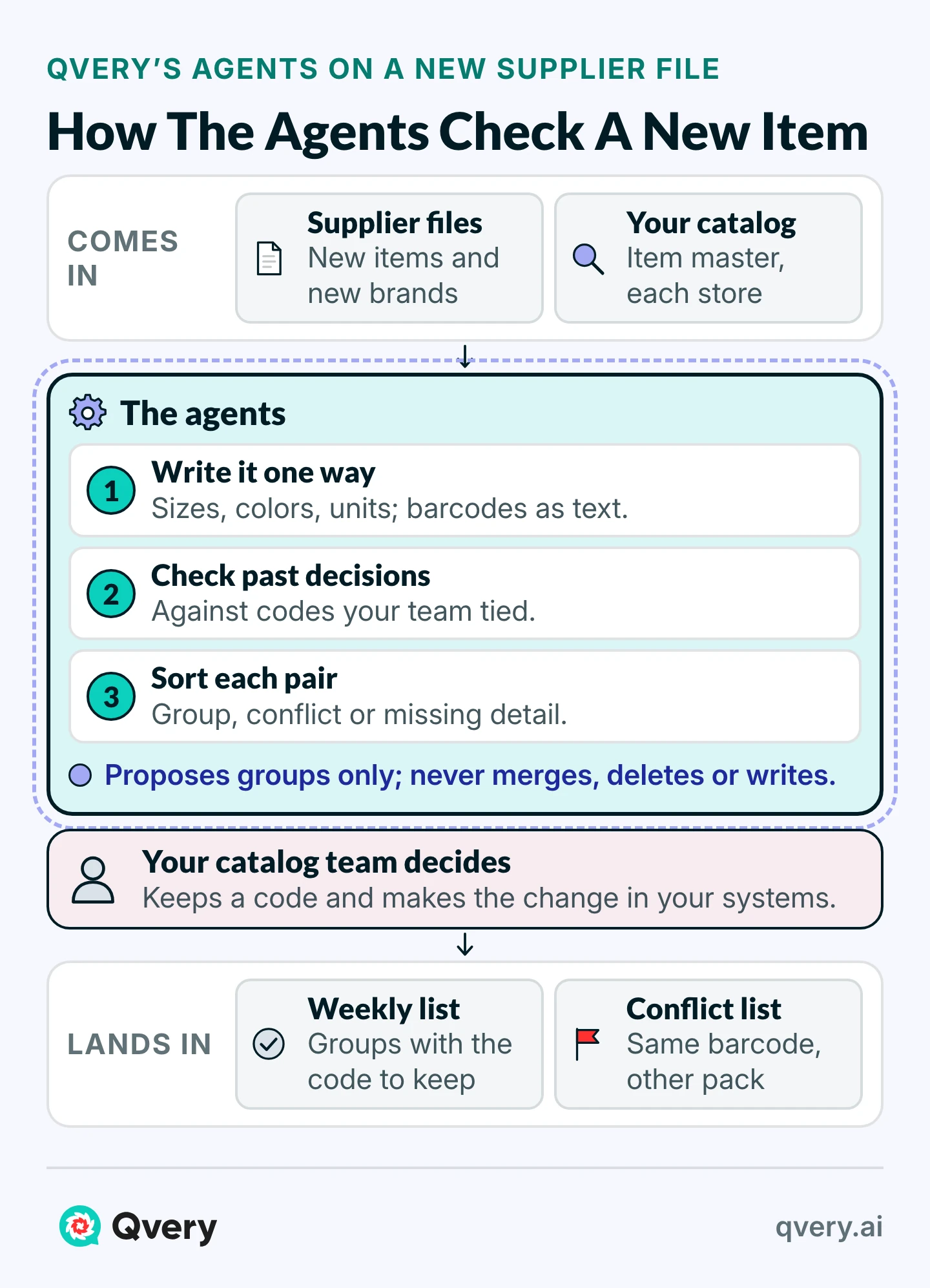
Before comparing anything, they write sizes, colors and units one way, so “Nvy XL 2pk” and “navy, extra large, pack of 2” read as the same thing. Barcodes are read as text, leading zeros included, so a spreadsheet can’t drop the zero that ties a code to its twin.
Each new item is checked against the codes your team has already tied together, so a decision made in March still holds in October. Two codes join a group only when every detail they share agrees: brand, model, size, color and pack count.
A matching name on its own only marks a pair worth a look. When the barcode agrees and the pack count doesn’t, the pair goes on a separate conflict list, because that’s the record that would make a bill look wrong later.
Each group reaches your catalog team with the code your rule keeps and the details that match and differ. Your team settles it in your own systems, and the agents never merge or delete a product.
Codes your brands keep apart on purpose stay apart: your team turns that group down, and we tighten the rule so it stops coming back.
Within two weeks of access they have run on your whole item master and handed over the first groups. From then on, every new supplier item is checked as it’s set up, and the likely twins reach your team in a weekly list.
 Piotr BabelPartner @ Qvery
Whatever the agents compare against decides how far you can trust a group. So they hold each new item to the codes your team has already tied together, and two codes group only when brand, model, size, color and pack all agree. A row missing its size waits for it instead of guessing, and every group shows why it formed.
On the example’s numbers, checking one item by hand costs about $7.93 of a clerk’s time. With the agents it’s about $2.85, their running cost included: 3 minutes instead of 15, our assumption, because most items need a glance at the agents’ answer and a likely twin a few minutes, plus about $380 a month to run them.
That’s 720 hours a year handed back, about $18,271, and every $10,000 of build comes back in about 6.6 months.
The hours go to checking every new item, twin or not, so they don’t depend on how many turn out to be twins. They’re worth that money when they go to new ranges your catalog team would otherwise need another person for.
The calculator counts only the clerk’s time. The split stock, the stale prices and the false bill differences the agents head off come on top; they’re harder to price, and we leave them out. Put in your own catalog’s numbers:
Supplier Item Matching ROI Calculator
What Checking New Supplier Items Costs You, And With The Agents
Saved Per Year
$18,271
720 hours handed back, after $4,560 a year to run it
- Hours Handed Back
- 720 hours a year
- Agent Running Cost (Estimate)
- $380 a month
- Payback Per $10,000 Of Build
- 6.6 months
On these numbers, each supplier item costs $2.85 instead of $7.93, the agent saves $18,271 a year after its own running cost, and every $10,000 of the build is earned back in 6.6 months.
The agents read your item master, each brand’s store and the supplier files. Which exports and folders they may open, and where they run, is agreed in writing before they open any of it.
Supplier costs and prices play no part in the matching and never appear in a group. Each proposed group is logged, and Qvery AI OÜ, registered in Estonia, handles your files under the GDPR.
The quickest test is your own catalog export.
If the groups on your export look right, the next step is the same check on your whole item master and on every supplier file as it lands, held to your own rule for which code survives.
Supplier Bills Look Like the Better First Job
An overcharge is money on a page, and checking bills is the bigger job. On the example in our two-way matching post, a retailer this size spends about 1,500 hours a year checking bills by hand, against 900 for new items.
Across industries, payables teams report that 18.4% of invoices hit an exception and that an invoice costs $9.84 to process on average, by Ardent Partners’ 2025 survey. The people who check supplier bills see it too.
What Reddit says
People who check supplier bills on what they catch
I receive well over 250 invoices a month and my best guess is this saves me approximately 20 hrs per week just in paperwork but I probably catch 4 or 5 receiving errors per month which has saved me 1000’s of dollars.
I’m starting to notice small cost changes like a packaging surcharge showing up on certain SKUs or a fulfillment line item shifting by a few cents per unit that isn’t being flagged anywhere.
All of that is true, and on our own examples the bill agents hand back more hours a year as well. With a clean catalog, that would settle the order. It’s also why they’re the second agents we’d build here, right after the first.
What keeps them second is what a bill gets checked against. The agents hold each bill to the order and to the record of what arrived, and in retail that record is often the supplier’s own shipping notice, booked when the cartons are scanned rather than counted.
A bill and that receipt can agree and both be wrong. That’s a receiving problem, not a catalog one, and it means part of what bill agents report as a match is only as good as the count behind it.
Then there’s the catalog itself.
A pack size set up wrong on one item, a case of twelve recorded as single units, can make every bill for that item differ from its order, every time you buy it.
Bill agents would find it, but one bill at a time, as a question to a buyer about the supplier’s bill, when the error sits in your own item record.
UK grocery’s own estimate in that 2009 report was that as many as 40% of invoices didn’t match deliveries, with a significant share of it down to product data.
The product code agents catch the same error once, at setup: every pair with the same barcode and a different pack goes on their conflict list, and your team sets the right pack from the supplier’s spec. Settle those first, and the bill agents stop meeting the same false difference on every bill for those items.
 Vlad ShvetsPartner @ Qvery
The bill check is the bigger job, and I’d build it second, not later. But it can only hold a bill to the order and the receipt it finds, and both lean on your catalog. Fix the codes and pack sizes first, so the bill agents spend their first month on real differences instead of the same false one every week.
Our retail playbook prices the product codes, the supplier bills and the customer lists for one retailer of about 200 people.
Customer Lists and Returns Come Later
Matching customer records comes in waves: the work piles up before a loyalty launch, a big campaign or a move to a new online store, and goes quiet between them.
So the agents for it earn the most when one of those dates is on the calendar: put them on before the next one. They group the records that look like one shopper, with the evidence, and they never merge a record or touch anyone’s marketing consent.
Returns come last. Large US retailers expected 19.3% of online sales to come back in 2025, by the National Retail Federation’s survey, and agents that read every return comment can show which listings keep causing them.
The refunds only fall once someone changes the size chart, the photo or the supplier order the agents point at, and the saving shows up weeks later, in returns that never come.
The returns report also counts by product code, so on a catalog with twins, the shirt that keeps coming back can sit in the middle of the list.
On all four jobs, the decisions stay with your people:
- Your catalog team decides which code survives
- Your payables team decides which bill gets paid
- Your CRM lead decides which customer records merge
- Whoever owns the product pages decides what changes on a listing
The Catalog Comes First, Then the Bills
In a retailer with several brands, the bills, the reorders and the returns all count by the catalog, so that is where the first agents belong.
Working with us on it starts with your item master and the next supplier file that lands. Your catalog team already has a rule for which code wins when two collide, oldest active or best sales history, and that rule is the first thing we build in.
Two weeks after we have access, the first groups are on their desk.
Once they trust them, the bill agents go to work on the same catalog.
Frequently asked questions
Where should a retailer start with AI?
With a back-office job your team does by hand every week and can check line by line. In a retailer with several brands, that’s the product catalog: matching new supplier items against the codes you already have. Supplier bills come next, then customer lists before a campaign, then returns.
Where does AI help most in a retail back office?
In jobs that read and compare records people now check by eye: supplier files against the item master, bills against orders and receipts, customer records across brands, return comments by product. The agents prepare each match or difference with its evidence, and nothing in your systems changes until someone on your team says so.
Will the agents merge or delete products in our catalog?
No. They read your item master and each brand’s store without writing to them, and propose groups of codes that look like one product. Your catalog team accepts or rejects each group and makes the change in your own systems. A rejected group changes nothing, and the rule behind it gets tightened.
What if our supplier files have no barcodes?
Other details carry the match: brand, model, size, color and pack count, written the same way before they’re compared. A row missing its size waits rather than guesses. Where a file holds only names and codes, the agents say which extra columns would find more twins.
Do we need a PIM before we start?
No. The agents read the item master wherever it lives today: your ERP (the system that runs your orders, stock and accounts), a product information system (PIM) or a spreadsheet export, plus each brand’s online store. If you run a PIM, they read from it without writing to it.
Do the agents read our marketplace listings?
Yes, where the marketplace offers an export of your listings. They’re compared like any brand’s catalog, so a product you list twice on a marketplace shows up in the same weekly groups as the twins in your own stores.
How big a catalog can the agents handle?
The whole item master, every brand’s catalog and every supplier file, never a sample. We size the build to your row count before it goes live, and each run states how many rows it read from each file, so you can check it against your own count.
How long before we see the first duplicate codes?
Within two weeks of access, the agents run on your whole item master and hand your catalog team the first groups. After that, new groups arrive in a weekly list, with the hours saved and the groups your team turned down.
What does it cost to run product code agents?
On the example’s 300 new supplier items a month, about $380 a month: roughly 10 cents an item for model use, plus hosting, the weekly read of the whole item master and upkeep of your rules. The build is a fixed price agreed before we start.
How fast do they pay for themselves?
On the example’s numbers, about $18,271 a year of clerk time comes back after the running cost, so every $10,000 of build is repaid in about 6.6 months, counted in time rather than cash. Put your own volume and minutes into the calculator above.
Can the same agents check supplier invoices?
Bills have their own agents: they hold each bill line to its purchase order and delivery notes, add up deliveries that came in parts and list every difference for the buyer. We build them second, on the same catalog, so pack sizes your team fixed from the conflict list stop showing up as false differences.
Who decides which product code survives?
Your catalog team. Each group arrives with the code your rule keeps, such as the oldest active code, and the dates that decided it. Without a rule, the agents suggest the fullest record and say why.
Are our supplier costs and prices safe?
Costs and prices play no part in matching and never appear in a group list. A written agreement fixes which exports and folders the agents may read, where they run and how long files stay, and every group they propose is logged. The processing terms, under the GDPR, are signed before your first file arrives.
Why not start with a chatbot for customers?
A chatbot answers from the same catalog the back office keeps, so a twin code or a wrong pack size reaches the customer through it too. Its conversations are also harder to check than a list of product groups. Fix the catalog first, and a chatbot added later answers from it.
