
On this page
- Two-Way Matching Is Enough Where There Is Nothing to Count
- Your Oldest Supplier Still Needs a Count
- Drop-Ship Orders and Deposits Need a Different Third Document
- What the Wrong Rule Costs a Retailer Your Size
- Your Accounting System Sets the Check Before the Bill Arrives
- Qvery's Agents Pick the Check When the Bill Lands
- Your Clerks Work Beside the Agents by Week Two
- Frequently asked questions
When one matching rule covers every supplier bill, it fails at a retailer in two directions. The cleaning contractor's monthly bill waits on hold for a goods receipt nobody will ever post, because nothing was delivered.
A merchandise bill goes through clean, because its receipt was scanned from the supplier's own shipping list and nobody opened the cartons.
At a retailer of about 200 people that is roughly 500 bills a month. On our assumptions, a quarter of an hour of a clerk's time each comes to about $52,200 a year before anyone has argued with a supplier.
In a payables queue, the one rule shows up like this.
- A store cleaning or security bill on hold for a "missing receipt"
- A store manager asked to "receive" a software subscription so it can be paid
- A drop-shipped order billed, with nothing in your system to check it against
- A deposit to a factory that nobody knows how to match
- A merchandise bill matched to a receipt copied from the supplier's own list
At Qvery, we help retailers pay only for goods that arrived and keep service bills moving, with custom AI agents that check each bill line against its proof and flag gaps.
Each bill line should get the check its proof allows, decided when the bill arrives. That is work Qvery's agents do beside your clerks.
Two-Way Matching Is Enough Where There Is Nothing to Count
Three documents decide a supplier bill. The purchase order is what you agreed to buy and at what price. The goods receipt is your record of what arrived, counted by your people. The bill is what the supplier says you owe.
A two-way match checks the bill against the order: the right items, the right price, no more than you ordered. A three-way match adds the receipt, so you pay for what arrived rather than what you ordered. A four-way match adds an inspection report, for goods that must pass a check before they count as received.
Which one a bill needs follows from the proof that can exist for it. A cleaning contract has nothing to count; a pallet of terracotta pots does.
| The bill | What proves it | The check |
|---|---|---|
| Store cleaning, security, maintenance | The contract, and your store manager's word that the work was done | Two-way, against the order or contract |
| Rent, utilities, software subscriptions | The lease or contract, and last month's bill | Against the contract; often no order at all |
| Freight and fulfilment | The rate agreement and the shipments it covers | Against the rates, line by line |
| A deposit before a factory starts | The order and the deposit terms you agreed | Two-way for the deposit; the full check on the balance |
| Merchandise into your warehouse or stores | Your count of what arrived | Three-way, from every supplier |
| Deliveries straight to a store | The slip your store signed | Three-way, with the store's slip as the receipt |
| Drop-ship orders sent to your customer | The carrier's delivery record for that order | Against the order and the tracking |
| Private-label goods passed by an inspector | The inspection report, then your count | Four-way |
The first four rows can stop waiting for a receipt today. The fifth is where retailers are tempted to cut the check, and it is the one row I would never cut.
Your Oldest Supplier Still Needs a Count
Dropping the receipt for suppliers who have shipped correctly for years is the tempting shortcut. Retail receiving records show what it lets through.
Journal of Operations Management, vol. 38 (2015), a study of one major retailer's distribution center; Auburn University Center for Supply Chain Innovation, Advance Shipping Notification and Inventory Integrity Report (2018), a survey of 58 U.S. retailers
The first figure comes from a study of one large retailer's audit records in the Journal of Operations Management. The other two come from Auburn University's survey of retailers' receiving, published in 2018. Neither is your supplier. Both say deliveries arrive short or wrong often enough that nine in ten retailers in Auburn's survey still audit what comes in.
There is a second trap inside the receipt itself. Most retailers in Auburn's survey use advance ship notices (ASNs), the electronic list a supplier sends of what each carton holds, and many warehouses receive by scanning each carton's label against it.
It is fast. When nobody opens the carton, the receipt records what the supplier said it shipped, and a three-way match against it compares the bill with the supplier's own list.
Tips from Reddit
Payables and receiving people on what a receipt proves
if nobody records receiving its really just a 2 way match, which is fine for low risk stuff but id document it as a known gap
A lot of companies will have two check in processes; one for trusted shippers where they assume everything is correct, and another that is manual where they check everything on the shipment for accuracy, almost as if they didn't receive the ASN.
when we went to asn with coke it was that way for 4 weeks you had to have a 95% or higher check in rate then it moved to totals only and will have an "audit" full count check in on occasion
Retailers that handle this well audit by record. In Auburn's survey, the approach gaining ground may check every delivery from new and poorly performing suppliers and fewer from proven ones; about one retailer in ten checked every unit.
So the ruling for merchandise is a three-way match for every supplier. A good record changes how often your people open the cartons, not who does the counting.
 Vlad ShvetsPartner @ Qvery
A two-way match on a merchandise bill is a decision to take the supplier's count as yours. Some owners make it on purpose, for a handful of suppliers with years of clean deliveries. Others never decided it at all: a receipt got scanned from the supplier's list, and the check went quiet. Decide it on purpose, supplier by supplier, and make sure someone on your team owns the answer.
Drop-Ship Orders and Deposits Need a Different Third Document
Two kinds of retail bill have no receipt to match. A drop-ship bill needs proof from outside the order; a deposit is matched to the order now, and its balance to your count later.
A drop-ship order goes from your supplier straight to your customer. Nothing reaches your dock, so nothing can be received, and NetSuite's own help tells you not to require a receipt match on drop-ship lines.
The best proof you have sits outside your accounting system: the tracking number the supplier sent for that order and the carrier's record that it was delivered. That record is the third document I would check a drop-ship bill against.
A deposit to a factory is paid before the goods exist. A common arrangement with overseas factories is part of the price before production and the balance against a copy of the bill of lading, the carrier's receipt for the container.
Dynamics 365 and Business Central both record a deposit as a prepayment on the purchase order and take it off the final bill when that bill is posted.
What the Wrong Rule Costs a Retailer Your Size
A blanket three-way rule turns every bill with nothing to receive into a hold.
A clerk finds out who owns the bill, waits, and clears it, or someone posts a receipt on another person's word so the bill can be paid. Once that habit sets in, a receipt on a merchandise bill no longer proves anyone counted.
Ardent Partners' 2025 benchmarks, drawn from payables teams across industries, show how far exceptions reach into the whole queue.
A blanket two-way rule does the opposite damage. It clears the bills fast and pays for what was ordered, short cartons included. On the sample bill we built for this agent, a garden retailer's invoice, six lines billed at the ordered quantity carry 174 units that never arrived: $2,030.90 on one bill.
The time side, for a typical retailer of about 200 people on our assumptions: 500 bills a month, about 15 minutes of a clerk's time each by hand, at $34.80 an hour.
That last figure is the federal median for bookkeeping, accounting and auditing clerks, $24.36 an hour in May 2025, with pay at 70% of what a private employer spends on a person.
That is $8.70 a bill and 1,500 hours a year. With our agents checking each bill and a clerk spending about 4 minutes settling what they found, the bill costs $3.17, the agents' own running cost of about $425 a month included.
The difference is $33,180 a year and 1,100 hours handed back to your clerks, and every $10,000 of the build is earned back in 3.6 months. Put your own volume and minutes in.
Supplier Bill Check ROI Calculator
What Checking Supplier Bills Costs You, And With The Agents
Saved Per Year
$33,180
1,100 hours handed back, after $5,100 a year to run it
- Hours Handed Back
- 1,100 hours a year
- Agent Running Cost (Estimate)
- $425 a month
- Payback Per $10,000 Of Build
- 3.6 months
On these numbers, each supplier bill costs $3.17 instead of $8.70, the agent saves $33,180 a year after its own running cost, and every $10,000 of the build is earned back in 3.6 months.
The figures don't count the short deliveries caught before payment. Whatever those come to on your bills is on top.
Your Accounting System Sets the Check Before the Bill Arrives
Your ERP, the system that holds your orders, receipts and books, can already set the check ahead of time.
Dynamics 365 sets it for the company and lets you override it for a vendor, an item, a pair of the two or one purchase order. NetSuite has a "Match Bill to Receipt" box on each order line, which the item's record can tick by default.
If a supplier only ever sends services, or only ever sends stock to your warehouse, change its default and you are done. That costs nothing, and you don't need us for it.
The setting breaks on the bills that mix. The check is fixed on the order line when the order is written.
What happened shows up only with the bill: a delivery in three parts, a freight charge nobody put on the order, a line drop-shipped to a customer, a receipt scanned from the supplier's list, a deposit already paid. Changing the setting for those means someone editing the order, line by line, before the bill lands.
Qvery's Agents Pick the Check When the Bill Lands
Take the sample bill we built for this agent: one wholesaler's invoice to a garden retailer of about 230 people, covering two deliveries. It comes from one supplier, and its lines need four different kinds of proof.
| The line | What proves it | What the check finds on the sample |
|---|---|---|
| Garden goods from two deliveries | Both goods-in notes, added together | Six lines billed at the ordered quantity, 174 units short: $2,030.90 |
| Two lines from an earlier delivery | The earlier invoice and the supplier's statement | Already paid on the last invoice: $2,366.40 billed again |
| Freight and handling, $480 | The supply agreement | Freight is prepaid on orders over $4,000: not owed |
| No rebate line at all | The supply agreement | The 8% volume rebate is missing: $2,518.57 |
Set that supplier to three-way matching and the goods lines get the right check, which catches the short goods. The repeat needs the earlier bill beside this one, and the freight charge and the missing rebate need the supply agreement, which a receipt match never opens.
The agents we build for your payables team read each bill as it arrives: by email, by electronic data interchange (EDI) straight from a supplier's system, or from a supplier portal, in whatever layout the supplier uses.
In the build, we write down what each of your suppliers can prove. For each line, the agents look up what kind of line it is and pull only the evidence it needs: the order and every receipt against it, and, where your build adds them, a photo of the store's signed slip, the tracking record for a drop-shipped order, the rate agreement or the deposit already paid.
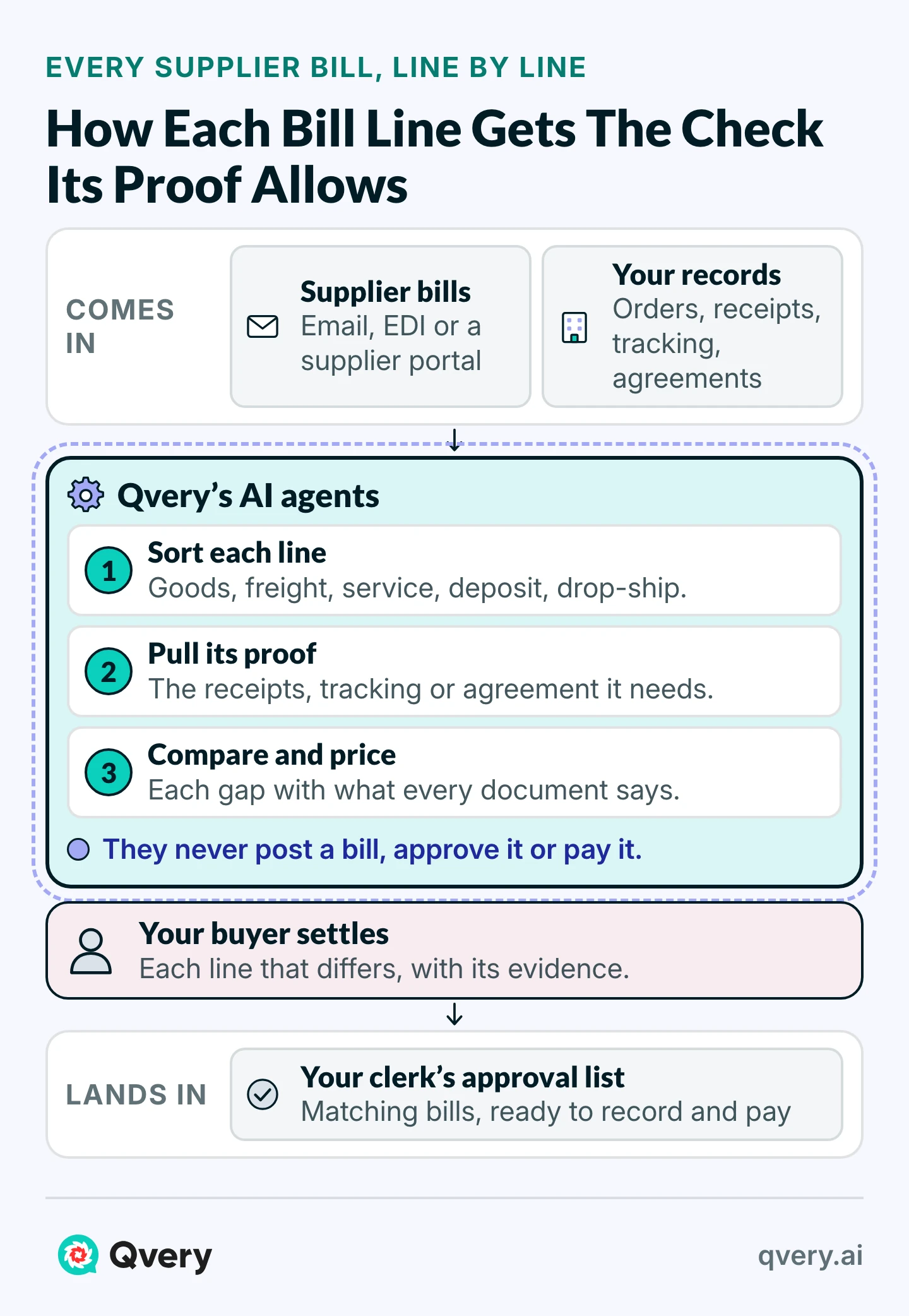
Lines that agree go to your clerk's approval list. A line that differs goes to the buyer who owns the supplier, with what each document says and the cost of the gap.
A line with no receipt behind it comes back "not found", never as a match, and the buyer gets a question ready to send to the store or the supplier. A freight line reaches a buyer only when it breaks the rate agreement.
They apply no tolerance unless you set one, and Dynamics 365's own default price tolerance is zero. Your clerks record and pay every bill in your ERP, exactly as they do now.
Send one of your own bills, with its order and delivery notes, and see what the agents make of it.
 Piotr BabelPartner @ Qvery
What the agents compare a line with decides how far you can trust their answer. So before they read a single bill, we write down what proof each of your suppliers can give. When that proof is missing, they say so on that line and stop. They never fill the gap with the bill's own number. A freight line, a deposit and a drop-shipped order each have their own proof, and that list says which.
What they may touch is agreed in writing before they touch it, starting with the least the job needs.
| The agents may | Your people keep |
|---|---|
| Read the payables inbox, orders, receipts, tracking and supplier agreements | Approving and paying every bill |
| Write a result for each bill and a question for the buyer | Recording bills and receipts in your ERP |
| Log every check they make, for your auditor to read | Supplier bank details and any change to them |
Qvery AI OÜ is an EU company, and the data processing agreement is signed before your first bill reaches us.
Your Clerks Work Beside the Agents by Week Two
The connections
We connect your payables inbox and your ERP, and we can run last quarter's paid bills through the agents so you see what slipped past.
Your live bills
By the second week after the connections go live, the agents check new bills beside your clerks, and your team compares their results with its own before it relies on them.
The weekly count
Every week you see the hours handed back to your clerks and the differences found before a bill was paid.
Frequently asked questions
What is two-way matching in accounts payable?
Two-way matching checks a supplier's bill against the purchase order before you pay it: the right supplier, the right items, the right price and no more than you ordered. It can't tell you whether anything arrived. For services, rent and subscriptions that is fine, because there is nothing to count. For goods, it pays the ordered quantity even when the delivery came up short.
When is a two-way match enough?
When nothing on your side can be counted: store cleaning, security, maintenance, software, utilities and rent. A deposit paid before a factory starts production is also checked against the order alone. Merchandise is not on that list, even from a supplier you have bought from for years, because a long record makes short deliveries rarer, not impossible.
What is the difference between two-way and three-way matching?
The goods receipt. A two-way match compares the bill with the order. A three-way match also compares the billed quantity with what your people recorded as received, so you pay for what arrived. It only works if the receipt is yours: a receipt scanned from the supplier's own shipping list, with no carton opened, checks the bill against the supplier's word.
What is four-way matching, and does a retailer need it?
A four-way match adds an inspection or acceptance report to the order, the receipt and the bill. Retailers use it where goods must pass a quality check before they count, such as private-label products inspected at the factory before the balance is paid. For most branded merchandise, a three-way match on your own count is enough.
How do you match a drop-ship bill?
There is no receipt, because the goods went straight from the supplier to your customer. Check the bill against the order for item, price and quantity, then against the carrier's delivery record for that order's tracking number. If the tracking shows no delivery, the bill waits and the buyer asks the supplier. A customer's complaint that nothing arrived should reach the same buyer.
How should a deposit to a supplier be matched?
Pay the deposit against the purchase order, recorded as a prepayment, not as a bill for goods. When the goods arrive, the final bill gets the full three-way match, and the deposit is set against it. Dynamics 365 and Business Central both record a prepayment on the order this way. When the goods land, the balance is matched like any other merchandise bill.
Should freight on a supplier bill be matched to a receipt?
No. A freight line has nothing to count, so it is checked against the supply or rate agreement: whether freight is owed at all on that order, at what rate, and for which shipments. A freight charge on an order your agreement says ships freight prepaid is a line to send back, however well the goods lines match.
What tolerance should we set?
Start at zero for price, which is Dynamics 365's own default, and add small tolerances only where you have a reason: a cent of rounding, or goods sold by weight. A supplier that bills just inside a tolerance month after month is worth a look. The agents we build apply none unless you set one.
Do we switch off our ERP's matching when the agents run?
No. Your ERP keeps its settings and your clerks keep recording bills in it. The agents work before that step: they read the bill, decide the check for each line, gather the proof and hand your clerk the result. Where a supplier's ERP default is plainly wrong, such as three-way matching on a cleaning contract, changing the default is still worth doing.
Can a service bill ever get a three-way match?
Yes, when the work is signed off in stages. A store refit or a new till system paid at milestones can be matched against the sign-off for each stage, which stands in for the receipt. A monthly cleaning or security contract has no such stage, so it is checked against the contract and your store manager's word that the work was done.
How does a three-way match handle a delivery that came in parts?
The bill is compared with what has arrived so far, not with the whole order. The agents we build add up every receipt against the order line, so a part bill with a lower total than the order is normal and isn't flagged. A receipt scanned twice is counted once, and when the next delivery lands, the open lines are checked again.
What happens when a supplier sends a credit note or the same bill twice?
A credit note is set against the bill it corrects, so the amount compared is what you really owe. A repeat, often a supplier resending a bill as a reminder, is held as a question next to the first one, with both dates, and your clerk decides which one stands before anyone pays.
