
On this page
- Count Each Return Once Before Adding Anything
- Read the Comment Beside Every Reason Code
- Rank Products by Return Rate
- Set the Boot's Page Beside Its Supplier's Fit Note
- Hold Every Refund Against the Written Policy
- Claim the Supplier's Credit Before the Window Closes
- Give Each Fix to the Person Who Owns It
- Qvery's Agents Read Every Return, Every Week
- Returns You Could Fix Cost About $151,000 a Year
- Three Months of Returns Is Enough to Start
- Frequently asked questions
Somebody on your merchandising team pulls the returns export once a week, pastes it into a workbook and reads the comments. They sort the products by how many came back, write a short note for whoever owns the product pages, and start again the next week.
That review shows what came back. The questions that cost money take documents it never opens: is the product page telling buyers the wrong size? Did the returns portal approve refunds the written policy forbids? Does a supplier owe a credit for the damaged ones, and when does it lapse?
The answers sit in the policy, the portal's settings, each page and each supplier's terms, and the export carries none of them.
Take a clothing retailer of about 200 people with about $19 million of online sales. At the 19.3% of online sales the National Retail Federation's 2025 report says come back, it takes back around 3,000 returns a month.
If a fifth of them come from a page or a product it could fix, an assumption, at about $21 to bring each one back, that is $12,600 a month of returns with a fixable cause.
AI agents can read all of it now, every week, beside the documents.
At Qvery, we help retailers cut what returns cost them, with custom AI agents that set every return against their own policy, product pages and supplier terms.
We ran the whole job on one retailer's files, step by step as Qvery's agents run it, and each step below shows what that run produced.
The retailer is invented: Pennant Row Apparel, a 195-person online apparel and footwear retailer in Columbus, Ohio, that does not exist, with files made for this purpose. It runs its returns through Loop, a returns portal, and sells on its own site, a Canadian site and one marketplace.
The files are 1,277 return rows from August to November, its units sold, its product pages and size charts, a supplier's technical sheet for one boot, that supplier's terms, the returns policy, the portal's settings and the returns team's notes. Its answer key was fixed when the files were made, before this run opened them.
One Boot Comes Back at More Than Three Times the Store's Rate
share of units sold that came back
View the data
| Label | Value |
|---|---|
| Harlow Chelsea Boot | 38.0% |
| Wren Slip-on | 21.0% |
| Larkin Loafer | 18.2% |
| Vale Fleece | 17.6% |
| Moss Rain Boot | 17.2% |
| Corin Vest | 16.8% |
| Summit Hiker | 16.7% |
| Whole store | 11.1% |
The store-wide rate is 11.1%, a number nobody would act on. One boot is at 38.0%. That gap is the reason to read returns by product.
| What the run found | The money | Who owns the fix |
|---|---|---|
| A boot the page calls true to size | $12,006 refunded on 118 "too small" returns | Whoever owns the product page |
| Refunds outside the written policy | 90 returns, $9,904 | Whoever owns the policy and the portal |
| Supplier credit for damaged units | $1,276 still open, $2,600 already lapsed | The buyer |
| An export pasted in twice | 113 rows, $9,978 counted twice | Whoever pulls the export |
The seven steps below each carry what the run produced. After the supplier step, you can send your own returns export through the same check.
This reads products and the reasons behind them. It never scores the people who send things back: repeat returners are a different job with its own consent rules, and nothing here flags a customer.
Count Each Return Once Before Adding Anything
The first mistakes in a returns review happen before anyone reads a comment, in what one row stands for. So the agents settle that first, with code, the same way on every row.
Pennant Row's export holds 113 rows that repeat exactly, all dated 14 to 23 October. The team's notes explain it: the portal was down on 14 October, so someone re-ran the export for those days and pasted the new rows under the old ones. Counted twice, they would add $9,978 of card refunds.
Identical rows count once, and the repeat becomes one finding with the money it would have added. The fix is one line in the routine: export each week once, and if it has to be re-run, replace the old rows rather than add to them. Next week's run should then report no repeated block.
Three return lines are a different problem. Each appears twice with a different reason and a different refund. Neither version is right by default, so both stay out of the totals and go to a person to pick one.
Three more rules keep the totals to money that left. 24 rows are from the Canadian site in Canadian dollars, and they are never added to US dollars. 18 refunds are blank, which means unknown, not zero. Exchanges and store credit stay apart from card refunds.
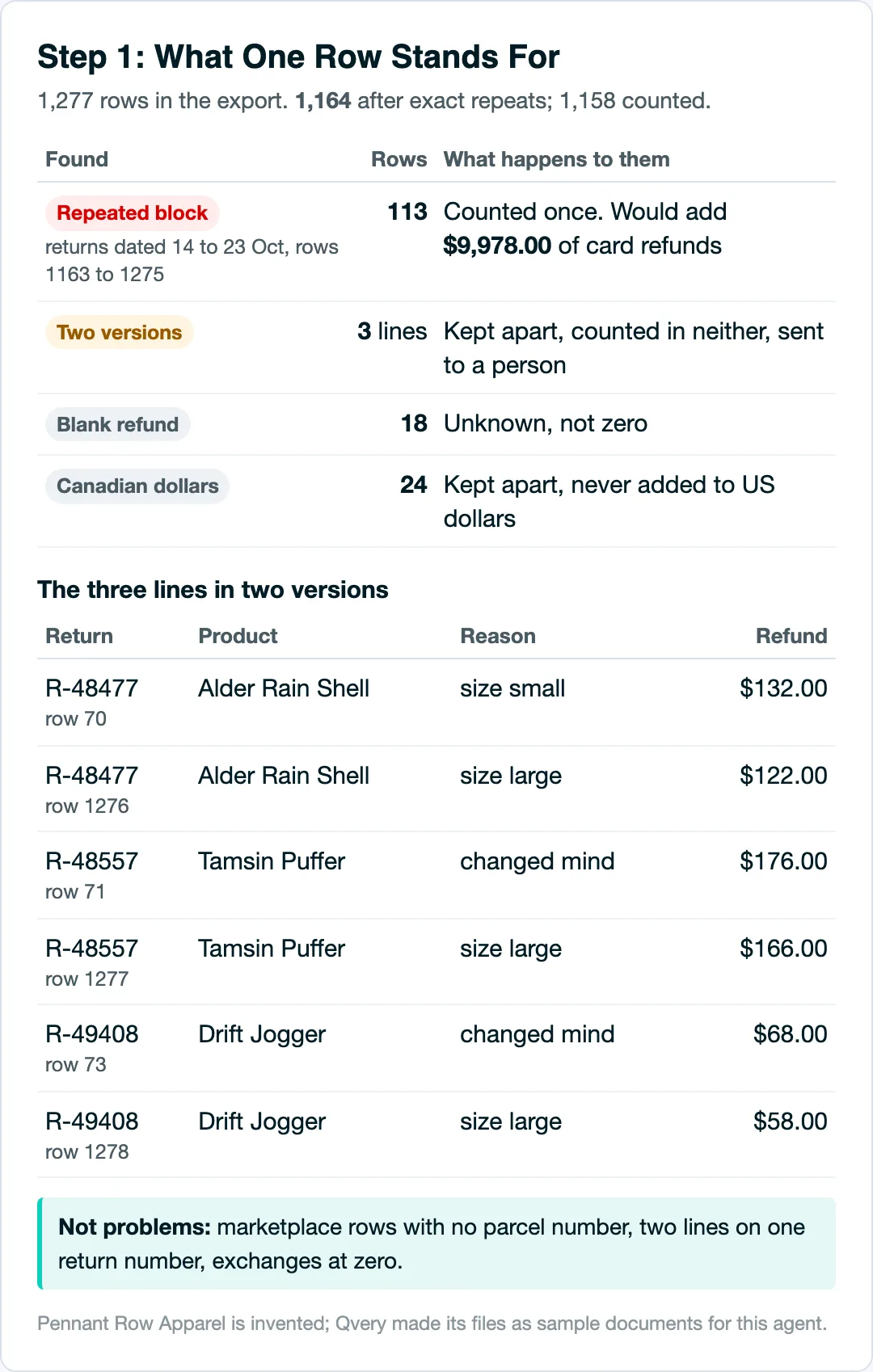
Some rows look wrong and are fine, and the agents leave them off the list. Marketplace returns have no parcel number, because the marketplace sends the label. Two lines on one return number are two items in one parcel, and an exchange refunds nothing by design.
Read the Comment Beside Every Reason Code
The reason code is what a customer clicks to get a return label; the comment is where they say what went wrong. The agents put both under plain labels the team already uses: too small, too large, not as described, damaged on arrival, changed mind, arrived late, and other.
A comment can sharpen a code. It never overrides one that contradicts it.
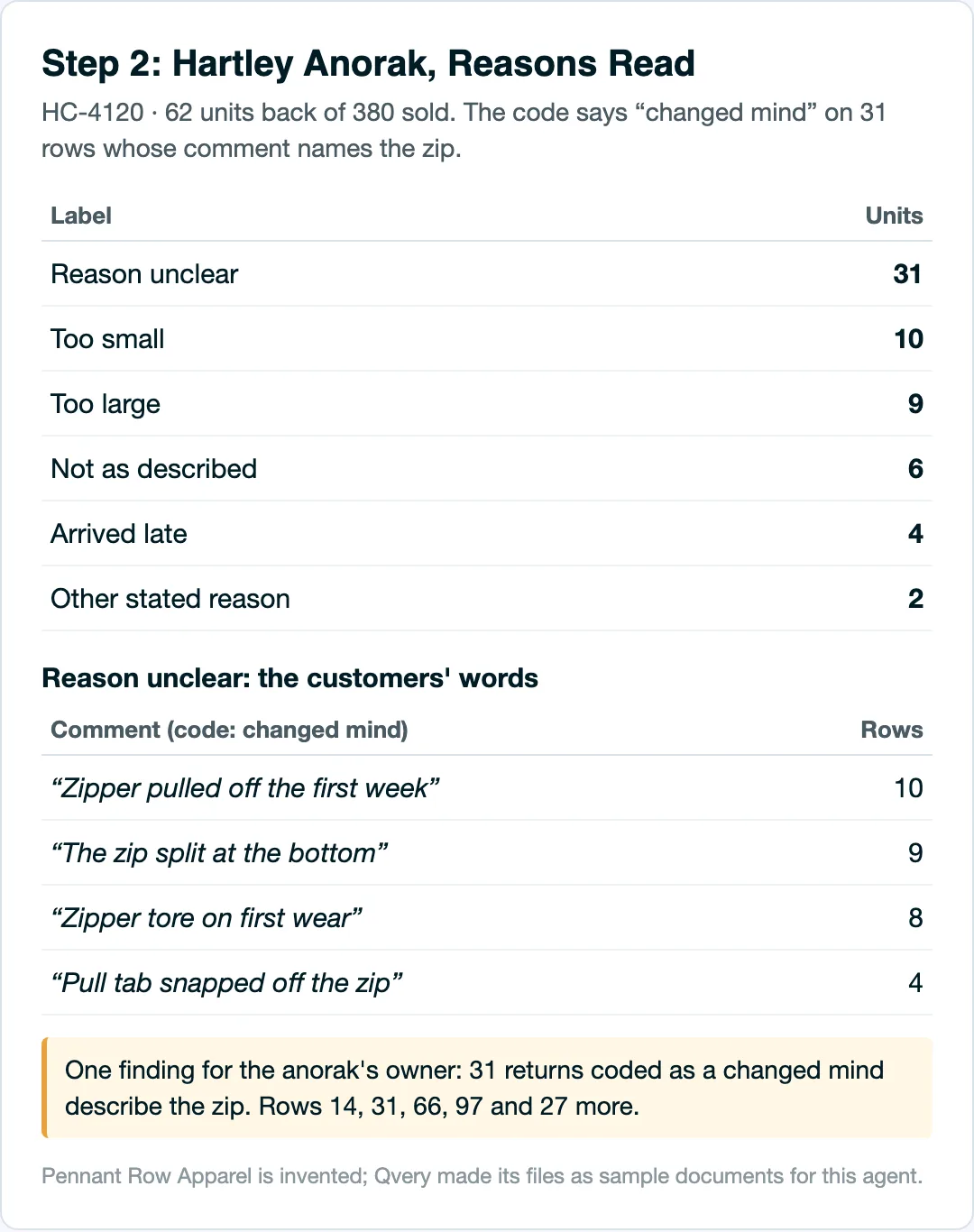
41 rows are coded "changed mind" while the comment says the zipper pulled off, the zip split, a merino crew shrank two sizes after one cold wash, or the wrong item was in the bag. 31 of them are on one product, the Hartley Anorak.
Those rows go under "reason unclear", one finding per product, because a changed mind and a broken zip land on different desks. Counted by code, the anorak's returns look like customers changing their minds; read, 31 of them describe the zip.
Whoever owns the anorak decides whether that is a supplier question. If a fix ships, zipper comments on orders placed after it should stop arriving.
63 rows carry no reason code at all. They count by product under "no reason", never guessed into a category.
Customers also type things that do not belong in a report. Three comments carry a street address, an email or a full name, and the agents take those out before anything is quoted.
The labels are the one part of this job a model does. We gave Claude Sonnet 5.5 and the smaller Claude Haiku 5.5 every distinct pair of code and comment in the export, 87 of them, with the labelling rule.
| What we checked | Haiku | Sonnet |
|---|---|---|
| Pairs labelled the way the rule says | 87 of 87 | 66 of 87 |
| Comments with a name, email or address caught | all of them | all of them |
| Where it went its own way | nowhere | gave a reason to 18 blank codes from the comment |
Eighteen of Sonnet's 21 differences are rows the customer left without a code, where it filled in a reason from the comment. The rule never asked for that judgment.
Whether a comment can stand in for a missing code is a call your team makes once and writes down. Two more of Sonnet's flags were contradictions the code had already set aside, the second copies of the lines in two versions, and the last called a sole that came away on first wear a defect, not damage on arrival.
Rank Products by Return Rate
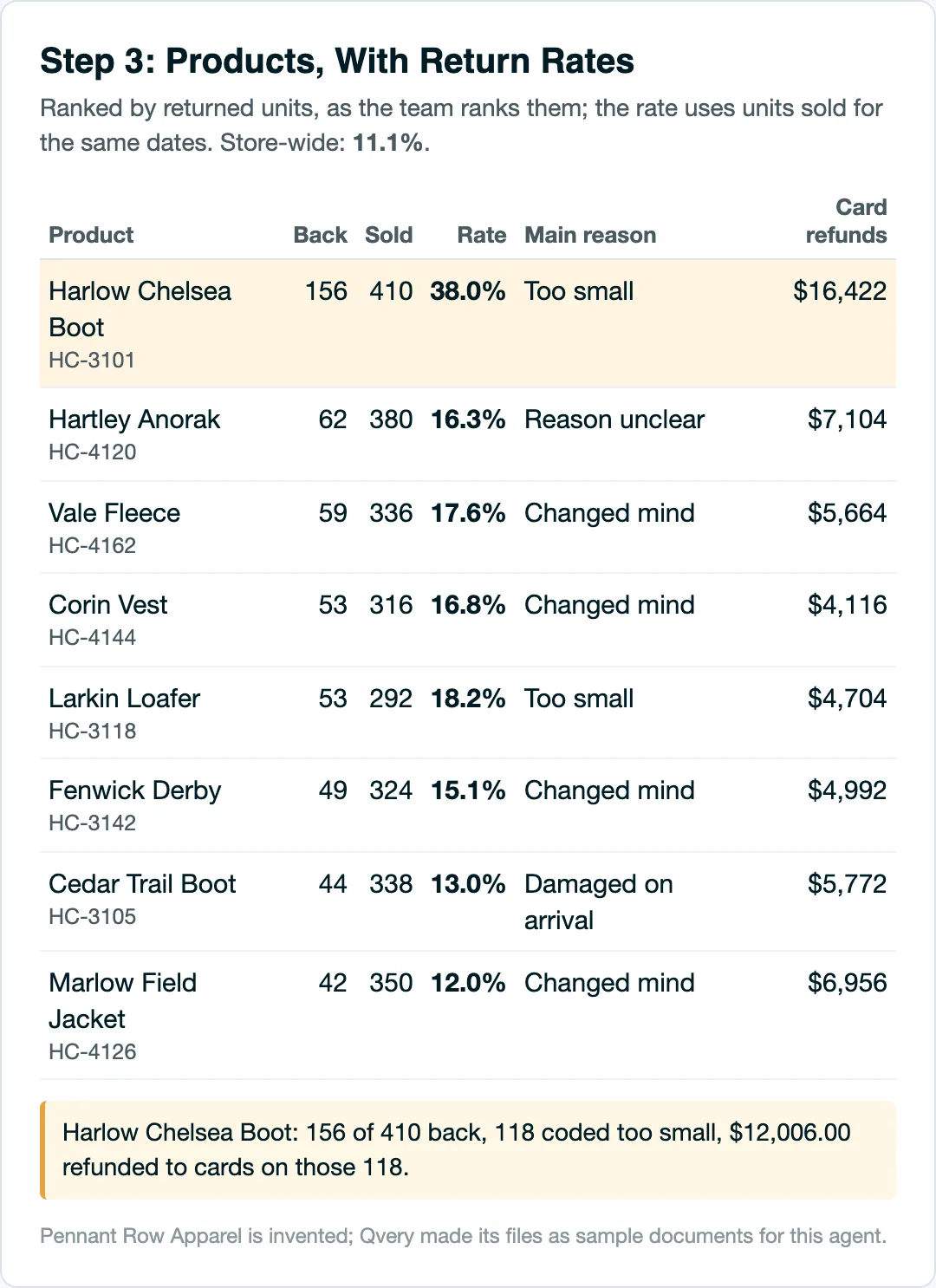
Pennant Row's team ranks products by how many came back. That ranking puts the Hartley Anorak second, with 62 back. Add units sold for the same dates and the order changes: a slip-on with only 22 returns comes back at 21.0%, more than the anorak's 16.3%, and the boot leads everything at 38.0%, 156 returned of 410 sold.
118 of those boot returns are coded too small, and they carry $12,006 of card refunds. Across all 156, it is $16,422.
Returns in a period come partly from earlier sales, so a rate built this way ranks products well but is not a precise chance of return. A refund is not all loss either: an unworn boot can go back on the shelf, while the label, the handling and the lost sale stay spent.
Set the Boot's Page Beside Its Supplier's Fit Note
The ranking points at the boot. Its page and its supplier's technical sheet show what buyers were told and what the factory knew. The sheet speaks of the last, the foot-shaped form a boot is built on.
| The product page says | The supplier's technical sheet says | Customers wrote |
|---|---|---|
| "True to size: order your usual size." | "This last runs one half size small against the US standard." | "Too tight across the toes" (26 times) |
| US 8 fits a 260 mm foot | The US 8 last measures 255 mm against a 260 mm standard | "Runs small. Ordered my usual size and it pinched" (25) |
| No line about sizing up | Recommends telling buyers to "order a half size up" | "Small. Wish the page told me to size up" (11) |
The supplier's sheet is dated June. The size charts on the site were written in March, and the page still says true to size. Nothing in the weekly routine sets a supplier's technical sheet beside the page it should change.
The agents join them. They never call the page wrong or the boot faulty; they put the three columns in front of whoever owns the page, here the head of merchandising.
One change on the page, a line telling buyers to size up, is the smallest fix the run points to. What the page says is still her decision.
The next lists count too-small returns on orders placed after the change against the boots sold since, once those orders have had time to come back. If that rate doesn't fall, the cause was somewhere else, and the comments will say where.
Tips from Reddit
What sellers who cut their returns check first
Have really good sizing charts, make sure your manufacturer is actually making them correctly graded and have good photos.
If a product is not fitting the majority of customers, then the easiest and quickest thing to do is pull your size and try it on yourself.
Our products are low return rate already, but on Amazon where prepaid returns are mandatory, our return rate is 12x our own site where customer arranges returns.
Hold Every Refund Against the Written Policy
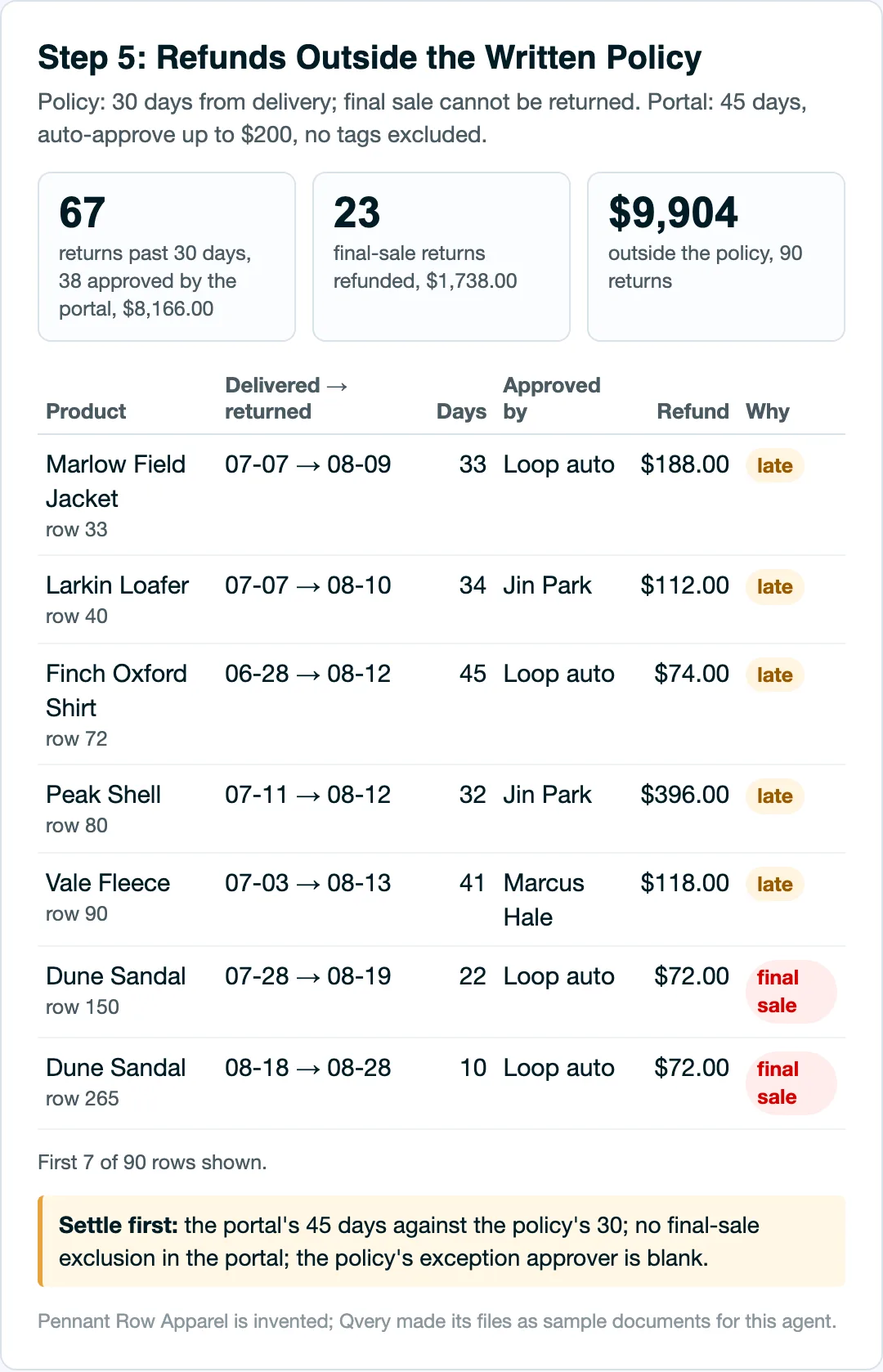
Pennant Row's policy gives buyers 30 days from delivery and says final-sale items cannot come back. The portal's settings say something else: a 45-day window, automatic approval up to $200, and no product tags excluded. They were last changed on 9 March.
So the agents check every refund against the written policy, not against the portal. 67 returns were accepted more than 30 days after delivery, and the portal approved 38 of them on its own. 23 returns of final-sale styles were refunded anyway. Together that is 90 returns and $9,904 outside the rules the company published.
None of the late ones went past 45 days. The portal did what it was set to do; its settings and the policy disagree.
The policy has one more gap: the line for who approves an exception reads "approved by ____". Nobody is named, so no exception has an owner.
Each of these is a person's decision, so they go to the top of the list as the points to settle first:
- Should the portal window match the 30 days in the policy, or should the policy say 45?
- Should final-sale styles be excluded in the portal, so they cannot be returned without a person?
- Who approves an exception, by name?
Whoever owns the policy settles them. Changing the portal is a change customers feel, so a person makes it. Once that is settled, the outside-policy sheet should hold only returns someone approved by name.
Claim the Supplier's Credit Before the Window Closes
The footwear supplier's terms give Pennant Row credit, at the invoice cost, for every unit a customer returns damaged or defective, as long as the claim reaches the supplier within 45 days of the return. Fit, color and changed minds are excluded.
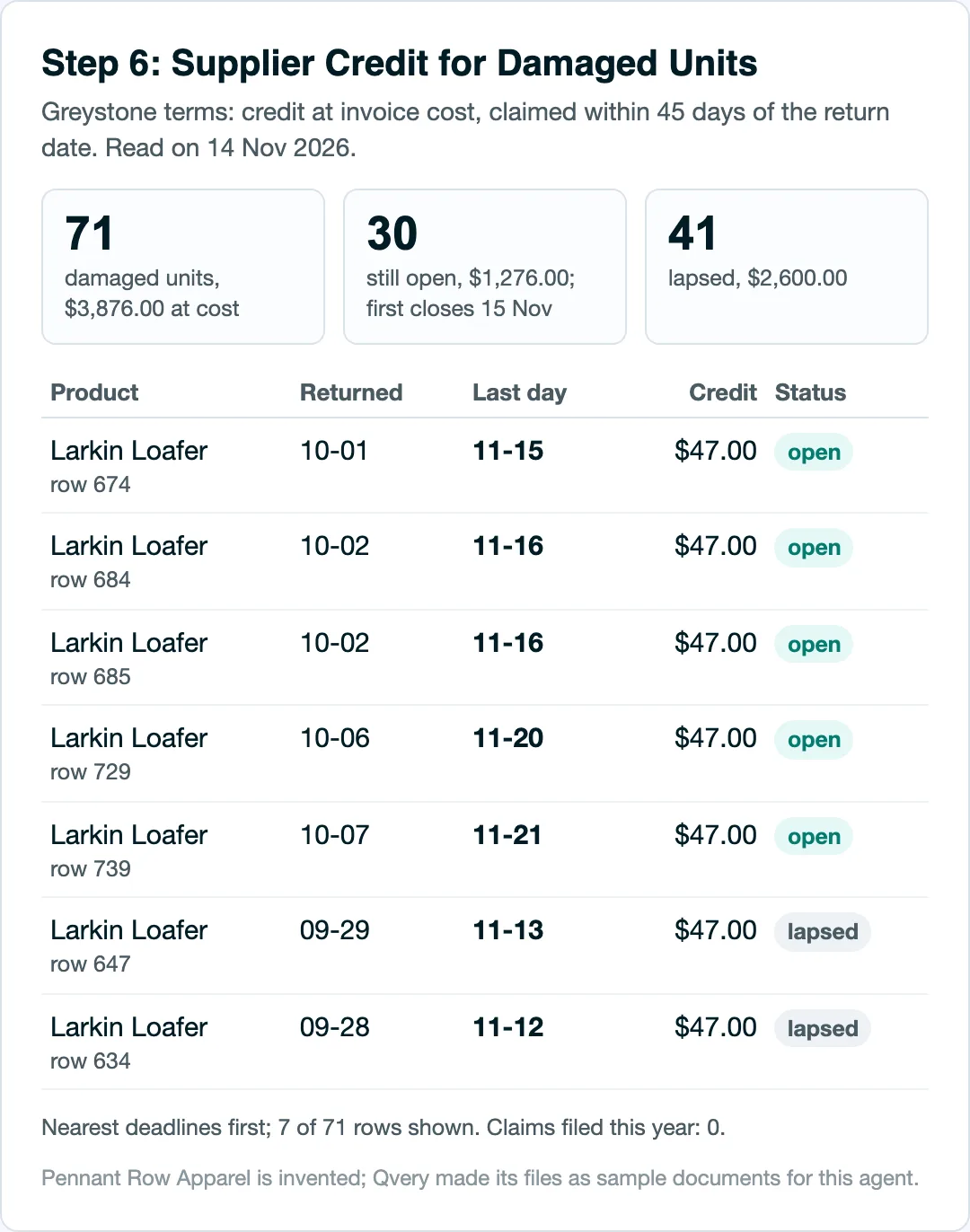
The run found 71 damaged units on that supplier's styles, worth $3,876 at cost. By the report date, 14 November, 41 of those claims had already lapsed: $2,600 of credit nobody can ask for now.
30 are still open, worth $1,276, and the first of them closes on 15 November. The team's notes say no claim has been filed this year.
The agents list every damaged unit with its last day to claim and the credit at cost, nearest deadline first. They never file the claim and never call a product defective; the buyer decides which to send.
From then on, the open claims should show as filed on the next list, and none should lapse unread.
A comment like "sole came away on first wear" sits under damaged even though nothing arrived broken. The supplier's terms cover defective units too, so it stays on the claim list; the label only has to tell the buyer what the customer saw.
The same check runs on your own returns: send your export below, and the products, the reasons and the refunds behind them come back to you by email.
Give Each Fix to the Person Who Owns It
The work above ends in one short list. Each line names a product or a rule, what the files show, the money on it, and who decides.
The boot's page and the anorak go to merchandising, the three policy points to whoever owns the policy and the portal, the open claims to the buyer, and the repeated export to whoever pulls it.
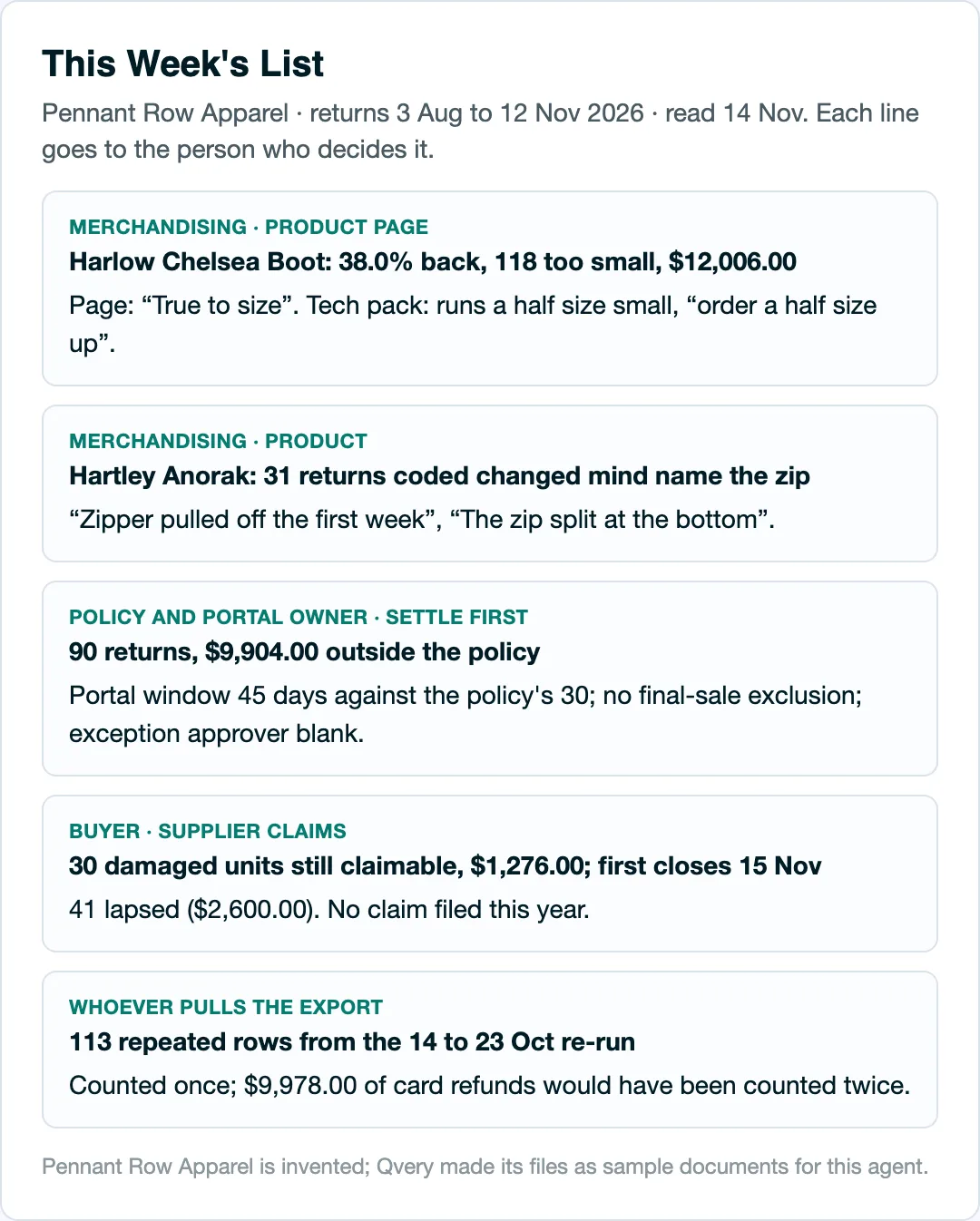
Each person gets only their lines, with the customers' own words and the source rows, and the workbook stays behind every line for anyone who wants to check a figure.
Qvery's Agents Read Every Return, Every Week
What you just read is one pass over three months. Our agents do the same on their own, every week, on a retailer's own files.
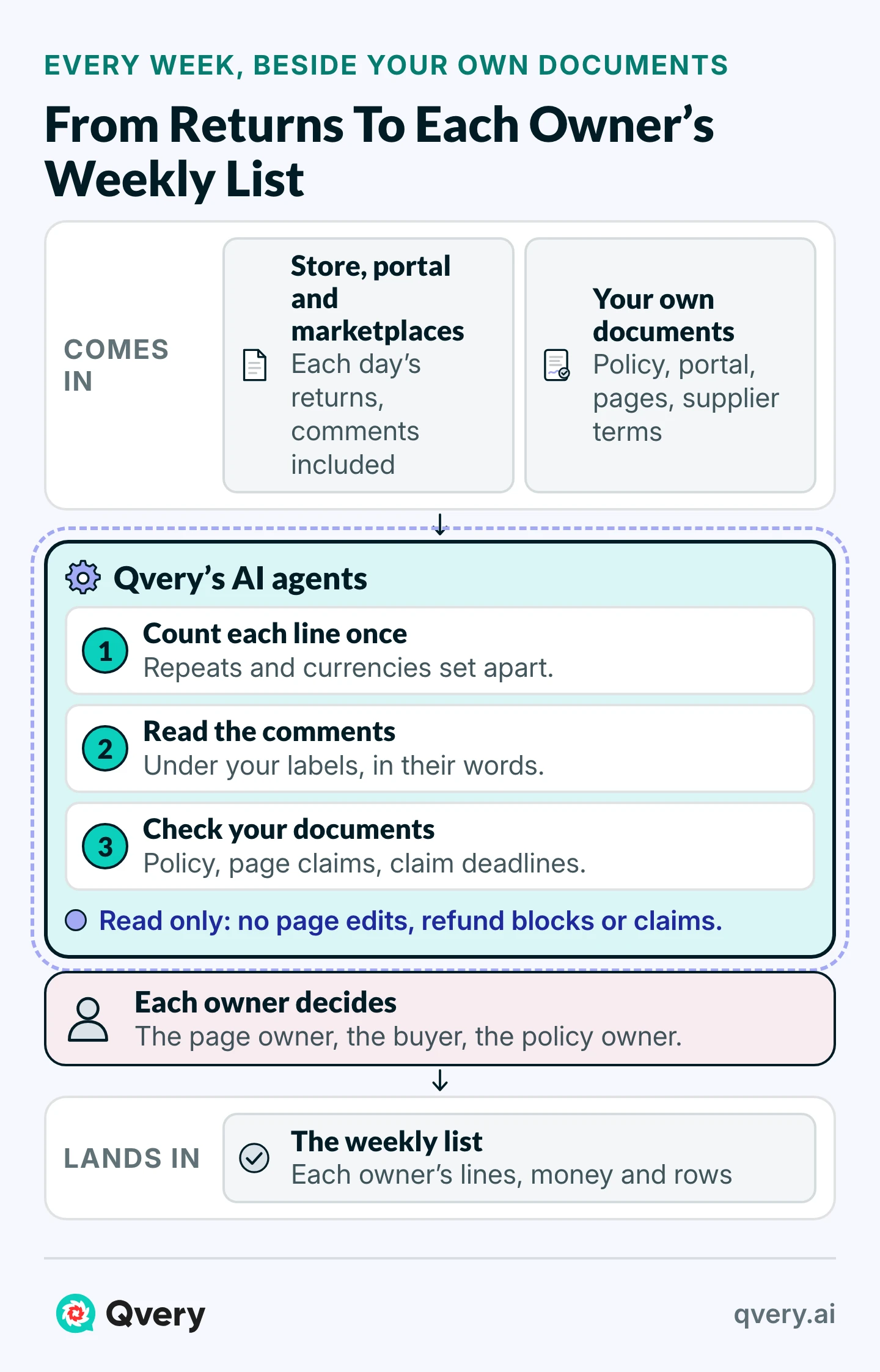
Each day they collect the new returns from your store, your returns portal and each marketplace, and from your helpdesk if you have one, straight from the tool where it allows or from a daily export.
Code counts every line once, keeps the currencies and refund types apart and works out each product's rate. A model reads the comments and puts them under your labels. Then the agents set each return against the policy, the portal's settings, the product pages and the supplier terms.
Once a week, whoever owns each product, rule or supplier gets their lines. Between weekly runs, a product that crosses the threshold your merchandisers set is flagged the same day.
 Piotr BabelPartner @ Qvery
A refund total must match on every run, so code adds it up and a model never does. Models are good at the words: they read "pinched across the toes" as too small without a list of synonyms. Where the page, the supplier's sheet and the comments disagree, the list shows all three with the rows behind them.
Two questions come up first with this job. The first is privacy: the comments carry customers' names, emails and addresses, so those come out before anything is quoted.
The export is read under a written agreement that names who at Qvery may see it, where the comments are processed and when the files are erased, and every action the agents take is logged. We are an EU company, so the GDPR governs how every comment is handled.
The second is what the agents may touch.
Returns You Could Fix Cost About $151,000 a Year
The weekly review is the small cost. Pennant Row's notes put it at about 9 hours a week across two people. At the $31.29 an hour the Bureau of Labor Statistics gives as the mean wage for market research analysts at clothing retailers, that is about $14,600 a year before benefits.
The money is in the returns nobody traces back to a page. Pennant Row's sample is smaller, about 350 returns a month, so the calculator below works on the example retailer from the top of this page.
That retailer takes back 3,000 returns a month, one in five from a page or a product it could fix, at $21 to bring each one back: 21% of a $100 order, the average a 2022 Pitney Bowes survey of 168 US online retailers found.
That is about 7,200 returns a year and $151,200 at stake. A monthly reasons report that stops a fifth of them in time leaves most of it slipping through; agents reading every comment each week, with the page owners making the changes, might stop half.
| The example retailer's year | Returns from fixable pages | Still slipping through |
|---|---|---|
| With a monthly reasons report (20% stopped) | 7,200, $151,200 at stake | $120,960 |
| With the agents and the page owners (50% stopped) | 7,200, $151,200 at stake | $75,600 |
| Difference | $45,360 |
Running the agents costs about $500 a month at that volume, an estimate: model usage of about 5 cents a return plus hosting and upkeep. On those shares, about $39,360 a year is left after it, and every $10,000 of build is earned back in about three months.
Both shares are assumptions, and your first lists are what test them. The calculator takes your own.
Returns Traced To Listings ROI Calculator
What Returns From Fixable Listings Cost You, And What The Agents Stop
Recovered Per Year
$39,360
$45,360 more caught a year, after $6,000 to run the agent
- Returns From Listing Faults A Year
- 7,200
- Agent Running Cost (Estimate)
- $500 a month
- Payback Per $10,000 Of Build
- 3 months
On these numbers, the agent stops $45,360 a year from slipping through, $39,360 after its own running cost, and every $10,000 of the build is earned back in 3 months.
Three Months of Returns Is Enough to Start
The first run reads the history you already have. Bring the same files this run read:
- The returns export for the last few months, comments included, as it comes out of your store, portal or marketplace
- Units sold by product for the same dates
- The returns policy and the portal's settings
- Product page copy and size charts, with each supplier's technical sheets and terms
The first lists go through your merchandisers with us. They set the labels your team uses and the threshold that should flag a product between weekly runs. Two weeks after the exports are connected, the weekly runs start, and each report counts the hours it took off your team.
If the review on your team looks like Pennant Row's, the export it already pulls every week is where we start.
 Vlad ShvetsPartner @ Qvery
Most retailers treat returns as the price of selling online, so nobody owns them. Read product by product, they turn into a page to correct, a supplier credit to claim and a policy to settle, each with real money on it. That is the reading we hand to agents, and why every line on their list carries a name.
Frequently asked questions
Our returns app has reports. What do the agents add?
A returns app reports what came back through it. The agents read its export beside the files it never sees: units sold, the written policy, each product page and each supplier's terms. In this run, the refunds outside the policy and the lapsing supplier credits came from those documents; the export on its own showed neither.
Does it work on marketplace returns that only come with a code?
Yes. Marketplace downloads often carry a reason code and nothing else, and those rows still count by product and by channel. The comments from your own site and portal supply the detail. Each source keeps its own label, so a marketplace's own return rules are never mistaken for a product problem.
Does it pick up buyers who order two sizes?
Where order lines are in the files, yes, as a pattern on the product, never on a person. Bracketing, ordering two sizes to keep one and send the rest back, shows up as one size of a style returned from orders that kept another. This run's sample held returns without full order lines, so this page has no bracketing figure.
Does it flag customers who return too often?
No. It reads products and the reasons behind them, never the people. Repeat returners are a separate question with its own rules and consent checks, and we would scope that as a different job, so this list stays about your products.
Our reason codes are a mess. Is the data good enough?
Usually, yes, because the agents never trust the code alone. They read the comment beside it, mark rows where the two contradict, and keep rows with no code as their own group. In this run, 41 rows coded "changed mind" described a broken zip, a shrunken sweater or a wrong item, and the list showed which product they sat on.
Can it file the supplier claims for us?
No. It lists every damaged unit on each supplier's styles with the credit at cost, the last day to claim and the customer's words, nearest deadline first. Your buyer decides which to claim and sends them, because a claim is a conversation with a supplier you work with.
Can it count what returns cost us in shipping?
Yes, where your notes or your carrier's invoices give the cost per label. Shipping is counted once per parcel and kept as its own figure, never spread across products. In this run, 917 parcels at $8.40 came to $7,702.80, and marketplace returns, which ship on the marketplace's label, added nothing.
What if one product has two names in different systems?
It stays one product, and the name gap becomes a question for whoever keeps the catalog. In this run, the same style code was a Brindle Knit Cardigan in the returns export and a Birch Knit Cardigan in the sales sheet. The code ties the two together, so the cardigan's return rate still works out, and the list asks which name is right.
Does it read helpdesk tickets and reviews too?
Where you have them, yes, under the same labels as the return comments, each keeping its source so a pattern can be traced to the channel it came from. In this run the sample held the export and the company's documents only, so every figure on this page comes from those.
Do we need Loop or Shopify for this?
No. The agents read the export your returns tool or store already produces, as a file or straight from the tool where it allows. What matters is that each row keeps its reason code, the customer's comment and the refund, and that units sold can be pulled for the same dates.
What are the monthly running costs?
On the calculator's example, about $500 a month at 3,000 returns: model usage of about 5 cents a return plus hosting and upkeep, an estimate. The build itself is priced once, as a fixed price for a defined result agreed before any work starts. The calculator above shows the payback on your own volumes.
How do we know a page fix worked?
The weekly list keeps counting the product's returns and their reasons on orders placed after the change. If the share coded too small falls, the fix held. If it doesn't, the comments say what the change missed.
