
On this page
- Most Firms Still Charge the Way They Did Before AI
- Firms Say Clients Are Not Asking, and In-House Legal Teams Say They Are Waiting
- Most Firms Use AI Now, and the Larger Ones Use It More
- A Third of Law Firm Staff Use AI Tools Their Firm Never Approved
- Larger Firms Have AI Policies More Often, and Few Count What AI Saves
- Frequently asked questions
A law firm with a few hundred lawyers and staff lives in its documents: matter files, discovery productions (the batches of documents each side hands the other in a case), contracts, research memos, and the email around all of them.
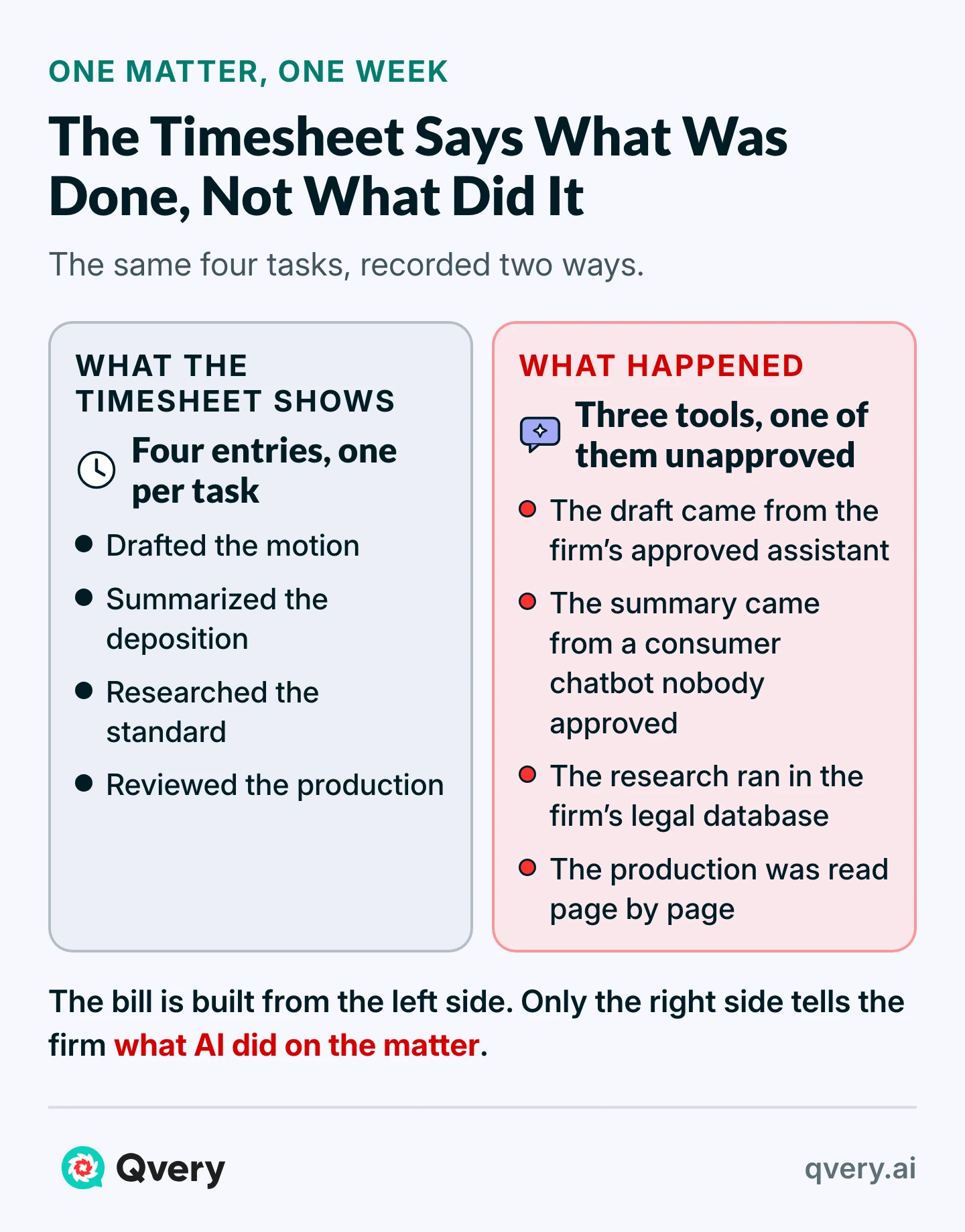
The lawyers and paralegals already draft and summarize with AI, some of it on tools the firm bought and some on tools nobody approved. The bill that goes to the client often looks the way it did before, and nobody has decided what the firm charges when a task that took five hours now takes one.
Most of these surveys are run by companies that sell legal software, each with its own sample and wording, and none reports firms of 100 to 500 people as a group of their own, so read them as direction, never as one series.
Most Firms Still Charge the Way They Did Before AI
Of the in-house legal professionals Thomson Reuters surveyed, 71% expect the firms they hire to change the way they charge as AI use increases. 28% of law firm respondents say their firm has changed its pricing in response to AI, and 62% say it is unchanged.2
What the in-house respondents expect splits three ways: 33% expect new pricing with more cost certainty, 23% expect lower fees, and 15% expect similar or higher fees for measurably better outcomes.2
What In-House Legal Professionals Expect in Place of the Usual Bill
share of in-house legal professionals
View the data
Clio's solo and small report compares four sizes of firm on the same question. 86% of solo firms and 78% of small firms have made no pricing change since adopting AI, against 51% and 46% in Clio's two larger groups.4 The larger firms have moved further, and about half of them have not moved at all.
Firms That Have Made No Pricing Change Since Adopting AI, by Firm Size
share of firms with no pricing change
View the data
Often the bill does not tell the client either. Four in ten law firm respondents in Bloomberg Law's survey say their firm does not disclose attorney AI use on client bills at all.3
The rule on hourly work is plain. Under the American Bar Association's Formal Opinion 512, which is model guidance, a lawyer billing by the hour charges the actual time spent: in the opinion's own example, the fifteen minutes spent putting the facts into the tool and the time spent checking its draft.5
The rest is arithmetic, not a survey figure: a task that took five hours and now takes one, billed by the hour, bills 80% less.
What Reddit says
Lawyers on whether the hour AI saves belongs to the firm or the client
Depo transcripts have indices. And, I was present. And I bill hourly, give me my hour back.
Good plan, until they send it to the guy that bills one instead of two. My clients read their bills.
Do I still have work to do? You bet. But that probably saved 5+ hours of junior associate or paralegal time.
Firms Say Clients Are Not Asking, and In-House Legal Teams Say They Are Waiting
Only 6% of 8am's respondents said clients are asking for AI-related price cuts, and 3% said clients often ask for proof of AI-driven efficiency.6 In Thomson Reuters' survey of law firm professionals, 11% believe they could start losing clients over AI within 12 months, and 50% do not believe they would lose clients over it at all.2
Thomson Reuters also asked 203 people in corporate legal departments, the buyers of outside counsel.2 71% of them call AI-enabled quality from outside counsel very important or essential, and 3% say most of their firms deliver it; on speed and cost the split is 70% against 6%.2
11% are already reconsidering firm relationships over it, and another 22% will within 12 months if they see no AI-enabled value.2 61% report pressure from inside their own companies to adopt AI faster.2
What In-House Legal Professionals Expect From Outside Counsel, and What They Get
share of in-house legal professionals
View the data
The two surveys asked different people. 83% of 8am's respondents were solo practitioners or at firms of two to five lawyers, and its largest practice areas were family law, personal injury and immigration.6 Thomson Reuters' 203 work in companies' legal departments.
 Vlad ShvetsPartner @ Qvery
When partners say clients are not asking about AI, they are describing the clients who talk to them. The in-house lawyers who send a firm corporate work answer a different survey: 11% are already reconsidering firms that cannot show AI-enabled value, and another 22% will within a year. Ask the general counsel at your three largest clients what they would want to see on a bill, before they decide for you.
Consumers ask for something else: to be told. In Clio's consumer survey, 82% want to know when their lawyer uses AI and 70% trust a lawyer more when the use is disclosed, while 6% identify the technology as a deciding factor in choosing a lawyer.7
Most Firms Use AI Now, and the Larger Ones Use It More
Clio, a practice management software company, puts AI use at 71% of solo practitioners and 75% of small firms4, and 86% of firms with 20 to 199 employees report using it1. Its October report has 85% of legal professionals describing some level of AI adoption at their firm, up from 79% a year earlier.7 Bloomberg Law's first practice survey of 2026 has 83% of lawyers using AI at work.8
The bar's own count is a year older and asked a narrower question. In the American Bar Association's survey of late 2024, 30.2% of attorneys said their offices used AI-based tools, rising from 17.7% of solos to 47.8% at firms of 500 or more lawyers.9 Every survey here that splits by size points the same way: the bigger the firm, the higher the share.
Offices Using AI Tools in Late 2024, by Firm Size
share of attorneys whose office used AI-based tools
View the data
The number that matters more for a firm your size is the gap between the people and the firm. 8am, another practice software company, found 69% of legal professionals using chatbots anyone can open, such as ChatGPT, for work, more than double the 31% of a year before, while 46% said their firm had implemented those tools as a firm, 58% at firms with 20 or more lawyers.10
Most lawyers and staff now use AI somewhere in their work, so the share alone tells you little about where your firm stands. The figures that separate firms are what the AI does, who approved it, and whether the policy changed.
A Third of Law Firm Staff Use AI Tools Their Firm Never Approved
Most of that is paperwork: of 8am's respondents who use those chatbots, 47% use them to summarize documents.10
28% of all respondents use AI every day and another 31% several times a week.10 The hours saved are modest and self-reported: of those using AI, 38% say one to five hours a week, and a third say it saves no time but improves the work.10
A good share of that paperwork runs on tools nobody chose for the firm. 34% of the law firm professionals Thomson Reuters surveyed use AI tools at work that their firm never authorized.2 Clio found 47% to 48% of solo and small firms relying on generic AI tools.11
Larger Firms Have AI Policies More Often, and Few Count What AI Saves
57% of solo firms and 55% of small firms have no AI policy in place,12 against 30% and 24% in Clio's two larger groups.13 In Clio's survey of firms with 20 to 199 employees, 60% report formal policies guiding AI use.1
Firms With No AI Policy in Place, by Firm Size
share of firms with no AI policy
View the data
In 8am's mostly small-firm sample the picture is thinner: 9% of respondents say their firm has a policy in place that is actively enforced, 43% say it has none and no plans for one, and 54% say it offers no AI training and has no plans to.10
Half of the law firm professionals Thomson Reuters surveyed say their firm's AI strategy is invisible in day-to-day work.2 Where a defined strategy exists, 64% say AI is meeting or beating their expectations for creating value; where none exists, 29%, which says the two travel together and not which causes which.2
Across legal, tax, accounting and the other professional services Thomson Reuters surveyed, not legal alone, 18% say their organization tracks the return on AI, and another 40% do not know whether anyone measures it.14
The firms that can price AI work are the ones that count, per matter, what the document work took and what a lawyer checked. That count belongs to whoever runs operations, before the next fee conversation with a client.
Frequently asked questions
Will AI take over law firms?
Not on the evidence so far. Most lawyers use it, 83% of them in Bloomberg Law's 2026 survey,8 but in Clio's October report most respondents saw no change in the number of lawyers or other staff attributable to AI, and where the number changed, additions were more common than reductions.7 What is changing is the work inside each matter and what clients expect to pay for it.
How are law firms using AI today?
Mostly for paperwork. In 8am's survey, those using chatbots anyone can open put it to drafting correspondence and general research (58% each), brainstorming (54%) and summarizing documents (47%); those using legal-specific tools put them to legal research (58%) and drafting documents (49%).10 28% of all respondents use AI every day.10
What percentage of law firms have an AI policy?
It depends on size. In Clio's 2026 report, 57% of solo firms and 55% of small firms have no AI policy,12 against 30% and 24% in its two larger groups.13 In its survey of firms with 20 to 199 employees, 60% report formal policies.1 In 8am's mostly small-firm sample, 9% of respondents say their firm has a policy that is actively enforced.10
Do clients expect law firms to use AI?
Corporate clients do. In Thomson Reuters' survey of 203 people in in-house legal departments, 71% call AI-enabled quality from outside counsel very important or essential, and 3% say most of their firms deliver it.2 Across professional services, two-thirds of corporate respondents want their outside firms to use AI, and fewer than 20% require it.14 Consumers want to be told: 82% of those Clio surveyed want to know when their lawyer uses AI.7
Can a lawyer bill hourly for work AI made faster?
Only for the actual time spent. In ABA Formal Opinion 512's example, a lawyer billing hourly charges for the minutes spent giving the tool the facts and for checking what it produced; it is model guidance, and each state's rules govern.5
Do law firms have to tell clients when they use AI?
Sometimes. Opinion 512 requires it when the client asks, or when the engagement terms or the client's outside counsel guidelines (the rules a client's legal department sets for firms it hires) call for it; otherwise the facts of each case decide, and each state's rules govern.5 Four in ten law firm respondents in Bloomberg Law's survey say their firm does not disclose attorney AI use on client bills at all,3 while 70% of consumers in Clio's survey trust a lawyer more when the use is disclosed.7
Do clients expect lower fees when a firm uses AI?
A minority do. Of Thomson Reuters' in-house respondents, 23% expect lower fees, 33% expect new pricing with more cost certainty, and 15% expect similar or higher fees for measurably better outcomes.2 Only 6% of 8am's mostly small-firm respondents say clients are asking for AI-related price cuts.6
How many hours a week does AI save a lawyer?
By their own account, a few. In 8am's survey, 38% of legal professionals using AI say it saves one to five hours a week and 14% six to ten, while a third say it saves no time but improves the work.10 These are self-reports: across professional services, 18% say their organization tracks the return on AI.14
Are courts still catching AI mistakes in lawyers' filings?
Yes. By Qvery's count of the public database of these decisions, 917 involve a lawyer or other legal professional as of 9 November 2026, 525 dated in 2026 against 361 in 2025, and the database keeps growing.15 The control is a check of every citation before anything is filed.
What should a law firm of 100 to 500 people do with AI first?
Pick one document job that eats associate and paralegal hours, time it the way it runs now, and move it onto an approved tool or agent connected to the firm's own systems, with a lawyer reviewing what leaves the firm. That one job then gives you both the policy line and the number for the pricing conversation.
Do firms that use AI earn more?
Some do, and size tracks it. In Clio's 2026 report, 32% of solos and 31% of small firms say their revenue rose with AI, against 39% and 59% in its two larger groups.11 The survey shows the association, not the cause, and the size groups reporting more revenue are also the ones that changed their pricing more often.4
Do clients want to know when their lawyer uses AI?
Consumers do. In Clio's consumer survey, 82% want to know when their lawyer uses AI and 70% trust a lawyer more when the use is disclosed, while 6% call the technology a deciding factor in choosing one.7
Sources
- Clio: AI Is Reshaping How Mid-Sized Law Firms Scale, Clio Reports (2026)
- Thomson Reuters Institute: Future of Professionals Report 2026: Actionable Insights for Law Firm Leaders (2026)
- Bloomberg Law: State of Practice: Trends Reshaping the Legal Industry (2026)
- Clio: Report: Small Law Firms Lag Larger Peers on Using AI to Grow Revenue (2026)
- American Bar Association: Formal Opinion 512: Generative Artificial Intelligence Tools (2024)
- LawSites: AI Adoption Among Legal Professionals Has More Than Doubled in a Year, New 8am Report Finds (2026)
- Clio: Clio's 2026 Legal Trends Report Reveals Record Gains in Billable Time as AI Reshapes Law Firm Economics (2026)
- Bloomberg Law: ANALYSIS: 83% of Lawyers Use AI But Efficiency Gains Lag (2026)
- American Bar Association: 2024 Artificial Intelligence TechReport (2025)
- 8am: Generative AI Data From the 8am 2026 Legal Industry Report (2026)
- Clio: 2026 Legal Trends Report for Solo and Small Law Firms (2026)
- North Carolina Bar Association: By The Numbers: What Surveys Show About Law Firm AI Adoption (2026)
- Clio: Can AI Give Legal Advice? (2026)
- Thomson Reuters Institute: 2026 AI in Professional Services Report (2026)
- Qvery: 59 AI Hallucination Cases in Court Statistics for 2026 (2026)