On this page
- Spellbook Is a Second Reader Built Around Your Playbook
- It Drafts From Your Precedents Once a Lawyer Picks Them
- Associate Handles a Document Set Once Someone Gathers It
- ACM Runs a Company's Contract Desk, Not a Firm's Deal
- Its Users Keep It for the Second Read and Check Its Citations
- Spellbook Prices by Quote and Keeps Inputs for Quality Checks
- Spellbook Fits a Group That Has Written Its Playbook
- Qvery's Agents File the Deal Paperwork Spellbook Never Sees
- Frequently asked questions
A transactional group's contract work is two jobs. Lawyers read the other side's draft and mark it up in Word, and that is the firm's most expensive time: a lawyer at the median pay of $159,670 costs about $110 an hour once benefits are counted.
The second job is the paperwork around each document. Each new version from the other side, each comment from a specialist or the client and each signature page arrives by email. Someone saves it, files it under the matter, compares it with the last version the firm sent and updates the closing checklist, the list of every document the deal needs signed and delivered.
That someone is usually a paralegal or a junior associate, working by hand, and for a group of about 40 transactional lawyers we put it at 1,200 hours a year.
Spellbook sells the first job. It is an add-in that reviews, redlines and drafts inside Microsoft Word, with a web app called Associate for work across several documents, sold to transactional lawyers at firms and to in-house legal teams.
At Qvery, we help transactional law firms keep their lawyers on the deal itself and give back the hours paralegals and junior associates spend on deal paperwork, with custom AI agents that file every new version and signature page under the matter, keep the closing checklist current and chase what is missing.
| The work | What Spellbook does | Who still does it |
|---|---|---|
| First read and markup | Suggests redlines in Word against your playbook | The lawyer, change by change |
| Drafting from precedent | Drafts from files you select | The lawyer |
| One change across a set | Associate edits several Word files | Whoever gathers the set |
| Filing each version under the matter | Not on its pages | A paralegal or junior |
| The closing checklist | Not on its pages | A paralegal or junior |
Spellbook Is a Second Reader Built Around Your Playbook
Review reads the whole contract and drafts redlines and comments, and they appear under the lawyer's name, so a marked-up draft can go to the client as it stands.
Playbooks run the firm's own written positions: each rule, its fallback and the questions to answer, marked passed, failed or fallback with the language that would fix it.
Who gets value depends on that playbook, and the firm writes it.
Spellbook's in-house plan comes with a playbook build service; its law-firm plan lists group training and support, and no playbook build. October's release added rule groups, guidance that applies to every rule, and Skills, where a lawyer describes the firm's standard documents and usual side.
Where the positions are already written down, every draft gets a fast, consistent first pass.
Where they live in two partners' heads, there is no playbook to run, only Spellbook's general review.
It Drafts From Your Precedents Once a Lawyer Picks Them
Draft writes a clause or a full agreement, and Ask answers questions about the open document or files you add. Both work from the firm's own precedents through Spellbook's connections, and the document system's permissions and ethical walls carry over.
| Connection | What it does | Files anything back? |
|---|---|---|
| iManage | Brings files a lawyer selects into Ask or Associate | No step listed |
| SharePoint, OneDrive, Dropbox, Google Drive | Imports files into your Spellbook library | No step listed |
| Slack | Turns a message into a request in ACM | Into ACM only |
The precedents arrive where the lawyer works. Every document-system connection runs one way: files come in when someone picks them.
Files added to Ask are deleted after three days, and the Word add-in takes documents up to 4 MB.
Associate Handles a Document Set Once Someone Gathers It
Associate is a web and desktop app for work across documents: revise one agreement from another, compare several, ask a question across a set. Spellbook names data room reviews, financing documents and disclosure schedules among its jobs.
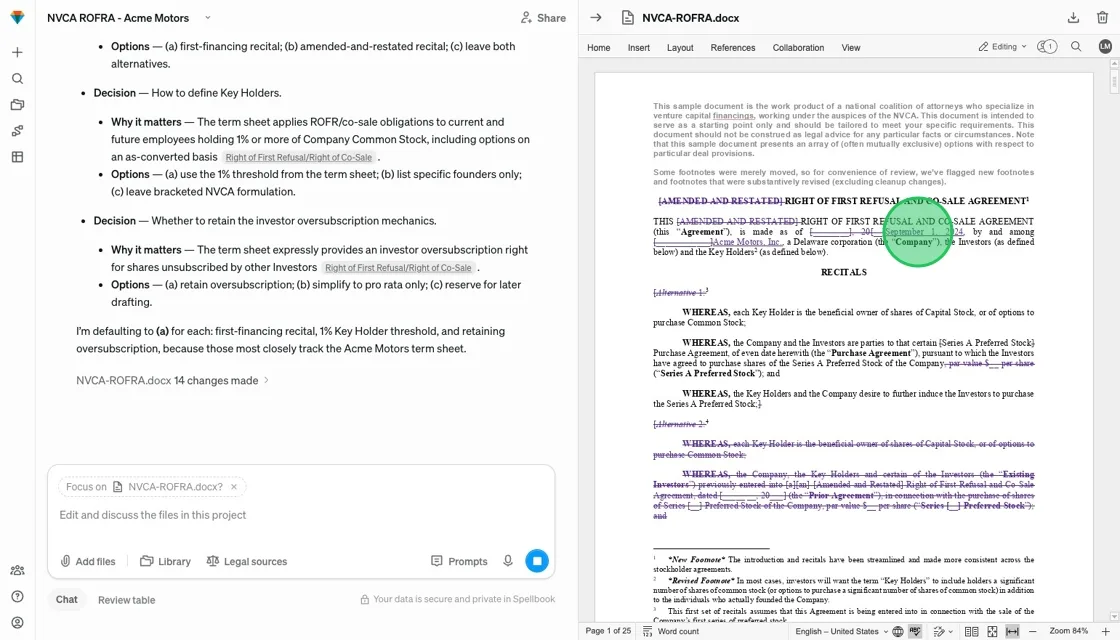
It edits Word files only, and Spellbook's own guidance is to start with two to five. For conforming a set to a term sheet (party names, defined terms, the same threshold in four places) that is the right tool.
ACM Runs a Company's Contract Desk, Not a Firm's Deal
In October, Spellbook made generally available a second product: Autonomous Contract Management, or ACM.
It takes contracts in from intake forms, Gmail, Outlook and Slack, runs a first pass against the playbook, routes each one by rules (Spellbook's own example auto-approves contracts under $50,000 that pass every rule), tracks versions and stores signed agreements in its repository.
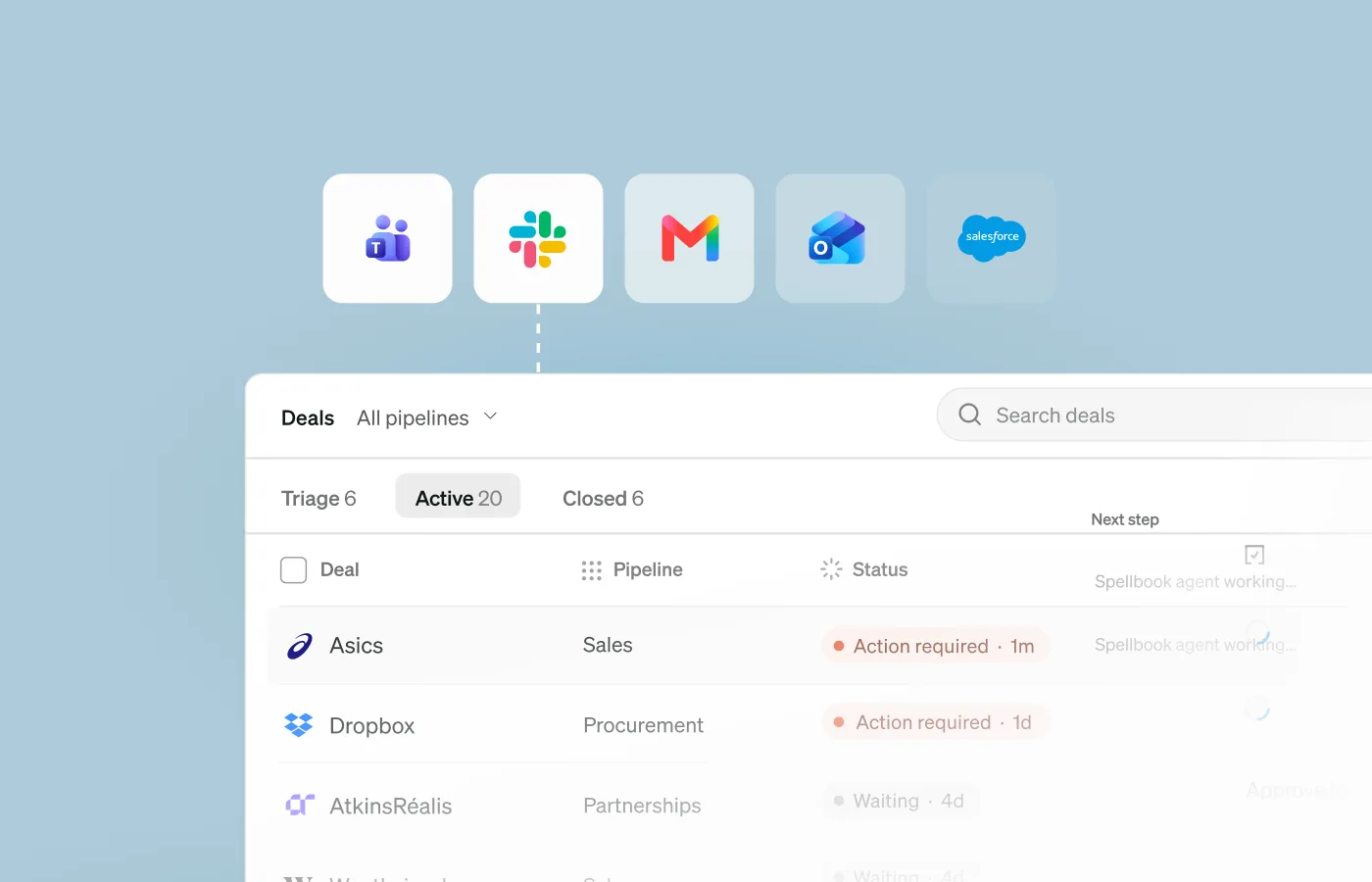
Its pipelines are sales, procurement and partnerships; its October release let teams like Legal, Finance and Procurement own deals; its own page says it helps in-house legal teams. An in-house team with a steady flow of sales and supplier contracts should see a demo.
At a firm, the deal is one client matter with many documents and parties, and its closing checklist sits in the matter's folder. Nothing on ACM's pages speaks to that, and five weeks after it became generally available, the user record we read holds no review of it.
Its Users Keep It for the Second Read and Check Its Citations
What Reddit says
What lawyers who use or trialed Spellbook say
In my opinion, Spellbook is way better. It’s a Microsoft plugin so is right there in the document you’re working on.
Spellbook, I like the way it looks and feels better, but you have to build your own playbooks and I don't have the time to do that
I don’t mind useful wraps, but the price point in this one is so steep…
Spellbook - $350 for the word addon. Seems like the best choice so far.
The record agrees with Spellbook on one thing: it sits in the document, and lawyers who live in Word say that is why they keep it. Where it parts company is the citations it gets wrong, the playbooks a buyer has to write, and the price.
Spellbook Prices by Quote and Keeps Inputs for Quality Checks
Spellbook prices per person on the license, by quote after a demo, with a seven-day trial. One in-house lawyer reported $350 a month for the Word add-in in February 2026; that is one seat at one company, not a price list.
Spellbook holds zero data retention agreements with OpenAI and Anthropic, and what it sends them is never used to train their models. Data sits with cloud providers in Canada and the US, and Spellbook holds SOC 2 Type II, an outside audit of its security controls.
What the firm owes its clients when lawyers use a tool like this is set out in our reading of ABA Formal Opinion 512.
Spellbook Fits a Group That Has Written Its Playbook
Pros
- Works inside the Word document the lawyer has open, with redlines in the lawyer's name
- Runs the firm's own playbook and shows each rule passed, failed or fallback
- Drafts from precedents in iManage or SharePoint under the firm's existing permissions
- Associate makes one change across a set of Word documents
- Zero data retention with OpenAI and Anthropic, and a SOC 2 Type II audit
Cons
- The law-firm plan lists no playbook build service, so the firm writes its own rules
- Two G2 reviewers report wrong or out-of-date citations
- No published price; one seat was reported at $350 a month
- Its terms allow it to keep inputs and outputs up to 90 days
- Nothing on its pages files a document under the matter or keeps a closing checklist
Spellbook is as good as the playbook your lawyers write for it, and it stops at the edge of the document they have open.
Buy it for a transactional group whose positions are written down, whose precedents sit in a connected document system, and whose lawyers live in Word: they get a consistent first pass and a second read they will use daily.
Pass for now if the positions live in partners' heads, or if the hope is that it runs the deal: it reads the document in front of a lawyer, and the rest of the deal is still yours.
Qvery's Agents File the Deal Paperwork Spellbook Never Sees
Spellbook works on the draft a lawyer opens. Every version and signature page around that draft still has to be saved, filed, compared and ticked off, and on a live deal they arrive all day.
What Reddit says
Deal lawyers on keeping the closing checklist current
Right now it's a junior manually reconciling all the action into the Excel or Word checklist, and things slip.
A single document might go to 4 different specialist teams and opposing counsel for comment, and making sure the checklist is updated to reflect whose comments are in, whose are pending etc. Not rocket science by any means, but all adds up very quickly at scale
Our agents read every email on the deal as it lands. A new version from the other side is saved under the firm's naming rule, filed in that matter's workspace in iManage or whichever document system the firm runs, compared with the last draft the firm sent, and the lawyer who holds it gets a note of what changed.
A signature page is matched to its document and its party and ticked on the closing checklist; each morning the paralegal gets the pages still missing, with the chasing emails drafted. After closing, the executed set is filed under the matter.
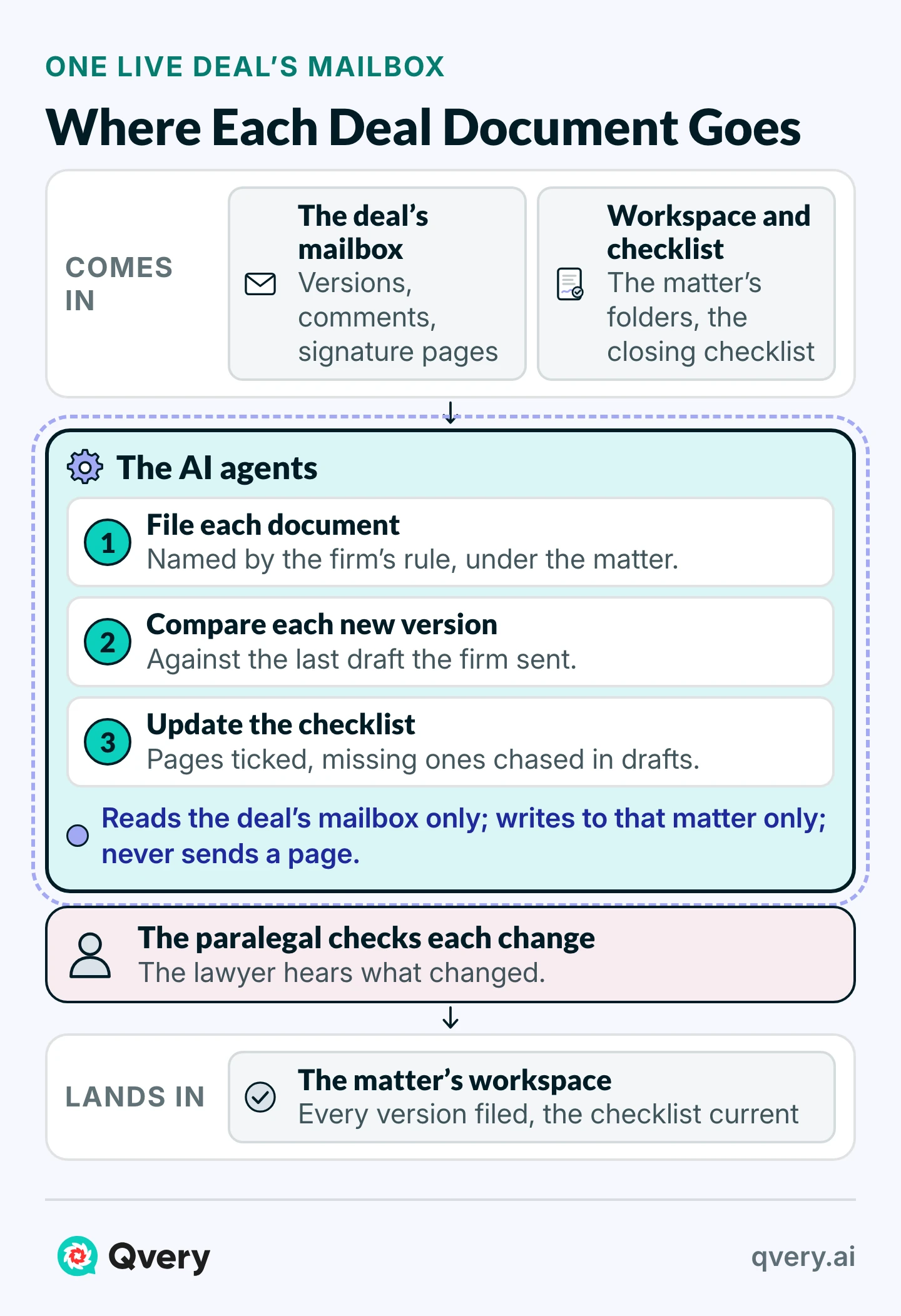
Nothing goes to the other side or the client without a person.
The agents never release a signature page or mark a document final, and they read only the deal's mailbox and write only to that matter's folders and checklist. The agents log each step, and the log is open to your paralegal.
Before the agents open a client's file, the firm and Qvery, an EU company, sign a data processing agreement.
Put your own group's numbers in:
Cost Per Deal Document ROI Calculator
What Each Deal Document Costs You To File And Track, And With The Agents
Saved Per Year
$41,275
960 hours handed back, after $4,680 a year to run it
- Hours Handed Back
- 960 hours a year
- Agent Running Cost (Estimate)
- $390 a month
- Payback Per $10,000 Of Build
- 2.9 months
On these numbers, each document costs $2.25 instead of $7.98, the agent saves $41,275 a year after its own running cost, and every $10,000 of the build is earned back in 2.9 months.
The example is a transactional group of about 40 lawyers at a firm of roughly 200 people. Six hundred deal documents a month at ten minutes each is 1,200 hours a year: $57,444 of a paralegal's time at $47.87 an hour, or $7.98 a document.
With the agents filing and updating the checklist and a paralegal spending two minutes checking each, a document costs $2.25: the firm saves $41,275 a year after $4,680 to run them, and each $10,000 spent on the build comes back in 2.9 months.
Where a junior associate does the filing, the hour costs more than twice as much.
The calculator counts minutes, not mistakes: a signature page attached to the wrong draft, or a client signing a version that was not the last one agreed.
We start with one practice group and one live deal. We learn how the group files and tracks today, connect the agents to its mailbox and document system, and by the end of the second week with access they run beside your paralegals. From then on, each week's report shows the hours they handed back.
Frequently asked questions
Is Spellbook worth it for a law firm?
For a transactional group with written positions and precedents in a connected document system, yes: it gives every lawyer a consistent first pass in Word. For a group without a playbook, the value is much smaller, because Spellbook reviews against the rules you give it and the law-firm plan includes no help writing them.
How much does Spellbook cost?
Spellbook publishes no price. It prices per person on the license and quotes after a demo. One in-house lawyer reported $350 a month for the Word add-in in February 2026; treat any number as one buyer's quote until you have your own.
Is there a Spellbook trial?
Yes, seven days, and Spellbook says larger organizations can get longer ones. A trial is most telling on the firm's own documents and playbook. When the trial ends, its projects become inaccessible unless you buy, so download anything you need before then.
Does Spellbook work with our Word templates?
It works inside the Word document you already have open, and its redlines can go in as tracked changes under your name. Since October it can create tables, match numbered lists to the document's style and apply formatting. One G2 reviewer still asks it to stop mixing bold text and font sizes in what it drafts.
How accurate is Spellbook's contract review?
We found no independent test of Spellbook's review, and the vendor's own figures come without their conditions. Its G2 reviewers say it catches inconsistencies they would miss, and two report wrong or out-of-date citations. It works as a second reader: the lawyer still checks every change, every citation and every rule it marks passed.
Does Spellbook train on client documents?
Its terms say no. Spellbook holds zero data retention agreements with OpenAI and Anthropic, and data sent to them is not used to train their models. Spellbook itself may keep inputs and outputs for up to 90 days for quality checks, which is the clause a firm's confidentiality review will ask about.
Where does Spellbook keep our data?
With cloud providers in Canada and the United States, by its security page. It holds a SOC 2 Type II report and can agree to a business associate agreement for work involving health records. The firm's own duties to its clients stay the firm's, whichever vendor it picks.
Does Spellbook work with iManage or NetDocuments?
It connects to iManage: a lawyer selects files and brings them into Ask or an Associate project, under the existing iManage permissions and ethical walls. NetDocuments is not among the integrations Spellbook lists. Neither connection files anything back into the document system.
What is Spellbook Associate?
Associate is Spellbook's web and desktop app for work across several documents: revising one agreement from another, comparing versions, asking questions across a set. It edits Word files only and works best, by Spellbook's own guidance, starting from two to five documents.
What is Spellbook ACM?
ACM, Autonomous Contract Management, is Spellbook's contract system, generally available since October 2026. It takes contracts in from forms, email and Slack, runs a first pass, routes them for approval and stores signed agreements. Its pipelines and its own pages are built for in-house legal teams handling a company's contracts.
Does Spellbook work in Google Docs?
Yes. Spellbook runs inside Google Docs with its review, playbooks and Ask, for teams that draft and review there.
What does a lawyer still check after Spellbook reviews a contract?
Every suggested change before accepting it, every citation it adds, and the rules marked passed, because a passed rule is only as good as the rule. The lawyer also keeps everything outside the document: the client's instructions, the history of the deal and what was conceded on earlier turns.
Can Spellbook file our deal emails into our document system?
Nothing on its pages describes it. ACM reads email for its own repository, built around a company's contracts. A firm's document system files an email when a person picks the folder. Keeping every deal document filed under its matter and the closing checklist current is the job Qvery's agents do.
Do Qvery's agents replace Spellbook?
No. Spellbook reads and marks up the draft with the lawyer; our agents handle the paperwork around it, filing each version and signature page and keeping the checklist current, so the right draft reaches the lawyer and Spellbook in the first place.