On this page
- Harvey Sells by the Seat, and the Seat Count Is Yours to Negotiate
- An Hour Harvey Saves on a Billed Matter Comes Off the Client's Bill
- Vault Is Where Harvey Earns Its Price
- Harvey's Agents Now Run on a Schedule, but Only on Legal Work
- Research Cites Its Sources, and LexisNexis Costs Extra
- Lawyers Who Use It Split by the Work They Give It
- Buy Seats for Your Document-Heavy Teams, Not for Every Lawyer
- Qvery's Agents Draft the Time Entries Harvey Leaves to Your Lawyers
- Frequently asked questions
At a firm under 200 lawyers, the Harvey decision is a seat commitment with no price list to check it against. Harvey publishes no price: its sales team quotes seats, products and a contract term, and its own help centre puts the average at several hundred dollars per user per month.
At $500 a seat, our assumption inside that range, 40 seats cost $240,000 a year and 80 seats $480,000. The firm pays that, and under the billable hour the time those seats save on billed work comes off the client's bill.
Harvey earns its price where a defined group of your lawyers reviews and drafts documents all day and the firm turns the hours it saves into more matters. It has also started on the firm's own paperwork: work done in Harvey now becomes a draft time entry, for firms on Aderant's timekeeping.
The rest of each lawyer's day, the calls, the meetings and the email written outside Harvey, still gets written up by hand, and a firm this size pays for that in lawyer time every day.
At Qvery, we help law firms spend less lawyer time on timekeeping and keep their lawyers on client work, with custom AI agents that read each lawyer's day, match every call, email and document to its matter and draft the time entries for the lawyer to approve.
Harvey pays us nothing for this page, and we don't resell or install it.
We didn't run a Harvey seat for this review: Harvey sells through its sales team, and trials run on its own terms. The page rests on Harvey's product pages, help centre and contracts, read on 10 November 2026, and on what lawyers who bought, trialed or turned it down report in public.
Harvey Sells by the Seat, and the Seat Count Is Yours to Negotiate
Harvey is licensed per seat, and the firm decides who gets one. The way in, by Harvey's own description, is a demo on the firm's own kind of work, then a quote. What the seat buys, and for how long, is settled in the order form:
Harvey now sells to a firm your size by name. Its page for smaller firms speaks to "roughly 15 to 150 lawyers", counts 2,300 smaller firms as customers, and promises a customer success manager and legal engineers, lawyers who build the first workflow with you, so the firm needs no innovation team of its own.
In August 2025 small firms on Reddit said they couldn't get a demo; that has changed.
What it has not published is a price or a minimum. Buyers who posted their quotes fill the gap, one firm each. A large firm's innovation committee was first quoted $1,200 a seat a month, $2,400 with LexisNexis, and later offered a lower tier around $399 with less in it.
A firm of about 200 lawyers described a minimum number of licenses and a 12-month minimum. Another firm negotiated the size of its pilot for three weeks: Harvey asked for 40 lawyers, the firm agreed to 15.
| Seats | At $399 a seat a month | At $1,200 a seat a month |
|---|---|---|
| 20 | $95,760 | $288,000 |
| 40 | $191,520 | $576,000 |
| 80 | $383,040 | $1,152,000 |
Where a firm lands in that range is negotiated. Whether it should buy at all turns on how many of its lawyers would open Harvey every working day.
An Hour Harvey Saves on a Billed Matter Comes Off the Client's Bill
The American Bar Association's ethics opinion on generative AI, Formal Opinion 512, is plain about hourly billing: lawyers who bill by the hour must bill their actual time. If Harvey turns a six-hour draft into two, the client is billed two.
A tool that works like the rest of the firm's equipment is overhead, not a charge to the client unless the firm discloses it in advance, and the time a lawyer spends learning it can't be billed to clients.
Harvey says as much in its own buying guide: for firms on billable hours, time savings alone aren't enough. Its page for smaller firms measures the return in non-billable and first-pass hours, and in matters taken on without new hires.
| The hour saved on | Who keeps it |
|---|---|
| Billed work on an hourly matter | The client, as a smaller bill |
| A fixed-fee matter | The firm, as far as the fee stays reasonable for the work |
| Work nobody bills: time entries, precedents, admin | The firm, as lawyer time back |
| A matter you'd otherwise have turned away | The firm, as new fees |
So the case for Harvey at a firm this size is capacity: the same lawyers taking on more document-heavy matters. The other place a firm keeps every hour is the work nobody bills, and one piece of it every lawyer does each day: writing up their time.
Our legal playbook walks through the jobs where agents pay off first in a law firm, from client intake to records requests.
Vault Is Where Harvey Earns Its Price
Vault is Harvey's document store for a matter. It holds up to 100,000 documents a vault, synced from a document management system such as iManage, SharePoint or Google Drive, and its review tables pull the same data points out of thousands of documents into one grid: every change-of-control clause in a data room, the key facts across a production.
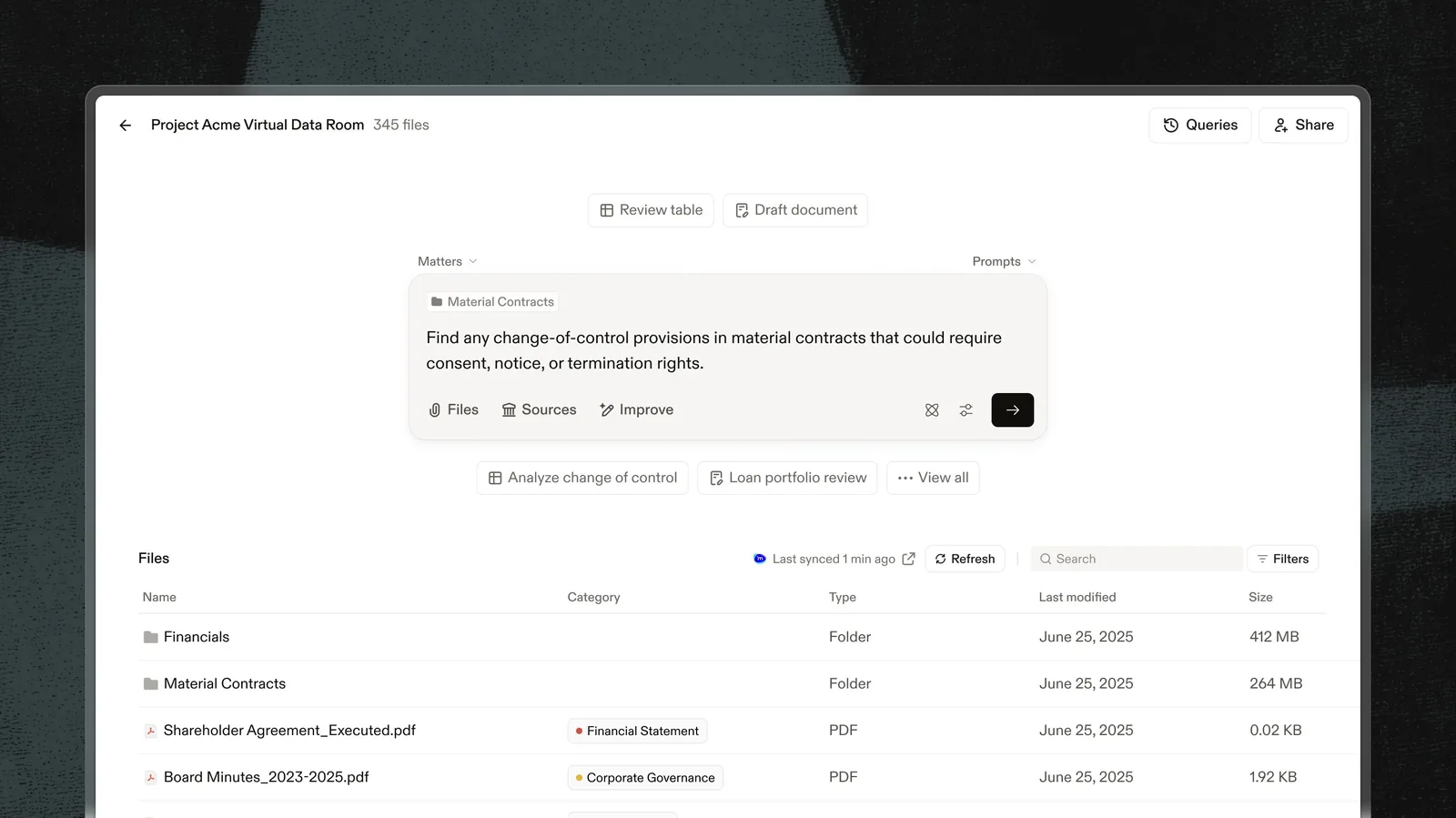
It's the feature lawyers who use Harvey praise most, and the one they complain about most; their own words are further down.
Vault is worth the seat for a litigation or deal team that runs a review most weeks. A lawyer who reviews a set a quarter is paying for it the other eleven weeks.
Harvey's Agents Now Run on a Schedule, but Only on Legal Work
Until August, every task handed to Harvey needed a lawyer to gather the documents, write the instructions and move the result on; Harvey says so itself. Harvey II changed that.
Agents now plan and run multi-step work in parallel, scheduled agents run reports, updates and reviews on a timetable you set, and since October a matter's phases, tasks and sign-off points can live in Harvey, with an agent running a task and the reviewing partner notified when it's done.
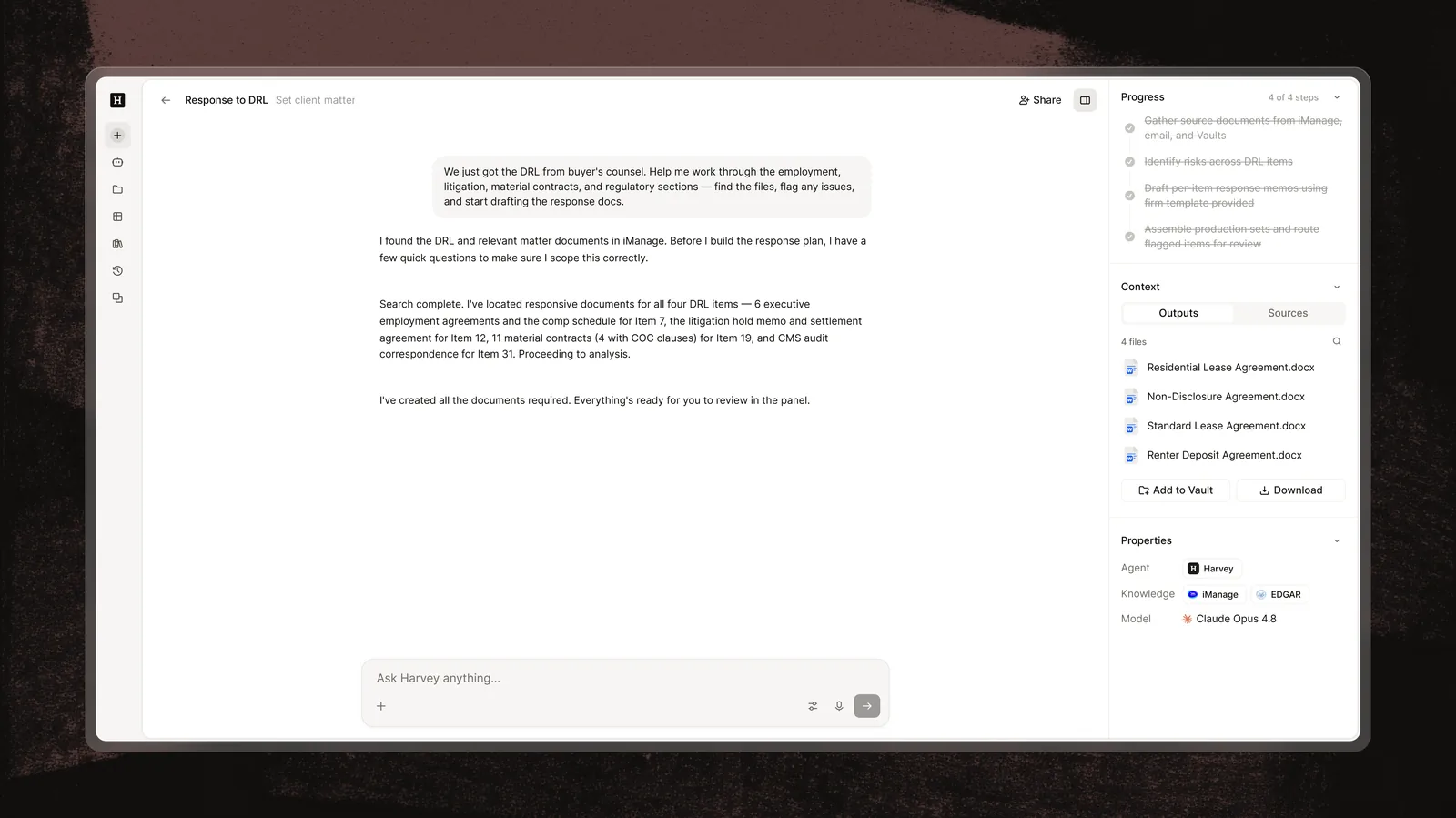
What the agents can reach is the Connector Library, generally available since 21 October. It reads where lawyers work and, starting with document management, writes finished work back:
| Kind of system | Listed |
|---|---|
| Document management | iManage, NetDocuments, SharePoint, Box, Google Drive |
| Email and chat | Outlook, Microsoft Teams, Slack |
| Review platforms and data rooms | Everlaw, Datasite |
| Signatures | Docusign |
| Billing, time or practice management | none listed |
A firm can add its own connector for an internal system, so the last row is a build, not a ban. As shipped, Harvey's agents do legal work on matters, for the lawyers who hold seats.
Research Cites Its Sources, and LexisNexis Costs Extra
Harvey answers legal questions from sources you pick: US law, SEC filings, EU law, the web, your own vaults, and LexisNexis primary law with Shepard's, its flags on whether a case is still good law, through Ask LexisNexis, licensed separately. Every answer links back to what it used.
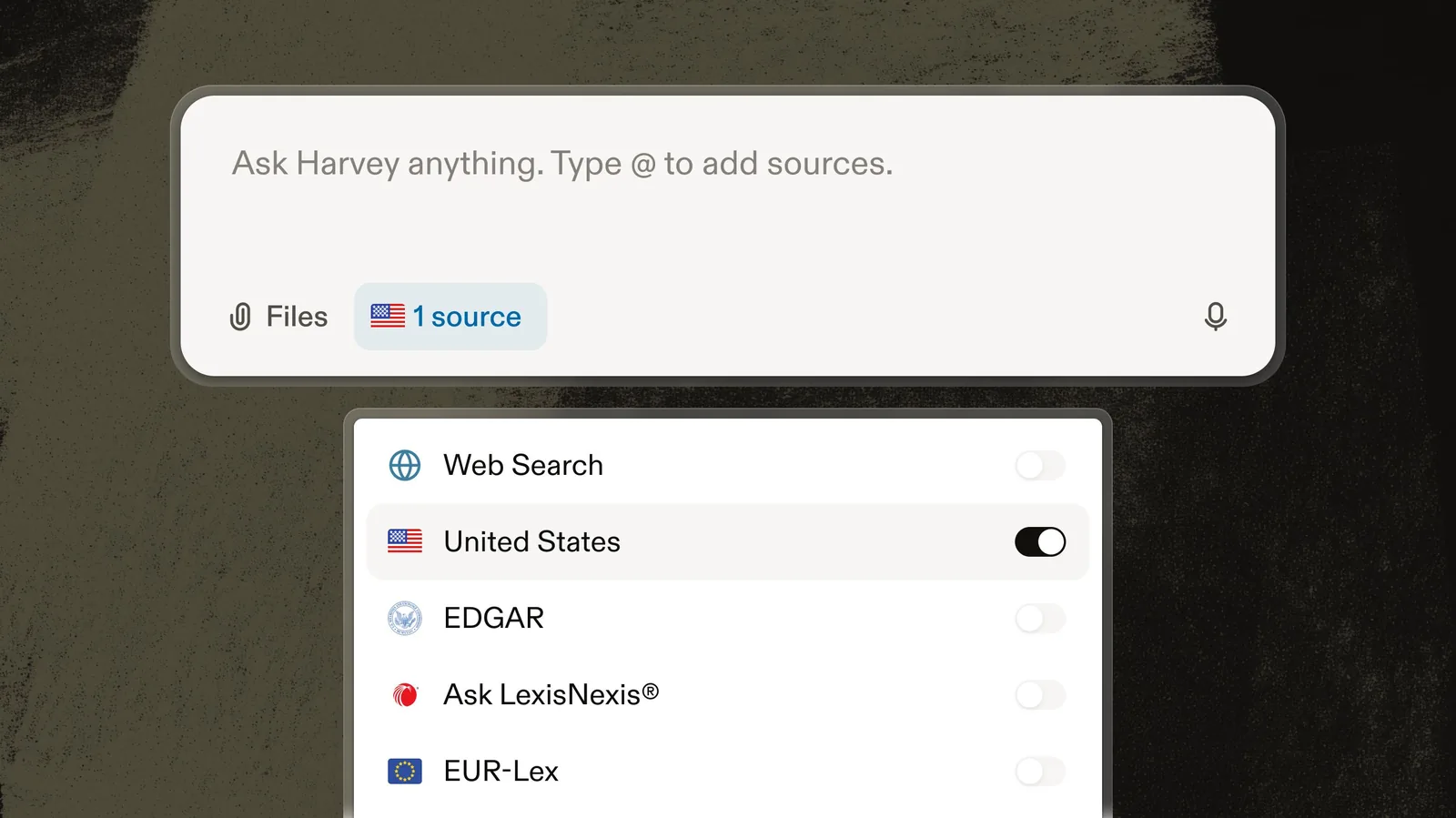
Checking the citations stays the lawyer's job. Opinion 512 says relying on a tool's output without appropriate independent checking could breach the duty of competence, and Harvey's own help centre warns that open-ended questions raise the risk of invented answers.
The rest of the platform matters less to the purchase:
- Word add-in: drafts and edits from prompts and precedents, and runs your playbooks on a contract.
- Outlook add-in: summarizes a thread with its attachments, drafts the reply and files the email to a vault.
- Data: inputs, outputs and documents are not used to train models, by contract; data can stay in the US, the EU, Switzerland or Australia.
- Intake: a front door for in-house legal teams, on a waitlist; not built for a firm's new clients.
Lawyers Who Use It Split by the Work They Give It
The G2 score says little: most of its reviews were invited with an incentive, and several come from outside law. The useful record is what lawyers and firm technologists wrote on Reddit; none of the posters quoted here shows a tie to Harvey or a rival in their history.
What Reddit says
What lawyers who bought or trialed Harvey say
We went with Harvey. … The ability to feed it 200 documents and use the built in table tool to build a spreadsheet of data off them.
I have some state court litigation where sub-1000 documents are produced in PDF or native formats, and it does a pretty good job at doing preliminary doc review/flagging hot and bad docs.
Even when I add docs to a vault and ask for a review table, getting Harvey to … “read” the docs is like pulling teeth.
My firm trialed Harvey and CoCounsel. All the associates hated Harvey and weren’t too keen on CoCounsel.
Lawyers who give Harvey document sets, discovery and drafting from precedent defend it; lawyers who want analysis they can sign without checking it line by line are the ones disappointed.
The firm-level stories run the other way from the demos: a firm of more than 100 lawyers tried Harvey in 2025, found the cost not justified and chose a general assistant for everyone instead, and a 30-attorney firm ran Harvey and two rivals for three weeks each and decided to build its own.
We can't confirm any of these from our own use, and we didn't find a firm under 200 lawyers reporting a firm-wide return.
Buy Seats for Your Document-Heavy Teams, Not for Every Lawyer
Pros
- Vault and its review tables pull the same data points out of thousands of documents into one grid
- Agents now plan and run multi-step matter work, on a schedule if you want, with every step logged
- Research answers cite their sources, with LexisNexis and Shepard's available inside Harvey
- Sold to firms of 15 to 150 lawyers with a success manager and legal engineers, no in-house team needed
Cons
- No published price or minimum; quotes reported from $399 to $1,200 a seat a month, $2,400 with LexisNexis
- Integrations, custom workflows and LexisNexis are priced on top of the basic service
- The order form's term binds: seats bought for the year are paid for the year
- Connects to no billing or practice-management system as listed; time entries only for work done in Harvey, only into Aderant's iTimekeep
Buy Harvey if one or two practice groups review and draft documents every working day, litigation with real productions or deals with real data rooms, and you can name the lawyers who would fill every seat. Count the return in matters those groups take on without hiring, because under hourly billing the hours come off the bill.
Pass, for now, if the seats would go to lawyers who use AI a few times a week, or if the cost you want gone is the work nobody bills. A general assistant on a business plan, about $20 a seat a month billed annually, covers occasional drafting, and Harvey doesn't reach the billing system where that unbilled work lands.
Harvey is a serious legal workbench, and that's the trap for a firm your size. The demo shows a partner's best hour. The invoice shows every seat, every month, including the ones nobody opens. Buy the seats your document-heavy teams will fill, and judge Harvey on the matters those teams take on, because the hours it saves on billed work go back to the client.
Qvery's Agents Draft the Time Entries Harvey Leaves to Your Lawyers
Harvey has started on time. Since 17 August, firms that run both Harvey and Aderant's iTimekeep, a timekeeping app, get a draft entry for work done in Harvey, with the matter, the duration and a narrative the lawyer reviews and submits. Harvey's own product manager called it "the first step". It covers the work done inside Harvey, in one vendor's timekeeping.
The rest of the day still has to be written up: the client call, the meeting, the email to opposing counsel, the redline saved at 7 p.m. Each lawyer reconstructs those once the day or the week is over, and the time spent doing it is billed to nobody.
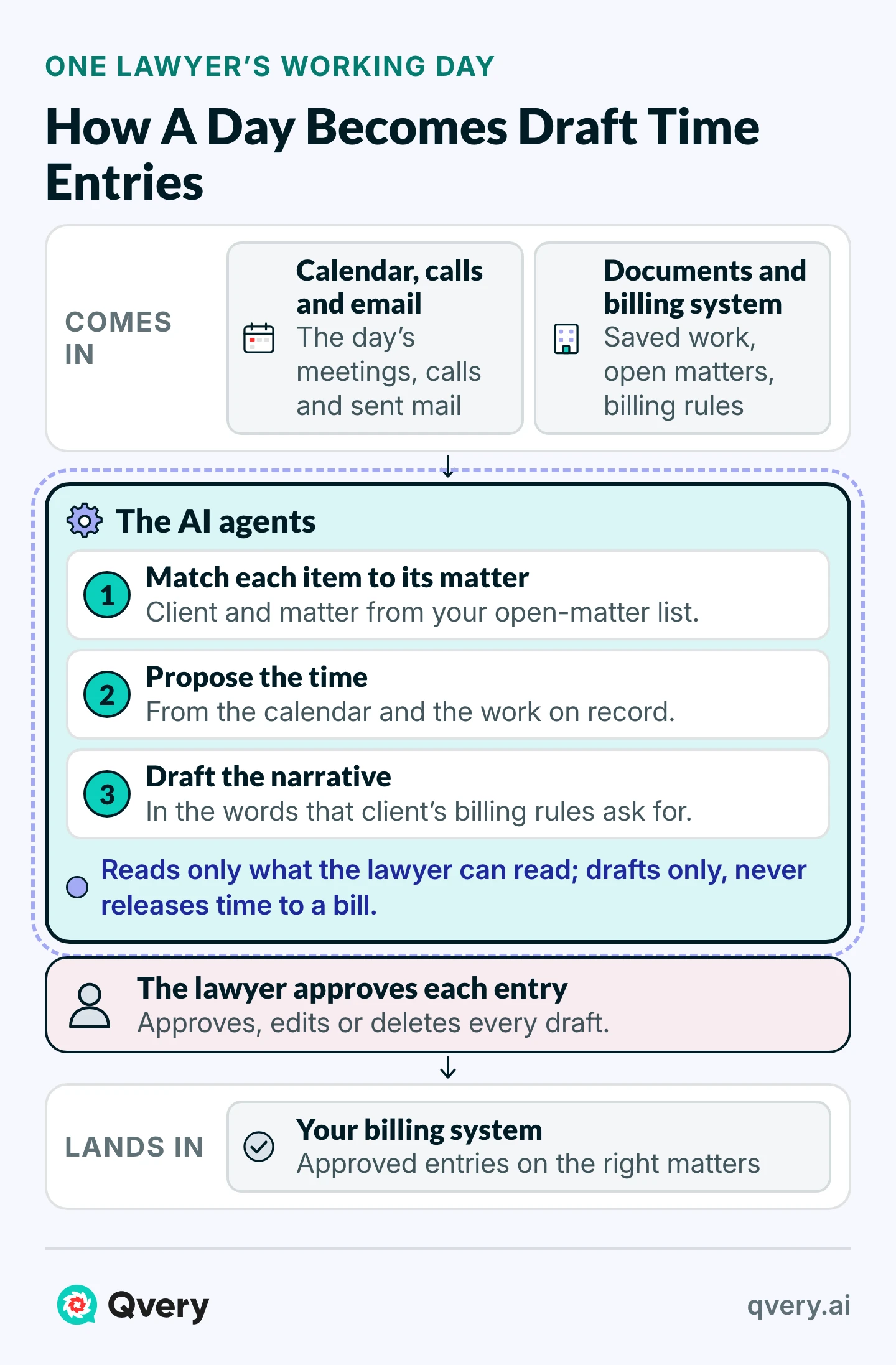
At Qvery, the agents we build for a firm's time entries start at the end of each lawyer's day. They read the lawyer's calendar, the email the lawyer sent and the documents saved to the firm's document management system, and the call log if the phone system keeps one.
They match each item to a client and matter from the open-matter list in your billing system, propose the time from the record, and write the narrative the way that client's billing guidelines require.
The drafts wait in the billing system, unreleased. The lawyer approves, edits or deletes each one, and an item the agents can't place on a single matter goes to the lawyer with the reason.
For example: a 40-minute call with a client's general counsel on the calendar, an email to opposing counsel twenty minutes later and a revised purchase agreement saved to the matter's folder become one draft entry: 1.1 hours on that matter, "Call with client's general counsel re indemnity cap; email to opposing counsel re same; revise draft asset purchase agreement." The lawyer reads it, changes nothing or a word, and approves.
What it costs today is lawyer time. Take a firm with 80 lawyers keeping time, each costing about $228,100 a year with benefits (the US median lawyer's pay of $159,670 in May 2025, by the Bureau of Labor Statistics, with benefits at 30% of employer costs).
If writing up time takes 3% of a lawyer's week, a little under 15 minutes a day, the firm spends $547,440 a year of lawyer time on it, about 4,992 hours.
With the agents taking the matching, the timing and the drafting, about 70% of that work, and the lawyer keeping the review, that becomes $164,232 of lawyer time plus about $580 a month for the agents to run: $376,248 a year back, and about 3,494 hours.
Every ten thousand dollars of the build is earned back in about ten days of that return. Put in your own lawyers and minutes:
Law Firm Time Entry ROI Calculator
What Writing Up Their Time Entries Costs You, And What An Agent Saves
Saved Per Year
$376,248
3,494 hours handed back, after $6,960 a year to run it
- Hours Handed Back
- 3,494 hours a year
- Agent Running Cost (Estimate)
- $580 a month
- Payback Per $10,000 Of Build
- 0.3 months
On these numbers, the agent saves $376,248 a year after its own running cost, and every $10,000 of the build is earned back in 0.3 months.
Hours are the saving here, so the firm gets the most from them where they turn into billed work or into matters it would otherwise turn away.
The agents read what the lawyer can read and nothing more, so a lawyer walled off from a matter has nothing from it drafted for them.
Before they touch a system we agree in writing what they may read and do and where the data is processed; they start with the least access the job needs, log every action, and post nothing to a bill: the lawyer approves each entry, and the billing partner keeps every write-down, the time cut before a bill goes out.
Qvery AI OÜ is an EU company and signs a data processing agreement.
Working with us starts with one practice group. Bring us a week of its calendars and the billing guidelines of its three biggest clients, and we map with your billing partner how entries are written today.
Two weeks after we have access, the group's lawyers find their entries drafted each morning, and every week after that we show you the hours handed back and the entries the lawyers had to correct.
Frequently asked questions
How much does Harvey cost per lawyer?
Harvey doesn't publish a price. Its help centre puts the average at several hundred dollars per user per month, depending on the number of seats, the products deployed and the contract terms. Quotes buyers have posted ran from about $399 to $1,200 a seat a month at one large firm, $2,400 with LexisNexis. Each is one firm's negotiation: get your own quote in writing, every product line itemized.
Does Harvey require a minimum number of seats?
Harvey's public pages and contracts state no minimum. Buyers have reported one: a firm of about 200 lawyers described a minimum license count and a 12-month minimum in 2025, and another negotiated its pilot from the 40 lawyers Harvey asked for down to 15. Ask for the minimum, the term and the rules for reducing seats at renewal before the demo, not after it.
Can a firm under 200 lawyers get a Harvey trial?
Trials exist as evaluations Harvey authorizes under its Evaluation Terms, and Harvey can end one at any time or limit what it includes. There is no self-serve trial and no sign-up page. Firms report that the pilot's size, length and scope are negotiated with sales, so ask for a pilot on one practice group's live matters, with the success measure agreed in advance.
Is Harvey better than ChatGPT or Claude for legal work?
Harvey runs on models from Anthropic, OpenAI and Google and adds legal structure on top: vaults of up to 100,000 documents, review tables, LexisNexis and Shepard's inside the tool, playbooks, and legal engineers who set it up. A general assistant on a business plan costs far less and drafts well from one document at a time. The difference pays for lawyers who review documents in volume.
Does Harvey train its models on our client files?
No, by contract: Harvey's Platform Agreement commits it not to use the firm's inputs, outputs or documents to train models, and data can stay in the US, the EU, Switzerland or Australia. Confidentiality still runs through the firm: Opinion 512 asks lawyers to vet an AI vendor like any other, and to get a client's informed consent before client information goes into a tool that learns from it.
Can we bill clients for Harvey?
Not by default. Under Opinion 512, a tool that works like the firm's other equipment is overhead, charged to clients only where the firm disclosed it in advance, and time spent learning a tool the lawyer will use regularly can't be billed to clients. On hourly matters the lawyer bills the time spent, so a faster draft is a smaller bill.
What happens to our documents if we leave Harvey?
Under its Platform Agreement, Harvey securely deletes any remaining customer data within 30 days of termination unless the firm instructs otherwise, and the firm keeps all rights in what it uploaded. Termination takes effect only when the order forms expire, so plan the export of vaults and review tables before the term ends, not after. The same 30-day deletion applies at the end of an evaluation.
Does Harvey connect to our billing or practice management system?
Its Connector Library lists no billing, time or practice-management system as of November 2026; the firm can add its own connector for an internal system. The one billing link is Aderant's iTimekeep, which turns work done in Harvey into draft time entries for firms that run both.
Do Qvery's time-entry agents post time to a bill on their own?
No. They draft entries and leave them unreleased in the billing system; the lawyer approves, edits or deletes each one, and the billing partner keeps every write-down. Which entries a lawyer may approve in bulk, if any, is the firm's decision, and the agents log every draft and every change.
Which billing systems do the agents work with?
The one the firm already runs. The agents are built for the firm's own systems, not sold as a product that needs a particular vendor, so the drafts land where your lawyers already review and release their time.
Can the agents follow clients' billing guidelines, such as a ban on block billing?
Yes. Each client's billing guidelines are part of what the agents read before they draft: where a client bars block billing, several tasks under one time figure, every task gets its own entry; where it requires task codes or caps a task's time, the draft carries the code and marks any entry over the cap. A rule the agents can't apply goes to the billing partner as a question.
Do our lawyers need Harvey for the time-entry agents to work?
No. The agents read the calendar, email, documents and call log the firm already has, so they work the same for lawyers with a Harvey seat and lawyers without one. Where the firm also runs Harvey with iTimekeep, the agents can treat those drafts as one more source and stop the same work being entered twice.