On this page
At a law firm of a few hundred people, research fills part of every associate's week: a partner's question, hours in the cases, a memo, then a check that each case cited exists and is still good law. The client pays for those hours, or the firm writes them off.
These seven are the tools a firm your size chooses between, set in order by the library each answers from, and each entry says how a lawyer confirms a citation in it. None of them runs that check on every final brief before filing; firms build it, and we build it at Qvery.
1. Westlaw Advantage with CoCounsel: Deep Research on the Library Most Courts Use
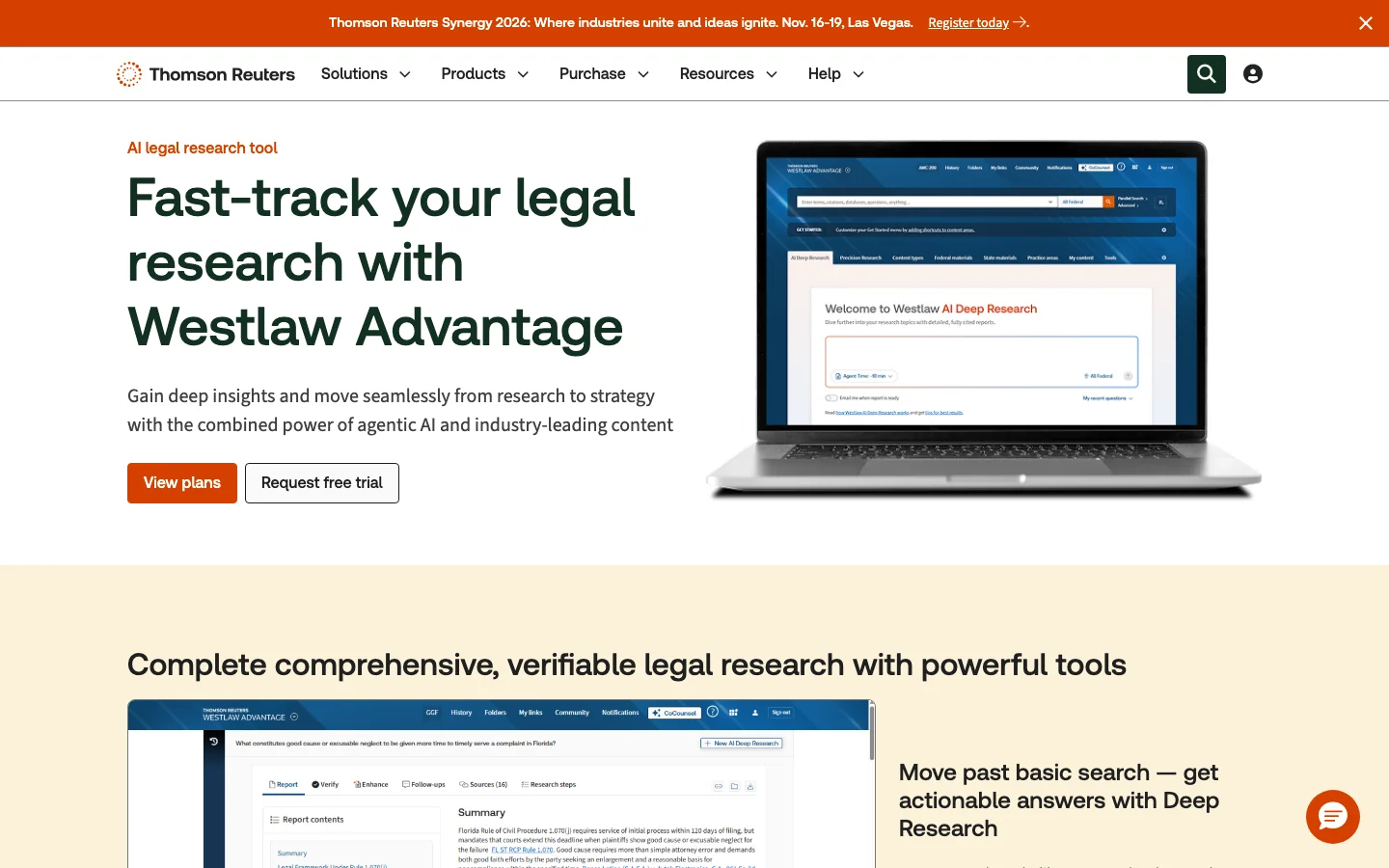
Westlaw Advantage puts an agent to work on the Westlaw library, which Thomson Reuters says 94% of U.S. state courts use. Deep Research plans a search, runs it and returns a report with the primary law linked, and CoCounsel Legal carries that research into a draft.
- Deep Research: a multistep plan run over Westlaw and Practical Law, returned as a report with linked primary law
- Litigation Document Analyzer: flags potential mischaracterizations and hallucinated cases in your litigation documents
- CoCounsel Legal: research, analysis and drafting from Westlaw, Practical Law and your firm's documents
- Works with iManage, NetDocuments and SharePoint, and inside Word and Outlook
What Reddit says
50.4 / 100
127 independent mentions in 37 threads, 5 vendor posts set aside; give or take 7.1 points
Most of the time I find WL AI Deep Research to be superior, especially if you “enhance” with additional facts in response to its questions.
CoCounsel is like a 4th or 5th year when it comes to drafting briefs or motions. Probably a 2nd or 3rd when it comes to research.
Westlaw AI is good at finding the relevant line of cases, terrible at summarizing the holdings and terrible at identifying which are the current law and which are obsolete.
Pros
- The library 94% of state courts use, by its own count
- Deep Research shows its steps and links the law
- A published online price for small firms
Cons
- A quote above 10 attorneys
- Lawyers split on its summaries of holdings
- Overlapping product names for one bundle
2. Lexis+ with Protégé: Answers From Lexis, Checked by Shepard's
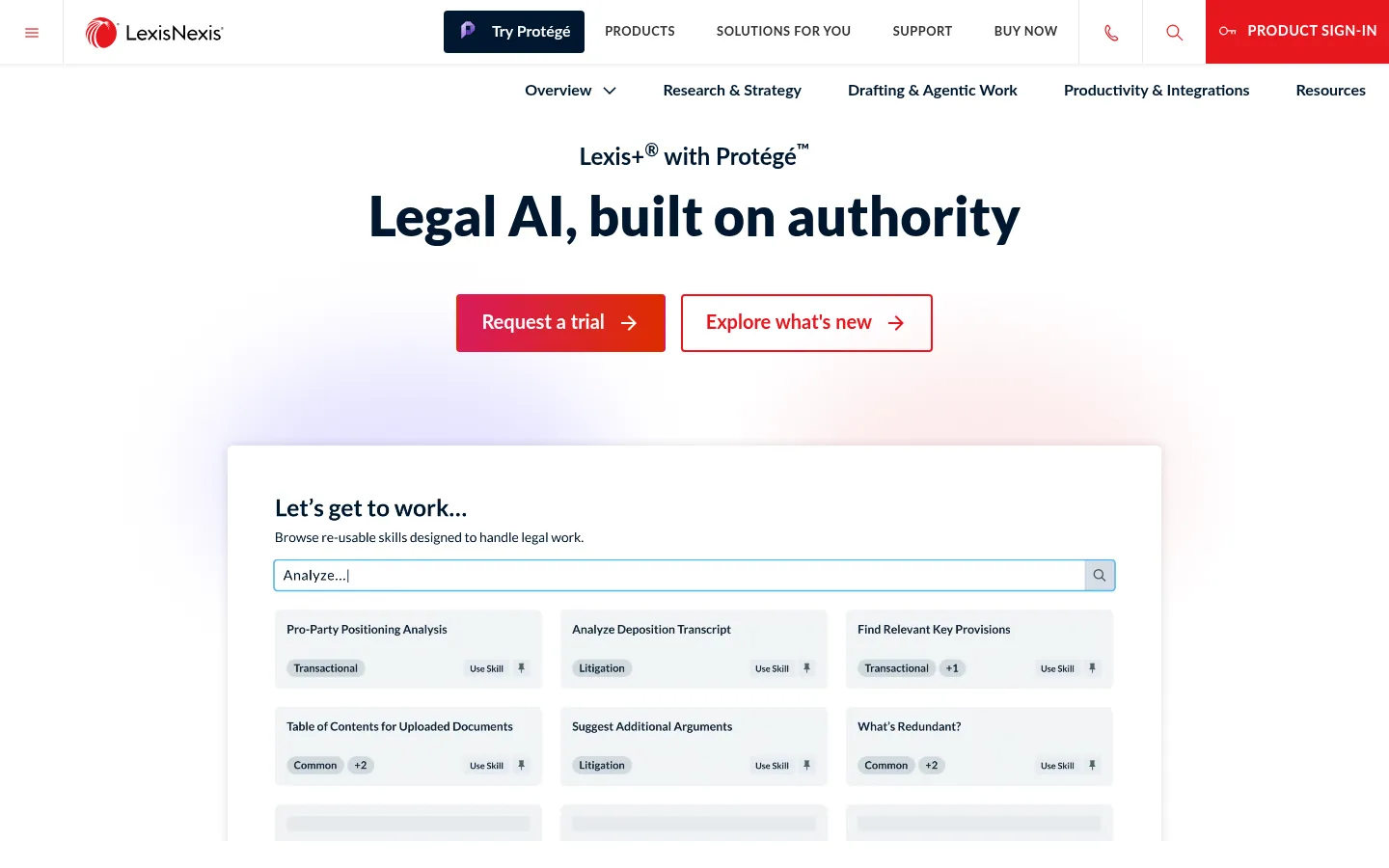
Protégé answers from the Lexis library, your firm's own documents and the web, and Shepard's Verify checks the citations in its answers and in your drafts, flagging statements no authority supports.
- Shepard's Verify on AI answers, documents and drafts, with each authority's status and treatment
- Answers grounded in LexisNexis content, your firm's documents and web sources
- Connections to iManage, SharePoint and NetDocuments
- Vaults for document sets: up to 50, each holding 1 to 500 documents
What Reddit says
44.9 / 100
69 independent mentions in 28 threads, 4 vendor posts set aside; give or take 9.3 points
What I find are real cases but misquoted and irrelevant.
it still tends toward stopping its search on the first case it thinks is related, and then webbing out from that case rather than looking for the most cited or most on point case.
I loved Lexis Protege when I had it at my last firm because the cases were real and didn't hallucinate.
Protege has had massive improvement in the last 6 months. It’s better at drafting than answering questions, though.
Pros
- The citator runs on your drafts, not only on its answers
- Reads the documents in your document system
- The natural add for a firm already on Lexis
Cons
- No price at any size without a call
- The lowest Reddit score in this list
- Lawyers report misread holdings
3. Bloomberg Law: AI Inside One Flat Subscription, With Federal Dockets
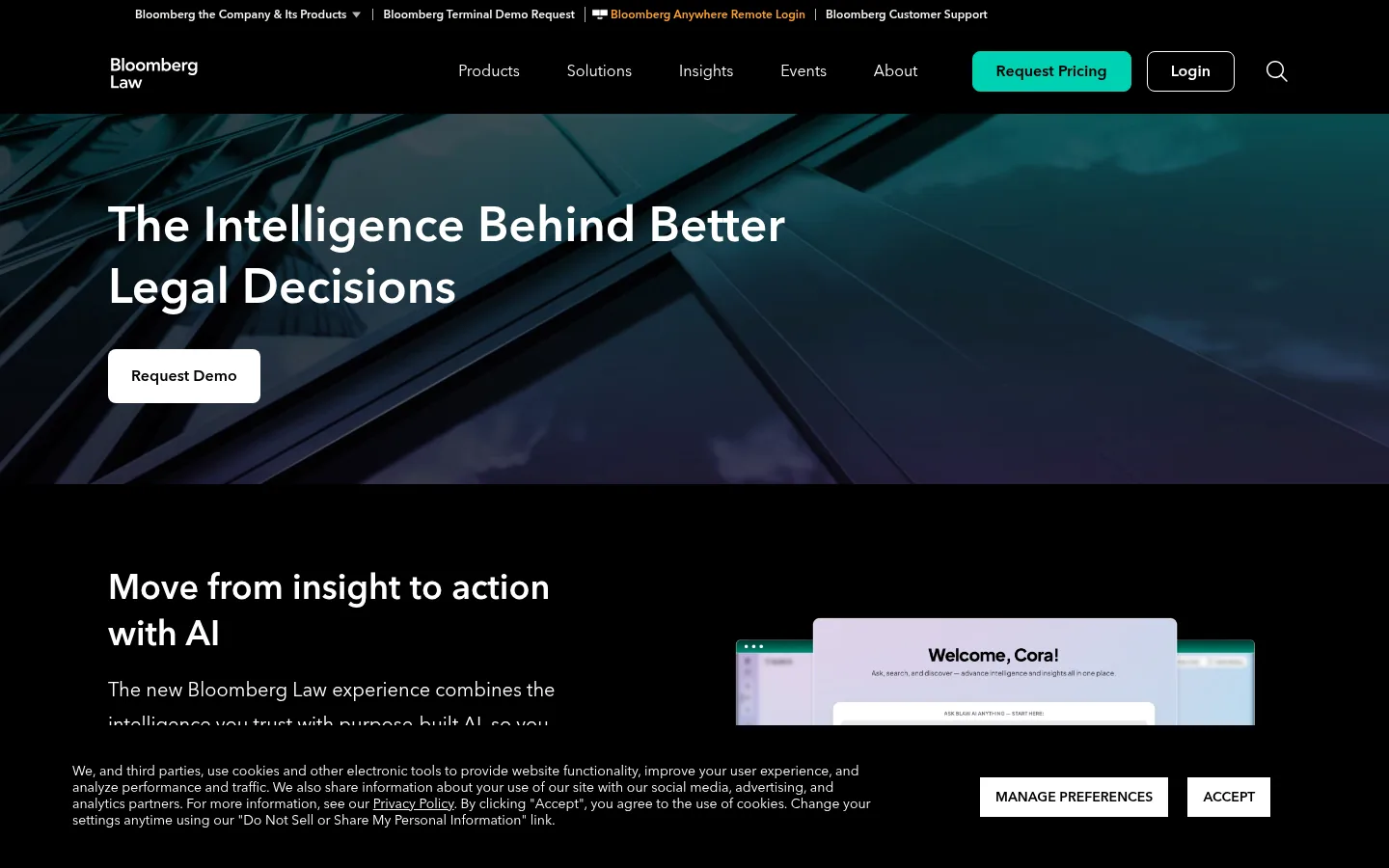
Bloomberg Law answers from its own opinions, statutes, regulations and practical guidance, footnotes the extract behind each part of an answer, and includes its AI in the one subscription price.
- AI answers with a footnote to the source extract behind each part
- Docket Search: classifies 200+ motion and brief types across every federal district court docket
- AI Deep Thinking for complex, multistep research questions
- Litigation analytics, news and practical guidance on the same platform
Lawyers on Reddit rarely discuss Bloomberg Law's AI, too rarely to score it or quote anyone.
Pros
- AI at no extra cost on top of the subscription
- Docket search across every federal district court
- Answers footnoted to the exact extract
Cons
- No published price
- Little independent discussion to read
- A third subscription for a firm already on Westlaw or Lexis
4. Vincent by Clio: A Global Library for Multi-State and Cross-Border Questions
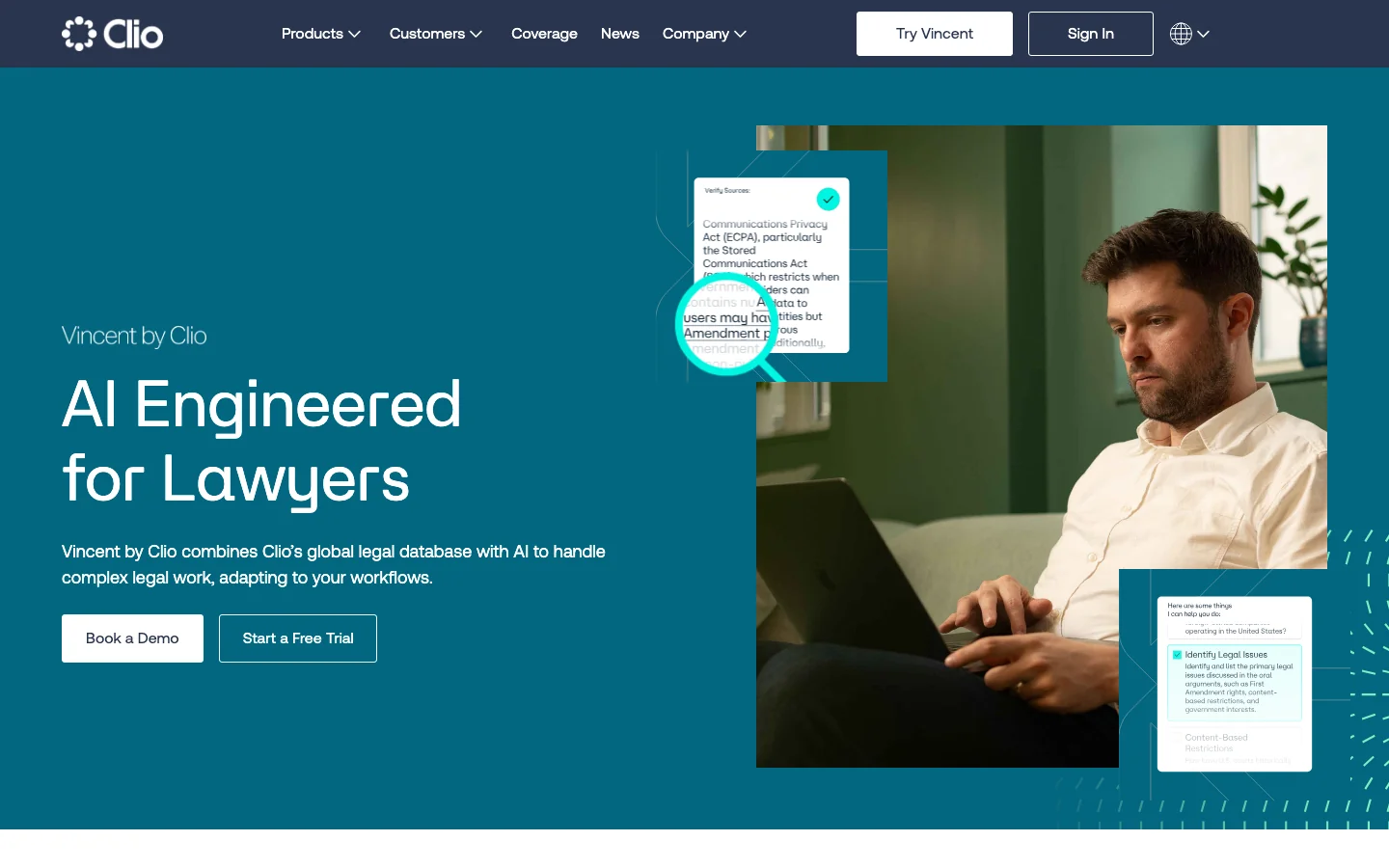
Vincent, now part of Clio, answers from Clio Library, over a billion documents from more than 100 countries by Clio's count, and marks each citation as matched, close or not found, so a lawyer sees at once which authority to open first.
- Authority Match: each citation marked matched, close or not found, with its judicial treatment
- Clio Library: 1B+ documents from 100+ countries, with daily editorial updates in 20+ of them
- 50-state surveys and side-by-side analysis across jurisdictions
- Works in Word, Outlook and iManage
What Reddit says
66.7 / 100
15 independent mentions in 13 threads, 5 vendor posts set aside; give or take 12.3 points
Great for multi-jurisdiction research (17+ including US federal, state, and EU). Links directly to sources. My main pick for AI-assisted legal search.
VincentAI has been really helpful with outlines for depositions, briefing, etc.
Pros
- The widest geographic coverage in this list
- Every citation marked by how well it matches
- Built into Clio for firms that run on it
Cons
- No published price
- Fewer independent reviews than the incumbents
- Most Reddit talk is about Fastcase, the older service in its library
5. Midpage: Its Own Case Law and Citator, Inside the Assistant You Choose
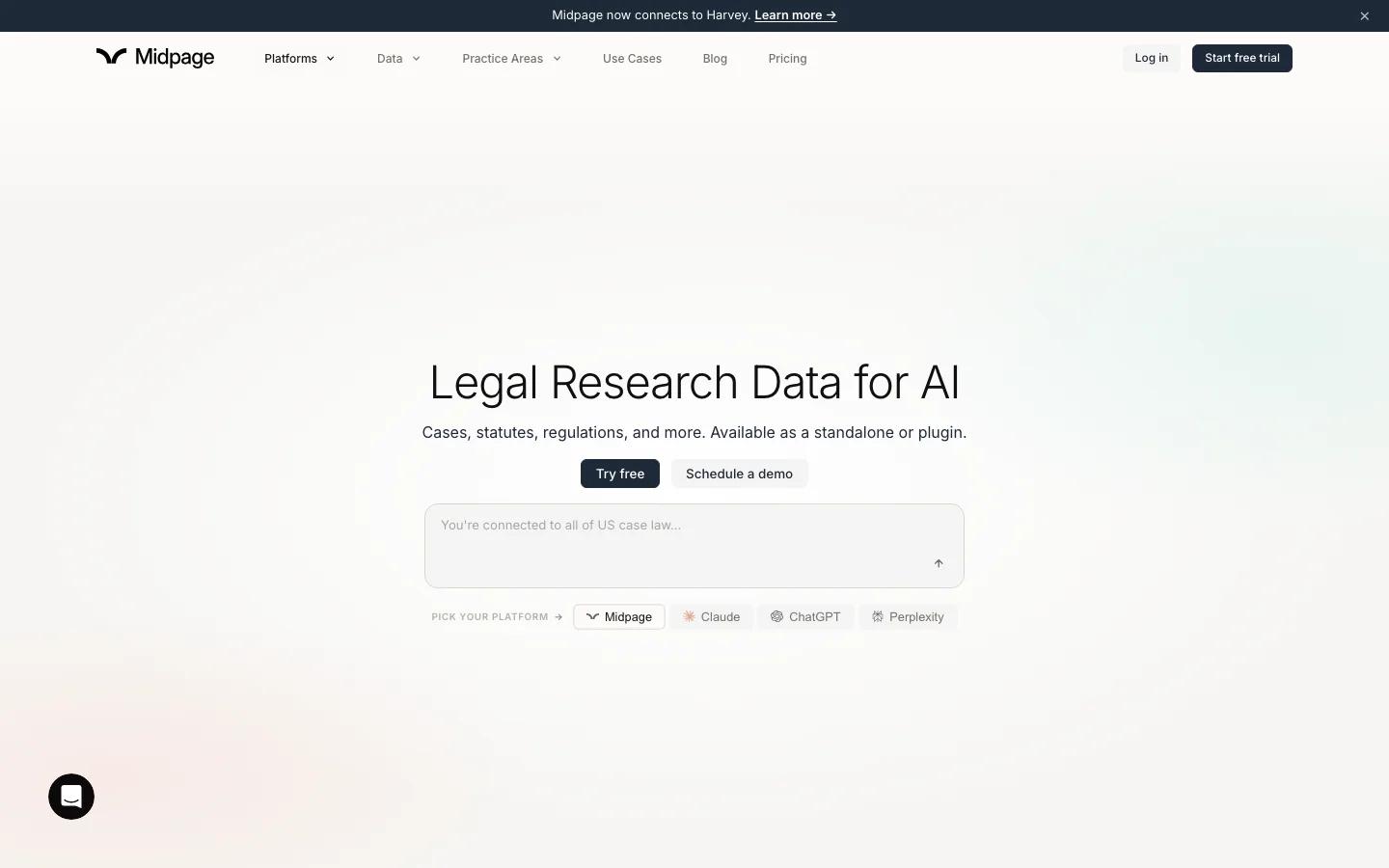
Midpage built its own collection of U.S. case law, more than 16 million opinions with an AI citator, and sells it at a published price, in its own app or as a connector for Claude, ChatGPT, Perplexity or Harvey.
- 16M+ U.S. opinions, federal and all 50 states, with treatment signals from an AI citator
- Statutes, regulations and agency guidance
- Cite checks on a draft, and federal dockets pulled from PACER
- Connectors for Claude, ChatGPT, Perplexity and Harvey
What Reddit says
59.1 / 100
11 independent mentions in 7 threads, 2 vendor posts set aside; give or take 22.2 points
I love Midpage for this (you can create columns let let you answer yes/no questions, and then filter by them).
We’ve been using midpage and it’s been pretty solid
Midpage is attempting to build its own legal database and it's not structured well. Lots of gaps and returns bad information.
Pros
- A published price per seat
- Brings case law into the assistant your lawyers already use
- Its own citator on every opinion
Cons
- A newer library, and some users report gaps
- Few independent reviews yet
- No treatises or practice guides
6. Descrybe: Citation and Quote Checks Inside Copilot, ChatGPT or Claude
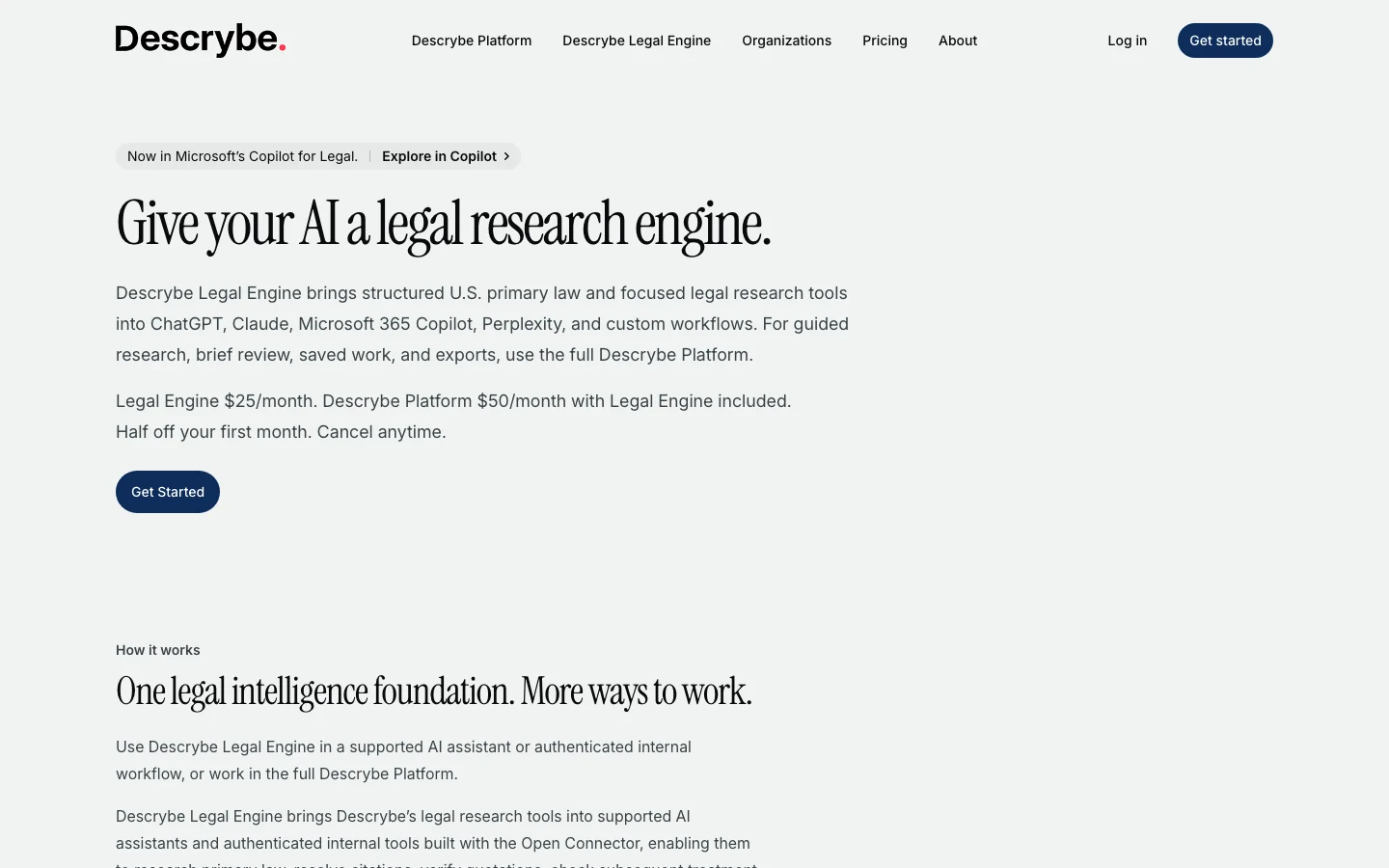
Descrybe is a research engine more than an app: it puts structured U.S. primary law, citation checks and quote checks inside the assistant your firm already pays for, whether that is Microsoft 365 Copilot, ChatGPT, Claude or Perplexity.
- Resolves citations, checks later treatment and verifies quoted language
- Works inside Microsoft 365 Copilot, ChatGPT, Claude and Perplexity
- A full platform for brief checking, saved research and exports to Word
- A flat price per named user for firms
Too few lawyers discuss Descrybe on Reddit to score it or quote anyone.
Pros
- $25 a month inside an assistant
- Checks quotations against the source text
- Runs inside Microsoft 365 Copilot, if your firm licenses it
Cons
- U.S. primary law only
- Little independent discussion yet
- Needs an assistant or its own platform around it
7. Claude for Legal: Answers From Whichever Library You Connect
Claude has no library of its own. Since May 2026 it connects to the ones lawyers use, CoCounsel Legal, Midpage, Descrybe, Trellis and the public CourtListener, and answers from what they return, inside the Word and Outlook your lawyers already have open.
- Research connectors: CoCounsel Legal, Midpage, Descrybe, Trellis and CourtListener
- Document connectors: iManage and NetDocuments
- Legal plugins by practice area, set up around a team's own playbooks
- Works in Word, Outlook, Excel and PowerPoint
What Reddit says
69.1 / 100
118 independent mentions of Claude for legal research in 31 threads, 16 vendor posts set aside; give or take 6.0 points
The Trellis connector works great in getting you answers to what you’re researching and has citations to the cases you can click on to see the documents.
It also corrects the pincites and lets me know if there are better cases than what Westlaw chose.
I find Claude to be far worse in the research department. It seems to have trouble even retrieving case law.
Pros
- The highest Reddit score in this list
- One assistant across several libraries
- Lives in the Office apps your lawyers use
Cons
- Only as good as the library you connect
- No treatises or full citator through its connectors, by the USC law library's account
- Every connector is one more vendor holding client facts
What Differs Is the Library Behind Each Answer
| Tool | Answers from | Check it offers |
|---|---|---|
| Westlaw Advantage | Westlaw, Practical Law | Flags hallucinated cases |
| Lexis+ with Protégé | Lexis, your documents | Shepard's status in drafts |
| Bloomberg Law | Its own library, dockets | Footnotes to the source |
| Vincent by Clio | Clio Library, 100+ countries | Matched, close, not found |
| Midpage | Its own U.S. case law | AI citator treatment |
| Descrybe | Its own U.S. primary law | Treatment and quote checks |
| Claude for Legal | The libraries you connect | The connector's own |
A firm that already holds a Westlaw or Lexis contract decides first whether its AI is worth the add-on. The other five are a second library, or a way to bring one into an assistant the firm already pays for.
Only Midpage, Descrybe and Claude publish a price a firm your size can buy at; the other four are priced by quote at that size.
If a different job fills your associates' and staff's week, that job may be the better place for an agent.
Start With the Library Your Firm Already Licenses
- If your firm is on Westlaw, start with Westlaw Advantage and its Deep Research.
- If your firm is on Lexis, start with Protégé, whose Shepard's Verify also reads your drafts.
- If your litigators live in federal dockets, Bloomberg Law includes its AI in the subscription.
- If your matters cross states or borders, Vincent's library and 50-state surveys are built for them.
- If you want a second library at a published price, Midpage costs $100 a seat a month.
- If the firm already runs Microsoft 365 Copilot or ChatGPT, Descrybe brings case law and quote checks into it.
- If your lawyers already work in Claude, connect it to the library you license before buying another seat.
None of them moves the duty. In Grymes v. Fodera, a New York decision of November 2025, a lawyer who cited a case invented by AI was ordered to pay a $2,000 sanction and nearly $17,000 of the other side's fees. The court noted that checking a citation on Westlaw or Lexis takes minimal effort.
Every tool here checks what a lawyer runs through it, but a brief is assembled in Word from several people's sections, co-counsel's inserts and late edits. None of these tools, as their own pages describe them, checks every final version before filing and keeps a record of the check.
When a brief is saved as final in your document system, the agent lists every case, statute and quotation, checks each one and sends the signing lawyer a short list of what does not match, with the reason.
It logs every check in the matter and files nothing itself. The signature stays with the lawyer, who reviews only what the agent could not match.
If your firm's filings pass through more hands than any one tool sees, that check is the place to start.
Frequently asked questions
Which AI legal research tool hallucinates the least?
No current independent test ranks them. A 2024 Stanford study, Hallucination-Free?, tested the 2024 versions of Westlaw's and Lexis's AI: Lexis+ AI answered 65% of queries accurately and Westlaw's 42%, and each hallucinated 17% to 33% of the time. Both have been rebuilt since, and neither company entered Vals AI's 2025 legal research test.
How much do CoCounsel and Lexis+ with Protégé cost?
Thomson Reuters sells CoCounsel Legal online to firms of up to 10 attorneys, from $637 a month for one attorney, all states and federal, on a three-year term. Above that the price is a quote. LexisNexis lists Lexis+ with Protégé as pricing on request, so a firm your size gets a quote for both.
What is the difference between Westlaw Advantage and CoCounsel Legal?
Westlaw Advantage is the research platform, with Deep Research and the Westlaw library. CoCounsel Legal is the bundle on top of it: Westlaw Advantage, the Practical Law Dynamic Tool Set and CoCounsel Essentials, which adds document analysis and drafting in Word. A firm buying for research alone can ask for Westlaw Advantage without the bundle.
Can lawyers use ChatGPT or Claude for legal research?
For finding authority, only when connected to a case law library. On its own a general assistant answers from memory: in Vals AI's test, ChatGPT sometimes said it could not find a judgment and answered anyway. Connected to CoCounsel, Midpage, Descrybe or CourtListener, it answers from real cases with links, which the lawyer still opens.
Do we still need Westlaw or Lexis if we buy a newer AI research tool?
The newer tools bring their own U.S. case law and citators, but the USC law library's 2026 guide notes that the connected databases lack premier secondary sources and full citator functions. That gap is why I would keep one incumbent for treatises and its citator, and add a newer tool beside it.
Can these tools search our own memos and briefs?
Several can, through your document system. Lexis+ with Protégé connects to iManage, SharePoint and NetDocuments; CoCounsel Legal works with the same three; Vincent works with iManage; and Claude has connectors for iManage and NetDocuments. What each one may reach should match the matters each lawyer is cleared to see.
Does an AI research tool replace a citator check?
No, and the vendors say so. Thomson Reuters' own help page says Deep Research should never be relied on without further research, and LexisNexis builds Shepard's Verify into Protégé because its answers still need checking. The tools make the check faster; the lawyer who signs still runs it on every authority.
Is it safe to put client facts into an AI research tool?
It depends on each vendor's terms, so read them before client facts go in. Clio says it holds zero-retention agreements with its model providers, and Claude's Team plan does not train on your content by default. Every connector sends your question to that provider's servers, one more vendor holding client facts.
Will AI research tools replace junior associates?
They take part of the research and leave the judgment. In the Vals AI test the tools beat a lawyer control group on 75% of 200 questions, yet the lawyers did better on four of ten question types. Someone still reads the cases, decides what they mean for the client and signs the filing.
Which tool suits a firm that works across several states?
Vincent is built for it, with 50-state surveys and side-by-side analysis across jurisdictions drawn from Clio Library, and Westlaw and Lexis cover every state too. Multi-state answers deserve the closest read: in the Vals AI test, questions spanning several jurisdictions scored 14 points lower on average than single-jurisdiction ones.