
On this page
- Courts Have Written 2,286 Decisions on AI-Made Errors in Filings Since 2023
- 917 of the 2,286 Decisions Involve a Lawyer
- 109 of 163 Dollar Amounts Against Lawyers Are $5,000 or Less
- The Invented Case Is Only Part of What Courts Find in Lawyers' Filings
- A Check That Only Asks Whether a Case Exists Misses 148 Lawyer Decisions
- Frequently asked questions
In a firm that litigates, an associate or a paralegal drafts the brief, sometimes with an AI tool open beside them, and a partner signs it.
When a citation in a signed brief fails and a judge notices, the court says so in writing. A case that does not exist, a quotation that is not in the opinion, a holding stretched past what the court decided: each one becomes a decision with the lawyer's name in it, and often the firm's.
We counted every decision of that kind in the public database that tracks them, as it stood on 9 November 2026, and sorted it by who filed, what went wrong, and what the court did.
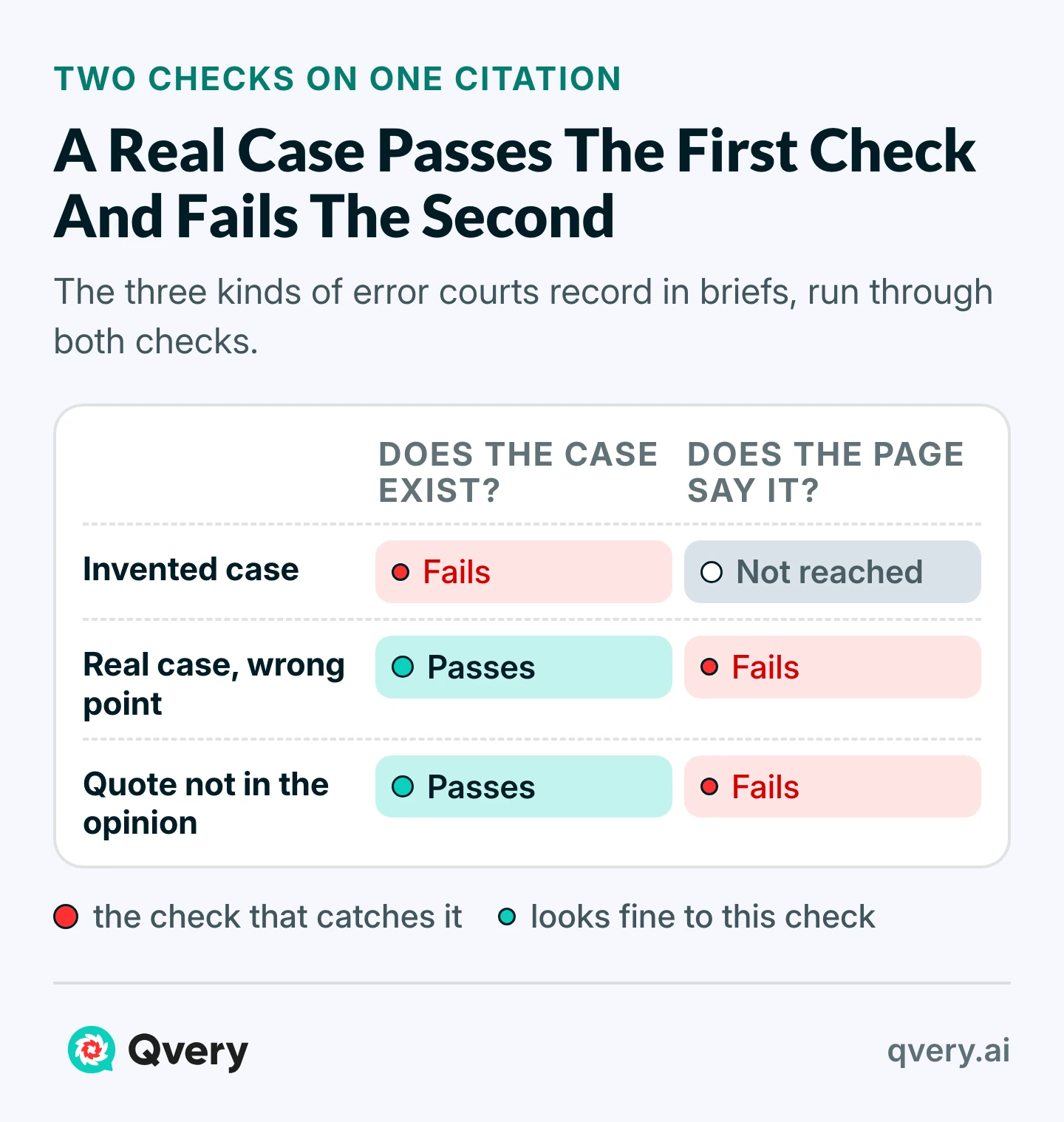
The invented case is the part a firm already knows to look for. In most of the decisions about lawyers, the court found real authority misread or misquoted, and in 148 of them every authority cited was real.1
The database holds only what a judge caught and wrote about, so it counts discovered errors, never how often they happen.2
Courts Have Written 2,286 Decisions on AI-Made Errors in Filings Since 2023
The count comes from the AI Hallucination Cases database kept by Damien Charlotin, a French lawyer and data scientist whose work a federal appeals court has cited in its own opinion.4 It records decisions in which a court or tribunal addressed AI-generated material beyond a passing reference and found, or implied, that a party relied on it.1
By the date of the decision: 16 in 2023, 61 in 2024, 865 in 2025, and 1,344 in 2026 to 9 November 2026, with 0 undated1. The newest months are never final, because decisions keep arriving after their date.
1,550 of the decisions come from US courts (67.80%), then Canada: 245, Australia: 112, and the UK: 91, across 46 jurisdictions.1 Part of that share is American court records, which are easier to search than most; the maintainer says so himself.2
So compare whole years: 2026 has already passed all of 2025 for self-represented litigants, lawyers and judges alike.1
2026 Has Already Passed All of 2025 for Litigants, Lawyers and Judges
decisions
View the data
917 of the 2,286 Decisions Involve a Lawyer
907 decisions name a lawyer among those responsible, and a handful more a prosecutor, a government lawyer, a paralegal or a federal defender: 917 decisions with a legal professional in all.1 1,314 name a self-represented litigant, 34 a judge, and 18 an expert witness.1 A decision can name more than one.
None of these totals says which group errs more often. Nobody counts how many filings each group makes, so the record holds totals, not rates.
In a Stanford Law School study of US decisions up to October 2025, half of the firms behind them were solo practices, lawyers working on their own5.
Size did not keep larger firms out. K&L Gates, with more than 1,000 lawyers, is in that sample,5 over the brief in Lacey v. State Farm.
109 of 163 Dollar Amounts Against Lawyers Are $5,000 or Less
268 of the 917 lawyer decisions carry a monetary sanction (29.23%), against 123 of the 1,314 decisions about self-represented litigants (9.36%). 164 carry a professional sanction, such as a referral to the state bar, the body that licenses and disciplines lawyers (17.88%).1
Where the database records a dollar amount against a lawyer, 163 times (the other monetary sanctions are in other currencies or of unknown amount), the median is $3,000 and 109 of the 163 are $5,000 or less; 13 are above $25,000.1 The figure mixes fines with the other side's fees, and the three largest amounts are all mainly fee or costs awards.1
Two in Three Dollar Amounts Against Lawyers Are $5,000 or Less
lawyer decisions
View the data
The largest is Couvrette v. Wisnovsky in Oregon, $110,204.38: a $15,500 fine on the lead lawyer6 and $94,704.38 of the other side's fees3, after three briefs cited fifteen cases that do not exist, and the court dismissed the clients' claims for good. Local counsel, who had skimmed the first brief and read none of the later ones, still paid 15% of those fees, $14,205.663.
The database's maintainer reads the sanctioned decisions this way: people are rarely sanctioned for the AI error alone, and usually for refusing to own up, doubling down, or blaming the intern.2 The Fifth Circuit's $2,500 order of February 2026 named both: counsel failed to verify the brief, then was not forthcoming when asked.4
The Invented Case Is Only Part of What Courts Find in Lawyers' Filings
In the 917 lawyer decisions, courts found fabricated material in 736 (80.26%): a case, a statute or another source that does not exist. They found real authority misrepresented in 426 (46.46%), a case cited for a point it does not make, and false quotations in 301 (32.82%), words attributed to a real court that are not in its opinion.1
450 of the decisions carry more than one kind, so the shares overlap and never add up to the whole.1
Count the two kinds that involve real authority together and they reach 550 of the 917 lawyer decisions, 59.98% of them.1 Case law is the material in nearly every decision of the database, 2,047 of the 2,286, ahead of statutes and rules at 262 and exhibits at 166.1
In Lawyer Decisions, Misread and Misquoted Authority Sits Beside the Invented Case
share of the 917 lawyer decisions
View the data
 Vlad ShvetsPartner @ Qvery
A check that a case exists covers only part of the risk; in most of the lawyer decisions, courts found real authority misread or misquoted. The rule worth writing down is stricter: nobody files until someone has read each cited passage against the sentence that relies on it. That reading takes real time on every brief, so budget it like any other step, or it will be the step that gets dropped when a deadline is close.
A Check That Only Asks Whether a Case Exists Misses 148 Lawyer Decisions
In 148 of the 917, 16.14%, every authority the filing cited was real. The court still found it misread, or found words attributed to it that it never wrote.1
That share was 39 of 361 lawyer decisions in 2025 (10.80%) and 106 of 525 in 2026 (20.19%).1 The database cannot say why it rose: more careful filers and more careful classification of new entries would both produce it.
In 148 of 917 Lawyer Decisions, Every Cited Authority Was Real
lawyer decisions
View the data
A tool or a paralegal that only confirms each cited case exists finds nothing to flag in these filings, because every case does. Opening the case at the cited page and reading the passage against the sentence that relies on it, checking each citation and quotation against the opinion it points to, is the check that can catch them; whether a real holding stretches as far as the brief needs is still a lawyer's judgment.
In Lacey v. State Farm, lawyers at two firms built a brief from an AI-assisted outline that no one checked before filing; about nine of its 27 citations were wrong in some way, and the two firms were ordered to pay $31,100 between them7.
What Reddit says
Lawyers on the briefs that cross their desks
It was clear they didn't read the cases. And they were real cases.
If anything, partners are more likely not to have read cases they cite because they read it 20 years ago and swear they remember it exactly (they don't).
They quote out of context, stretch the court's reasoning unreasonably, or hell sometimes they cite to cases that are interpreting/analyzing an entirely different area of law (different statute, etc.).
What a firm pays for an AI error follows from whether anyone read the cited passages before the partner signed. In Couvrette and in Lacey, nobody did.
Frequently asked questions
How many AI hallucination cases are there in court?
The public AI Hallucination Cases database held 2,286 decisions on 9 November 2026, 1,344 of them dated in 2026.1 It records only decisions where a court addressed AI-hallucinated material, so its maintainer calls it necessarily an undercount.2
Which country has the most AI hallucination cases?
The United States, with 1,550 of the 2,286 decisions, then Canada, Australia, and the UK.1 The maintainer puts part of that down to American court data, which services such as PACER and CourtListener make easy to find, while elsewhere court records are harder to reach.2
Who files more AI hallucinations, lawyers or self-represented litigants?
Self-represented litigants appear in 1,314 decisions and lawyers or other legal professionals in 917.1 Neither count is a rate, because nobody records how many filings each group makes. The totals say where courts have written about the problem, not who is more likely to make it.
What is the largest AI hallucination sanction so far?
The largest dollar amount in the database is $110,204.38 in Couvrette v. Wisnovsky, in Oregon.1 It combines a $15,500 fine on the lead lawyer6 with $94,704.38 of the other side's fees, 15% of them charged to local counsel.3 The court also dismissed the clients' claims for good.
What is a typical sanction for a lawyer caught filing AI hallucinations?
Where the database records a dollar amount against a lawyer, the median is $3,000, and 109 of 163 amounts are $5,000 or less.1 164 of the 917 lawyer decisions carry a professional sanction such as a referral to the state bar.1 Sanctions mostly follow how a lawyer responds once caught.2
Do legal research tools also produce these errors?
They can be part of it. In Lacey v. State Farm the lawyer had used CoCounsel, Westlaw Precision, and Google Gemini, and the record does not say which produced the errors.7 The database names a tool in only 161 of the 917 lawyer decisions, ChatGPT in 70,1 and warns that naming a tool does not prove it caused the error.1
Does the database include AI errors nobody caught?
No. Its maintainer leaves the finding to the courts and adds a decision when a judge found or implied reliance on hallucinated material, with a few exceptions.2 Errors that went unnoticed, or that the other side spotted and the court never addressed, are not in it, so every count here is a floor.
How fast are AI hallucination cases growing?
Its maintainer saw two or three cases a month before 2025 and five a day by February 2026.2 By our count, 2026 has already passed all of 2025: 1,344 decisions to 865.1 Recent months keep filling in, because decisions are added after they are found.1
Have judges filed AI hallucinations too?
Yes. 34 decisions in the database name a judge among those responsible, 19 of them in 2026.1 Most of the record is still about filings by parties: 1,314 decisions involve a self-represented litigant and 917 a lawyer or another legal professional.1
What does a firm have to check before it files?
Rule 11 of the Federal Rules of Civil Procedure makes the signature a certificate that the brief's legal arguments are supported by the law as it stands, or by a serious argument for changing it.8 The American Bar Association's opinion on generative AI asks lawyers to review its output, the analysis as well as the citations, and to correct misstatements of law before anything reaches a court.9
Are large law firms in the database?
Yes, though rarely. In Stanford's study of 114 US decisions involving lawyers, half the 129 firms were solo practices and eight had between 26 and 500 lawyers; K&L Gates was one of two with more than 1,000.5 Its brief with a second firm in Lacey v. State Farm cost the two firms $31,100.7
Sources
- Damien Charlotin: AI Hallucination Cases Database (export of 9 November 2026, CC BY 4.0) (2026)
- Artificial Authority: Hallucinations Case Database: FAQ (Damien Charlotin) (2025)
- U.S. District Court for the District of Oregon: Couvrette v. Wisnovsky, No. 1:21-cv-00157, Opinion and Order of March 23, 2026 (Document 225, via Justia) (2026)
- U.S. Court of Appeals for the Fifth Circuit: Fletcher v. Experian Information Solutions, No. 25-20086, opinion (2026)
- Stanford Law School, Center for Internet and Society: Who's Submitting AI-Tainted Filings in Court? (Riana Pfefferkorn) (2025)
- U.S. District Court for the District of Oregon: Couvrette v. Wisnovsky, No. 1:21-cv-00157, Opinion and Order of December 12, 2025 (copy hosted by the AI Hallucination Cases Database) (2025)
- U.S. District Court for the Central District of California: Lacey v. State Farm General Insurance Co., No. 2:24-cv-05205, order of the Special Master (copy hosted by the AI Hallucination Cases Database) (2025)
- Cornell Law School, Legal Information Institute: Federal Rules of Civil Procedure, Rule 11 (2026)
- American Bar Association: Formal Opinion 512: Generative Artificial Intelligence Tools (2024)