
On this page
- A Return Reason Describes the Customer's Problem, Not the Product's
- Every Place You Sell Records the Return Its Own Way
- Buyers Pick the Reason That Ships Free
- The Customers' Own Words Name the Fault
- The Money Is in the Returns That Keep Coming Back
- What Qvery's Agents Hand Your Product Team Each Monday
- Your Product Team Sees Its First List Within Two Weeks
- Frequently asked questions
Returns reach a clothing retailer with a reason attached, and once a month someone ranks them. The report counts how many said "too small" and how many "not as described", and stops there: it can't say which jeans, which jacket or which size run the reasons belong to.
Take a retailer of about 200 people that sells clothing on its own site and on Amazon: around 3,000 returns a month, each costing about $21 to bring back and process.
If one in five traces to something on the listing or in the product it could fix, and most of those keep coming back because nobody saw the pattern in time, that's $120,960 a year spent on returns from listings it could have fixed.
What Reddit says
Sellers on what the reason field tells them
When I look at the return reasons, most just say "didn't fit" or "wrong size" but that tells me nothing actionable.
Quite often there will be a buyer comment that proves the item description WAS accurate, they just made a mistake.
Check your reviews. They can indicate what customers don't like, because nobody bothers with a real return reason.
it is frustrating to have customers who know they ordered the wrong unit, blame us for a defective unit, it happens a few times a month.
The reason field was never built to name a product. It records what the customer chose to answer, from whichever list the place they bought from offered, and the words that would name the fault go somewhere else.
Those words are already in your returns: in the comment box, the review and the support ticket. Nobody reads the three together, product by product.
A Return Reason Describes the Customer's Problem, Not the Product's
A return reason is the short answer a customer picks from a list when they start a return: "too small", "not as described", "changed my mind". Some lists add a box for a comment, usually optional.
Shopify has made its own list better. Since January it suggests reasons by product type, so a pair of jeans gets "too big" and "too small" instead of a generic "didn't fit". The code is more specific now, and it still doesn't say why.
On a pair of jeans, "too small" covers at least four different faults:
- Size chart: it says a 32 waist and the jeans measure 31.
- Cut: it runs small, and the listing doesn't say so.
- Photo: the model wears the size up.
- Bracketing: the customer ordered two sizes to keep one. In apparel and footwear, merchants surveyed by the National Retail Federation say 26% of purchases include a bracketed item.
Three of the four are the retailer's to fix, on the page or with the supplier. The fourth is part of selling clothes online, and no change to the listing touches it. The code is the same for all four.
Every Place You Sell Records the Return Its Own Way
A retailer this size rarely has one list of returns. It has the online store, a returns portal on top of it, a marketplace or two, and a helpdesk where customers write in. Each keeps its own reasons, and the comment lands in a different report, or a different system, from the code.
| Where | What it keeps | What it misses |
|---|---|---|
| Online store | A reason from Shopify's list for that product type | A portal reason not matched to Shopify's, which shows as "Other" |
| Returns portal | A main reason, a sub-reason, a comment if you turned it on | The comments, in its reports by product and by item code |
| Marketplace | Amazon's reason, and the comment in a column of the downloaded report | Your own store's returns of the same jeans |
| Helpdesk | The customer's own sentence about the waist | Any product or reason code |
Loop, a returns portal built for Shopify stores, says it plainly in its help pages: comments are left out of its reports by product and by item code (the code for each size and color), because comments aren't grouped by product. So the report sorted by product is the one without the customers' words.
Amazon has started on its own side: its returns report now tags some comments with whether the listing may have led to the return. That covers the returns that went through Amazon, and none of the others.
Buyers Pick the Reason That Ships Free
The code is thin, and it's chosen with the fee in mind. On Amazon the return label is charged to the buyer or the seller by the reason the buyer picks.
In Amazon's own table, "Item is too small" is the customer's fault. "Different from website description" and "Not satisfied with the quality" are the seller's.
So a buyer who ordered the wrong size has a reason to pick another answer, and sellers on Amazon's own forum describe exactly that: "defective" chosen to get the free label, with a note saying the buyer ordered the wrong item.
Your own store sets up the same choice once it charges for some returns and not others. 72% of large US merchants now charge for at least one way of returning, up from 66% a year earlier, by the federation's 2025 survey with Happy Returns.
The same study asked shoppers what they do when they return things.
Almost Half of US Shoppers Admit Bending the Truth on Returns
% of shoppers
View the data
| Label | Value |
|---|---|
| Bend the truth sometimes when returning | 45% |
| Buy with the intent to return (bracketing) | 36% |
| Return items they have used | 27% |
Almost half say they bend the truth sometimes. A code picked by that customer tells you which answer cost them least, and only sometimes what went wrong with the product.
The Customers' Own Words Name the Fault
What the code can't hold, the customer usually writes down somewhere: a comment like "the waist gaps at the back", a review a week later saying the green is darker than the photo, an email to support about the second pair fitting differently from the first.
Amazon's own researchers measured what those words are worth. In a study of 90,962 Amazon.com returns, a model guessing why an item came back did far better when it also read the customer's review: its average precision rose from 0.660 to 0.894. The reviews also turned up reasons the customer's code didn't carry at all.
A listing that keeps coming back is a page telling customers something the product isn't.
The comments rarely get read by product. At 3,000 returns a month, that's 3,000 comments, plus the reviews and the tickets, spread across four systems that don't share a product list. So they get read once a month, on a sample, by whoever has time.
The Money Is in the Returns That Keep Coming Back
In our example, 3,000 returns a month with one in five pointing to a listing the retailer could fix comes to 7,200 returns a year.
Each costs about $21 to bring back and process: a 2022 survey of 168 US online retailers by the shipping company Pitney Bowes put the average at 21% of the order's value, and we've assumed a $100 order. That's $151,200 a year in returns from listings someone could correct.
Say a fifth of those get stopped in time today, because someone spots the product on the monthly report and fixes the size chart. The other $120,960 is paid. With a ranked list every week and the customers' words beside each product, say half get stopped. Then $75,600 is paid, and $45,360 a year isn't.
Our agents run for about $500 a month at that volume: about 5 cents of model usage for each return they read, plus hosting and upkeep. That leaves $39,360 a year, so each $10,000 spent building them comes back in about 3 months.
Put in your own returns a month, the share that traces to a fixable listing, what one return costs you, and how many you catch today.
Returns Traced To Listings ROI Calculator
What Returns From Fixable Listings Cost You, And What The Agents Stop
Recovered Per Year
$39,360
$45,360 more caught a year, after $6,000 to run the agent
- Returns From Listing Faults A Year
- 7,200
- Agent Running Cost (Estimate)
- $500 a month
- Payback Per $10,000 Of Build
- 3 months
On these numbers, the agent stops $45,360 a year from slipping through, $39,360 after its own running cost, and every $10,000 of the build is earned back in 3 months.
Every share in that example is our assumption, and the cost of a return is the low one: it leaves out the sale you refunded and the markdown on whatever can't go back on the shelf at full price.
It also leaves out the reading. If someone on your team gives it a day a week now, that's about $12,000 a year more, at the federal wage survey's mean of $31.29 an hour for market research analysts and marketing specialists in clothing retail.
What Qvery's Agents Hand Your Product Team Each Monday
Each Monday our agents take the week's returns from every place you sell: your returns portal's export with its comments, the marketplace's returns report, and the support tickets that mention a return.
They match each line to its product, size and color, and to the units of it you sold, so a listing is ranked by how often it comes back, not by how much of it you sell.
Then they read the words. Each comment, review and ticket goes into a reason group in plain terms: runs small at the waist, darker than the photo, seam came apart.
Where the code and the comment disagree, like a "defective" with a note saying the customer ordered the wrong size, the comment counts and the line goes to customer care. Where there's no comment, they use what the product's other returns, reviews and tickets say.
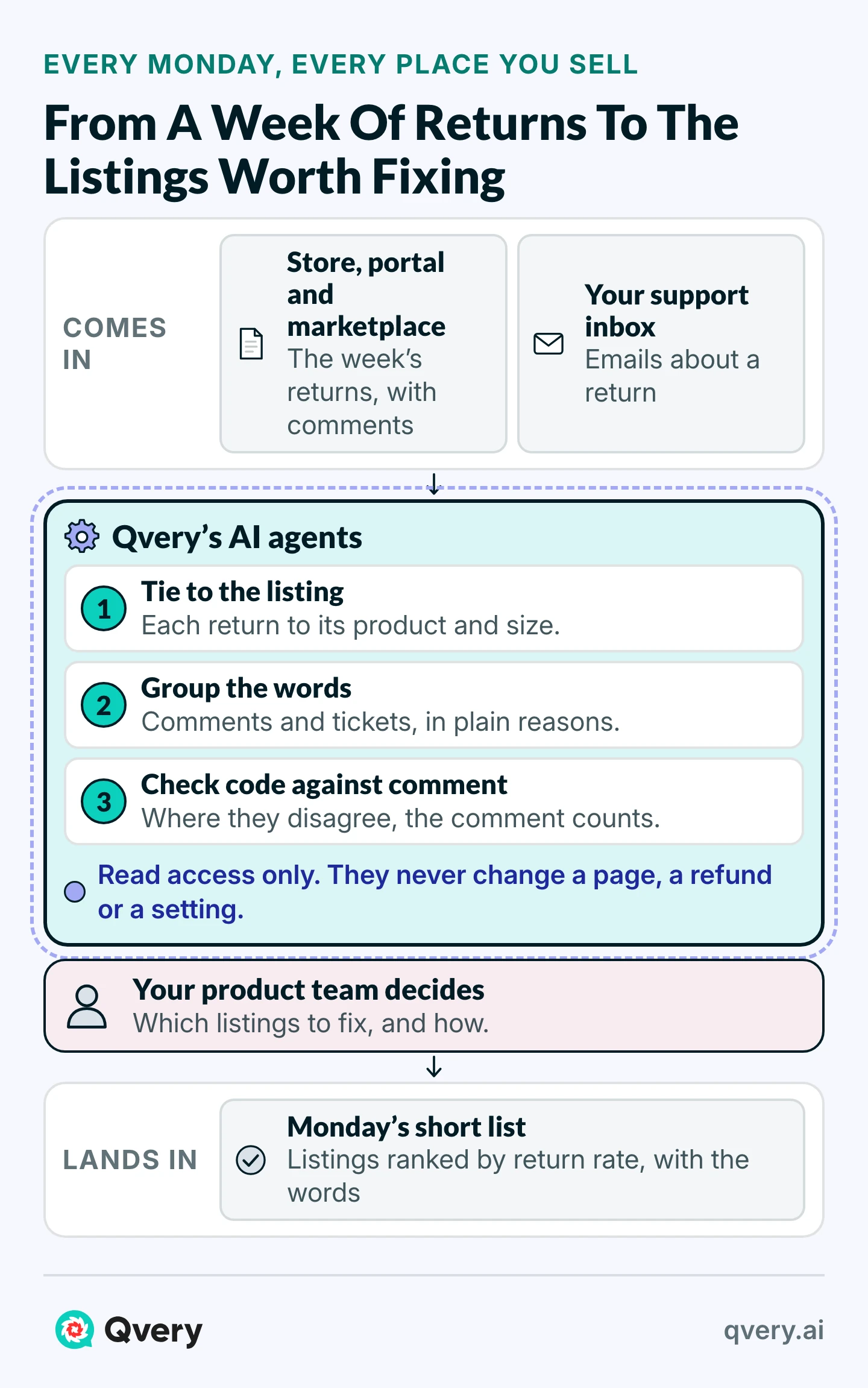
What your product team gets is short: the listings that came back most often this week, the refunds attached, and the customers' own words beside each. Returns damaged in a way a supplier owes you credit for go to your buyer, with the date the claim is due.
 Piotr BabelPartner @ Qvery
One comment tells you what one customer felt. Three saying the waist runs small on the same jeans is a pattern, and the pattern is what your product team needs. So our agents wait until a listing has enough returns to call it, at a bar your team sets, and every line on the list shows the comments it rests on. Where the comments are empty or contradict the code, the line says so.
Drop in a month of your returns export and see which products it points to.
Returns carry names, addresses and order numbers. Before our agents open anything, we put in writing which exports and inboxes they may read and where that data is processed. They have read access only. Names and addresses stay out of the list they produce, and every step they take is logged.
They never change a product page, a refund or a setting, and they never call a product defective. The list says what the customers' words point to. Your product team decides what to change, and the page owner makes the change.
If nobody on your team reads returns by listing today, that's the job our agents take first.
Your Product Team Sees Its First List Within Two Weeks
We start where your returns already are: last quarter's exports, which our agents read and group by listing before they see a single live week.
 Vlad ShvetsPartner @ Qvery
Most retailers run returns as logistics: labels, refunds, restocking, and a chart of reasons once a month. The reading is the one part of returns that tells you what to fix, and it's the part nobody has a free afternoon for. That's why it's the first piece of returns I'd hand to agents, ahead of the labels and the refunds: those cost you minutes, and the comments nobody reads cost you the same returns again next month.
For that first list, we need four things from you:
- The returns exports from each place you sell, comments included.
- Units sold per product for the same weeks.
- Read access to the helpdesk inbox where customers write about returns.
- A few hours in the first week with whoever owns your product pages.
Your product team goes through that first ranked list with us about two weeks after we get access. Then the agents run on each Monday's returns beside your own reading until your team trusts the groups, and every week we count the return rate of each listing they flagged against the weeks before.
Frequently asked questions
What are the most common reasons customers return products?
Most lists offer the same few: the wrong size or fit, not as described, damaged or defective, the wrong item sent, arrived too late, changed my mind. Counting them tells you what customers said, not which products caused it. A size chart that's off and a customer who ordered two sizes both arrive as "too small".
Why are return reasons so often inaccurate?
Customers pick from a short list, and where the reason decides who pays the return label, many pick the one that ships free. On Amazon, "Item is too small" is the customer's fault and "Different from website description" is the seller's. The comment, when there is one, is usually closer to the truth.
Do customers lie about return reasons?
Some do. In the National Retail Federation's 2025 survey with Happy Returns, 45% of US shoppers said they bend the truth sometimes when making a return. Sellers describe it mostly as picking the reason that avoids a fee, and the comment often gives the real story away.
What is bracketing?
Ordering several sizes or colors of the same item to keep one and send the rest back. Merchants in the same survey said 23% of purchases included a bracketed item, 26% in apparel and footwear. Those returns say "too small" or "too big" and point to no fault on the listing.
Should we make the return comment required?
It helps. Loop, for one, lets you require a comment at the last step of its reasons. A customer in a hurry still types a word or two, so for the listings that keep coming back the agents read the review and the support email beside it.
Our returns portal already has a report by product. Isn't that enough?
It counts the reasons for the returns that went through the portal, which is a start. It doesn't divide them by units sold, so a bestseller looks worst on volume alone, and it can't see your marketplace returns or the emails to support.
What if most of our return comments are empty?
Then the agents lean on what else the customer wrote: the review, the support email, the chat. A listing with many returns and a few clear comments usually shows the pattern. They also tell you which products get no words at all, so you know where the form needs a better question.
Do the agents work with Amazon and other marketplace returns?
Yes. They read the marketplace's returns report beside your own store's and your portal's, matched to the same products. Amazon's report carries the buyer's comment in a column of the download, and since it uses its own reasons, the agents put both sets of codes into the same plain groups.
How often should we review return reasons?
Weekly, by product. A monthly review across the whole store hides the one listing running far above the rest, and every week it stays live, it sends more returns back. Our agents run on each Monday's returns and hand over the listings that need a look.
What do the agents do with customers' personal data?
They read the exports and tickets they've been given access to, in writing, and nothing else. Names and addresses stay out of the list your product team gets. Qvery AI OÜ is an EU company and signs a data processing agreement, and every step the agents take is logged.
Will the agents change our product pages or refunds?
No. They never edit a listing, a refund or a setting, and they never label a product defective. They hand your product team a list with the customers' words, and the people who own the pages decide what to change.
Can the agents tell a listing problem from a customer who ordered two sizes?
Where the order shows it, yes. Two sizes of the same item on one order, with one sent back, is grouped as bracketing and isn't counted against the listing. A run of "too small" returns from customers who ordered one size, with comments about the waist, counts against the listing.
Do we need a returns portal for this to work?
No. Your store's own returns, the marketplace's returns report and the support inbox are enough to start. A portal helps where it collects comments; without one, the reviews and the support emails carry more of the reading.
What does it take to build?
One price, fixed before we start, for a result we define with you. The calculator above shows how fast the return covers each $10,000 of it on your own numbers, and we count the result with you every week after the agents go live.
How soon do we see the first list?
About two weeks after we get access. Our agents read your last quarter of returns first, your product team goes through that list with us, and then they run on every Monday's returns.
