
On this page
At a company of about 200 people, the month-end close, the days after a month ends when your finance team makes the books complete and correct, often runs past a working week. Much of that week goes to waiting for things people outside finance hold.
Three days in, a close is often still missing things like these.
- The warehouse’s receiving log for the month’s last days, to record goods that came in without a bill.
- Three supplier bills with no purchase order number, the reference that says who ordered what.
- A customer contract that changed on the 28th and moves the month’s revenue.
- Receipts for the month’s company card spending.
- A manager’s approval, sitting in an inbox.
Each takes a few minutes to answer and days to arrive, because nobody asked until the month was over. Your controller does the asking, between reviews, and re-dates the checklist every morning as answers trickle in.
For a controller and three accountants, planning the close and chasing it takes about a tenth of their month, around $55,320 a year at their pay. The days are the other cost: the numbers you run the company on arrive with the slowest reply.
Most of the Close Waits on People Outside Finance
In a survey of 624 US finance and accounting staff who work on the close, run in August 2026 for Vena, a finance software company, the challenge named most often was chasing information from other departments, by 34%. Asked what would help their close most, they put more staff last.
More Staff Came Last Among What Would Help the Close
% of respondents
View the data
| Label | Value |
|---|---|
| Better integration between systems | 32% |
| More standardized processes | 28% |
| More automated data consolidation | 27% |
| Additional staff | 19% |
Another accountant would wait on the same warehouse and the same managers. Every option ranked above staff is a way of getting those inputs to finance without someone carrying them by hand.
Teams that still collect what they need by email close later. In Vena’s survey, the 37% of teams that still take data from email or shared documents averaged 6.8 business days to close, against 5.9 for everyone else.
Some of what a close waits for doesn’t exist until the month is over, but most of it could be asked for while the month is still running.
| What the close needs | Who holds it | Before the month ends? |
|---|---|---|
| Deliveries received but not yet billed | The warehouse | Yes, all but the last day or two |
| What a bill with no purchase order was for | Whoever ordered it | Yes, as each bill arrives |
| Contract changes that move revenue | Sales | Yes, the week they’re signed |
| Receipts for company card spending | Everyone with a card | Yes, every week |
| Approvals for bills and entries | Managers | Mostly, as they’re raised |
| The stock count | The warehouse | Only where it can move a few days early |
| The bank statement | The bank | No, it closes with the month |
| Bills for the month’s last days | Suppliers | No, so finance records an estimate, called an accrual |
The last two rows have to wait for the month to end. Everything above them could be asked for during the month; asked for once the close has started, each answer adds its own wait to the close.
The Chasing Lives in One Person’s Head
Most closes are run from a spreadsheet: one row per task, whose it is, the day it’s due. The people the close waits on, the warehouse lead, the sales manager, everyone with a company card, aren’t on it, and a spreadsheet can’t email anyone.
So the asking falls to your controller, who knows the order: which reconciliation (the check of your books against the bank or another record) needs which report, who always answers late, and whose manager to copy when they don’t.
It happens from their inbox, between reviews, and mostly after the month ends, because that’s when the close starts on the calendar.
That knowledge is rarely written down. When a controller quits mid-close, the team has to work out where the spreadsheets were saved and whose replies were still due, and some staff relearn their own reconciliations from last month’s files each close.
Accountants who close fast describe one fix in different words: start asking while the month is still open, and take the stragglers to their managers.
Tips from Reddit
March month end close started March 1, not April 1.
Most of month-end is done before day one
Log which warehouses are your common offenders and escalate issues to their respective managers as necessary.
Asking early is a job in itself, every month, and on a team of four nobody has the hours to hold it.
What the Chasing Costs a Company of 200 People
Picture the finance team of a 200-person company: a controller and three accountants.
Accountants and auditors earned a mean $94,750 in May 2025, by the Bureau of Labor Statistics, and benefits make up 31.5% of a full-time private employee’s cost, so each costs about $138,300 a year. A controller earns more, so the example runs low.
Say a tenth of their month goes to planning the close, re-dating the checklist and chasing what it needs: about two days each per close, 17 hours a month. Across four people that’s 832 hours and $55,320 a year, before anyone reconciles anything.
Put in your own team and the share of their month it takes.
Month-End Close Chasing ROI Calculator
What Planning The Month-End Close And Chasing What It Needs Costs You, And What An Agent Saves
Saved Per Year
$22,860
416 hours handed back, after $4,800 a year to run it
- Hours Handed Back
- 416 hours a year
- Agent Running Cost (Estimate)
- $400 a month
- Payback Per $10,000 Of Build
- 5.2 months
On these numbers, the agent saves $22,860 a year after its own running cost, and every $10,000 of the build is earned back in 5.2 months.
On the example, our agents take about half of those hours: the plan, the asks, the follow-ups, reading the replies and keeping the status current. That’s 416 hours a year back.
They run for about $400 a month, so the chasing costs $32,460 a year instead of $55,320, and you keep $22,860. Each $10,000 a build might cost comes back in 5.2 months.
The tenth and the half are our assumptions for a company this size, and the $400 is our estimate of model use, hosting and upkeep. Freed hours pay best where they stand in for a hire, and for a growing finance team that’s the next accountant.
The calculator counts hours. It leaves out the date, which matters more to you: a bank loan or an investor may want monthly numbers a set number of days after month end, and until then you decide on the month before.
Late answers also move the numbers after you’ve seen them. In Vena’s survey, 27% of the teams that corrected a closed month traced the latest correction to information that reached finance late from another department.
 Vlad ShvetsPartner @ Qvery
When I look at a close, I count the days its numbers spent waiting on someone outside finance. Ask your controller what held up last month’s close and when each item was first asked for. If most of it could have been requested before the month ended, another accountant won’t move the date. Someone has to start asking earlier, every month, without being reminded.
The close isn’t the only finance job a team this size does by chasing. Our accounting playbook works out four of them for a company of about 200 people, the close plan among them.
With Qvery, the Asks Go Out Before the Month Ends
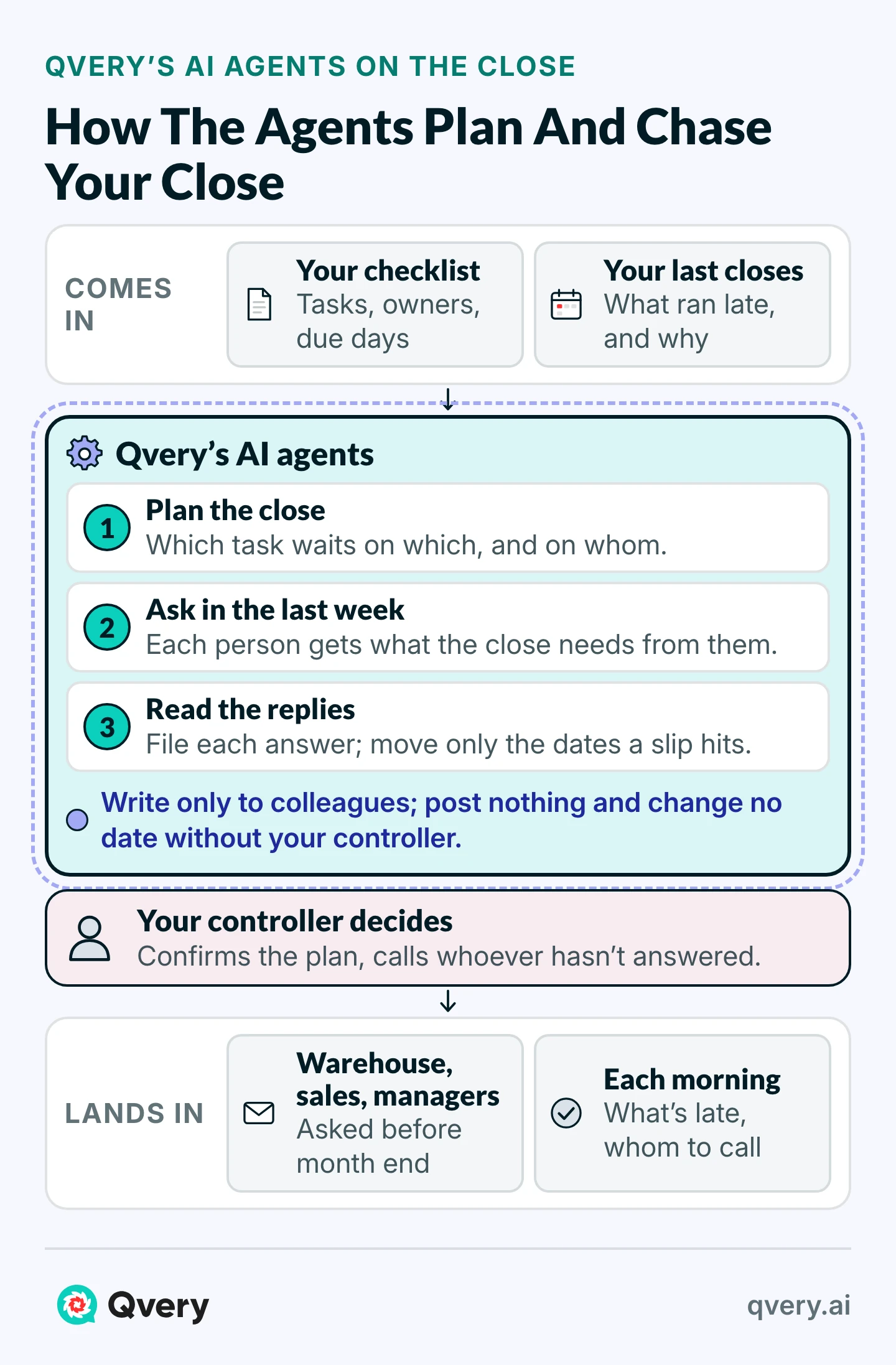
The agents we build for a close start from the checklist you already keep and your last few closes: when each task was due, when it finished, and which ones ran late.
Your controller fills in what the sheet doesn’t say, which task waits for which and whose answer each one needs, and that becomes the plan. From then on the agents run it on their own.
In the month’s last week, the agents ask each person for what the close will need from them, in one message they can answer in a minute.
The warehouse lead gets the deliveries still missing from the receiving log. The manager who ordered something gets the three bills with no purchase order, attached, and one question: what were they for? Sales gets asked for any contract signed or changed this month.
They read the replies and attach each answer to its task. A reply that doesn’t answer goes back with the question again. On the first morning after month end, your controller’s note says what’s in, what’s late, what each late item holds up and whom to call.
When something slips, they move the dates behind it and nothing else, so the plan stays true and nobody re-dates a spreadsheet by hand.
Close software can already send a fixed request on a schedule: FloQast’s ReMind add-on, for one, was built to send the same request email every month and follow it up. That covers the asks that never change.
The days go to the ones that change every month, the bill nobody recognizes or the delivery nobody billed. Nobody can ask about those until someone has read the month’s books against what came in, and that reading is what our agents add.
| The agents | Your controller |
|---|---|
| Write to colleagues inside the company | Sends anything addressed to a supplier or a customer, at first |
| Propose the order, the reviewers and new dates | Confirms them; no due date moves without them |
| Send reminders | Decides when they start: once the dates hold |
| Ask twice, then stop | Calls whoever still hasn’t answered |
| Attach each answer to its task | Judges it; nothing is posted from a reply |
Before the agents read anything, we agree in writing what they may read and send, and every message they send is logged. Anyone who stays silent goes on your controller’s list, because a call from the person who signs the books moves people a reminder doesn’t.
The planning half runs here on your own checklist. Send it with a recent close’s due and finish dates, and the plan comes back by email with the tasks that ran late.
 Piotr BabelPartner @ Qvery
The agents learn the order of your close from the closes you already ran: which task finished after which, and whose reply each one waited for. Where the checklist doesn’t say what a task needs or from whom, they ask your controller instead of guessing. For the first weeks the plan is mostly that list of questions, and the answers become the order of your close, written down for whoever runs it next.
Every company’s close waits on a different set of people, so the first thing we write down is yours.
Working With Us Starts From Your Last Three Closes
We start where your controller starts: the checklist, the due and finish dates of your last six closes, and three hours of their time in the first week on what always slips and whom it waits on.
Week 1: Learn Your Close
We go through your last three closes with your controller and write down which task waits on which, and on whom.
Weeks 1 and 2: Plan a Close You Already Finished
Your controller compares the agents’ order with how that month went.
Weeks 3 and 4: Run Beside Your Next Close
Your own tracker stays in use, and the reminders start once the dates hold.
From Week 5: Plan Every Close, Each Morning
We count the day the numbers reach you, the tasks that finished late and the hours your team spent chasing.
We also train your people to work with the agents, so the order of your close lives on a page instead of in one person’s head.
Frequently asked questions
What is the month-end close process?
The steps that turn a month of recorded transactions into numbers you can rely on: the bank and card balances matched to the books, costs that came without a bill recorded, prepaid costs and equipment adjusted, anything that moved more than expected explained, and a sign-off. Until then the month’s figures are a draft.
What are the steps of a month-end close?
Roughly four: collect what the month needs (bills, receipts, deliveries, contract changes), reconcile the accounts, post the adjusting entries, then review and report. The steps are easy to write down. The order between them, and who outside finance has to supply what, is what most checklists leave out.
How long should a month-end close take?
In Vena’s August 2026 survey of 624 US finance staff, the average was 6.2 business days: 4.7 for a single company, 8.3 for groups of more than ten. In Ledge’s smaller 2025 survey of 100 finance professionals, 18% closed in three business days or fewer and 27% took more than seven.
Can you close the books before every bill arrives?
Yes. Finance records an accrual, an estimate of the cost, for anything received or used whose bill hasn’t come, and swaps in the real amount when it does. An estimate is only as good as what finance knows was received, so the warehouse’s receiving log matters more than the supplier’s timing.
What is a soft close?
A lighter close, often used for months that aren’t a quarter or year end: the big accounts are reconciled and the material estimates booked, and smaller items wait. Some teams also close payables early, entering most bills days before month end so the close itself starts with less left to do.
Will the agents email our suppliers or customers?
Not at first. They write to people inside your company. A message that would leave the company, like asking a supplier for a missing bill, is drafted for a person to send until you decide the agents may send that kind on their own.
What happens when someone never answers?
After a second unanswered message the agents stop and put the item on your controller’s morning note: who has it, what it holds up and how long it’s been open. Your controller decides whether to call, copy a manager or record an estimate and move on.
Will the agents change our checklist or due dates?
Only with your controller. They propose the order, the reviewers and the new dates when something slips, and your controller confirms. They never mark a task done, review anyone’s work or approve an entry, and the checklist stays yours to edit.
Will our managers mind being asked by an agent?
They’re asked for the same things they’re chased for today, once, in the month’s last week, with the item attached, instead of several times during the close. We agree with you which address the agents write from and how each message is signed.
Do we still need close software?
If you already use it, the agents read the checklist from it, and if you don’t, they work from the spreadsheet you keep. Close software tracks the tasks and can send fixed reminders; the agents add the asks that change every month and read the answers that come back.
What if our controller leaves or is out during the close?
The order of the close stops living in one head. The plan, who each task waits on, every message sent and every answer received are on record, so whoever steps in starts from where the close stands instead of from spreadsheets saved on someone’s laptop.
Does this work with QuickBooks, NetSuite or Sage Intacct?
Yes. The agents read your checklist, your past closes, the inbox where bills arrive and the reports your system exports, so they don’t depend on one accounting system. Where your system allows direct read access, we connect them to it; where it doesn’t, they work from the exports your team already pulls.
What does it cost to run the agents?
About $400 a month for a close like the example’s, our estimate of model use, hosting and upkeep. Building them is a fixed price for a defined result, agreed before we start.
Can the agents do the reconciliations too?
Those are separate jobs, and we build agents for them as well: matching bank deposits to your books, customer payments to your open invoices, and the entries between your own companies. Each prepares the match and a person approves it. Which one comes first depends on where your team’s hours go.
Is our financial data safe with the agents?
Before they open anything, we agree in writing what they may read and where the data is processed. They start with the least access the job needs, every action is logged, and Qvery AI OÜ, an EU company, signs a data processing agreement with you.
