
On this page
- Start With What the Checklist Leaves Out
- The Late Close Shows Up Before Day One
- Six Earlier Closes Name the Tasks That Slip
- The Note Your Controller Reads on Day One
- Qvery's Agents Keep the Plan Current Through the Close
- What the Planning Costs a Firm Like Marlowe Quay
- Your Controller Checks the First Plan Against a Real Close
- Frequently asked questions
At a company of a few hundred people, the month-end close runs from a checklist: a spreadsheet with a row per task, an owner and a due day.
The plan behind it lives in the controller's head: which task waits on which, how long each one takes, who is away that week. The controller rebuilds the dates every morning after the daily call.
The sample company in this tutorial writes the cost into its own close policy: planning, re-dating and chasing take about two working days a month for each of the four people on the close. That is close to $50,000 a year at an accountant's average pay with benefits.
In September its close package still arrived three days late, and the covenant certificate its loan requires reached the bank two days late, with a $3,500 fee.
AI agents can now build that plan from the files a finance team already keeps, before the close starts, and keep it current every morning while the controller decides what moves.
At Qvery, we help finance teams cut the days lost to planning the close, with custom AI agents that turn your checklist into a dated plan and flag what runs late.
We ran one close end to end for a company that does not exist: Marlowe Quay Engineering, a 240-person engineering and design firm in Portland, Oregon. Every file is invented, and the answer key was written before anything ran.
The files are the ones a real close has: the October checklist, the record of six earlier closes, the close policy, the controller's kickoff note, the team's time off for November and the notes from September's close.
The plan says all four before the close's first day. Seven steps get there from the files, the same seven Qvery's agents run each morning of a live close, and a checklist of your own runs through them too.
This plans the close and drafts the asks. It does no reconciliation, posts no entry, signs nothing off and promises no shorter close.
Start With What the Checklist Leaves Out
Step 1: Read Every Row and List What Each Task Lacks
The checklist comes in as the team keeps it. Every task stays on the list, including the ones with blanks, and each blank is named.
Marlowe Quay's checklist has a column for each task's preparer, the people allowed to review it, its due business day, its duration and the tasks it waits for. Seven of its 46 tasks leave something blank: two have no owner, three no due day, two no duration and one no link.
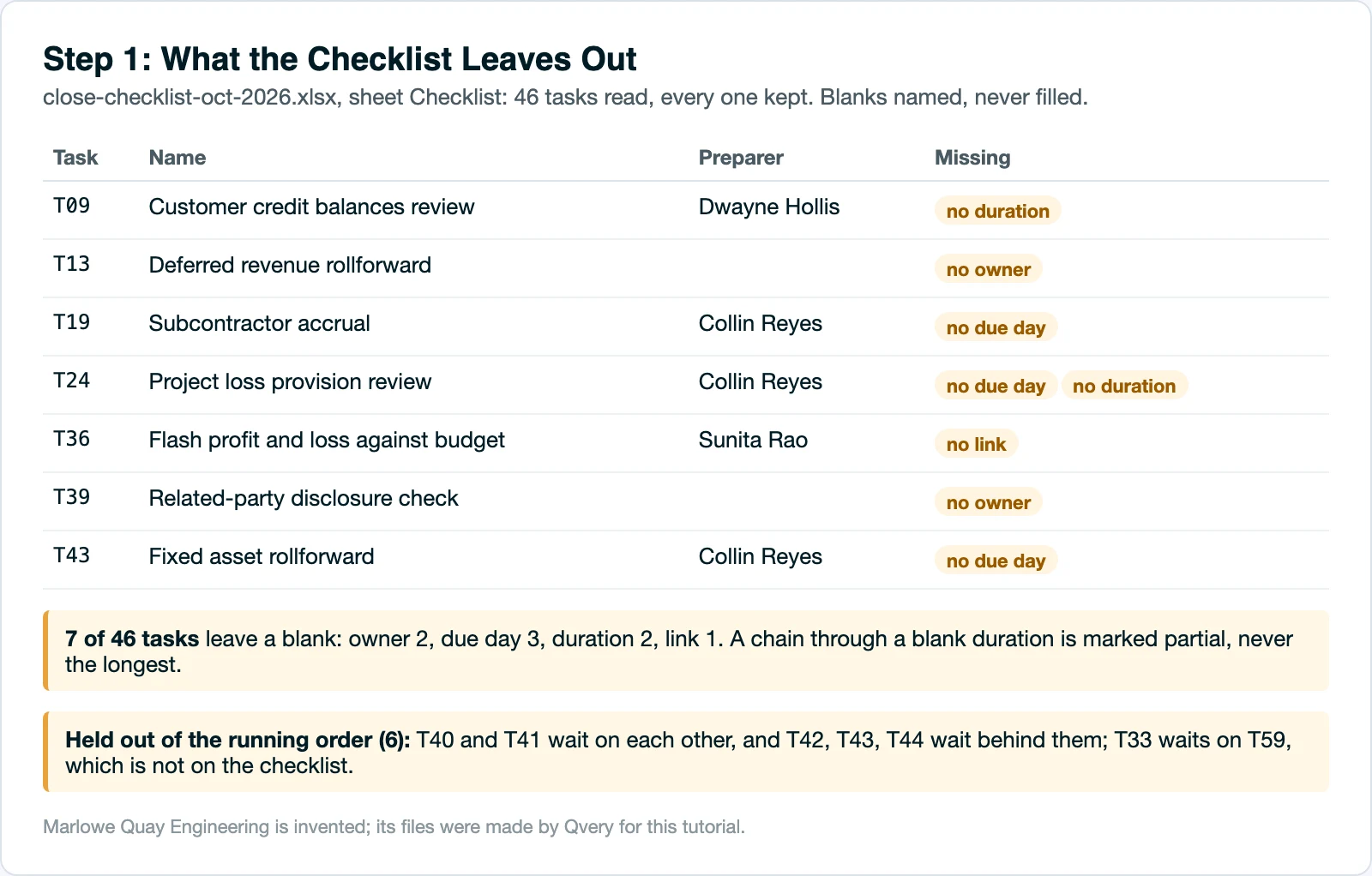
A blank duration is never filled with a guess. A guessed duration hides exactly the risk the plan exists to show, so a chain with a blank in it is marked partial and never counted as the longest.
Step 2: Test Every Link Before Putting Anything in Order
Each task names what it waits for, and every name gets checked against the list. Two things turned up.
A loop
The fixed asset additions review waits on the capitalization memo, and the memo waits on the review. The depreciation journal, the rollforward and the reconciliation wait behind them, so five tasks have no place in the order.
A missing task
The interest accrual waits on T59, a code that is on no row of the checklist.
Those six stay out of the running order, listed, until someone fixes the links. Ordering them anyway would mean picking which link is wrong, and that is the controller's call.
Step 3: Check Every Reviewer Against the Rule
The rule sheet says the reviewer is never the preparer, and anything over $50,000 is also reviewed by the controller. 44 of 46 tasks pass.
The Late Close Shows Up Before Day One
Step 4: Add Up the Chain on Business Days
With the links checked, code adds up the durations on the business days the policy uses, letting tasks that don't wait on each other run at the same time. Day 1 is Monday 2 November. Veterans Day, Wednesday 11 November, is skipped, so day 8 is Thursday 12 November.
Eight tasks set the finish: the sub-ledger lock, card settlement clearing, cash application (matching each customer payment to its invoice), the receivables reconciliation, the percent-complete revenue schedule, the revenue review, the ledger lock and the close package. Together they take eight business days. The package is due on day 6.
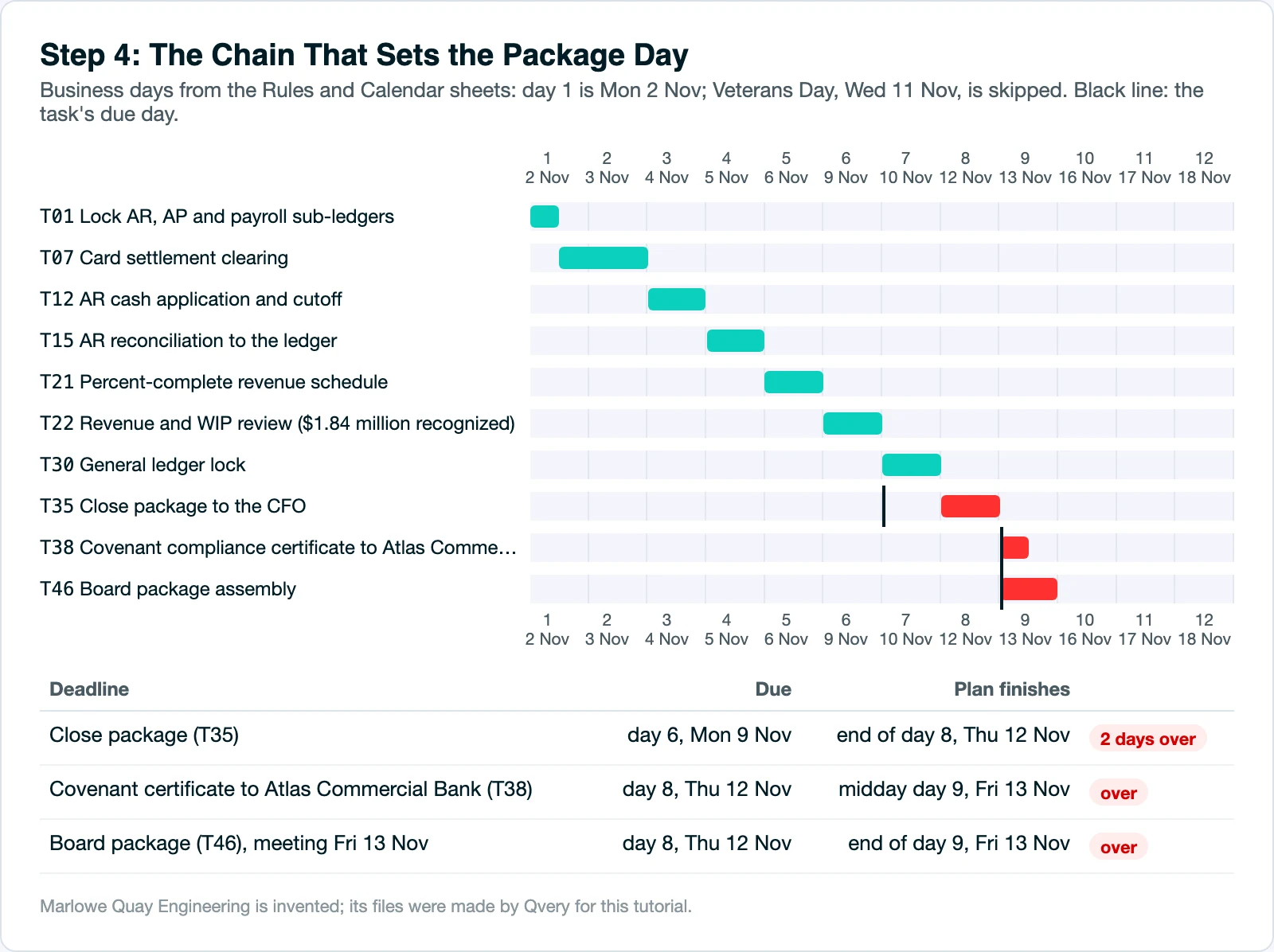
The two deadlines behind the package move with it. The covenant certificate for the lender is due on day 8 and lands at midday on day 9. The package for Friday's board meeting is due the day before and is ready at the end of that Friday.
To check this step, read the chain back against the checklist: every task on it waits on the one before, and the durations add up to the finish. If the chain runs through a task with a blank duration, the finish is a floor, and the plan says so.
Tips from Reddit
How accountants plan the close today
To plan a close timeline just grab a calendar and from the date you're closing lay out all your journal entries in sequence of how they are prepared and how long it takes to get the necessary information to prepare them.
Find ways to close dependent processes earlier and compensate for the early close.
my normal process is to book my PTO around the more challenging times of close, and I expect my team to do the same.
Step 5: Lay the Time-Off Calendar Over the Plan
Maribel Okoye, an accountant, is out from Wednesday 4 to Friday 6 November, business days 3 to 5, and prepares three tasks on the chain. Card settlement clearing is done before she leaves. Cash application would start on day 3, so it waits for her return on day 6, and everything behind it waits too.
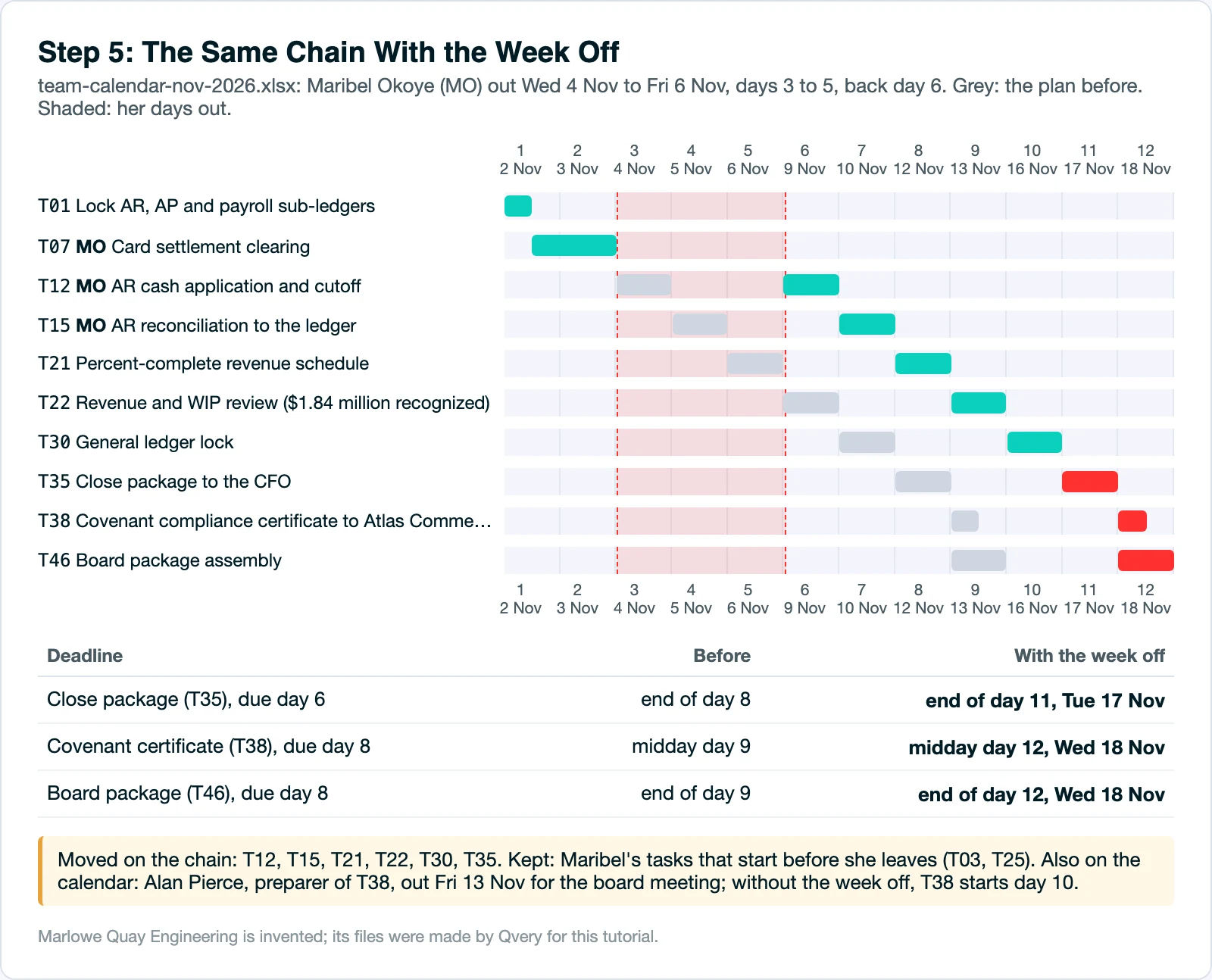
The package moves to the end of day 11, Tuesday 17 November. The certificate moves to day 12, four business days past its due day, and the package for Friday's board meeting lands the Wednesday after it.
The calendar held one more. Alan Pierce, who prepares the certificate, is at that board meeting on day 9, the day the plan would start it, so even without the week off it moves to day 10.
The sample's own answer key doesn't list that one. Code found it because it reads every name on the chain against every day out.
The plan names the tasks on the chain that move, never every task Maribel prepares. Her payroll accrual and the payroll account's reconciliation start on day 1, before she leaves, and keep their days: that is the check that the move is right.
 Vlad ShvetsPartner @ Qvery
In September, what reached the sample company's leadership was a package three days late and a $3,500 fee from its bank. The plan shows the slip before the first day: two days on the checklist alone, five once one accountant's week off is counted. With the agents it shows up the morning the close starts, while there is still time to move a person or a deadline, the one decision that changes the date.
Six Earlier Closes Name the Tasks That Slip
Step 6: Count the Late Finishes, Then Read the Notes Beside Them
The record of six closes holds 250 task closes. 22 finished after their due date. One task accounts for four of them: card settlement clearing, late in four of six closes, by two or three business days each time.
The Close Package Slipped From Day 6 to Day 9
Business day
View the data
| Label | Value | Note |
|---|---|---|
| Apr | Day 6 | |
| May | Day 6 | |
| Jun | Day 7 | |
| Jul | Day 6 | |
| Aug | Day 8 | |
| Sep | Day 9 | September: the covenant certificate followed on day 10, and the bank charged a $3,500 late reporting fee. |
The September notes give the reason: "The card settlement report from the processor reaches us at about 10:00 on business day 3. We keep planning the clearing for days 1 and 2." The checklist still starts it on day 1.
The notes and the record also disagree once. The notes say the revenue review "ran a day over again" in September. The record has it finishing on its due date that month, and late in May and August. The agents report both and pick neither.
 Piotr BabelPartner @ Qvery
The finish day of a close is arithmetic on links and durations someone already wrote down, so code does it, the same way every morning. The model reads what code can't: the policy, the kickoff note, the notes after a bad month. In our run it missed the card settlement note until it had the task names beside the codes. So the build hands it every name and owner, and checks each date it writes against code's own.
The Note Your Controller Reads on Day One
Step 7: Set the Documents Against Each Other and Write the Note
Three documents set the package's deadline, and they don't agree. The policy and the checklist say day 6. The kickoff note says "Alan Pierce wants the package on day 5 this time". The policy also leaves one rule unfinished: when the controller owns a late task, it is reported to a blank.
A model reads those documents, with code's dates beside them, and writes the morning note. Every figure in it is checked in code against the files and code's own output. This is the note from our run:
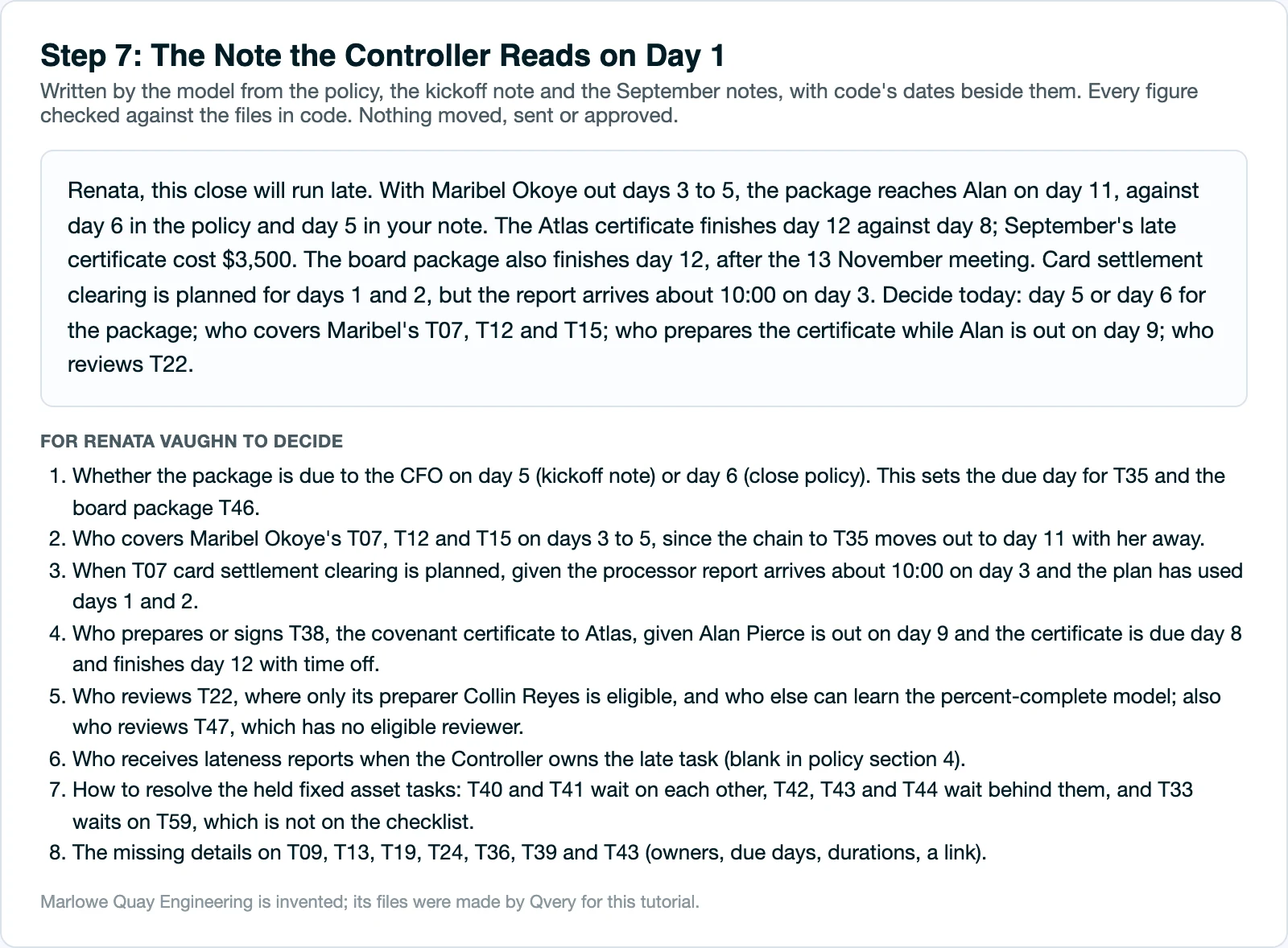
It moved nothing. The dates, the cover for Maribel, the certificate and who reviews the revenue review are Renata Vaughn's decisions, and the note gives her the reason for each.
You can run the same plan on your own checklist, or on Marlowe Quay's files, and get it back by email.
Qvery's Agents Keep the Plan Current Through the Close
The steps above are one morning.
In a live close, the agents we build for your finance team run them every morning, after your team updates its rows. They read the tracker you already keep, a spreadsheet or your close software's export, and write the dated plan back beside it with the morning note.
When a task slips, everything behind it moves, and the controller sees the new finish the same day.
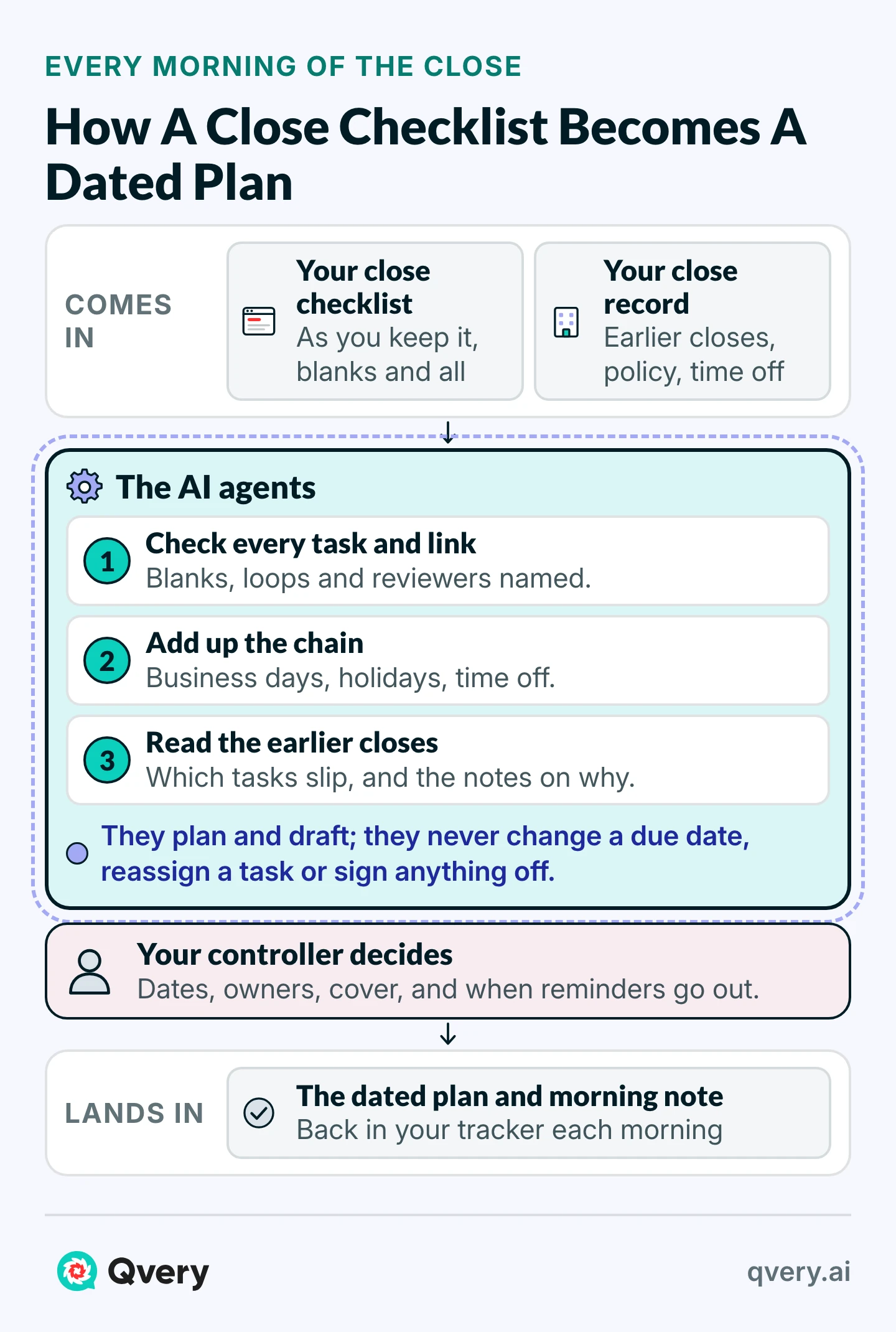
A close plan holds people's names and their time off, so the agents work under three rules.
Your team's names and time off are personal data
The agents read the tracker, the close record and the calendar you point them to, and nothing else on your shared drive. Before they see a single name, what they may read is written into a data processing agreement with Qvery AI OÜ, a company registered in the EU.
Every change is logged
each plan, each note and each drafted reminder, with the files it was built from.
The controller decides
Reminders go to task owners only once the controller trusts the dates, and the agents never change a due date, reassign a task, review an entry or sign anything off.
Close software already stores links, durations and due dates, and sends notices when a task is overdue. Keep it. The agents add what it doesn't do: read the chain against the deadline, the calendar, the earlier closes and the team's own notes before day one, and say what to decide.
Close plans are one of three jobs our accounting playbook works through for a finance team, beside matching customer payments to their invoices and the entries group companies record differently.
What the Planning Costs a Firm Like Marlowe Quay
The calculator counts the job the way the checklist does, by task. Its example is Marlowe Quay: 46 tasks, and the policy's two working days each for four people, about 64 hours a month, spread over them: 83 minutes a task each close.
With the agents, we assume 40: the controller's morning read and decisions, owners still updating their own rows, and the calls no agent makes.
Month-End Close Planning ROI Calculator
What Each Close Task Costs You To Plan, And With The Agents
Saved Per Year
$20,998
396 hours handed back, after $4,752 a year to run it
- Hours Handed Back
- 396 hours a year
- Agent Running Cost (Estimate)
- $396 a month
- Payback Per $10,000 Of Build
- 5.7 months
On these numbers, each close task costs $52 instead of $90.04, the agent saves $20,998 a year after its own running cost, and every $10,000 of the build is earned back in 5.7 months.
At an accountant's mean pay of $94,750 a year in the federal wage survey for May 2025, with benefits at the 30% of a worker's cost that private employers paid in June 2026, an hour costs $65.09. The close's planning costs about $49,700 a year today.
With the agents, about 396 of those hours come back. After their running cost of about $396 a month, the difference is close to $21,000 a year, and at that pace a $10,000 build pays for itself in 5.7 months.
A controller earns more than the accountant's mean, so the example runs low.
The calculator leaves out the fees. One late reporting fee the size of September's, $3,500, is close to nine months of the agents' running cost.
Your Controller Checks the First Plan Against a Real Close
Bring the checklist, the due and finish dates of your last six closes, your close policy and reviewer rules, and the team's calendar. The first working plan is ready in two weeks, and it is tested on a month you know before it touches a live one.
| When | What happens |
|---|---|
| Week 1 | We record your close's unwritten links and rules from three recent closes |
| Weeks 1 and 2 | The agents plan a close you already finished; your controller checks it against that month |
| Your next close | The agents plan it beside your tracker; reminders wait until the dates are trusted |
| The close after | Your team works from the agents' plan, and the hours handed back are counted every week |
Frequently asked questions
What is month-end close automation?
It is software doing the repeating parts of closing the books: pulling bank feeds, matching transactions, posting recurring entries. The plan around that work can now go to AI agents too. They read the checklist, the earlier closes and the team's calendar, and keep a dated plan current each morning of the close.
What is a close calendar?
A close calendar puts each task on a business day, with its owner and the tasks it waits for, so the team sees when the package will be ready. Kept in a spreadsheet, its dates move by hand as tasks slip. The agents build it from the checklist and re-date it from your team's own status updates.
Can AI do the whole month-end close?
No. The planning agents described here plan and remind; your accountants still do the reconciliations, book the entries and sign off, and your controller decides every date and every owner. The agents touch none of the accounting: they read the checklist and the records and write a plan and a note.
What if our checklist has no durations or links?
The first plan still runs. It lists every task missing a duration, a link or an owner, and dates the rest. The finish stays unknown until every task on the chain has a duration, because a guessed one hides the risk. Your team can fill the gaps in one sitting with the people who do the work.
We already use FloQast or BlackLine. Why add agents?
Keep it. It holds the checklist, the links and the due dates, and sends overdue notices. The agents read its export with your earlier closes, the time-off calendar and your policy, and tell your controller before day one where the close will run late. Where it lets an agent write, the dates go back into it.
Does it work with NetSuite, QuickBooks, Sage Intacct or Deltek?
The planning agents don't read your accounting system: they read the checklist and the close record, wherever you keep them. Where your close tracker lives inside your accounting system or a tool connected to it, we connect to its export and write the plan back beside it.
How does it handle a close across several entities?
Each entity's checklist keeps its own owners and due days, and the group tasks, such as consolidation, wait on every entity they need. A subsidiary on a different holiday calendar is planned on its own business days. When one entity runs late, the plan names it as the reason the group package moves.
Will the agents email our team?
Only once your controller says so. At first the plan and the morning note go to the controller alone. Reminders to task owners start once the controller trusts the dates; when a task slips, each owner whose task moves gets one.
What happens when a key person is out during the close?
If the absence is on the calendar, the plan shows it before the close starts: every task that person prepares on the chain, the day it would start, and the new finish if nobody covers it. Who covers stays the controller's decision. An absence nobody planned shows up the next morning, once the task is marked or reassigned.
Who sees our staff names and time off?
Your checklist can use codes instead of names, and the plan reads the same either way. If names stay in, our data processing agreement with you covers them, the agents read only the tracker, record and calendar you point them to, and every read is logged.
What does it cost to run?
The calculator's example estimates about $396 a month for 46 tasks: hosting and upkeep, plus model usage for the daily refresh and the drafted reminders. A full plan of the sample close runs in under five minutes. The cost grows with the number of tasks, not with how late the close runs.
What is the critical path in a month-end close?
It is the chain of tasks, each waiting on the one before, whose total sets the earliest finish. Speed up a task off the chain and the finish holds; let one on it slip and the close slips. In our sample it ran through eight tasks, from the sub-ledger lock to the close package.
How good is the plan if our durations are rough?
The plan is as good as the durations it is given. A first estimate from whoever does the work is enough to start. The record of earlier closes then shows which tasks run long, and those are the durations worth correcting first. Each correction carries into every later plan.
Does a faster close mean a worse one?
The agents shorten no task. They show the slip early: a team that sees on day one that the package lands on day 8 can move a person or a deadline before the close starts, instead of rushing the reviews at the end.
