
On this page
If your business is two or more companies under one owner, say a US parent and a subsidiary in Germany, every sale, fee, loan and transfer between them is booked twice, once in each company’s books.
When the group’s numbers are added up, those amounts are taken out, because money you owe yourself is neither revenue nor debt. That removal is the intercompany elimination, and it only works when both companies’ books say the same thing.
Often they don’t, by a little.
Here is one October from a components group of about 310 people with exactly that setup, a sample we use at Qvery to show our agents at work.
| Whose books | What the subsidiary owes the parent |
|---|---|
| The parent’s, in Columbus | EUR 926,721.41 |
| The subsidiary’s, in Germany | EUR 921,561.41 |
| Left over | EUR 5,160.00 |
That EUR 5,160 is the net of five separate mistakes, the biggest of them EUR 14,250 running the other way. Finding them takes the group’s two accountants and its group controller about four working days each, every month. At an accountant’s pay, that’s $75,635 a year spent getting the group to agree with itself.
At Qvery, we help groups of companies stop paying accountants to chase their own ledgers, with custom AI agents that pair both sides and list only what needs a person.
Every Gap Comes From One of Five Places
US accounting rules require a group to remove what its companies owe each other in full before it reports as one business. Whatever the two sides don’t agree on stays behind in the group’s numbers, and the reasons aren’t equally serious.
| What happened | What it looks like | Who corrects it |
|---|---|---|
| The exchange rate | Same euro amount; the parent’s dollars used another rate or another day | Nobody: the group records a currency difference |
| The date | Same amount, booked days apart: money in transit, an invoice booked on arrival | Nobody, inside the days your policy allows |
| One side only | One company booked it, the other never did, often a rejected or late invoice | The company that missed it |
| Booked twice | One company entered the same charge two times | The company that doubled it |
| A different amount | Both booked it, for different amounts: a fee that changed, a typo | The two accountants agree which is right |
The first two need nothing corrected. They still look exactly like the other three until someone traces them.
The rate gap is the subtle one. The parent holds what the subsidiary owes in euros and restates it in dollars every month end, while the subsidiary’s euro figure never moves. Post at another rate than the one the group compares against, and the dollars stop matching with nobody at fault.
In the sample October, the parent posted 30 entries between 13 and 16 October at 1.0795, the rate it had also used on the 12th. The treasurer’s daily sheet, the rates the group agreed to compare against, ran from 1.0840 to 1.0854. That alone is $1,582.30 of differences, every cent of it the rate.
The date gap is just as innocent. On Tuesday 27 October the treasurer sent the subsidiary EUR 72,000 to settle September, and Germany booked it on Friday the 30th.
That’s three working days, one more than the group’s policy allows, while a note on the treasurer’s rate sheet works on three. Even the rule had been written two ways.
The other three are where the real money hides, and in the sample they pull in both directions.
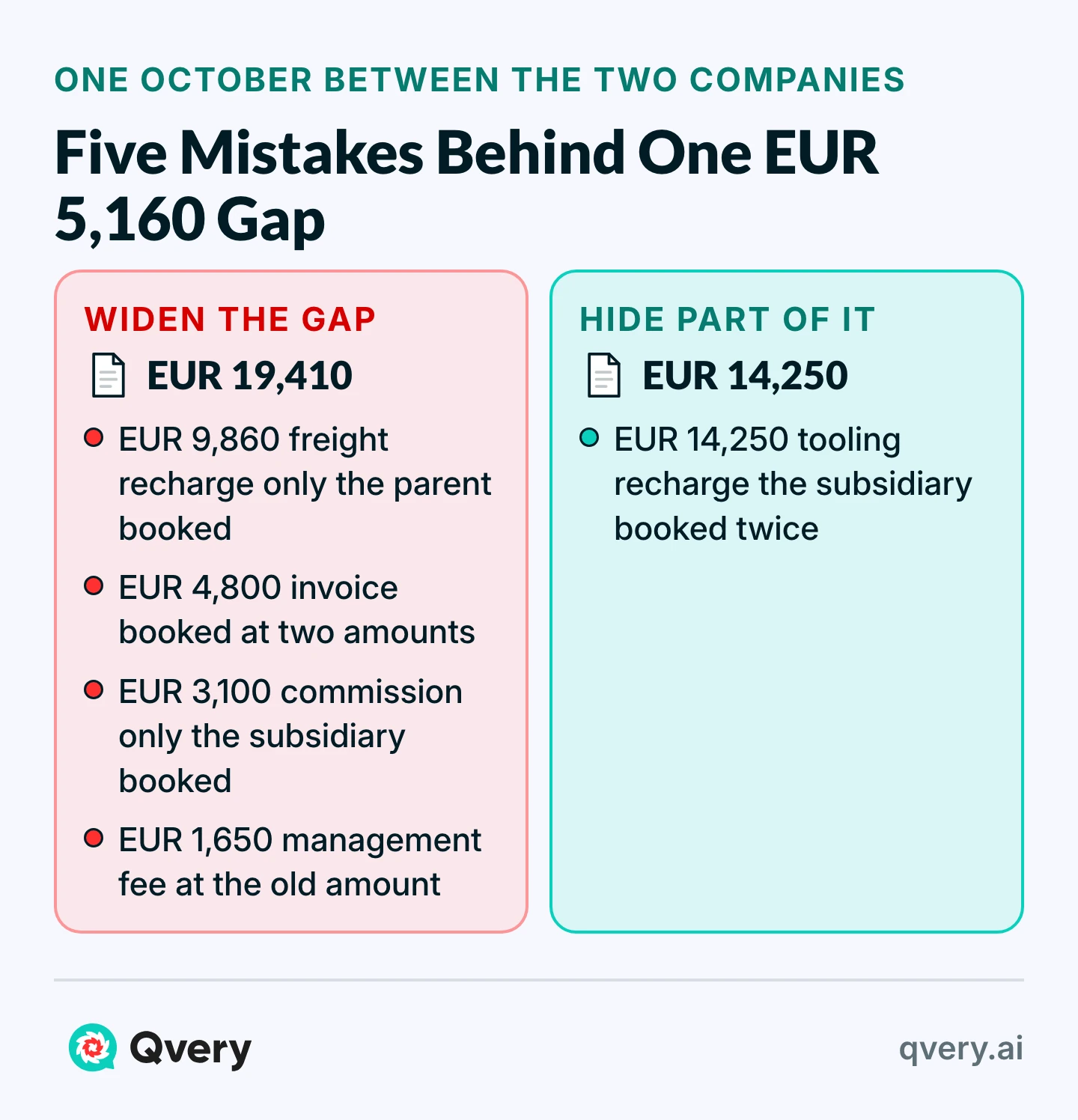
Those add up to EUR 33,660, and the net still looks small. The subsidiary entered EUR 14,250 of tooling recharge twice on 8 and 9 October, while a EUR 9,860 freight recharge the parent booked on the 28th never reached its books. A month later neither is in anyone’s memory.
Telling Them Apart Is Where the Hours Go
By hand, every gap costs the same tracing until you know which kind it is. Each accountant exports their company’s intercompany account, lines the two up in a spreadsheet and looks up every reference that doesn’t tie.
Then they email the other company about each one, across an ocean if the subsidiary is abroad, and in the first days of the month-end close, when the books are being finished and everyone is busiest.
Accountants describe it plainly. One spent about 4 hours tracing a single intercompany transaction and still left a $1,900 difference unexplained, with a note. Another, at a far larger company, spent 4+ hours a day on one high-volume intercompany account.
In APQC’s cross-industry benchmark of 1,249 organizations, the median puts half of all journal entry lines, the individual lines in a company’s books, between parts of the same organization. This isn’t a corner of the books.
A gap nobody can explain is either plugged, booked to an expense line so the books balance, or carried in a note until the other side finds it. Accountants argue about it. The case for carrying: the other company is off by the same amount, so a plug only hides the gap until the balance is settled.
What Reddit says
If it’s intercompany someone somewhere must also be off 1900. Did they plug it? Find your counterparty.
Biggest issue I’ve run into is having too many hands in the cookie jar/nobody communicating what is being booked.
We currently slap bandaids on it every month.
Carried breaks age. The sample group’s log holds 6 open breaks older than 30 days, worth EUR 20,265, two with no owner. The policy line naming who they go to next is blank, and the management fee gap has sat on the log since July: EUR 6,600 so far.
 Vlad ShvetsPartner @ Qvery
A plug is a decision about your group’s numbers that nobody made. If you run a group, two questions tell you where you stand: how much was booked last year just to make intercompany balance, and how old the oldest open item is. If either answer takes a day of digging, your accountants spend the month finding gaps, and finding them is the part agents can do every close.
What Qvery’s Agents Do With Both Ledgers
The agents we build for intercompany run on their own at every close. They start from the files your accountants already export: each company’s intercompany account, in its own layout and currency, and your treasurer’s rate sheet.
Entries that agree on reference, amount and date pair first. Then the agents convert the dollar side at your comparison rate and allow the days your policy allows, showing for each pair how much of the gap the rate or the date explains.
Whatever is left goes on one list with both companies’ lines next to each other and a likely cause, marked as a suggestion.
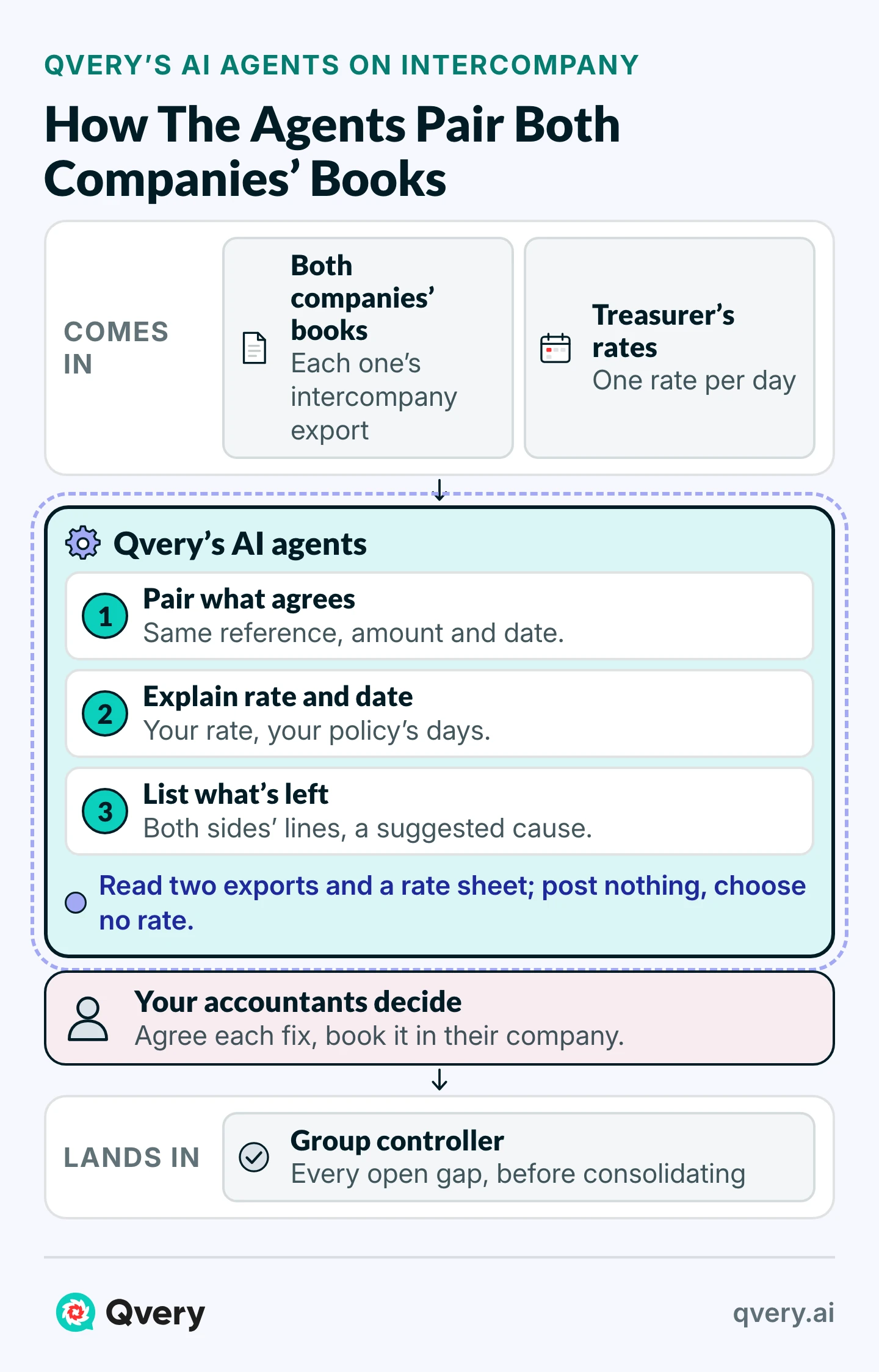
On the October above, this is the list your accountants open on day one of the close:
- 151 of 166 transactions paired on reference, amount and a date inside the policy’s two working days.
- 71 of the parent’s entries set aside as rate differences, $1,729.77 in all, each with the two rates beside it.
- 18 left for a person: the five real breaks, seven pairs posted further apart than the policy allows, three entries made on a day the rate sheet has no rate for, and three pairs whose references the subsidiary typed differently.
The agents don’t guess. With no rate for a day, the gap stays unexplained. A reference typed “IC 0063965” on one side and “0063965” on the other is offered as a possible pair, never matched on the agents’ say-so. When two entries could both match the same line, neither is paired, and a person chooses.
They post nothing: no corrections, no eliminations. The two accountants agree each fix and book it in their own companies. Your group controller keeps the consolidation, the adding-up of the group’s books, now working from a list both companies have already seen.
The agents can’t make the other company answer an email, so the chasing stays with a person, on a much shorter list.
If both your companies run on one accounting system that books both sides of every transaction together, many of these gaps never happen. Manual entries, late invoices and a subsidiary on its own system still produce them, and the sample group runs its two companies on two systems.
 Piotr BabelPartner @ Qvery
The agents only call a gap explained by a rule you gave them: the treasurer’s rate for that day, the window in your policy. If the policy says two days and the treasurer’s sheet says three, we ask you which one holds before the first run. And when two entries could both be the match, they leave it open. A wrong pair is worse than an open item, because nobody looks at it again.
Before the agents touch anything, we agree in writing what they may read: two exports and a rate sheet, nothing else. Every file they open is logged, and descriptions that carry staff or customer names can be swapped for codes without breaking the pairing.
We’re an EU company, Qvery AI OÜ, and we put a data processing agreement in place before any ledger reaches us. You can see the pairing on two of your own ledger exports and your rates, as a spreadsheet with the pairs, the rate and date gaps, and what’s left.
What a Group This Size Gets Back
The calculator below opens on the sample group: 166 intercompany transactions a month, about 35 minutes each by hand once you spread the four working days of three people across them, at $65.09 an hour for an accountant with benefits. Put in your own volume and pay.
Intercompany Matching ROI Calculator
What Each Intercompany Transaction Costs You To Agree, And With The Agents
Saved Per Year
$46,504
764 hours handed back, after $3,199 a year to run it
- Hours Handed Back
- 764 hours a year
- Agent Running Cost (Estimate)
- $267 a month
- Payback Per $10,000 Of Build
- 2.6 months
On these numbers, each transaction costs $14.62 instead of $37.97, the agent saves $46,504 a year after its own running cost, and every $10,000 of the build is earned back in 2.6 months.
Today that’s 1,162 hours a year and $75,635, or $37.97 a transaction. With the agents doing the pairing, your accountants spend about 12 minutes a transaction checking what was set aside and agreeing the short list with the other company.
That’s 398 hours, plus about $267 a month to run the agents, or $14.62 a transaction. You keep $46,504 a year, or 764 hours, and each $10,000 a build might cost is earned back in 2.6 months.
The 35 and the 12 minutes are our assumptions for a group like this one, and the $267 is our estimate of model use, hosting, the pair log and upkeep. Hours handed back are worth most where they stand in for a hire, usually the next accountant a small finance team was about to add.
The calculator leaves out two things you’ll care about more. Fewer plugs: a gap with a named cause can be fixed instead of booked to an expense line. And the group’s numbers can arrive sooner, because the intercompany step no longer waits on two people tracing spreadsheets.
Intercompany is one of several finance jobs a team this size still does by matching one file to another. Our accounting playbook works out what three of them cost the finance team of a 200-person distributor, intercompany among them.
Your First Run Is a Month You’ve Already Closed
We start with a month your accountants have already finished: both companies’ intercompany exports, the treasurer’s rates for that month, your policy and your log of open breaks.
| When | What happens |
|---|---|
| Week one | We map each company’s codes and write down the rate and window you really use |
| By week two | The agents run the closed month; your accountants check it against their own breaks |
| Next close | Both accountants open the month on the agents’ list instead of two spreadsheets |
| Every week after | We count hours spent on intercompany, breaks still open and their age |
Where the agents’ list and your accountants’ differ on the closed month, we find out why before anything goes live. We also train both accountants to work beside the agents, including whoever keeps the subsidiary’s books.
Frequently asked questions
How long does intercompany reconciliation take each month?
It depends on how many transactions cross between your companies and how many systems they sit in. The sample group’s own policy puts it at about four working days each for two accountants and the group controller, every month, in spreadsheets. Most of that goes to the few transactions that don’t tie, not the many that do.
What are intercompany eliminations?
When a group adds its companies’ books together, it removes what they owe and sell each other, so it reports only its business with outsiders. Those removals are the eliminations: a sale to the subsidiary, a loan, a management fee. They net to zero only when both companies recorded the same amount.
Why don’t intercompany balances net to zero?
It comes down to one of five reasons: an exchange rate, a date, an entry only one company booked, an entry booked twice, or an amount the two disagree on. The first two need nothing corrected; the other three are real mistakes. Until someone traces them they look alike, and several can offset each other.
Should we plug an unexplained intercompany difference?
A plug, booking the gap to an expense line so the books balance, closes the month and hides the cause. If the difference is real, the other company is off by the same amount, and it returns when the balance is settled. I’d leave it open with an explanation and an owner; our agents hand you both companies’ lines for it.
Can the agents explain currency differences?
Yes, with the rates you give them. They convert at your treasurer’s rate for each day and show how much of every gap that rate explains, beside the rate the entry was posted at. They never choose a rate source or call a rate correct, and a day your rate sheet doesn’t cover stays unexplained.
What’s the difference between intercompany reconciliation and elimination?
Reconciliation comes first: each month the two companies agree they’ve recorded the same transactions for the same amounts. The elimination comes after, when the group adds its books together and removes those balances. If the reconciliation leaves a gap, the elimination can’t net to zero. Our agents work on the reconciliation, so the elimination has less left over.
Does it work with more than two companies?
Yes. In a build for your group, the agents run every pair of companies that trade with each other at each close. Each company sends one export, and the agents split it by the company on the other side. You get a list for each pair with its open total, and a summary for the group on top.
Do both companies need the same accounting system?
No. The agents read the intercompany export from each company’s own system, so a parent on NetSuite and a subsidiary on Sage or Xero work together. Each company’s codes for the other are mapped once at setup. Groups on one system still get gaps from manual entries and late postings, and the agents read those the same way.
Do the agents post the corrections or the elimination?
No. They post nothing in either company and never book the elimination, and they give no view on whether a balance is fairly stated; that stays with your accountants and auditors. What they add is a record: every pair they proposed, every one a person confirmed, and when.
What if one company never booked it?
The entry goes on the list as having no counterpart, with its date and amount, and the list shows how old it is. Often the other side books it days later, after a late or returned invoice, and the pair is proposed then. In the sample October, a EUR 9,860 freight recharge sat in the parent’s books alone.
Why does the elimination come back next month in NetSuite?
Because it’s designed to. NetSuite creates the elimination entries when you close a period and, for the intercompany receivable and payable accounts, reverses them in the next period before the next close eliminates again. A balance reappearing on the first of the month isn’t a new gap.
How do we clean up years of old intercompany balances?
The agents work forward from the first month they run, and anything still unpaired shows its amount and age, so the gaps stop piling up unseen. Matching years of history means hunting documents and asking people who may have left, which stays with your accountants. I’d clear the newest items first, while someone still remembers them.
Who sees our group’s ledgers?
Only the people named in the agreement we sign before we start, and only to set up and run the agents. They read the two exports and the rate sheet, and every file they open is logged. Names in descriptions can be swapped for codes first, and our data processing agreement comes before the first file.
