
On this page
- Prove the Statement Adds Up Before Matching Anything
- Read the Limits Your Policy Already Wrote
- Carry Last Month's Open Items Forward
- Pair the Lines by the Same Rules, Every Month
- Explain Every Line That Is Left
- Hand the Controller a Reconciliation That Ties
- What Qvery's Agents Take Off Your Accountants
- We Begin With a Month You Already Closed
- Frequently asked questions
At a company of a few hundred people, the bank reconciliation waits for the statements, so it lands in the first days of the month, on whoever in finance reconciles the accounts. The statement sits on one screen and the ledger export on the other, and every line gets a tick.
Most lines tie at a glance. The month stalls on the few that don't: a supplier paid twice, a customer's check that bounced, card fees the processor kept before the deposit landed. The controller's signature waits on those.
For a company with 400 bank lines a month, the calculator's example below, that is 480 hours a year of an accountant's time, $31,243. AI agents can now do the ticking and most of the chasing.
At Qvery, we help finance teams spend month-end on decisions instead of ticking, with custom AI agents that pair your bank lines with your books and explain what's left.
We ran the whole job on one month for a company that does not exist: Haldane Ridge Building Supply, a 230-person building supply distributor in Boise. Every document is invented, and the answer key was written before anything ran.
Its October 2026 files are the ones a real month has: the operating account's bank statement as a PDF, the cash ledger exported from its accounting system, the card processor's settlement report, the written reconciliation policy, September's reconciliation and two emails.
| The run | October |
|---|---|
| Statement lines paired by code | 162 of 178 |
| Fee lines grouped against the booked estimate | 12 |
| Lines with no pair, each handed over with a cause | 4 |
| Difference between bank and books | $21,741.24 |
| Left unexplained | $0.00 |
The six steps below take that month from the bank's PDF to a reconciliation the controller can sign, and your own month runs through the same six.
This reconciles bank accounts to the ledger and proposes entries. It posts nothing, moves no money and writes nothing off.
Prove the Statement Adds Up Before Matching Anything
Nothing gets paired until the statement is proven. The opening balance, plus every credit, minus every debit, has to land on the closing balance the bank printed, and the line counts have to match the bank's own.
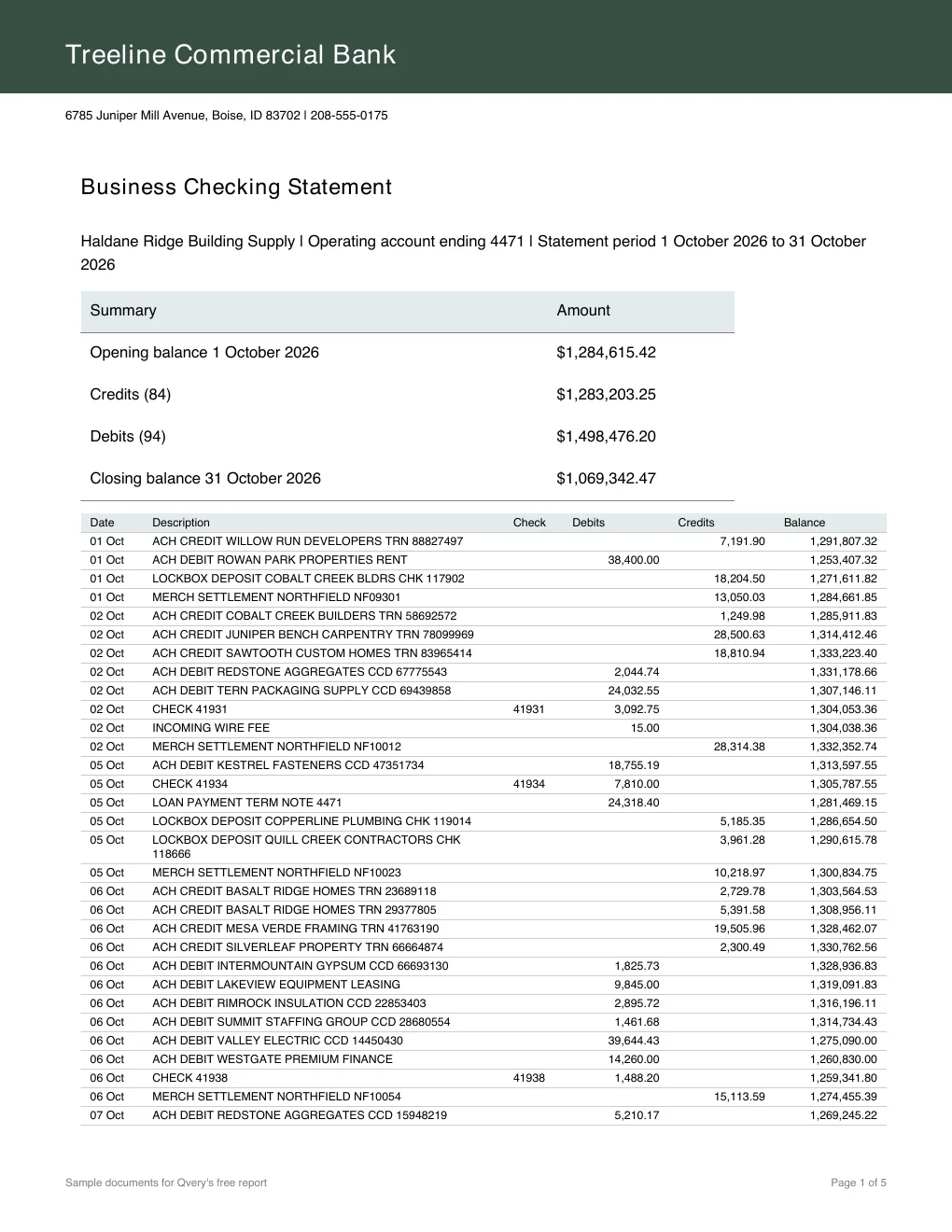
Haldane Ridge's statement opens at $1,284,615.42, lists 84 credits and 94 debits, and closes at $1,069,342.47. Code read all 178 lines from the PDF and recomputed the balance after each one, and every running balance agreed with the bank's.
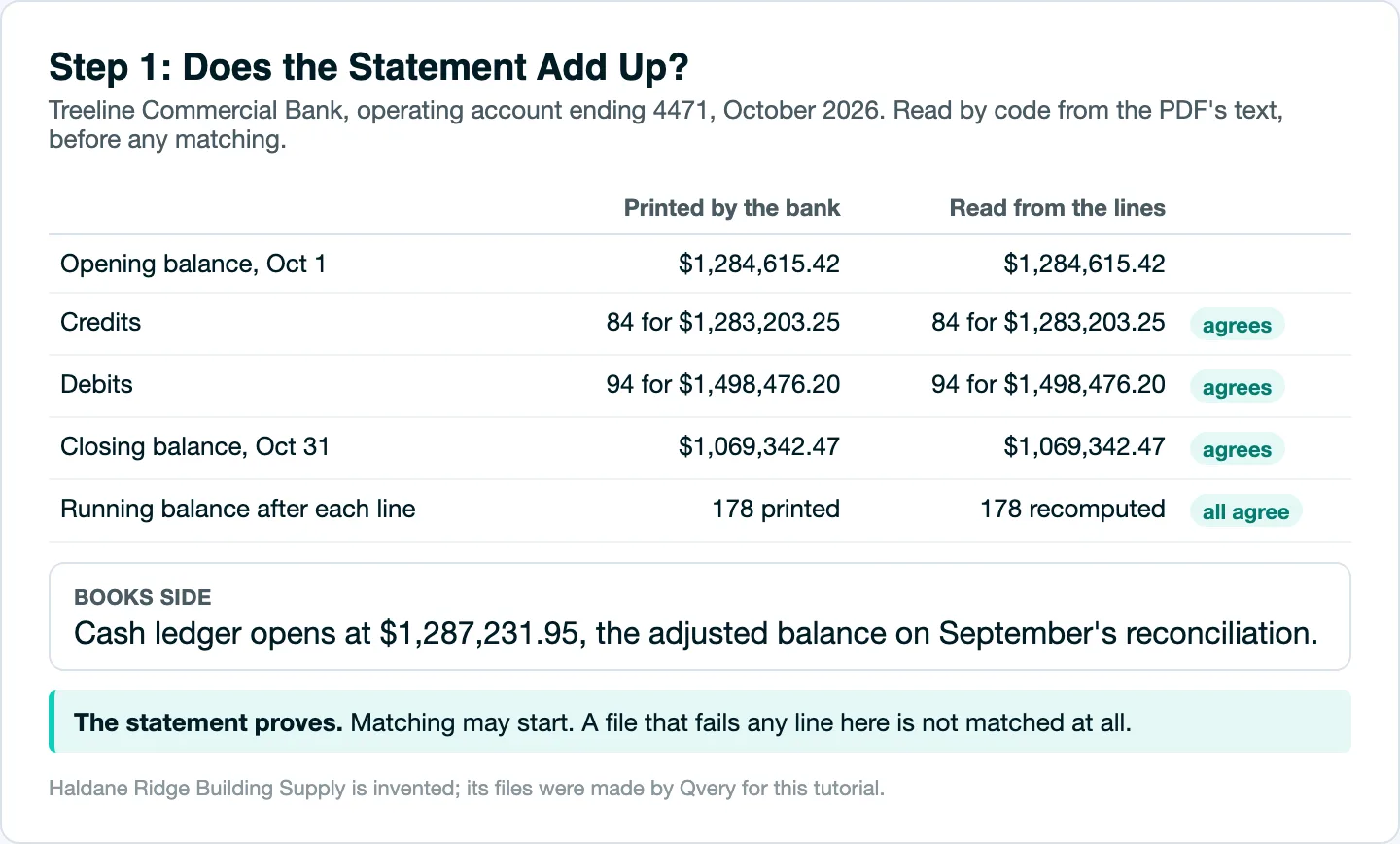
The books get the same check. The cash ledger opens at $1,287,231.95, the adjusted balance on September's reconciliation; a ledger that opened anywhere else would stop the run until someone found out why.
Read the Limits Your Policy Already Wrote
A reconciliation needs two settings: how far apart two amounts may be and still count as a match, and how many days apart. Haldane Ridge has written both down, in two places.
The policy says a bank line matches when the amounts agree and the dates are within two bank days, and differences up to $0.50 clear without an entry. The matching-rules sheet inside the ledger export says $5.00 and five bank days.
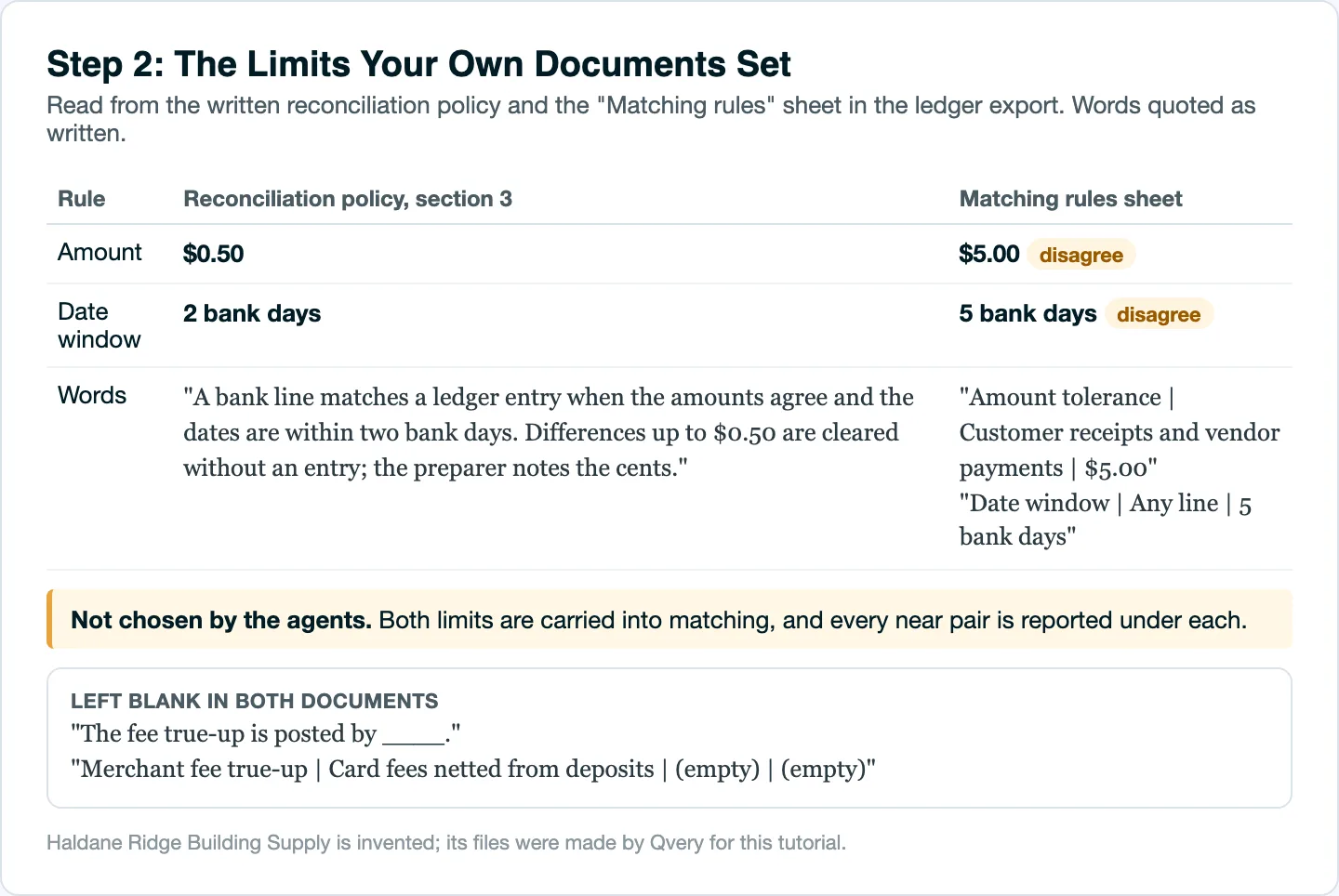
A model read both documents and returned each limit with the words that set it, and code checked that every quote appears in the files. The agents carry both limits forward and choose neither.
Later, every near pair (a bank line and a ledger entry from the same customer, a few cents or dollars apart) is reported under each limit, and the controller picks the rule.
The same read found a blank. Neither document names who books the card-fee true-up, the entry that brings the fees in the books up to what the processor charged, and in October that comes to $1,262.37.
Claude Haiku 5.5 split the sheet's two rows and wrote a date window of zero days on the amount row. Read literally, that would have tightened the window to same-day only. Code refuses any limit a document never wrote, so the fragment was dropped and both limits came through intact.
Carry Last Month's Open Items Forward
A reconciliation starts from last month's open items: deposits the bank had not received by month end, and checks written but not yet cashed. September left two deposits in transit and nine outstanding checks.
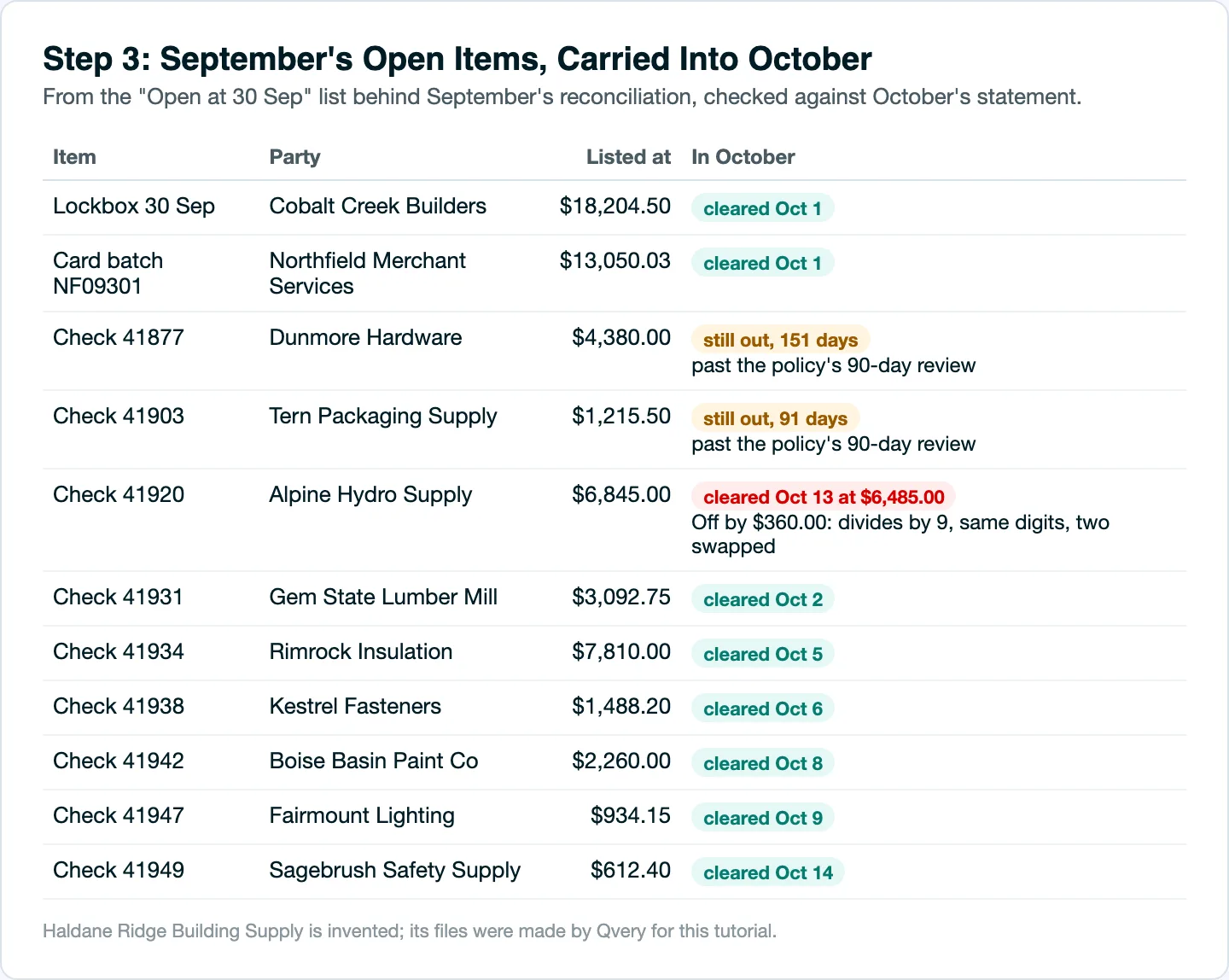
Both deposits cleared on October 1, and six checks cleared at the amounts listed. Two never cleared: check 41877 is 151 days old and 41903 is 91, both past the policy's 90-day review, so they go to Accounts Payable.
The ninth, check 41920 to Alpine Hydro Supply, cleared on October 13 at $6,485.00. September's list carried it at $6,845.00.
The agents stop at the hint. Which side holds the wrong figure is not in the files, and the model said so.
Pair the Lines by the Same Rules, Every Month
Pairing is the repeatable part, so it is code: the same files give the same pairs every month, and the model never touches it.
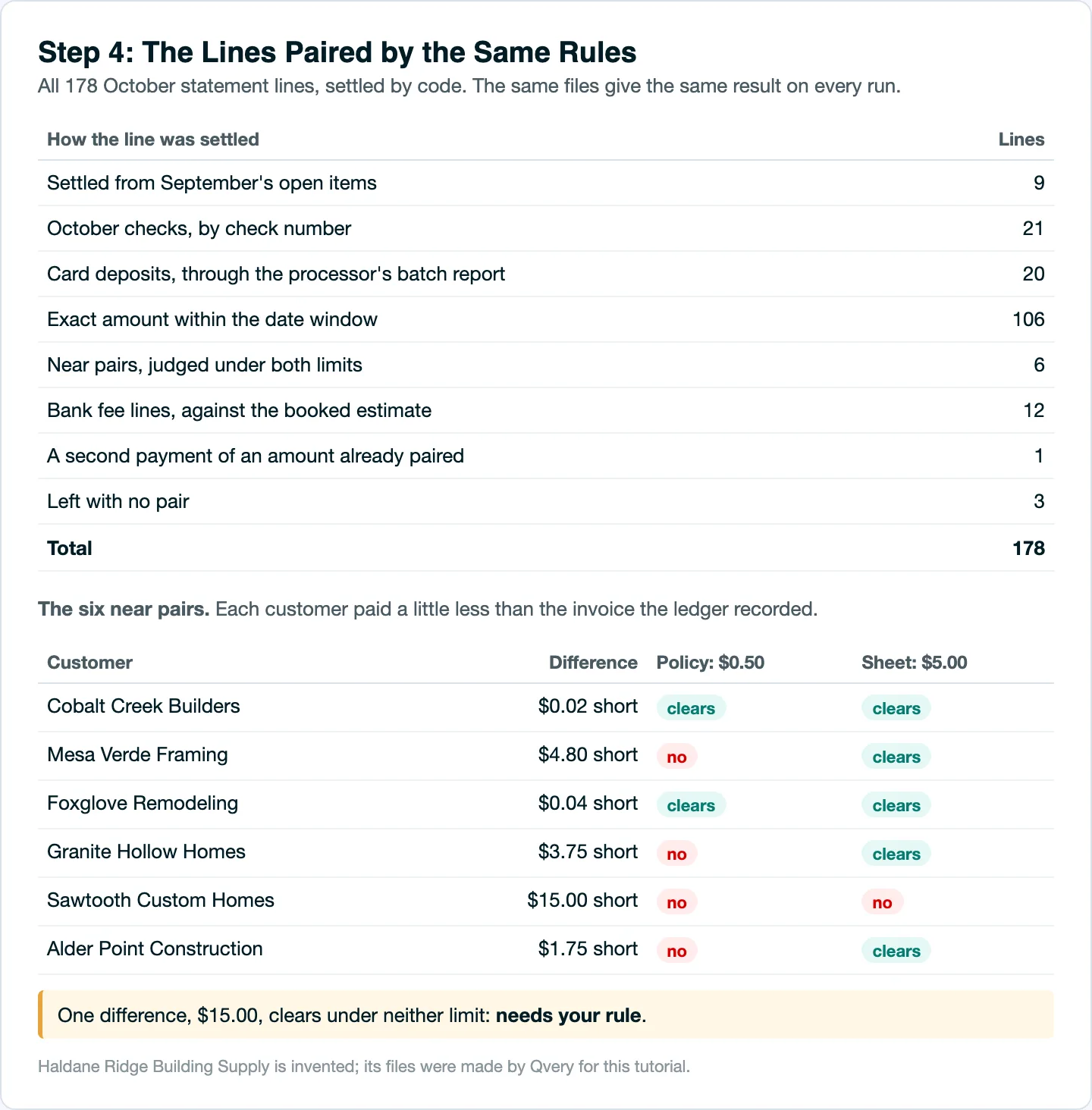
October's own checks pair by check number, 21 of them, and 106 lines paired on exact amounts within the date window.
Card sales reach the bank as one deposit per batch, net of the processor's fee, while the ledger books each batch at its full amount. So card deposits pair through the processor's report: gross less fee has to equal the deposit, batch by batch, and all 20 did.
Some lines look like problems and aren't.
- Two $4,150.00 payments to Peak Freight Lines on consecutive days are two invoices: two ledger entries, two bank lines, one pair each.
- The October 9 counter deposit reached the bank on October 13, four calendar days later. It was one bank day, because Monday the 12th was Columbus Day, a Federal Reserve holiday, and a window counted in calendar days would have flagged it.
- Two $150,000.00 transfers to and from the money market account are the company moving its own cash.
Six customers paid a little less than the invoice the ledger recorded.
| Customer | Short by | Clears under |
|---|---|---|
| Cobalt Creek Builders | $0.02 | both limits |
| Foxglove Remodeling | $0.04 | both limits |
| Alder Point Construction | $1.75 | the sheet's $5.00 only |
| Granite Hollow Homes | $3.75 | the sheet's $5.00 only |
| Mesa Verde Framing | $4.80 | the sheet's $5.00 only |
| Sawtooth Custom Homes | $15.00 | neither: needs your rule |
Three of them, $10.30 together, clear or don't depending on which document you believe. A tool configured from either one alone would have settled them silently.
Tips from Reddit
Accountants on automating the reconciliation
Claude will not repeat a process exactly the same way everytime. VBA macros, however, will.
it was easier to code our system to do it, which created an actual audit trail.
The key was reconciliations aren't comparing GL to GL, they need to find some other evidence, ideally external.
we have one team member who does daily recs on our 7 highest volume accounts (20-30 txn per account per day). Takes her about 10 minutes per day
Explain Every Line That Is Left
After the pairing, four statement lines and a handful of totals were left. This is where the hours used to go, and where the model earns its place: it reads the company's own files and writes, for each item, a likely cause, the words that support it and the entry a person would book.
Paid twice
Cascade Truss Works was paid $27,418.60 by ACH (an electronic bank transfer) on October 8 and again on October 9. The ledger holds one payment, and the supplier's own email says the second is sitting on Haldane Ridge's account as a credit.
Returned check
Redwood Framing's $12,640.00 check came back for nonsufficient funds (NSF) on October 19, with a $12.00 fee. The ledger still counts it as cash.
Wire on the last day
$63,000.00 from Ridgeline Homes landed Friday, October 30. The accounts receivable lead's email says he will apply it Monday, "so you will not see it in October."
Card fees
The processor kept $9,580.01 in fees from October's batches; the ledger booked $8,317.64. That leaves the $1,262.37 true-up nobody owns.
Bank fees
Twelve fee lines total $610.43 against a booked estimate of $350.00.
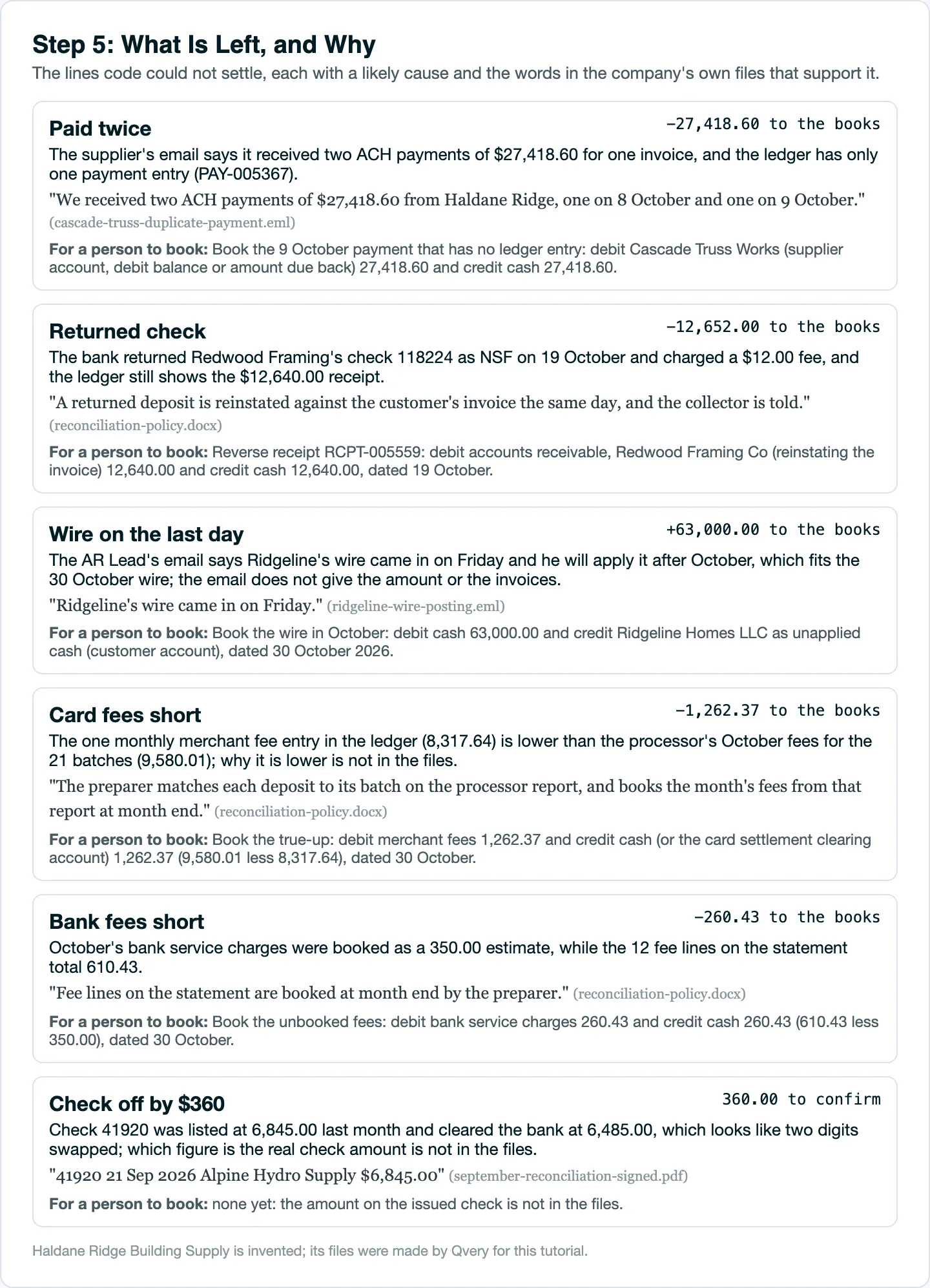
Most of the instruction behind those explanations is about what the model may not say. These are its rules, word for word.
- Copy evidence word for word, one continuous passage each; never join two passages with "...".
- Say what the files show. Never say an entry was made, money was recovered, a payment was stopped, or anyone was at fault. Never decide to write anything off; that is the controller's call.
- Where the files do not say something (who books an entry, why a customer paid short), say "not in the files".
- For a difference the written limits disagree on, say which limit clears it and that the controller must pick the rule.
Claude Sonnet 5.5 and Claude Haiku 5.5 both found all nine items in the answer key, and every quote they gave was in the files word for word.
They slipped on arithmetic. Haiku called six near pairs "five". Sonnet, given every file the company had, added the two stale checks up to $5,595.00; they are $4,380.00 and $1,215.50, which make $5,595.50.
So code checks every dollar figure a model writes against the files and its own sums before a person sees it, and that check caught the $5,595.00.
 Piotr BabelPartner @ Qvery
No count or sum your controller sees comes from the model. It reads your policy and your emails and writes why a line is left, and code checks every dollar it writes against your files before anyone sees it. In our sample month, the strongest run still added two stale checks to the wrong total, and that check caught it. So the pairing and the counting stay in code, done the same way every month.
Hand the Controller a Reconciliation That Ties
The last step is the sheet itself.
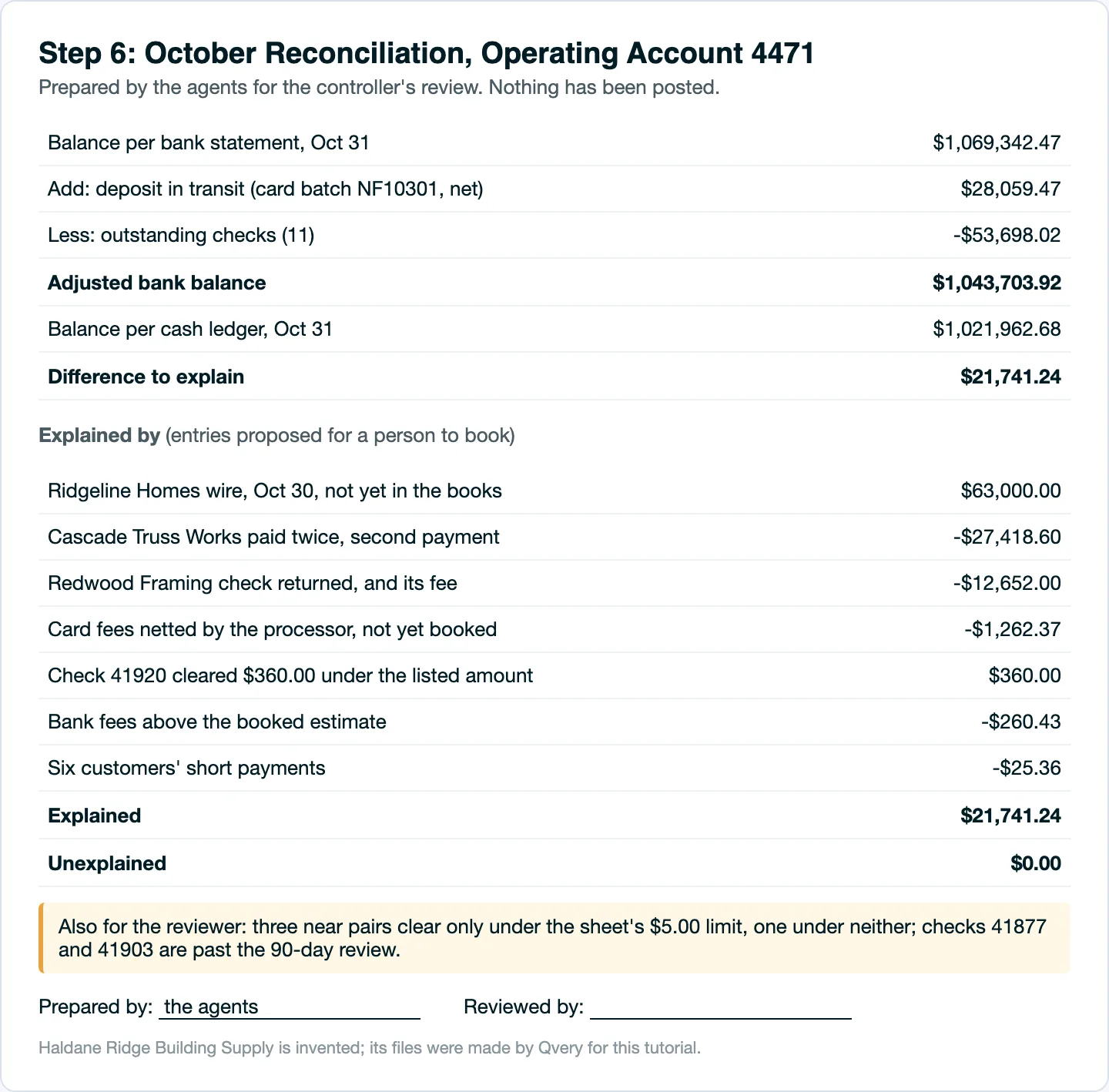
The bank's $1,069,342.47, plus the card batch still in transit, less eleven outstanding checks, gives an adjusted bank balance of $1,043,703.92. The ledger says $1,021,962.68. Seven items explain the $21,741.24 between them, to the cent.
The line that says the job is done is the unexplained one, and it reads $0.00. Had anything stayed unexplained, it would sit on the sheet under that name, with no balancing entry to make it disappear.
Every pair on the sheet keeps the statement line and ledger row it came from, so a reviewer, or next year's auditor, can trace any number back to the files.
The reviewer's line stays empty for the controller. September's sheet still has that line empty: it was prepared 14 bank days after month end, against a policy of five, and no review is recorded.
Run the same steps on one of your own months: drop a statement and its ledger export, or start from Haldane Ridge's files.
What Qvery's Agents Take Off Your Accountants
The agents we build for this run at month end. They pick up each account's statement, your ledger export, the processor's report and last month's sheet from where your team already keeps them, prove each statement, pair the lines your written rules allow and explain what is left with your own files.
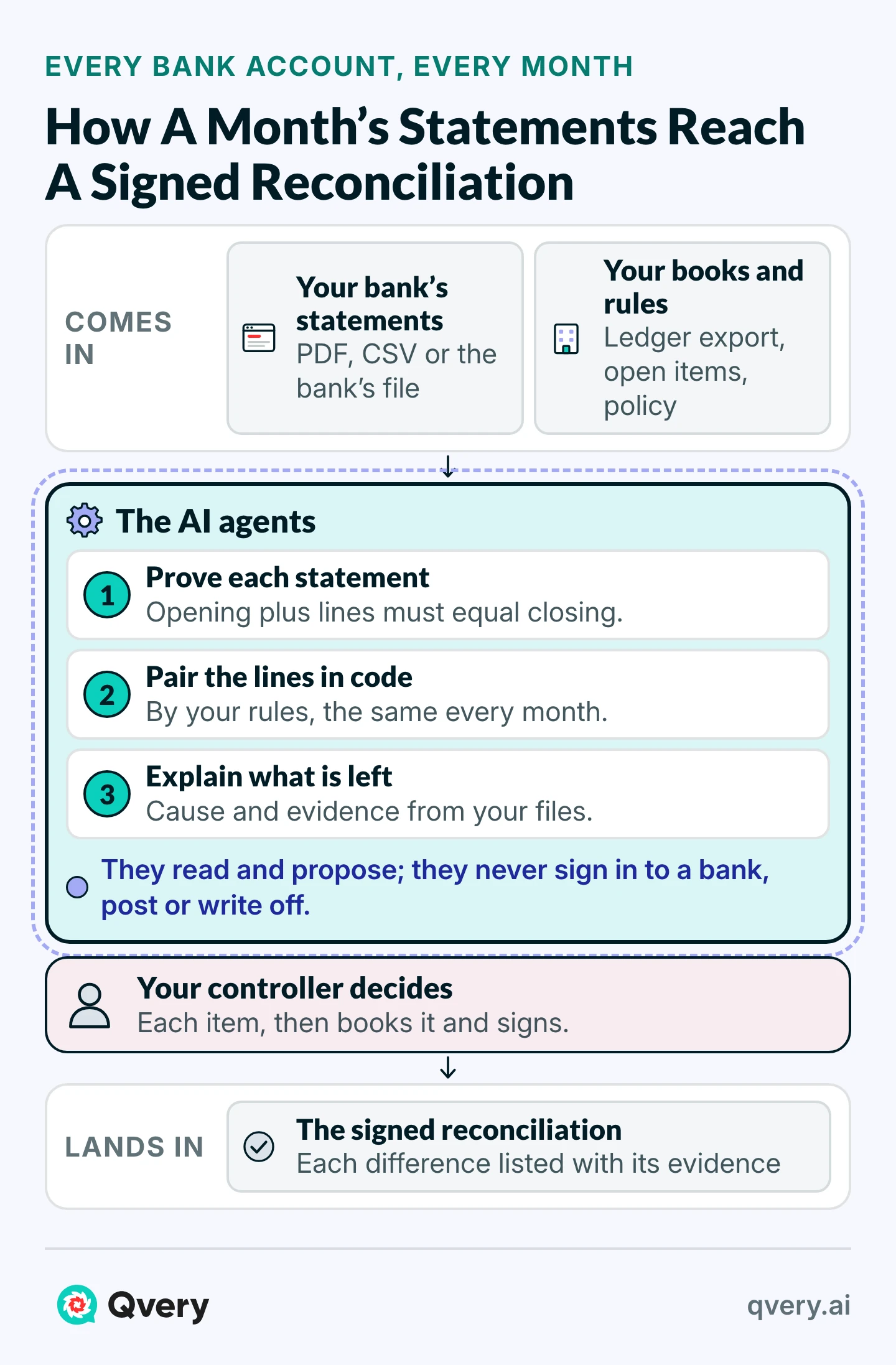
A reconciliation like the one above lands with your controller, who decides each item and books the entries in your accounting system. The table shows what the agents may touch, and what stays with your people.
| The agents | Your people |
|---|---|
| read the exports and files you give them | keep the bank logins; the agents never sign in to a bank |
| propose pairs and entries, with the evidence | post, clear and adjust entries |
| list a gap in your rules as "needs your rule" | write the rule, or decide the item |
| log every pair with its line and row | sign the reconciliation |
Bank statements carry account numbers and customers' names. Before any file moves, we agree in writing what the agents may read and where it is processed, and Qvery, an EU company, signs a data processing agreement.
 Vlad ShvetsPartner @ Qvery
On any reconciliation, the two lines that matter are the last ones: what is still unexplained, and who signed it. In our sample, September's sheet was prepared on October 21 and its reviewer line is still empty. With the agents, the sheet reaches your controller with each open item's evidence attached, so the work left is deciding those items and signing.
The return is what the calculator works out. Put in your own lines, minutes and hourly cost.
Bank Line Reconciliation ROI Calculator
What Each Bank Line Costs You To Reconcile, And With The Agents
Saved Per Year
$20,192
360 hours handed back, after $3,240 a year to run it
- Hours Handed Back
- 360 hours a year
- Agent Running Cost (Estimate)
- $270 a month
- Payback Per $10,000 Of Build
- 5.9 months
On these numbers, each bank line costs $2.30 instead of $6.51, the agent saves $20,192 a year after its own running cost, and every $10,000 of the build is earned back in 5.9 months.
On its example, a company with four accounts and 400 bank lines a month: at 6 minutes a line, that is 40 hours a month, two accountants' first two and a half days. The example assumes 1.5 minutes a line with the agents, for reading the proposed pairs and deciding the short list.
At $65.09 an hour (the $45.56 mean wage of accountants and auditors in May 2025, divided by the 70% that wages make of a private employer's costs), a line costs $6.51 by hand and $2.30 with the agents, their $270 a month included.
On those assumptions that is 360 hours and $20,192 a year of an accountant's time, and each $10,000 of build is matched by 5.9 months of it.
The hours are worth most where they go to work you would otherwise hire for, or to the dozen decisions the month needed instead of 178 ticks.
We Begin With a Month You Already Closed
You send a closed month's statements, ledger export, processor report, last month's sheet and your policy, and the agents reconcile it beside the reconciliation your team already signed. Every pair they propose is checked against how your people settled it, so you see their misses before they touch a live month.
Two weeks after we have access, the agents are reconciling that closed month, at a price fixed before any of it starts.
The Accounting Playbook prices the other finance jobs agents take off a team like Haldane Ridge's, from matching customer payments to planning the close.
From the next close, your controller starts from their sheet, and each week we report two numbers: the hours your accountants did not spend ticking, and the items the agents caught that the old sheet would have carried.
Frequently asked questions
Can AI reconcile bank accounts on its own?
It can do the matching and the explaining on its own. The decisions stay with a person: which entries to book, which limit applies, what to write off. The controller still reviews and signs, as before, but from a sheet that lists each difference with its evidence.
Does the agent get access to our bank account?
No. It reads the statements and exports you already download, and it never signs in to a bank or moves money. Before any file moves, we agree in writing what it may read and where it is processed. Account numbers can be masked in what it returns, and every file it opens is logged.
Can it reconcile from PDF bank statements?
Yes. A PDF with a text layer is read by code, line by line. A scanned PDF is read by a model, and that is why every statement is proven first: the opening balance plus the lines must land on the bank's closing balance, and the counts must match. A statement that fails is not matched at all.
We already have bank feeds and auto-match in our accounting system. What does this add?
Keep them. Bank rules and auto-match clear lines that agree exactly or follow a fixed pattern. What they leave is the slow part: the near pairs, the second payments, card fees netted out of deposits, items crossing month end. The agents work that remainder, give each its cause and evidence, and produce the sheet.
We built an Excel macro that already ties most lines. Should we rebuild it in AI?
Not the part that works. Pairing should be repeatable, and a macro is repeatable; a model is not. Keep the macro for the pairing, or move it into code. In our build, the model does what a macro is not built for: reading your policy and emails, explaining the leftovers and drafting the sheet.
What happens when it proposes a wrong pair?
Your reviewer rejects it, and both lines go back to the open list with nothing cleared. Nothing is posted until a person books it. A pattern behind rejections, such as one customer always paying a day late, becomes a rule you can write down, and the next run follows it.
What if we have no written tolerance?
Then nothing clears on a near match. A $15.00 short payment with no rule covering it is listed as "needs your rule", never matched on a guess. Write a limit per account if you want one, an amount and a number of bank days, and every run applies exactly that.
How does it handle outstanding checks and deposits in transit?
From last month's open-items list. Each item is checked against the new statement: cleared, cleared at a different amount, or still open with its age. Checks past your review period are listed for whoever your policy names. A deposit in transit at month end, like a card batch that settles on the last day, carries to next month's list.
What if a statement or an export is missing something?
The agents name what is missing and stop. A column the pairing needs, a month that does not follow on from the last one, a page they cannot read: each is reported, never guessed. A scanned page they cannot read is listed by its page number instead of filled in, and they never guess which column holds the debits.
Can it run several bank accounts and companies?
Yes. Each account runs on its own statement, ledger export and limits, so payroll never borrows the operating account's rule. Transfers between your own accounts pair across both statements. Accounts that belong to different legal entities stay apart, even at the same bank.
What form does the reconciliation come in?
A spreadsheet: the reconciliation itself (bank balance, deposits in transit, outstanding checks, adjusted balance against the books and every reconciling item), a tab of proposed pairs with both amounts and the rule each used, and a tab of what is left for a person. Every row carries its statement line and its ledger row.
What does it cost to run each month?
A few hundred dollars a month for a company this size: model usage of a few cents a bank line, plus hosting, the log and upkeep of your rules. On the calculator's 400 lines, about $270 a month. Building it is a fixed price agreed before we start.
