On this page
At a company of 200 or 300 people, the finance team reconciles several bank accounts and a payment processor or two (the companies that collect card payments and pay them out in one deposit, called a payout) every month. Someone exports each statement, matches every line to the books, chases the lines that match nothing, writes up what's left and signs, and the month-end close waits until that's done.
Besides the hours, the risk is a difference nobody explained:
- a supplier paid twice;
- a fee nobody booked;
- a debit nobody authorized.
Between two finance staff, that comes to some 28 hours a month, about 8% of their week, on our assumption: about $21,664 a year at the Bureau of Labor Statistics’ mean pay for accountants, with benefits.
| Say four bank accounts and two processors | Today | With the agents |
|---|---|---|
| Bank lines a month | 2,400 | 2,400 |
| Cleared by your matching rules (assume 90%) | 2,160 | 2,160 |
| Unmatched items | 240 at 6 minutes: 24 hours | 240 at 1 minute of review: 4 hours |
| Getting the files in, review, sign-off | 4 hours | 1 hour |
| Hours a month | 28 | 5 |
The 23 hours saved, at about $65 an hour, accountants’ mean pay with benefits, come to about $1,500 a month before the agents' own running cost. On wages alone that's a thin case.
What makes it worth building is a shorter close, and a wrong debit caught the morning after it posts instead of a month later.
What the Month Costs
The calculator prices that month: two finance staff at about $135,400 a year each, about 8% of the week, about $21,664 a year.
With the agents taking about 82% of it at about $300 a month to run (model use for each monthly run, hosting and upkeep), it costs about $7,500, saving about $14,164 a year and 273 hours; $10,000 of build pays back in about 8.5 months. The share of the week, the share the agents take and the running cost are our assumptions, to replace with your own.
Bank Reconciliation ROI Calculator
What Exporting Statements, Matching Every Line, Chasing The Leftovers And Preparing The Sign-Off Across Your Bank Accounts And Card-Payment Deposits Costs You, And What An Agent Saves
Saved Per Year
$14,164
273 hours handed back, after $3,600 a year to run it
- Hours Handed Back
- 273 hours a year
- Agent Running Cost (Estimate)
- $300 a month
- Payback Per $10,000 Of Build
- 8.5 months
On these numbers, the agent saves $14,164 a year after its own running cost, and every $10,000 of the build is earned back in 8.5 months.
It counts neither the shorter close nor the debit caught in time.
What the Agents Work
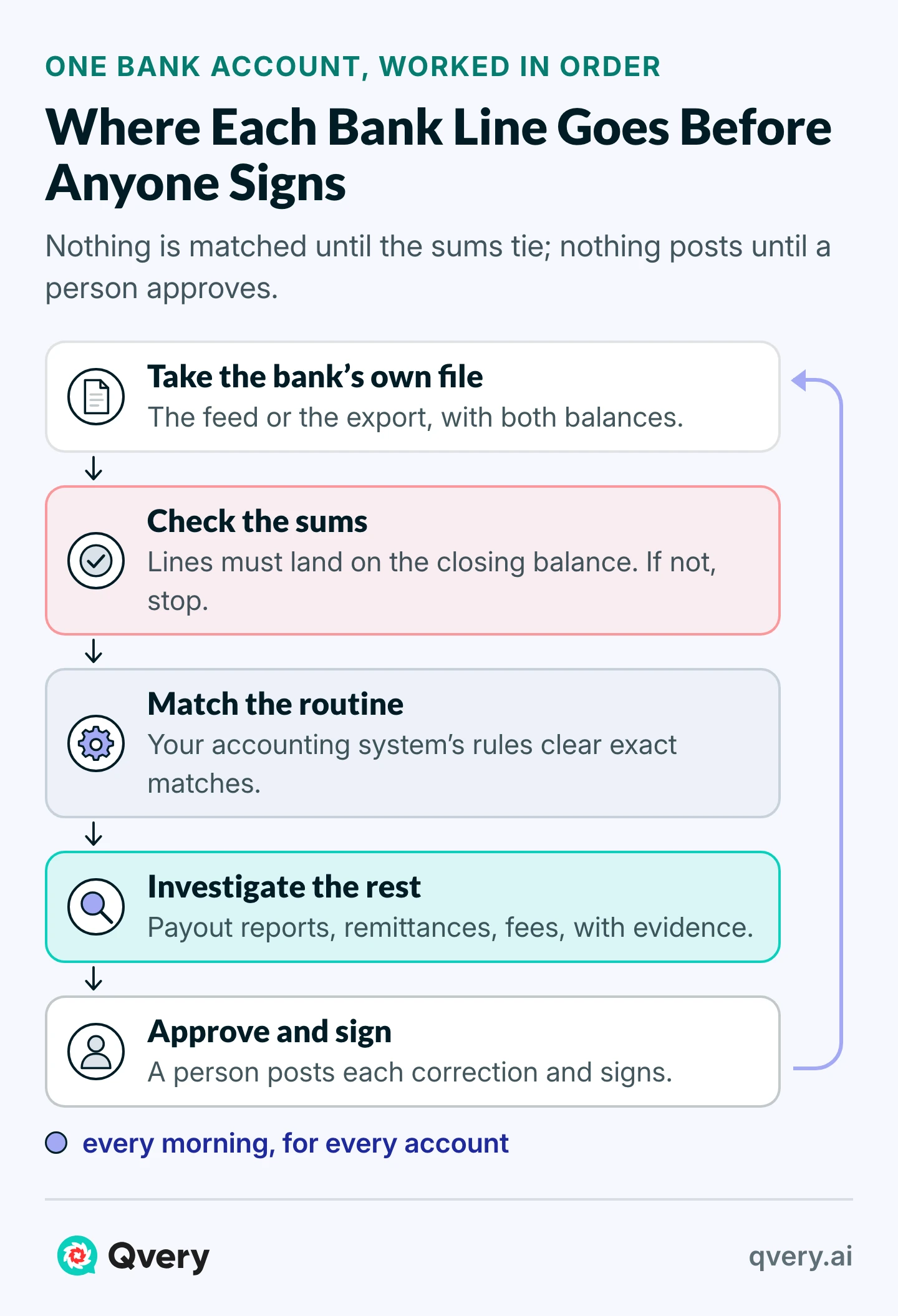
Your accounting system's rules already match the routine: exact amount, date and reference, transfers between your own accounts, the recurring fees. Where the feed is clean and only a handful of items are left each month, stop there, and if a spreadsheet or macro already does your matching, keep it.
The agents we build work what the rules leave behind. Each run starts with the bank's own numbers, and every proposal is checked in code before a person sees it: the opening balance plus every line has to equal the closing balance, and if it doesn't, the run stops and names the account and the day.
| Unmatched item | What the agents read | What they hand a person |
|---|---|---|
| A card-payment payout | The card-payment company's payout report | The sales and fees that add up to the deposit |
| One payment for several invoices, or a short one | The remittance email (the note saying which invoices a payment covers) | The invoices it covers and the difference |
| A bank fee, interest or a charge nobody booked | The statement line | A drafted entry, with the line attached |
| A returned payment | The payment it reverses | The return tied to that payment |
| A deposit or a debit nobody recognizes | Whatever it can check | No guess: the line and what it checked, sent to the person who would know |
What a Person Signs
| The agents may | A person approves |
|---|---|
| Read the bank files and the books | Every correction posted to a cash account |
| Propose matches, each citing a reference, never amount and date alone | Any write-off of a difference |
| Draft the correcting entries with their evidence | Any change to a matching rule, by someone other than the person who signs |
| List each open item with its reason and date | The signature on the reconciliation |
The agents never post to a cash account, never write off a difference, never edit a matching rule. They prepare; people approve, post and sign, and the person who changes the matching rules isn't the one who signs.
A difference is explained and left on the list, never plugged, and never parked without an owner in a suspense account, a holding account for unexplained amounts.
Run daily, the check also catches what a monthly one can't: on a US business account, a bank has two banking days after an automated clearing house (ACH) debit, the electronic transfer used for payroll and supplier payments, settles to return it as unauthorized. A daily run shows that debit to a person the next morning, while there's time to call the bank.
What the agents may read and do is set in a written agreement, your data is processed where that agreement says, and every action the agents take is logged.
We Start With Your Busiest Account
Bring last month's reconciliation and the bank files behind it. First the agents run on last month beside what your team did, on your busiest account; they run within two weeks once access is in place.
Frequently asked questions
Is 99 percent accuracy good enough for a bank reconciliation?
No. A reconciliation either ties to the bank's balance or it doesn't, so one wrong line in a hundred is a difference someone has to find. That's why the agents check the balances by arithmetic before any matching.
Should we rebuild a working Excel reconciliation in AI?
Usually not. A tested spreadsheet or macro returns the same result every month, and a model repeating the matching can't promise that. Point the agents at what the macro can't handle: the unmatched items, the payouts and the short payments.
Who approves corrections in an automated reconciliation?
A person with authority over the cash accounts, never the agents. The agents draft each correcting entry with its evidence. Write-offs, adjustments and anything nobody recognizes need a named approver.
How do the agents handle Stripe, PayPal or Shopify payouts?
A payout lands as one deposit covering many sales, minus fees and refunds. The agents pull the payout report, list the sales and fees that add up to the deposit, and check the sum in code before a person sees the proposal.
What will our auditor want to see?
Who prepared the reconciliation, who reviewed it, what each listed item is, and what changed in the matching rules during the period. The agents' log records what they matched, by which rule, and what they proposed, and the reconciliation stays inside your accounting system.
Should we reconcile daily or monthly?
Daily, once agents do the work. On a US business account a bank has two banking days to return an ACH debit you say you never authorized, so a daily run shows that debit to a person the next morning.
How is our bank data kept safe with the agents?
The agents get read access to the bank files and the books, and nothing that moves money. What they may read and do is set in a written agreement, your data is processed where that agreement says, and every action they take is logged.
How long before the reconciliation agents are running?
With Qvery, the agents reconcile your busiest account on your real data within two weeks once access is in place. The build starts from how your team reconciles now and the accounts that carry the volume.
What happens when the bank's lines don't add up?
The run stops and names the account and the day, before any matching. A line that arrived twice, went missing or changed shows up there, not in a wrong match weeks later.
Do the agents need a new bank feed?
No. They use the bank files your accounting system already receives, or the bank's export file, and never a model's reading of a statement as the source of the lines.
What do we see each week?
The hours saved and the errors avoided: every duplicate day, missing line and unbooked charge the agents caught and a person confirmed before the close, each one logged.
Do the agents replace our accounting system's bank rules?
No. Your rules keep matching the routine lines; the agents start where the rules stop, on the payouts, the short payments and the charges nobody booked.
What if a payout report doesn't add up to the deposit?
The agents don't guess. The payout goes to your finance lead with the gap shown, the report attached and the lines that do add up listed, so the person starts from the difference.
Can we start with one account?
Yes, and we do: the busiest account first, beside your team's own reconciliation, before any other account joins.
Do the agents need our bank passwords?
No. They read the bank files your accounting system already receives and hold no right to move money or post to a cash account.