
On this page
Every import shipment reaches a forwarder's desk as three papers from three senders. The commercial invoice says what was sold and for how much, the packing list says what is in each carton, and the bill of lading is the carrier's receipt for the cargo.
Before your broker writes the customs entry, the declaration that gets the goods released, someone on your desk reads the three together. The counts, weights and names on them have to agree.
Most days they nearly do. The invoice counts what was ordered, the list what was packed, the bill what the carrier was told, and one of them is off by a carton or a few kilos.
When that slips through, U.S. Customs and Border Protection (CBP) finds it at the port. There the entry and the carrier's manifest, its list of what it loaded, must agree before the container may leave.
| When it is found | What fixing it takes | What it costs |
|---|---|---|
| The day the last paper lands | An email to the shipper | Nothing beyond the email |
| After the container cutoff, before sailing | The carrier amends the bill of lading | $25 an amendment at Hapag-Lloyd |
| After the vessel sails | The carrier amends the bill of lading | $130 an amendment at Hapag-Lloyd |
| At the port, the entry and the manifest disagree | No customs release; the container waits | From $165 a day after four free days at Los Angeles, on COSCO's tariff |
| More than 15 days after arrival or release | A replacement entry, the first one cancelled | All of the above, for longer |
Catching it early has its own price, paid on every shipment. Take a forwarder of about 200 people whose import desk compares 700 shipments a month, about 2,100 papers. At 15 minutes a shipment, that is 2,100 hours a year, about $83,000 of a coordinator's time with benefits, spent comparing three documents by eye.
The Three Papers Come From Three Different Places
The commercial invoice is the seller's bill, written by its sales or accounts side from the order. US customs rules require it to describe the goods with the marks and numbers of their packages, give the quantities and each item's price in the currency of the sale, and name the country of origin.
The packing list comes from the shipper's warehouse when the cartons are closed: what is in each package, how many packages there are, what they weigh. The same rule asks for that detail package by package, and the rules list the packing list beside the invoice among the papers behind a release.
The bill of lading comes from the carrier. It is keyed from the shipping instructions the shipper sends, a draft goes back for checking before the bill is issued, and its count is the one CBP sees on the manifest.
| Paper | Who writes it, from what | What it counts |
|---|---|---|
| Commercial invoice | The seller's sales or accounts team, from the order | Units sold, at a price, on trade terms |
| Packing list | The shipper's warehouse, from the cartons it closed | Units and cartons packed, and their weights |
| Bill of lading | The carrier, from the shipper's instructions | Packages and gross weight, as the shipper declared them |
They disagree for ordinary reasons. On a partial shipment the invoice bills the whole order while the list counts what went. A bill may count pallets where the list counts cartons, or round a weight the list gives to the kilo.
The consignee, the company receiving the goods, can be spelled two ways. At some shippers the invoice and the list come out of two systems that never talk to each other, and nothing compares them until the papers reach your desk.
None of those systems are yours: the invoice and the list come out of your customers' suppliers, and the carrier's bill out of what the shipper told it. A better transportation management system (TMS, the freight system your desk runs on) stores what arrived and stops none of it.
What your desk can control is the comparison. These are the fields a set has to agree on before anyone writes the entry.
- The parties: the shipper and the consignee, named the same way on all three
- The pieces and packages: the units, and the cartons or pallets they travel in
- The gross weight, to the same figure on every paper
- The value and the currency, wherever a second paper states them
- The Incoterms, the trade terms that say who pays freight and insurance to where
- The goods, named plainly enough to classify
One difference is not a mismatch at all: on a partial shipment, ordered and shipped quantities should differ.
The Manifest Decides Whether the Container Leaves
At the port the papers stop being yours to fix. Your broker's entry tells CBP how many pieces the shipment holds, and the carrier's manifest says how many it loaded. A terminal may let a container go only when CBP's release covers the full quantity on the bill.
If you consolidate freight, there is one more count to match. Your house bill of lading, the one you issue to your customer, has to agree with the carrier's master bill, and where their piece counts differ CBP withholds the release for the master and cancels one already given.
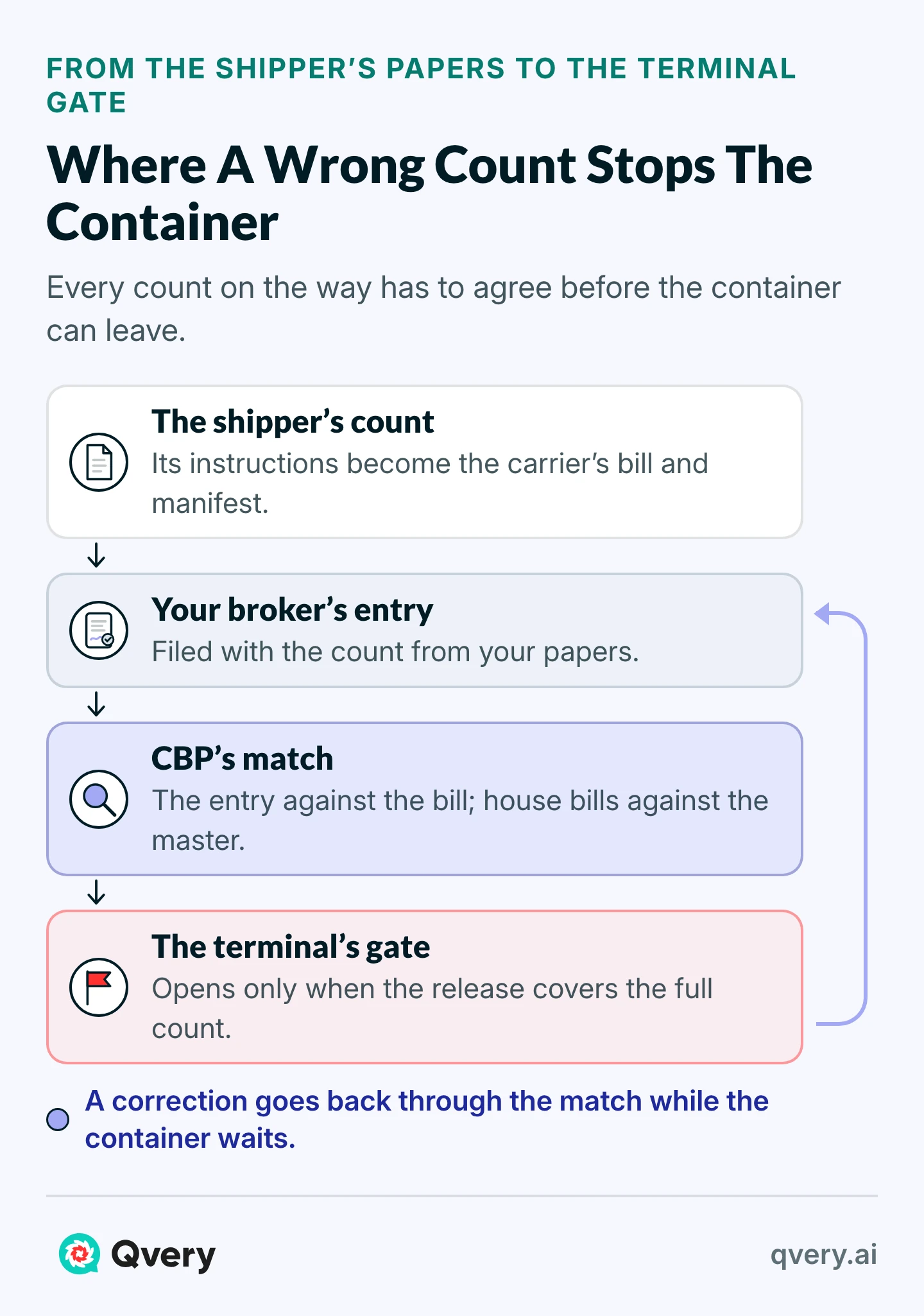
In one broker's case this summer, an entry was released for 1,500 pieces against a master bill manifested for 1,525. The terminal showed no customs release. The fix was refused because the importer's customs bond, which covers the duties it owes, had expired the day before, and the importer, a foreign company, would not put up the $50,000 of collateral a new continuous bond would have needed.
That case is the rare one. The usual fix is an amended entry, while CBP's system still allows one: 15 days from the earlier of arrival or release. After that a replacement entry is filed and the first one cancelled. Either way, the container waits at the terminal until the release covers the full count.
Demurrage is the carrier's charge for a container kept at the terminal past its free days, and carriers bill it to the cargo. At Los Angeles and Long Beach, one carrier's published rates run like this.
COSCO SHIPPING Lines, US import demurrage tariff, effective 14 August 2026
Hapag-Lloyd wrote to its US customers on 10 November that the terminal's storage during a CBP hold is theirs to pay, and that entry delays keeping a container at the terminal carry its demurrage as well.
If CBP also picks the container for an exam, the importer pays the examination station to unload and reload it, plus the moves and the storage. CBP's own guidance says a full unloading can cost several hundred dollars. Those charges reach your customer, and the questions about them reach your desk.
The brokers who avoid it have one habit in common: they check the counts again the moment anything comes back, from the carrier or from CBP's reply to the entry, which brokers call the ABI response.
Tips from Reddit
Customs brokers on catching a count before the terminal does
Continuity between ABI, manifest, and all shipper documents is important. Even if the BL or arrival notice says something different you should always mention it to the shipper.
I've had constant problems over the years with manifest showing something different from all docs. That's when I go back to carrier/shipper.
Yes, I keep pounding this into entry writers to always check ABI responses.
Comparing by Hand Costs a Desk Like This About $83,000 a Year
Back to the example desk: 700 shipments a month at 15 minutes each, our assumption for an ordinary set with three papers opened, the shared fields read across and the line totals added. That is 8,400 shipments and 2,100 hours a year, whether anything on them is wrong or not.
Cargo and freight agents at freight forwarding companies earned a mean $57,570 a year in the government's May 2025 wage count. Benefits were 30% of private employers' compensation costs in June 2026, so with them about $82,240, or $39.54 an hour. The 2,100 hours cost $83,034 a year, about $9.89 a shipment.
With our agents comparing each set, your coordinator spends about six minutes a shipment, our assumption again: reading the side-by-side, opening the pages the agents flag, editing and sending the note where there is a gap.
Running the agents costs about $445 a month at that volume, an estimate: some 35 cents a shipment of model usage plus $200 for hosting, the log of every check and upkeep of your rules.
Put your own desk's numbers in.
Shipment Paper Check ROI Calculator
What Comparing Each Shipment's Papers Costs You, And With The Agents
Saved Per Year
$44,480
1,260 hours handed back, after $5,340 a year to run it
- Hours Handed Back
- 1,260 hours a year
- Agent Running Cost (Estimate)
- $445 a month
- Payback Per $10,000 Of Build
- 2.7 months
On these numbers, each shipment costs $4.59 instead of $9.89, the agent saves $44,480 a year after its own running cost, and every $10,000 of the build is earned back in 2.7 months.
On the example, the year falls from $83,034 to $38,554, the agents' running cost included: about $44,480 saved and 1,260 hours handed back, close to $4.59 a shipment instead of $9.89. Each $10,000 of the build comes back in about 2.7 months of that saving.
The 1,260 hours are more than half of one coordinator's year: the time a growing desk would otherwise hire for when its volume rises.
For a desk handling a few shipments a week the case is weak. A careful coordinator already reads every set, and the agents' running cost would eat most of the saving.
 Vlad ShvetsPartner @ Qvery
Nobody on your desk is being careless. Three different people write the invoice, the packing list and the bill of lading, and none of them sees the others' paper, so the gaps arrive with the shipment. The part your desk controls is the timing. Found the day the last paper lands, a gap is one email to the shipper; found at the terminal, it is storage by the day.
Qvery's Agents Compare Each Shipment the Day Its Papers Arrive
The papers keep arriving the way they do today, into your shared inbox or a shipment folder, from shippers, carriers and overseas agents, often at different times and the bill of lading as a draft first.
Our agents file each one to its shipment by the reference number on it. Once all three are in, they compare them, whether they came as PDFs, scans or phone photos.
They read every field the three papers share: shipper and consignee, pieces and packages, gross and net weights, value and currency, the trade terms and the goods description, by the rules your customs lead sets for each field. The invoice total is checked against its own lines. Ordered and shipped quantities are kept apart, so a partial shipment isn't flagged.
What comes back is a side-by-side: each field that disagrees, what each paper says and the page it's on. A description too vague to identify the product is named, because customs may ask the shipper anyway, and a page the agents can't read is listed with what to send instead of it.
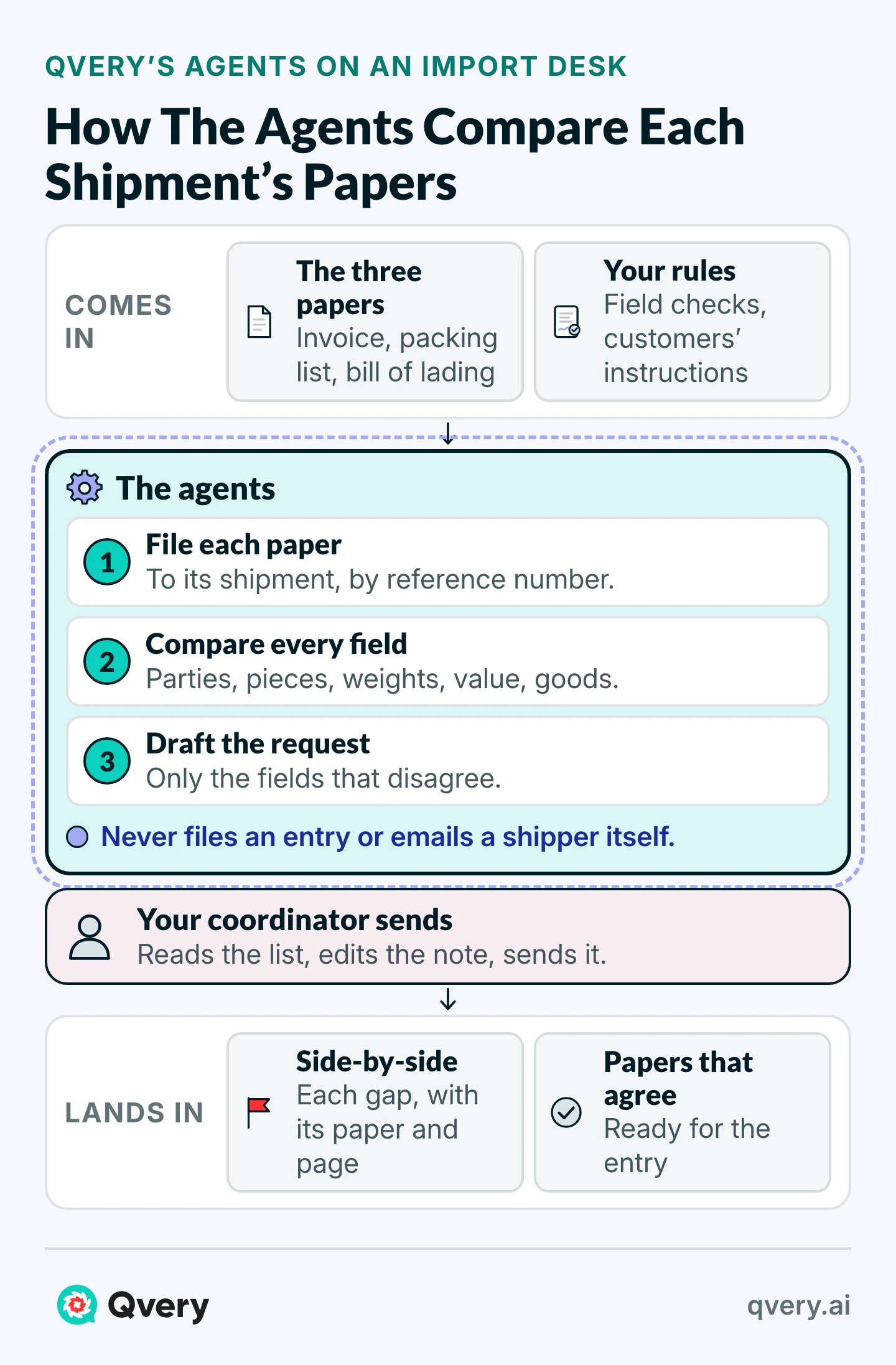
With the list comes the email to the shipper, already drafted, asking only for the corrections the set needs. Your coordinator reads it, changes what they want and sends it. When the corrected papers come back to the same folder, the agents compare the new set before anyone writes the entry from it.
The quickest test is a shipment your desk already had to fix once: send its three papers and see what the comparison would have caught on day one.
Your licensed broker keeps classification, value and duty. The agents never file or change an entry, never fill in a number they cannot read, and never send a shipper anything a person hasn't read. Checked figures go into your forwarding system only after the coordinator marks the set ready.
Trade papers carry your customers' prices, buyers and suppliers, so the places the agents may open are set down in writing with you before they start: the shared inbox, the shipment folders and the shipment records in your forwarding system.
The papers stay in the folders where they land, every comparison is logged, and the email to a shipper quotes only the fields in question.
 Piotr BabelPartner @ Qvery
Some gaps aren't between the papers at all. The invoice and the packing list agree, and both spell the consignee differently from the name your customer told you to use. So we write each customer's standing instructions into the rules once, and the agents show a breach of them apart from a mismatch. A field a paper never carries is marked not expected, never missing.
That is the job we take off your desk: the comparing, the drafted requests and the rules behind them, while your coordinators keep the shippers and your broker keeps the entries.
We Start From the Shipments Your Desk Had to Fix
The sets that went wrong teach the agents most. So working with us begins with twenty past shipments, the ones corrected after filing among them, your check procedure and the coordinator who owns it, your regular shippers' standing instructions, and read access to the inbox, the folders and the forwarding system.
In the first days we turn your procedure and those instructions into the agents' rules and settle with your broker what they leave alone. Within two weeks of access the agents are comparing the sets already in your inbox, and your coordinators read each result beside their own notes on the same shipments.
Once your coordinators trust the lists, every new set runs through the agents before an entry is written. Each week we count with you the shipments compared, the gaps caught before filing and the days any container waited on a correction, and the rules change where the count says they should.
Frequently asked questions
Is a packing list the same as a commercial invoice?
No. The commercial invoice is the seller's bill: what was sold, at what price, in what currency and on what trade terms. The packing list says what is physically in each package, how many packages there are and what they weigh. Customs reads the two together, so the fields they share have to agree.
Which fields must match between the commercial invoice and the packing list?
Everything they both describe: the shipper and consignee names and addresses, the goods description, the quantity of units, the number of packages, and the weights. The bill of lading has to agree with both on the packages and the gross weight.
What happens if the invoice and packing list don't match?
Caught before the bill of lading is issued, the shipper corrects a paper and nothing else happens. Caught at the port, the entry may not match the carrier's manifest, the container is not released until the counts agree, and demurrage and storage run until the entry or the bill is corrected.
What is a CIPL?
A combined commercial invoice and packing list: one form carrying each package's contents, weights and values together. It ends the disagreement between those two papers, but the carrier still writes the bill of lading on its own, so the comparison against the bill remains.
Can a terminal release a container with a piece count discrepancy?
Not until CBP's release covers the full quantity on the bill. Within 15 days of arrival or release the entry can be amended; after that a replacement entry is filed and the first one cancelled. One broker had CBP release a stuck container by hand after a resubmission, days later.
Does a mismatch mean CBP will examine the container?
Not by itself. CBP picks containers for exams for its own reasons, and a count that disagrees with the manifest holds the release whether or not there is an exam. If there is one, the importer pays the examination station, the moves and the storage, while the carrier's demurrage keeps running.
What does a held container cost a day?
It depends on the carrier and the port. On COSCO's published tariff at Los Angeles and Long Beach, a dry container gets four working days free, then $165 a day for days 5 to 9, $220 for days 10 to 13 and $375 from day 14. Terminal storage can come on top.
Can the agents read scanned or photographed papers?
Yes. They compare papers whether they arrive as PDFs, scans or phone photos. A page they cannot read is listed with what to ask for instead, so a coordinator requests a clean copy rather than finding the gap after filing.
How much does it cost to amend a bill of lading?
It depends on the carrier and the timing. Hapag-Lloyd publishes no charge before the container cutoff, $25 an amendment from the cutoff to sailing and $130 after the vessel leaves. One company paid $75 to fix a carton count with another carrier after sailing.
Is a wrong commercial invoice a customs penalty risk?
It can be, when it is wrong on something that matters, such as value. For a negligent error the federal maximum is two times the duties lost, or 20% of the dutiable value where none was lost. Telling CBP before it investigates, and paying what is owed, cuts a negligence penalty to interest on those duties.
Do the agents work for exports as well as imports?
Yes. Export shipments go through the same comparison of the three papers. On exports the useful moment is earlier still: the shipper's instructions against the draft bill of lading, before the container cutoff, when one carrier charges nothing to amend the bill.
Can the agents check house and master bills of lading?
Yes, in your build. A house bill should agree with the master on containers, pieces and weight, and with the invoice on parties and goods. Each pair runs as its own check, so a difference names both papers and their pages, and each house under a master is matched to it separately.
What if the shipper won't send corrected papers?
The agents don't chase on their own. The drafted email asks for exactly the fields in question, your coordinator sends it, and the set waits on a weekly list of shipments held for papers. What to do about a shipper who refuses stays a decision for your team and your broker.
Will the agents work with the forwarding system we already use?
They start from your shared inbox and shipment folders, so shippers and carriers change nothing. Where your forwarding system takes input, the checked figures go into the shipment after a coordinator marks the set ready; where it doesn't, the findings sit as a page beside the documents.
