
On this page
- The Hours and the Risk Sit in Different Emails
- Let the Action Set the Limit
- The Agents File Documents and Chase Paperwork on Their Own
- Anything That Commits You to a Carrier or Customer Starts as a Draft
- A Rate Request Splits at the Price
- Payments, Release and Customs Stay With a Person
- What Our Agents Do With the Shared Inbox
- What the First Two Weeks Look Like
- Frequently asked questions
A forwarder's shared operations mailbox is where every shipment's paperwork and questions arrive: shipping instructions, commercial invoices and packing lists, booking confirmations and their changes, rate requests, arrival notices, rolled cargo (cargo a carrier leaves off the sailing it was booked on), and the same customer asking twice where the container is.
A coordinator reads each message, finds its shipment, types what it says into the forwarding system, the forwarder's own system of shipment files, and moves on. That is hours of every coordinator's day, and the misses cost money: shipping instructions nobody chased, a container left off its sailing, a shipment never invoiced, new bank details someone acted on.
On a desk of 15 coordinators who each spend two hours a day on it, that reading and keying costs about $269,940 a year.
The inbox splits in three. The agents do the reading, filing and chasing on their own, with a coordinator approving each reminder at first. They draft anything that commits you to a carrier or a customer, for a coordinator to send. And anything that changes who gets paid, who collects the cargo or what customs is told, they flag and leave for the person who owns it.
The Hours and the Risk Sit in Different Emails
Say you run 15 coordinators on one shared mailbox at a forwarder of about 250 people, and each spends two hours a day reading mail and keying what it says into the shipment file. Both numbers are our example; put in your own.
Fifteen people, two hours, 230 working days is 6,900 hours a year, about 22% of their working time; the calculator takes the share as 22%, so it counts 6,864 hours. Cargo and freight agents earned a mean $57,230 in May 2025, the Bureau of Labor Statistics reports, and benefits are 30% of what private employers spend, so a coordinator costs about $81,800.
If the agents take half of those hours, the reading and the filing, they hand back 3,432 hours to the same coordinators: the inbox work falls from $269,940 to $146,970 a year with the agents' running cost, $122,970 less, and $10,000 of build is repaid in about a month. Put your own desk in; the calculator opens on this example.
Shared Inbox Filing ROI Calculator
What Reading And Filing The Shared Operations Mailbox Costs You, And What An Agent Saves
Saved Per Year
$122,970
3,432 hours handed back, after $12,000 a year to run it
- Hours Handed Back
- 3,432 hours a year
- Agent Running Cost (Estimate)
- $1,000 a month
- Payback Per $10,000 Of Build
- 1 month
On these numbers, the agent saves $122,970 a year after its own running cost, and every $10,000 of the build is earned back in 1 month.
That is capacity, not savings. Those hours go to the exceptions and the customers who need a person, and the case assumes nobody leaves. Checking drafts and the unmatched list, the messages the agents couldn't tie to one shipment, come off it, and half is our assumption.
 Vlad ShvetsPartner @ Qvery
The 3,432 hours in this example are capacity, and I would only buy them as capacity: the case assumes nobody leaves, and some of the time goes back into checking drafts and the unmatched list. What makes them worth having is where they go, to the rolled cargo, the exceptions and the customers who need a coordinator on the phone. Decide that before the agents run, so the hours land on that work instead of thinning out.
Running the agents, about $1,000 a month, is an estimate: a fraction of a cent to a few cents of AI model use a message, plus hosting and upkeep.
Let the Action Set the Limit
The AI's confidence decides only when the agents ask, never what they are allowed to do. The emails that cost most to get wrong are often the clearest.
A cleanly written cancellation reads with high confidence, and so does a polite note from a customer's accounts team with new bank details. A high score says the system is sure what the email asks for, not what acting on it would cost if the email is wrong.
So set the limit by the action.
The answers give three levels. Work that changes only your own records the agents do on their own; a reminder or question that commits you to nothing goes out once a coordinator has approved it, until you decide in writing that it may go alone. Work that commits you to a carrier or a customer is drafted for a coordinator to send.
Work that changes who gets paid, who collects the cargo, or what customs is told waits for a named person. Inside a level, the agents' confidence decides when they stop and ask. It never moves a job up a level.
Each job type, what the agents do with it, and who signs off before anything leaves:
| Job type | What the agents do | Who signs off | Cost of a wrong action |
|---|---|---|---|
| Shipping documents | File to the shipment, extract the fields, flag gaps | A person samples the filings and reads the unmatched list daily | A misfiled document |
| Carrier booking confirmations | Compare with the booking, update the record, flag differences | The coordinator checks each flag | A wrong date in the record |
| Reminders for missing documents | Send the reminder | At first a coordinator approves each one; you decide later which go alone | One unnecessary email |
| Customer status questions | Draft the answer from the record | The coordinator | A pickup planned on a wrong date |
| Booking changes and cancellations | Draft the request to the carrier | The coordinator | Carrier fees, and cargo that misses its sailing |
| Rate requests | Ask for what is missing; on contracted-rate lanes, compute the quote | A person sets or checks the price | A price you cannot book |
| Bank detail, release and delivery changes | Flag and stop | A named person, after a call to a number on file | Payment or cargo handed to a stranger |
| Customs filings | Assemble the data, flag what is missing | The person responsible | Penalties |
The Agents File Documents and Chase Paperwork on Their Own
Every message starts the same way: someone works out which shipment it belongs to. That is the work to hand over first.
Take one message, a shipper's packing list. The agents read its references (booking number, bill of lading number (the carrier's receipt for the cargo), container number, your file number) and look for the shipment in your forwarding system.
With exactly one match, they check that the document's other references agree and that it doesn't replace a newer version, then file it, extract the fields and write a one-line note in the shipment log.
With two matches, none, or a conflict, the message goes to the unmatched list. They never guess, because amended bookings and split shipments are where references stop lining up.
 Piotr BabelPartner @ Qvery
Matching a message to its shipment is most of the job, and where it fails is predictable: amended bookings and split shipments, where one reference points at two files. So the agents file only on exactly one match with every other reference agreeing, and everything else lands on the unmatched list a person reads each morning. If that list keeps growing, fix the references in your forwarding system before giving the agents more work.
On a carrier's booking confirmation they do one more thing: they compare the vessel, sailing, cut-offs and equipment with what was booked, and flag any difference to the coordinator who owns the shipment.
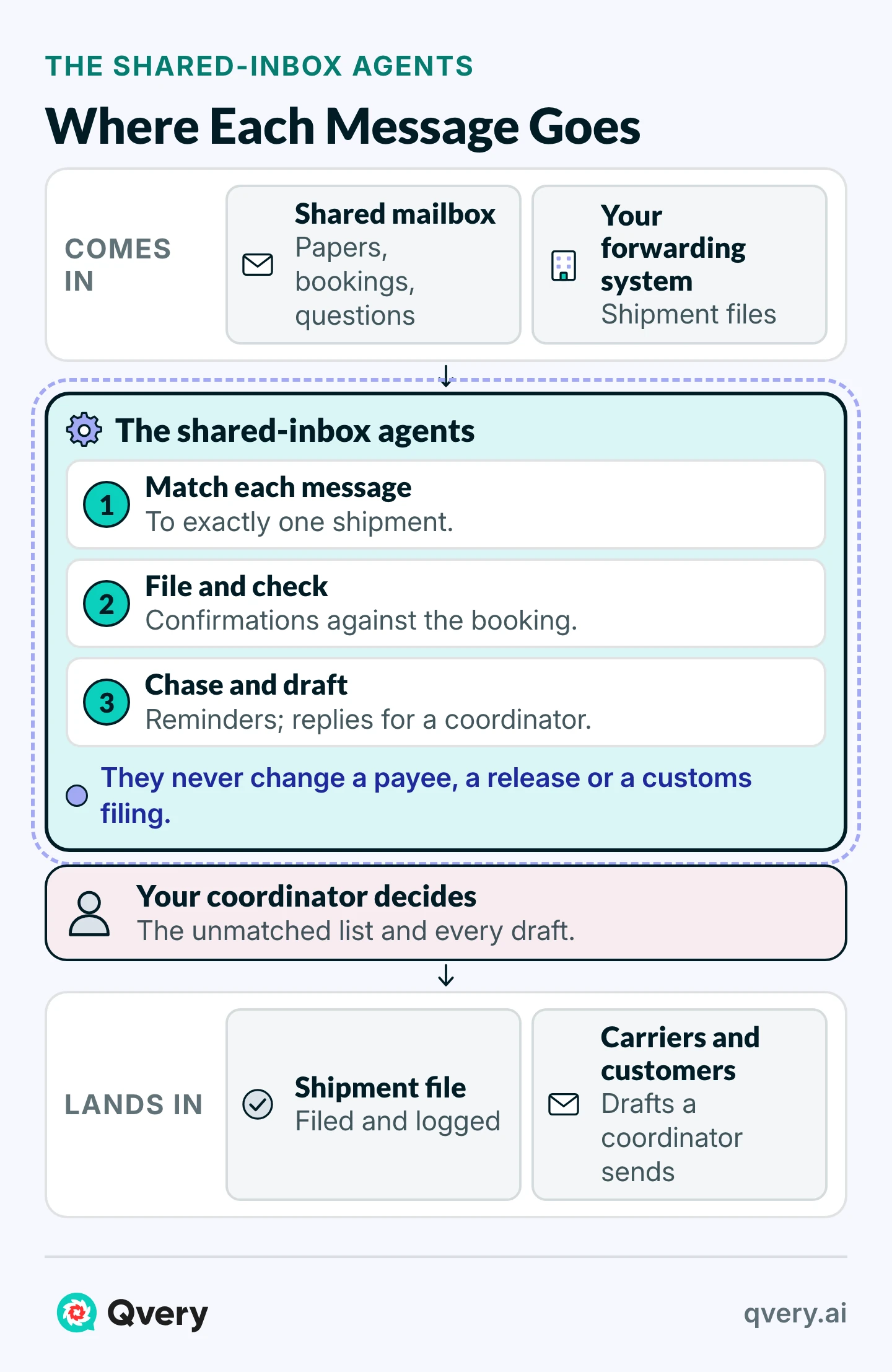
They also chase. They know which documents each shipment still needs before its cut-off and remind the shipper when one is missing. Three checks bound the reminder: it goes only to the contact already on the shipment, only for a document the record shows missing, and it names nothing beyond the shipment reference.
At first a coordinator approves every reminder; which kinds go alone later is your decision. A person reads the unmatched list every morning, and a sample of what the agents filed.
Anything That Commits You to a Carrier or Customer Starts as a Draft
Booking changes, cancellations, shipping instruction changes, status answers, and exception notices all commit you to something a carrier or a customer will act on. Getting one wrong costs carrier fees and more: the container that misses its sailing, and the customer who planned their week around it.
For a change request, the agents read the customer's email, find the booking, write the amendment or cancellation to the carrier, and stop. They quote the customer's own words beside the change, so a coordinator can check a request to cancel the second container against the draft in seconds and press send.
Status answers follow the same path: the agents draft them from the shipment record, and the coordinator sends. An arrival date that is a day wrong sends a customer's truck on the wrong day. Carrier exception notices get one change: the agents tell the shipment owner the moment rolled cargo or an equipment shortage lands, and draft the customer notice for them to send.
A Rate Request Splits at the Price
Quote automation is usually sold as one block, but a rate request holds two jobs. The first is reading the request: lane, cargo, weight and volume, dates, the agreed delivery terms, and what is missing. The agents do that and draft the questions back to the customer.
A stale rate is worse than no rate, because it quotes something you cannot book.
The second is the price, and it stays with a person. Spot rates, the one-off prices for a single shipment, move week to week, and the margin on top is a decision about your customer, which stays with whoever owns the account.
On lanes you price from contracted rates, the agents compute the quote from your rate sheet and show the lines they used. A person checks those lines and sends it; spot and new lanes stay with a person.
Rate requests waiting in the inbox are one of three freight jobs our logistics playbook prices, along with status requests chased by phone and carrier bills checked by hand.
Payments, Release and Customs Stay With a Person
Payment fraud arrives through the same inbox as everything else. The control is old: before anyone changes a payee, a bank account, a release or a delivery address, a person calls back on a number already on file.
What changes with AI agents is the reader: no person is there to notice an odd tone, and the agents read text that strangers wrote, including instructions planted in it. So they get no permission to change payee data or release instructions at all. They flag those emails and stop.
Customs work splits the same way. The agents assemble the data for a filing from the commercial invoice and the packing list and flag what is missing; the person responsible files. Sanctions screening hits go to whoever owns compliance.
You can run that check on one of your own shipments: drop in its commercial invoice, packing list and bill of lading, and see where the three disagree.
What Our Agents Do With the Shared Inbox
We build the agents for a single forwarder, around its own mail: its references, its carriers, its customers' habits. On autopilot, inside the shared mailbox and the forwarding system your desk works in, they file, check and chase, while every send stays with your coordinators until you decide in writing which kinds go alone.
Every message, filing and draft stays on record against its shipment, so a wrong filing can be found and undone.
We train the coordinators who read the unmatched list and send the drafts. Each week's count shows the hours they got back from reading and keying, and the errors held before they left the building: misfiled documents, confirmations that did not match the booking, bank-change emails held for a callback.
What the First Two Weeks Look Like
A week of your operations mail is the first thing we ask to see, and we sort it with your coordinators job type by job type, until every job has its level and the name of the person who signs.
In the first week the agents only write what they'd do beside what your team did; then filing goes live one job type at a time, every filing checked, and by the end of the second week the first version is working on your own mail.
Frequently asked questions
What can freight forwarders automate in the shared inbox with AI?
Reading, filing and chasing. AI agents match each message to its shipment, file documents, extract the fields and remind shippers about missing paperwork. Booking changes and customer answers start as drafts a coordinator sends.
What does keying the shared inbox cost a forwarder?
In this post's example, 15 coordinators each spend two hours a day reading mail and keying it into shipment files: 6,900 hours a year, about 22% of their time, and about $269,940 a year.
How much can AI agents save a freight forwarder's operations desk?
If the agents take half of those hours, the reading and the filing, they hand back 3,432 hours, and the inbox work falls from $269,940 to $146,970 a year with their running cost: $122,970 less.
How much AI model use does one email take?
A fraction of a cent to a few cents, in this post's estimate. With hosting and upkeep, a desk of 15 coordinators runs the agents for about $1,000 a month.
How do AI agents match an email to the right shipment?
They read its references: booking number, bill of lading number, container number and your file number. With exactly one match and no conflict they file it; with two matches, none or a conflict, it goes to the unmatched list.
Why shouldn't AI confidence decide what an agent can do?
Because the emails that cost most to get wrong are often the clearest. A cleanly written cancellation, or a polite note with new bank details, reads with high confidence. Confidence says what the email asks, not what acting on it costs.
How do you decide what an AI agent may do on its own?
By the action. Ask whether it leaves the building, to a carrier, a customer, customs or a bank, and whether a mistake can be taken back before it costs money. Work that changes only your own records the agents do alone.
What do agents check on a carrier's booking confirmation?
They compare the vessel, sailing, cut-offs and equipment with what was booked, and flag any difference to the coordinator who owns the shipment.
Can AI agents send document reminders to shippers?
Yes, within limits: only to the contact already on the shipment, only for a document the shipment still needs before its cut-off. At first a coordinator approves every reminder; which kinds go alone later is your decision.
How do AI agents handle a booking change or cancellation?
As a draft. The agents read the customer's email, find the booking, write the amendment or cancellation to the carrier, and stop, with the customer's own words beside the change so a coordinator can check it before sending.
Can AI agents quote freight rates?
They complete the request, reading lane, cargo, weight, volume, dates and terms. On contracted lanes they compute the quote from your rate sheet and show the lines used; spot rates, new lanes and the margin stay with a person.
How do forwarders stop payment fraud when AI reads the inbox?
With the old control: before anyone changes a payee, bank account, release or delivery address, a person calls back on a number already on file. The agents get no permission to change payee data or release instructions.
Who processes our customers' documents?
Qvery AI OÜ, an EU company, under a data processing agreement. The agents read the shared mailbox and the forwarding system, and they hold no permission to change payee data or release instructions.
Can AI agents file customs entries?
No. They assemble the data for a filing from the commercial invoice and packing list and flag what is missing; the person responsible files. Sanctions screening hits go to whoever owns compliance.
Are the hours AI agents save a cost cut?
They are capacity, not savings. The hours go to the exceptions and the customers who need a person, and the case assumes nobody leaves. Checking drafts and the unmatched list takes some of them back.
Which job type should go live first?
Filing shipping documents, because a misfiled document is the cheapest mistake in the inbox and the easiest to undo. The agents first write what they would do beside what your team did, then filing goes live one job type at a time.
Who reads what the agents could not match?
A person, every morning. The unmatched list holds the messages the agents couldn't tie to one shipment, since amended bookings and split shipments are where references stop lining up, and someone also samples what the agents filed.
Can AI agents answer customer status questions?
They draft the answer from the shipment record, and the coordinator sends it. An arrival date that is a day wrong sends a customer's truck on the wrong day, so status answers stay drafts.
Why is a stale freight rate dangerous?
Because it quotes something you cannot book. Spot rates move week to week, so the agents compute quotes only on lanes you price from contracted rates, and a person checks the lines before sending.