On this page
- A Title Search Is Three Jobs, and AI Is Ready for Two of Them
- Price It in Examiner Hours: Title Production Is 3.3 of a File's 22
- AI Reading Public Records Alone Missed Something in Four Files of Ten
- The Examiner Signs Anything That Changes What the Commitment Says
- Have an AI Agent Build the Examiner's File on Every Order
- Run Your First 40 Files Beside Your Examiners
- Frequently asked questions
Every order a title company opens needs a search. Someone pulls the deeds, mortgages, liens, judgments and tax records against the property and the people who own it, and an examiner reads the pile and decides what the commitment will require and what it will except.
Vendors now sell AI for that search, and some market it as title examination.
I set DataTrace's test of AI-only searches beside ALTA's count of where a title file's hours go.
AI can do the finding and the preparing, and it should. It cannot be trusted with the deciding, and the time it saves is a slice of each file, so the case for it is examiner capacity and turn time.
The evidence is residential files in four states, tested by a company that sells title plant data, so read the numbers as direction for residential work.
A Title Search Is Three Jobs, and AI Is Ready for Two of Them
Each of the three takes a different person and carries a different risk.
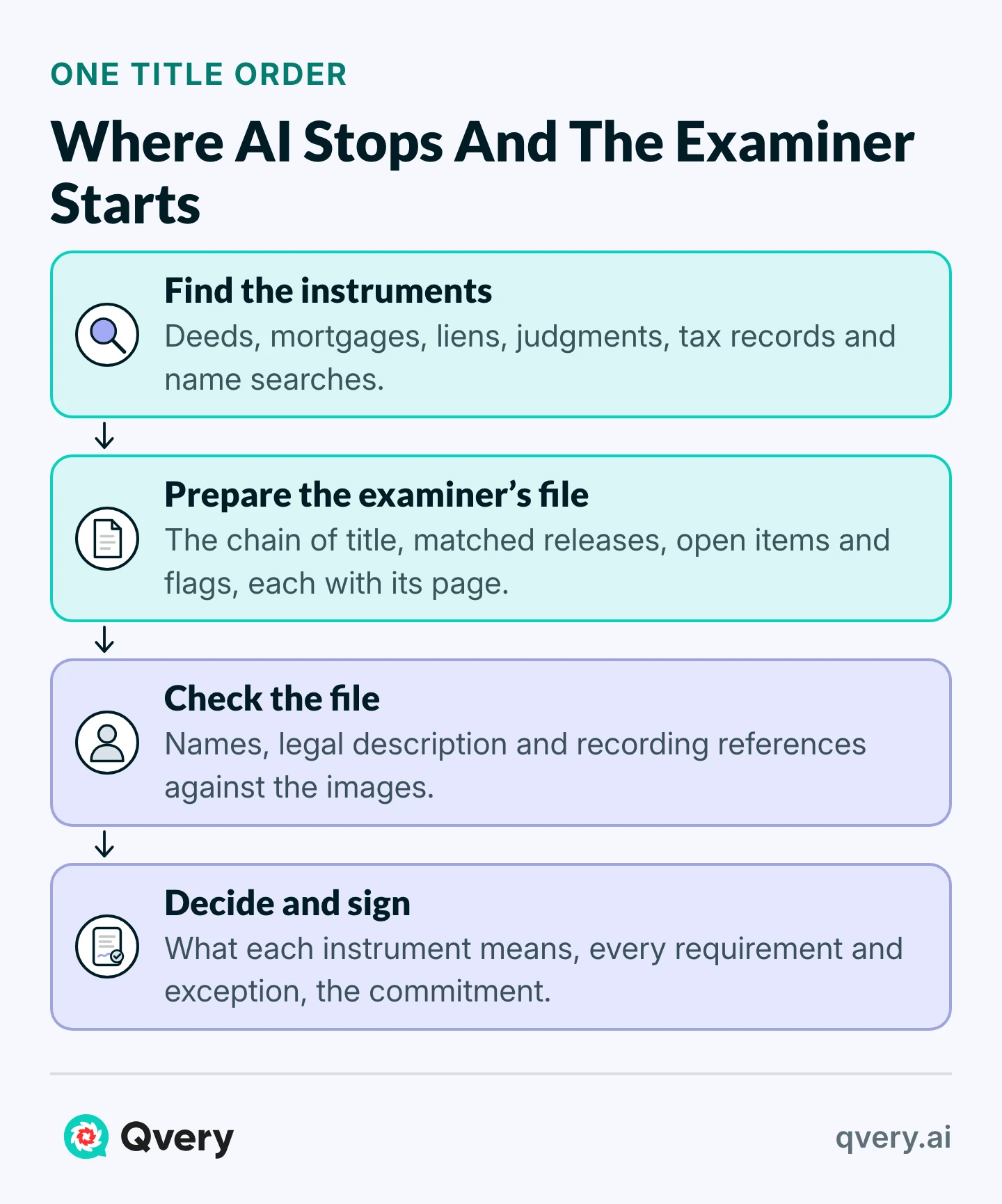
Finding is pulling every recorded instrument, tax record, court filing and name search that touches the parcel and its owners.
Nearly every respondent to ALTA's 2026 survey goes to both the recorder and the taxing authority, and name searches come up in 88.1% of searches. In that survey, 61% of purchase transactions needed 11 to 50 documents reviewed, and 21% more than 50.1
Preparing is sorting that pile into a chain of title, matching each mortgage to its assignment and release, pulling out the names, dates, recording references and legal descriptions, and listing what is still open.
Deciding is what each instrument means, whether a defect is cured, what goes on the commitment as a requirement or an exception, and whether the file can be insured, with the underwriter's approval where the file needs it.
Vendors sell the first two as the search. The third is the examiner's professional judgment, and it is the one that carries the risk.
First American, an underwriter building AI for this work, puts it in the same place. Its tool analyzes search packages, extracts and organizes the key information with references to specific sections, and reviews for breaks in the chain of title, missing information and data discrepancies.
Its own release says "final title determinations remain with the title professional".2
This is the kind of job we build AI agents for at Qvery: one package of documents, a fixed set of checks, and a person who signs.
Price It in Examiner Hours: Title Production Is 3.3 of a File's 22
ALTA counted the work behind a residential file in a survey with 674 responses from across the title industry, about their 2023 files.3
A standard file took 22 hours of work across ten tasks, from opening the order to issuing the final policy. A difficult file, one with heavy curative work, took 45.4 hours, and companies estimated that 36% of their files were difficult.
Title production, which ALTA defines as collecting the documents, researching, examining and issuing the commitment, took 3.3 hours of a standard file and 7.3 of a difficult one.3 The search, examination included, is about a sixth of the work on a file.
Put that on your own volume. Say you close 1,000 files a month (assumed) with ALTA's mix of difficult ones:
| Files | A month | Hours each | Hours a month |
|---|---|---|---|
| Standard | 640 | 3.3 | 2,112 |
| Difficult | 360 | 7.3 | 2,628 |
| Title production | 1,000 | 4,740 |
That is about 27 full-time people's month on title production, out of roughly 30,400 hours on those files in total.
First American reported its AI cutting processing time by "as much as 30 minutes per file, depending on complexity, in early usage".2 Take that ceiling on every file, as a ceiling and not a forecast, and the AI gives back 500 hours.
Take off 5 minutes a file for the examiner to read the flags (assumed), and about 417 hours a month come back: 2.4 people's month, 8.8% of title production. At an assumed $45 an examiner hour, that is about $18,750 a month, before the tool's own cost.
Read that as capacity. It gets commitments out sooner, absorbs a volume spike without overtime, and moves examiner hours onto the difficult files.
If your plan needs fewer examiners to pay back, it is the wrong plan: the examiner still signs every file, and the saving is under a tenth of the hours they spend producing title.
If your examiners spend the first part of every file sorting the package before they read it, that preparing is the job to hand over first.
AI Reading Public Records Alone Missed Something in Four Files of Ten
DataTrace, which sells title plant data and title automation, ran AI searches on public records alone across more than 200 residential files in Arizona, California, Florida and Texas. It set each one beside a search backed by its own title plant, an index of the recorded documents that affect each property.
Of the 184 files it could fully evaluate, 75 had at least one missed title matter: 40.8%.4 The company's release adds that the AI could not search 16 of the 200 files at all, because they lacked the title plant data or comparable normalized datasets the search needed.5
DataTrace reports the misses were not randomly distributed. Involuntary liens carried about 79.6% of the weighted risk by DataTrace's own weighting, and the rest fell in mortgages and other encumbrances, deeds, vesting, and the documents that hang off a mortgage.4
An underwriting review DataTrace ran on 50 of the properties estimated $6.1 million of maximum potential liability and $1.86 million of probable liability, figures the company says are not predicted losses.6
Read the test for what it measured. The answer key was DataTrace's own plant-backed search, so it shows the gap between two searches, not an absolute error rate, and it comes from the company that sells the side that won.
The gap still teaches the main lesson: the misses come from what the AI read.
DataTrace's chief data officer puts it in one line: public records "vary significantly by county, format, and historical practice".4 A judgment recorded under a slightly different name, or in an index the AI never opened, is not found however well the AI reads.
So ask of any AI search, first, what it searches. Point it at the same plant or search-vendor pull your examiners already trust, never at the county website alone where a plant is your standard.
The Examiner Signs Anything That Changes What the Commitment Says
Write the line into your procedure in one sentence.
AI may find, sort, extract, link and flag. An examiner decides what any instrument means, whether a defect is cured, and every requirement and exception on the commitment.
Here is that rule applied to each step of a file:
| Step | What AI may do | What the examiner decides |
|---|---|---|
| Pull the instruments | Run the searches on your usual sources | Which extra sources an unusual file needs |
| Sort and extract | Classify each instrument; read names, dates, recording references, legal descriptions | Checks names, legal description and references against the images, flagged or not |
| Build the chain | Order the deeds and link each to its image | What any gap means |
| Match mortgages and releases | Link each release it finds to its mortgage | What an unreleased mortgage means |
| Flag | List open items and doubts, each with its page | Which flags clear and which stay |
| Draft the commitment | Draft standard requirements from the open items | Every requirement and exception |
| Issue | Nothing | Signs |
Some things the AI must flag and never resolve, because they are where prepared searches go wrong:
- A name that is close to an owner's but not certain, including spellings and a junior with the same name.
- A legal description that differs from the prior deed after a split or a lot-line adjustment.
- Any conveyance through probate, heirship, divorce or a trust.
- A mortgage with a payoff but no recorded release, which a person can chase by phone and an AI can only report as open.
- A gap in the chain, two instruments that disagree, and any field it read with low confidence.
What the evidence cannot settle is whether a well-built AI could make some of these decisions alone.
Both companies whose evidence this piece uses sell AI into title work, and both keep the decision with a person: DataTrace in its study's release,5 First American in its own.2 I would keep the line where it is until your own trial and your underwriter say otherwise.
Have an AI Agent Build the Examiner's File on Every Order
Here is that AI agent, specified closely enough to brief whoever builds it:
Start with one county or one file type where your search sources are already digital.
You can try the preparing on one file today, before anything is built.
A chat assistant such as Claude or ChatGPT, on the business plan your company has approved for client data, can read a search package as PDFs and build the worksheet an examiner would start from. This prompt asks for that worksheet and forbids the decision:
You are preparing a title search package for an examiner. Do not decide whether title is insurable.
Read every attached document, then produce:
0. The search period and effective date the package covers, and any search or document type you would expect that is not attached. If anything is missing, write INCOMPLETE at the top.
1. A chain of title table, oldest first: instrument type, grantor, grantee, date signed, date recorded, book and page or instrument number, and the attachment and page where it appears.
2. Every mortgage or deed of trust, with the assignment and release you matched to it, giving the recording reference and page of both sides. If you found no release, write OPEN. If either image is missing, write UNVERIFIED.
3. Every lien, judgment, lis pendens and tax item, with the name it is recorded under and whether that name matches an owner exactly, closely, or not at all.
4. Flags, each with its page: any gap in the chain, any legal description that differs from the prior deed, any probate, divorce, trust or estate conveyance, any two instruments that conflict, and any field you could not read clearly.
Quote names and legal descriptions exactly as written. If you are not sure, say so instead of guessing.
You get a chain table with page references and a list of flags. Before you trust any of it, check three things against the images: that each page reference opens the right instrument, the names on every lien, and every mortgage marked released.
Then the examiner examines the file as usual, starting from the worksheet instead of the raw package.
Run Your First 40 Files Beside Your Examiners
For one month, let the AI agent prepare every file in a sample while your examiners work exactly as they do now, and compare. Pick about 40 files across the counties and file types you close most, purchases and refinances, standard and difficult.
Counties where you have no plant or normalized data stay on your current process.
Count four things on every file:
Log every miss
Anything the examiner found that the worksheet did not show.
Count the flags
How many the AI raised, and how many the examiner kept.
Time the examiner
Minutes per file, against the same kind of file last month.
Check the references
Page links that opened the wrong instrument.
Forty files will show whether the prepared file saves your examiners time and where it breaks. They cannot prove the AI catches the rare, expensive miss. That is why the examiner keeps signing every file after the trial too.
Then watch the flags month by month. An AI that is never punished for flagging tends to flag more each month, until your examiners are rechecking most files.
Log the examiner's verdict on every flag, and capture each correction as a field (wrong name match, missed release, bad page), not as a note nobody reads again.
If a vendor offers searches that skip the examiner, ask three questions first:
Pull ten files you closed last month and time the preparing apart from the deciding. That split is the number to bring to anyone selling you AI for title search.
Frequently asked questions
Can AI do a title search without a human reviewing it?
AI can pull the records, sort them and build the chain. In DataTrace's 2026 test, AI working from public records alone missed at least one title matter in 40.8% of the residential files it could evaluate. Plan for an examiner to sign every file.
Which title production tasks are safest to automate first?
The preparing: classifying instruments, reading names, dates and recording references, building the chain with links to each image, matching releases to mortgages, and listing open items and doubts. None of these changes what the commitment says, and an examiner checks the result.
What did the DataTrace AI title search study find?
DataTrace compared AI searches of public records with searches backed by its own title plant on residential files in Arizona, California, Florida and Texas. Of 184 files it could fully evaluate, 75 had at least one missed title matter, and involuntary liens carried about 79.6% of the weighted risk. DataTrace sells title plant data.
Who is legally responsible when AI-assisted title work is wrong?
Your company signs the commitment, so plan to answer for what is in it, whoever prepared the file. Before buying, read the vendor's contract for who carries a missed matter, and ask your underwriter whether it will insure over the tool's output.
How do I measure whether title automation is working?
Run it beside your examiners on about 40 files and count misses, flags raised and kept, examiner minutes per file, and wrong page references. After that, track the flag rate monthly so a rising number of flags does not eat the time saved.
Sources
- American Land Title Association: Measuring the Complexity of Title Production (2026)
- First American Title: First American Title Introduces AgentNet Assist: Title Intelligence (2026)
- American Land Title Association and ndp | analytics: More than pushing a button: Estimating the time and complexity of clearing title (2024)
- DataTrace: What 200+ Title Files Reveal About Public-Record AI Search (2026)
- DataTrace (press release): AI Alone is Not Enough for Reliable Title Search Automation and Insurable Title Decisioning at Scale (2026)
- DataTrace: Why Title Search Completeness Isn't the Same as Insurability (2026)