On this page
- A Lender's Monthly Report Rests on Two Systems That Have to Agree
- Handed the Raw Exports, the Assistants Got the Sums Right and the Report Wrong
- Keep Every Figure in a Calculation You Rerun, and Let the Assistant Write the Words
- Write Every Driver Down With Its Amount, or the Report Will Borrow One
- Asking the Assistant to Flag Everything Buries the Questions That Matter
- The Rules That Keep the Disagreements in the Report
- The Controller Still Reads the Portfolio and Signs the Report
- What Qvery Builds for a Lender's Monthly Report
- Run Next Month Twice Before the Assistant Writes It Alone
- Frequently asked questions
At a lender, a credit union or a wealth manager of a few hundred people, the monthly management report rests on two systems that have to agree. The servicing or portfolio system holds every loan, lease or account, and the general ledger holds the money.
When the books close, the controller and an analyst set the month against the budget workbook and write what moved and why, line by line, checking each figure against both systems.
It is the last job of close week. What it risks is one sentence: a figure the two systems disagree on, or a reason that belongs to another line, read by the people who run the company and decide on it.
An AI assistant can draft that commentary from the month's exports in a few minutes now, and it does the arithmetic in code while it writes.
We built one month for an invented equipment lender, with the problems an experienced controller would catch, and had assistants write its commentary fifteen times, three different ways.
The sums came back right, and the reports still misled. Handed the raw exports, every assistant put one system's figure in the report where the two systems disagreed, and moved the disagreement outside it.
The fix is a split: figures from a calculation you rerun every month, causes from a log your team keeps, and the assistant writing only the words, with every disagreement left inside the report.
This page shows where the drafts went wrong, how the split works, what the controller still checks, and the custom agent Qvery builds to draft the report at every close from a lender's own exports.
It is one invented month and two families of assistants, Claude and Gemini, so read the counts below as what to check in your own month, not as a rate.
A Lender's Monthly Report Rests on Two Systems That Have to Agree
The report has two halves. The portfolio half comes from the servicing system: principal outstanding, originations, loans past due, charge-offs. The money half comes from the ledger: interest and fee income, interest expense, the provision for credit losses, operating costs, each against budget and against last month.
Before anyone explains either half, the two have to agree on the one figure they share. The servicing system's total principal has to equal the loan account in the ledger. That check is the tie-out, and when it fails, every portfolio sentence after it describes a number nobody has settled.
A wealth manager ties the custodian's records of client assets to the ledger, and a fund administrator the fund's records to its books: different figures, the same rule.
Our month belongs to Larkfield Equipment Finance, an invented lender with about 6,400 contracts and $612 million of principal. Its controller starts September's report with what any controller has:
| File | What it holds |
|---|---|
| Ledger account summaries, August and September | every account's activity, debits positive and credits negative |
| September budget | one figure per report line, in thousands of dollars |
| Servicing system portfolio summary | contracts, principal, originations, days past due, charge-offs, by product |
| The controller's close notes | what the team knows about why lines moved |
| August's commentary | the format the report keeps |
And it has five things an experienced controller would catch:
- Professional fees nearly doubled against budget, and nothing in the notes says why.
- A $42,000 correction moved two months of software costs from one expense line to another.
- The provision for credit losses came in $108,000 under budget in a month when loans past due went up.
- The servicing system shows $225,500 more principal than the ledger, and nobody has explained it.
- A sales email calls the month a record, at $41.2 million of originations. The servicing system shows $38.6 million.
In APQC's benchmarking the median organization takes 6 calendar days from the first trial balance to finished statements, and its close checklist puts variance analysis in the final days of that window1.
Price your own month before deciding anything. Say your controller spends 16 hours and an analyst 24 hours of close week drafting, checking and rewriting the commentary. Those hours are an assumption: replace them with one counted month.
At the national median wages for financial managers, which include controllers, and for accountants, $80.08 and $40.23 an hour,2 that is $2,246.80 a month, about $27,000 a year in wages, before benefits and before the cost of a sentence that is wrong.
Handed the Raw Exports, the Assistants Got the Sums Right and the Report Wrong
We started with the plain request. Three Claude models and Gemini got the raw files and the words a controller would type: write the commentary for the September report, in the same format as last month.
The arithmetic held. Between them, the four Claude runs worked out 47 figures that no system and no calculation of the controller's had produced: allowance ratios, the monthly cost of a rate change, lines without the correction. One was wrong, an August ratio of 1.645% written as 1.64%.
They also caught what a good analyst catches: the system's $38.6 million for originations, not the sales email's "record" $41.2 million, and the $42,000 correction behind both expense lines it touched.
The report picked a number in silence. All five runs printed the ledger's principal, $612.2 million, in the report. The servicing system said $612.4 million.
Four runs mentioned the $225,500 gap only in a note to the user below the report, under headings like "Items to resolve before you send".
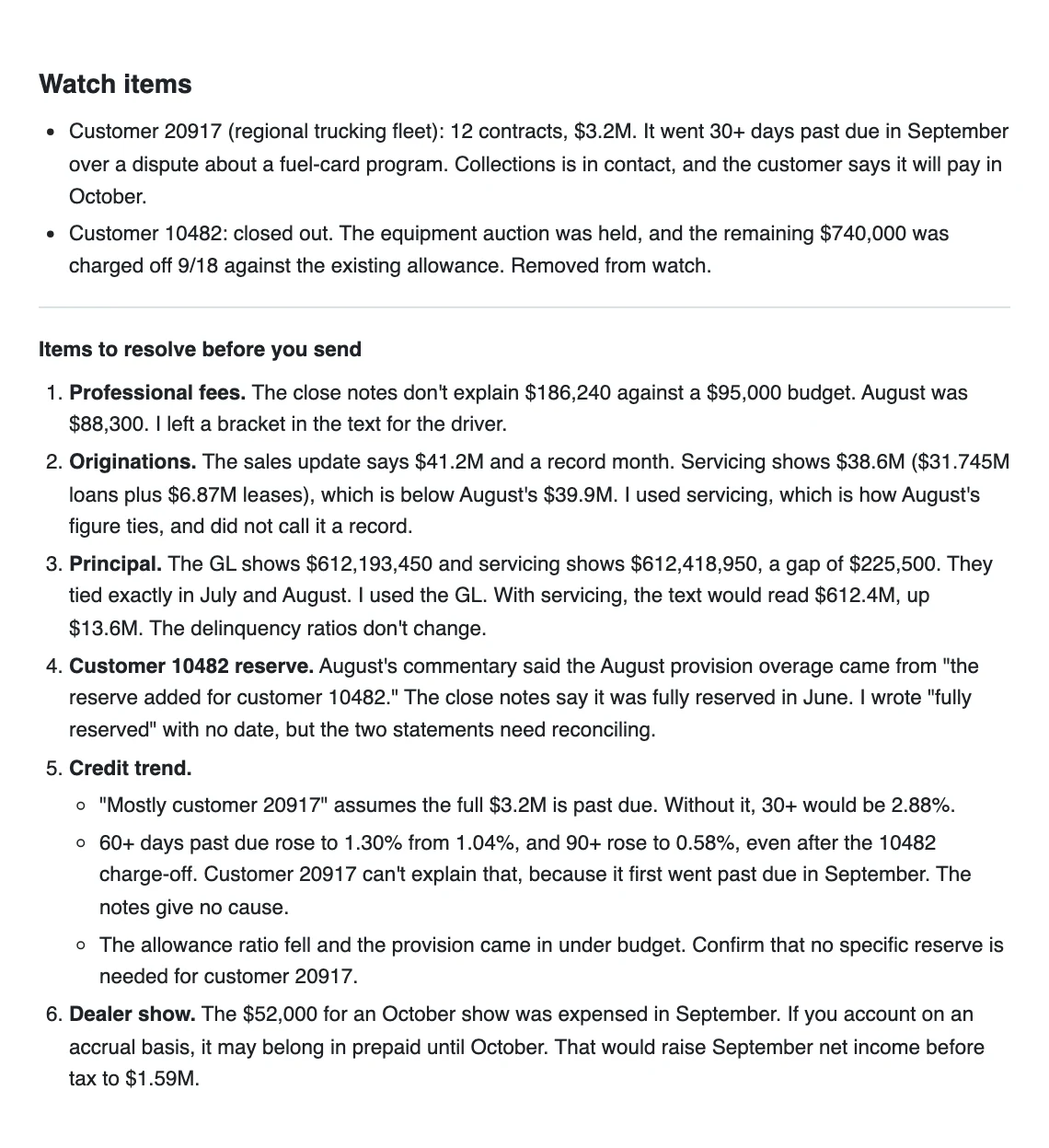
The gap is item 3, after the report has ended. The fifth run never mentioned it. Copy the report into the reporting package, and the disagreement stays behind in the chat.
The report carried figures nobody asked for. Each Claude run added 10 to 14 figures of its own, and every one of them is a figure the controller has to work out again before the report goes out.
Two runs worked out the same one, delinquency without the trucking account that fell behind this month, and got 2.88% and 2.89%, both defensible. A report should carry one, computed one way, every month.
The report borrowed a cause. The close notes say one account was fully reserved in June, so its charge-off in September needed no new provision. Every one of the five runs put that sentence right after the provision's favorable variance, as the reason it came in under budget.
The note explains one charge-off. It does not explain why the month's provision ran under plan while delinquency rose, and nothing on file does.
The obvious trap caught no one. Every one of the fifteen runs left professional fees unexplained rather than invent a reason for them. The invention that got through was quieter: a true sentence used as the reason for the wrong figure.
Keep Every Figure in a Calculation You Rerun, and Let the Assistant Write the Words
Decide where the figures come from before the assistant sees them. Which figure stands when two systems disagree is a decision, and it belongs to a person.
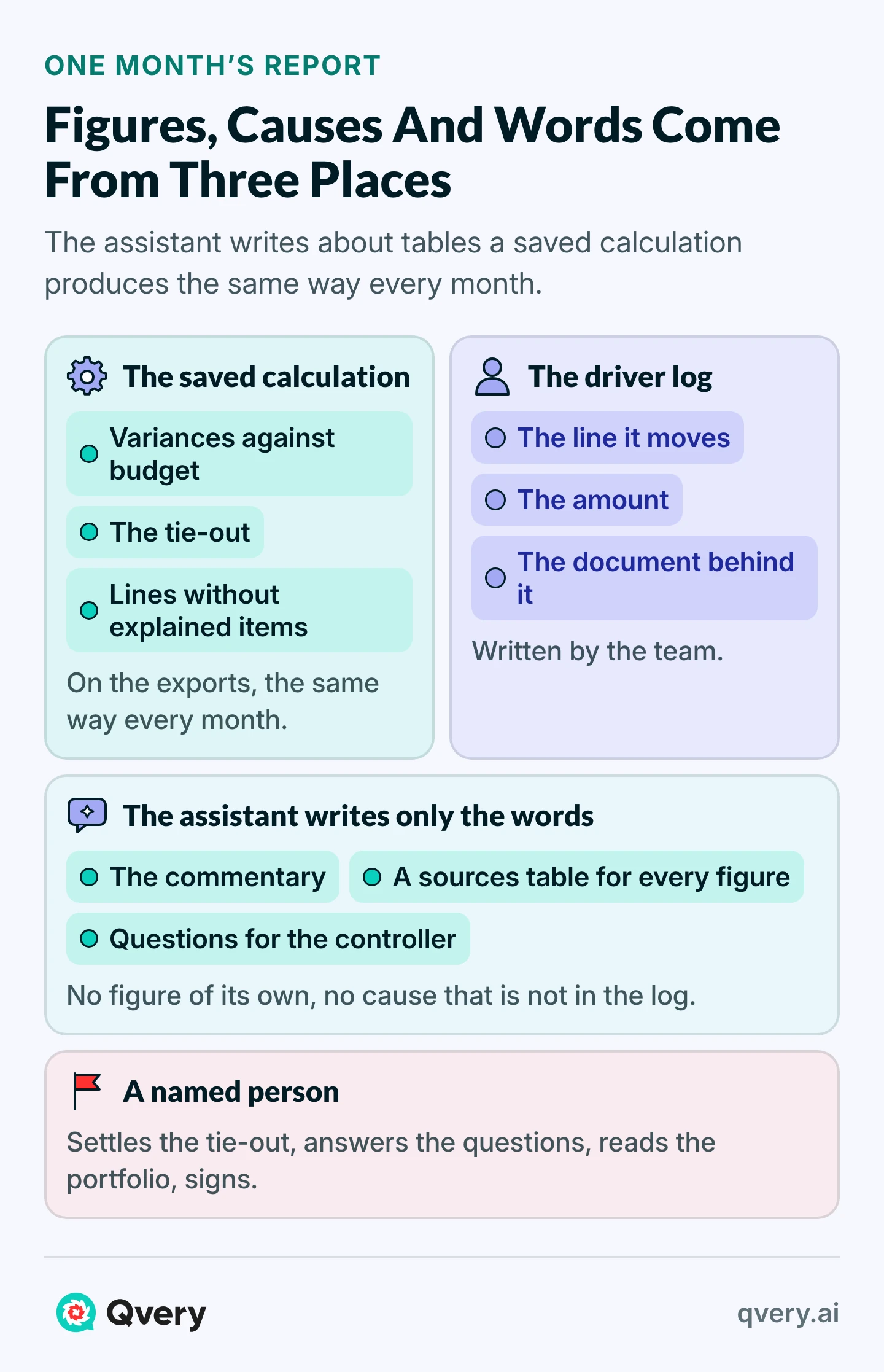
The split, job by job, as the drawing shows it:
| Job | Who does it |
|---|---|
| Variances against budget and last month, each marked favorable or unfavorable | the saved calculation |
| The tie-out between the servicing system and the ledger | the saved calculation, before anything else |
| Which lines and portfolio measures are material enough to need a reason | the saved calculation, from thresholds the controller sets |
| Each line without the items the team has explained, such as a correction or a timing item | the saved calculation, from the amounts in the driver log |
| Why each line moved | the controller's team, in a driver log (the next section) |
| The commentary, a table of sources for every figure, and the questions | the assistant |
| The answers, the call between two systems, and the signature | named people |
The saved calculation can be a workbook your team already trusts, a query in your reporting tool, or a short script an assistant writes once and you keep.
Claude3 and ChatGPT both run Python on uploaded files, and OpenAI tells users to review the generated code before relying on the result.4
Do that once, against a month your team closed by hand, and again whenever the calculation changes. After that it runs the same way every month, and the tie-out tells you when the two systems stop agreeing.
Run all of it on your company's business plan, not a personal account: Anthropic5 and OpenAI6 both say they do not train their models on business-plan data by default.
Keep each month in one folder: the exports, the calculation's tables, the driver log, the prompt, the draft, the questions with their answers, and who signed. A question next spring about September gets answered from it.
Write Every Driver Down With Its Amount, or the Report Will Borrow One
The causes are the part only your team knows. A variance table says what moved. Why it moved lives in invoices, journal entries, the collections file and the heads of the people who closed the month, and an assistant can only repeat what someone wrote down.
That is the driver log: one line per known driver.
| id | line | driver | amount | source |
|---|---|---|---|---|
| D4 | Marketing | dealer show booth and travel paid in September; the budget has the show in October | $52,000 | AP invoice |
| D5 | Technology; Other operating expense | correction of July and August software costs coded to the wrong account | $42,000 | journal entry |
| D3 | Portfolio, past due | one trucking customer, 12 contracts, behind over a fuel-card dispute | $3,200,000 | collections file |
Two columns do the work. The line column ties each driver to the figure it explains, so a sentence about one account cannot drift into the reason for another line, which is exactly how the provision got its borrowed cause.
The amount column turns each driver into a number the calculation can use, so it can produce Technology without the correction, $134,200 and $800 under budget, and nobody subtracts anything in a chat.
A driver with no amount, like the note that the bank raised the rate on the company's own credit line on September 1, explains a direction, not a size, and the commentary should say no more than that.
The log is still evidence a person owns: the rules stop the assistant from inventing a cause, not the team from writing a wrong one. In Larkfield's month the sales email's originations were off, and the only thing that caught them was the servicing system's own figure.
Asking the Assistant to Flag Everything Buries the Questions That Matter
Our first strict prompt gave the assistant the computed tables and the log, and told it to use only figures from the tables, cite every one, give a reason only from the log, and list every disagreement for the controller.
It fixed most of what it was meant to fix. All five runs put the $225,500 gap first in the portfolio section, inside the report, and four of the five kept the June reserve out of the provision's explanation. The fifth, Gemini, borrowed it as the raw-export runs had.
It also returned 8 to 12 questions per report, including what drove fee income $9,050 over budget. Every figure in the prose carried a bracketed citation, which no one would send to the owners.
And four of the five runs flagged the dealer show as a disagreement: the log said $52,000, the marketing variance was $48,200, so which was right? Both figures were: the show cost $52,000 and the rest of marketing ran $3,800 under budget.
A rule that said "a figure that disagrees with a table" read a partial explanation as a conflict.
| Version, five runs each | The $225,500 gap stated in the report | The June note given as the provision's reason | A driver called a disagreement | Questions for the controller, per report |
|---|---|---|---|---|
| Raw exports, plain request | 0 of 5 | 5 of 5 | not asked to list any | 0 to 6 |
| Computed tables, first strict prompt | 5 of 5 | 1 of 5 | 4 of 5 | 8 to 12 |
| Computed tables, final prompt | 5 of 5 | 0 of 5 | 0 of 5 | 4 |
Two small changes made the last row. The calculation writes a materiality column: a line needs a reason when it is $50,000 or more off budget, or $25,000 and 10%.
And the questions are limited to material lines with no driver, differences in the tie-out, and figures for the same measure that differ, such as originations in the sales email and in the system. The citations moved out of the sentences into a table after them.
The Rules That Keep the Disagreements in the Report
The final version gives the assistant the variance table, the portfolio figures, the tie-out, the driver log and last month's commentary.
It copies every number from a table and calculates none, explains a material line only with a driver from the log or writes "Driver not on file", and opens the portfolio section with any tie-out difference, choosing neither figure.
What comes back is last month's sections, a Sources table giving the table, line and column of every figure, and a short list of questions.
In our five runs of this version the list held the same four items every time: the provision, professional fees, the tie-out and the sales email's originations. Each is a point in Larkfield's month that only a person can settle.
This version was written after watching the first strict one fail, and tested on five fresh runs of the same month. Your next month is the test that counts.
The Controller Still Reads the Portfolio and Signs the Report
The shorter question list has a price. None of the five runs of the final prompt asked about loans 90 or more days past due rising from 0.42% to 0.58% of principal, which nine of the other ten runs had flagged.
The portfolio table carried no materiality mark, so the rule had nothing to ask about. Mark delinquency, charge-offs and originations with thresholds the controller sets, as the decision table above does. We did not rerun the month with those marks, so until your own month shows them working, read the portfolio yourself.
None of the runs held to the tables asked whether the $52,000 show belongs in October's books either, a question two runs on the raw files raised on their own. Held to the tables, the assistant stops questioning the accounting, so that question stays with whoever reads the draft.
What a person still does, in order:
Read the tie-out line first
If it shows a difference, nothing in the portfolio section is final until someone settles it.
Check the Sources table against the calculation's tables
Every figure, every month, until your own parallel months show the draft clean; then a sample plus every material line, and every figure again whenever the calculation, the exports or the prompt change.
Hold each cause in the commentary against the driver log
Answer the questions, or leave them in the report as open
Read the portfolio movements, which the questions do not cover
A named person signs
After a late entry, rerun the calculation and the draft rather than patching the commentary by hand. And whoever writes the month's drivers should not also be the one who changes the calculation, the materiality line or the prompt.
What Qvery Builds for a Lender's Monthly Report
All of this repeats at every close, so the agent we build around one lender's close starts once the controller marks it done.
It pulls the servicing system's summary, the ledger and the budget workbook, runs the saved calculation, and stops with the amount for the controller if the tie-out fails.
If it holds, it drafts the commentary, the Sources table and the questions from the driver log, sends each question to the line's owner, and holds the report for a named person to approve.
It works on autopilot, next to the controller, from the exports your team already closes the month with.
Last month's report is where we begin: your controller and analyst show us where each export comes from, who writes the drivers and who settles a gap.
The first working version drafts one of your real months before two weeks are out, and we train the controller and whoever reviews the draft to run it.
We report on it weekly: the hours of drafting and checking it saved the controller and the analyst, and the errors it caught before the report went out, such as a gap between the systems or a cause borrowed from another line.
Its first draft is built on your exports, not an invented lender's.
Run Next Month Twice Before the Assistant Writes It Alone
Next month, write the commentary the way you do now and have the assistant draft it beside you from the tables and the log. Count four things: figures in the draft that tie to the calculation's tables, causes that match the log, questions that were real, and the hours each way.
If drafting turns out to be half of each person's hours in the example above, that is $13,480.80 a year in wages, before benefits and before the time the driver log and the review add back.
The parallel month also shows the other count, the one wages miss: how often your report was about to go out carrying a disagreement nobody had settled.
Our finance playbook counts reporting packs the same way, in staff minutes per pack and figures caught before a report went out, beside the other finance jobs agents take first.
Start with last month's exports and the tie-out. If the two systems agree to the dollar, start the parallel month. If they don't, that difference is the first question for your controller, before anyone writes a word.
Frequently asked questions
Which parts of a monthly report can AI draft safely?
The commentary, the table of where each figure came from, and the questions for the controller. The figures come from a calculation you save and rerun, and the causes from a log your team keeps. The choice between two systems that disagree, the answers to the questions and the signature stay with people.
Can AI get the numbers in a monthly report right?
In our invented month, yes: four Claude runs worked out 47 figures of their own and one was a rounding slip. What failed was which figure went in where two systems disagreed, figures nobody asked for, and true notes given as the reason for the wrong line.
What is a tie-out in a lender's monthly report?
The check that the servicing system's total principal equals the loan account in the general ledger. Until it holds, every portfolio sentence describes a number nobody has settled, so it runs before anyone writes. A wealth manager ties the custodian's records to the ledger the same way.
Should the AI do the reconciliation itself?
It can do the arithmetic. In our month it did. Keep the tie-out in the saved calculation anyway: which figure stands when two systems disagree is a decision for a person, and the check has to run the same way every month.
Why does AI give the wrong reason for a variance?
Because a true note nearby reads like an explanation. Every raw-export run gave a June reserve on one account as the reason the provision came in $108,000 under budget, but the note explains one charge-off, not the month's provision. Tying each driver to its report line stops that.
Will AI make up a cause when nothing on file explains a variance?
Not on the line we set up to test it: all fifteen runs left professional fees unexplained rather than invent a reason. What got through was quieter, a real sentence beside the wrong figure, so hold every cause against the driver log.
What is a driver log?
One line per known driver: the report line it explains, what happened, the amount, and the document behind it, such as an AP invoice or a journal entry. The line keeps each cause on its own figure, and the amount lets the calculation net out what is already explained.
How do I check AI commentary for wrong numbers?
Ask for a Sources table that names the table, line and column of every figure, and check it against the calculation's own tables: every figure until your own months show the draft clean, then a sample plus every material line. Read the tie-out line before anything else.
How many questions should an AI draft raise for the controller?
Only what a person has to settle: material lines with no driver, tie-out differences, and two figures for the same measure. Told to flag everything, our runs raised 8 to 12 per report; with those limits, each of five runs raised the same four.
Which lines in the monthly report need an explanation?
The ones past a materiality line the controller sets in advance, written by the calculation as a column: in our month, $50,000 or more off budget, or $25,000 and 10%. Give delinquency, charge-offs and originations thresholds too, or the draft will not ask about them.
What does an AI draft of the report still miss?
Whatever no rule points it at. None of the five final runs asked about loans 90 or more days past due rising from 0.42% to 0.58% of principal, or whether a dealer show paid in September belongs in October's books. A person still reads the portfolio and the accounting.
How much time can AI save on the monthly report?
Count it on one month of your own. If the controller spends 16 hours and an analyst 24 on the commentary, that is $2,246.80 a month at national median wages; if drafting is half of it, $13,480.80 a year, before the time the driver log and the review add back.
Who is accountable when AI helps prepare the report?
Whoever signs it. Name that person, keep the assistant's questions with the report until they are answered, and keep each month's folder so anyone can see what the draft was given and what was changed.
Is it safe to give an assistant the ledger exports?
Use your company's business plan, not a personal account. Anthropic says it does not train its models on its commercial products' inputs or outputs by default, and OpenAI says the same of its business plans unless you opt in. Your own data policy still decides what leaves the building.
Where should a lender start?
With last month's exports and the tie-out. If the two systems agree to the dollar, run next month twice, by hand and with the assistant, and compare the figures that tie, the causes that match the log, the real questions and the hours.
What does Qvery build for the monthly report?
An agent made for one lender's close. It runs the saved calculation when the close is marked done, stops if the tie-out fails, and otherwise drafts the commentary, the Sources table and the questions for a named person. A first version runs on your own month within two weeks; whoever signs is trained on it.
Sources
- APQC: How Can You Improve the Month-End Closing Process? (2026)
- U.S. Bureau of Labor Statistics: Occupational Outlook Handbook: Financial Managers; Occupational Employment and Wage Statistics, May 2025 (2026)
- Anthropic (Claude Help Center): Create and edit files with Claude (2026)
- OpenAI Help Center: Data analysis with ChatGPT (2026)
- Anthropic Privacy Center: Is my data used for model training? (2026)
- OpenAI: Enterprise privacy at OpenAI (2026)