On this page
Somewhere in your company a job eats the same hours every week.
In finance it is supplier invoices: someone opens the payables inbox, keys each invoice into the accounting system, matches it to the purchase order, chases the approver, and sorts out what does not match before the payment run.
In a freight company it is carrier invoices, in a property company deposit returns, in a law firm the conflict check on a new client.
Before anyone buys an AI agent for that job, price it and map it. The price says whether an agent is worth building. The map, drawn from last month's real cases, says which steps the agent can take alone and which a person must release.
Skip either, and the hours you meant to save can move into checking the agent's work.
It is also how we would start an agent with you at Qvery: one job, priced and mapped with the people who do it, then built, with a first working result in two weeks.
The worked example here is supplier invoices, because every company in logistics, real estate, law, and finance pays them. Its numbers are a survey's rates and our stated assumptions, so put your own in.
Price the Job Before You Price the Agent
Ardent Partners' 2025 survey of 204 payables and finance leaders put the all-inclusive cost of processing one invoice at $9.84 on average. The fifth of teams with the lowest costs and fastest cycles spent $2.65; everyone else spent $12.42.1
More than half of the respondents work at companies with over $1 billion in revenue, so read the figures as a range, not as your number.
The cost sits in the invoices that leave the usual path. Outside that best fifth, 20.9% of invoices were exceptions, and Ardent calls exceptions typically the biggest single reason the benchmarks are not better.1
So price your own job in three lines: how many cases a month, how long a clean case takes, how long an exception takes. For a company that pays 1,500 supplier invoices a month:
| Cases | A month | Minutes each | Hours a month |
|---|---|---|---|
| Clean invoices | 1,186 | 6 (assumed) | 118.6 |
| Exceptions, at 20.9% | 314 | 20 (assumed) | 104.7 |
| The whole job | 1,500 | 223.3 |
That is about 223 hours a month, more than one full-time clerk's month (about 173 hours), and about $8,930 at an assumed $40 an hour. The exceptions are a fifth of the invoices and almost half of the hours, which is the first thing the map has to explain.
Map It From Last Month's Cases, Not From the Procedure
The written procedure describes the job on its best day. An accountancy practice that stopped work for half a day to write down how its jobs are really done put the risk in one sentence: "if three members of staff complete the same task using three different methods, deploying AI will simply produce those three different outcomes faster."2
Pull one month of the job instead: the emails that brought the work in, the export from the system it ends in, the approval log, the side spreadsheet if the team keeps one, and the threads where someone asked "what is this one?"
Then write one row per step, with six fields that answer what whoever builds the agent will ask:
| Field | What it answers | Example |
|---|---|---|
| Step | One verb, one object | Match invoice to purchase order |
| Reads | What it works from, in what form | PDF from the payables inbox, the PO |
| Rule | The decision and its written rule | Price and quantity within finance's tolerance |
| Changes | What is different after it runs | A draft |
| Exceptions | Last month's cases off the path, counted | No PO number, price off, no receipt |
| Owner | Who decides today | Payables clerk |
Three answers decide whether the job is ready for an agent at all. If any is no, fix that before anything is built:
- One way of doing it. Does everyone do the job the same way? When the cases show two ways, the owner of the process picks one, and a variant with a good reason is written down as a named exception.
- Written rules. Can every decision be written as a rule someone else could follow? A rule that lives in one person's head is the first thing to write down.
- Owned exceptions. Is every kind of exception counted, with someone who settles it? An exception nobody owns becomes the agent's guess.
A chat assistant such as Claude or ChatGPT, on the business plan your company has approved, can draft the rows from the exported cases if you ask it to cite the case behind each row. A map drawn from a paragraph you type can look complete and miss the exceptions.
Draw One Line: The Agent Prepares, a Person Releases
The Changes field decides who releases each step. A step that only reads, drafts or flags can run alone. A step that changes the books, moves money or leaves the building waits for a person until the first month's numbers say otherwise.
| Step | What it changes | Who releases it |
|---|---|---|
| 1. Take in the invoice | Nothing | The agent alone |
| 2. Identify the vendor | Nothing; a new vendor is a record | The agent; a person for a new vendor |
| 3. Match to the order | A draft | The system's rule; a person settles mismatches |
| 4. Code the lines | A draft | The agent drafts; a person confirms |
| 5. Check for duplicates | A flag | The agent alone |
| 6. Route for approval | A message inside the company | The agent alone |
| 7. Approve | Authorizes the spend | A person |
| 8. Post to the ledger | A record in the books | A person |
| 9. Change vendor bank details | Where money goes | A person, after a call to the vendor |
| 10. Pay | Money leaves | A person |
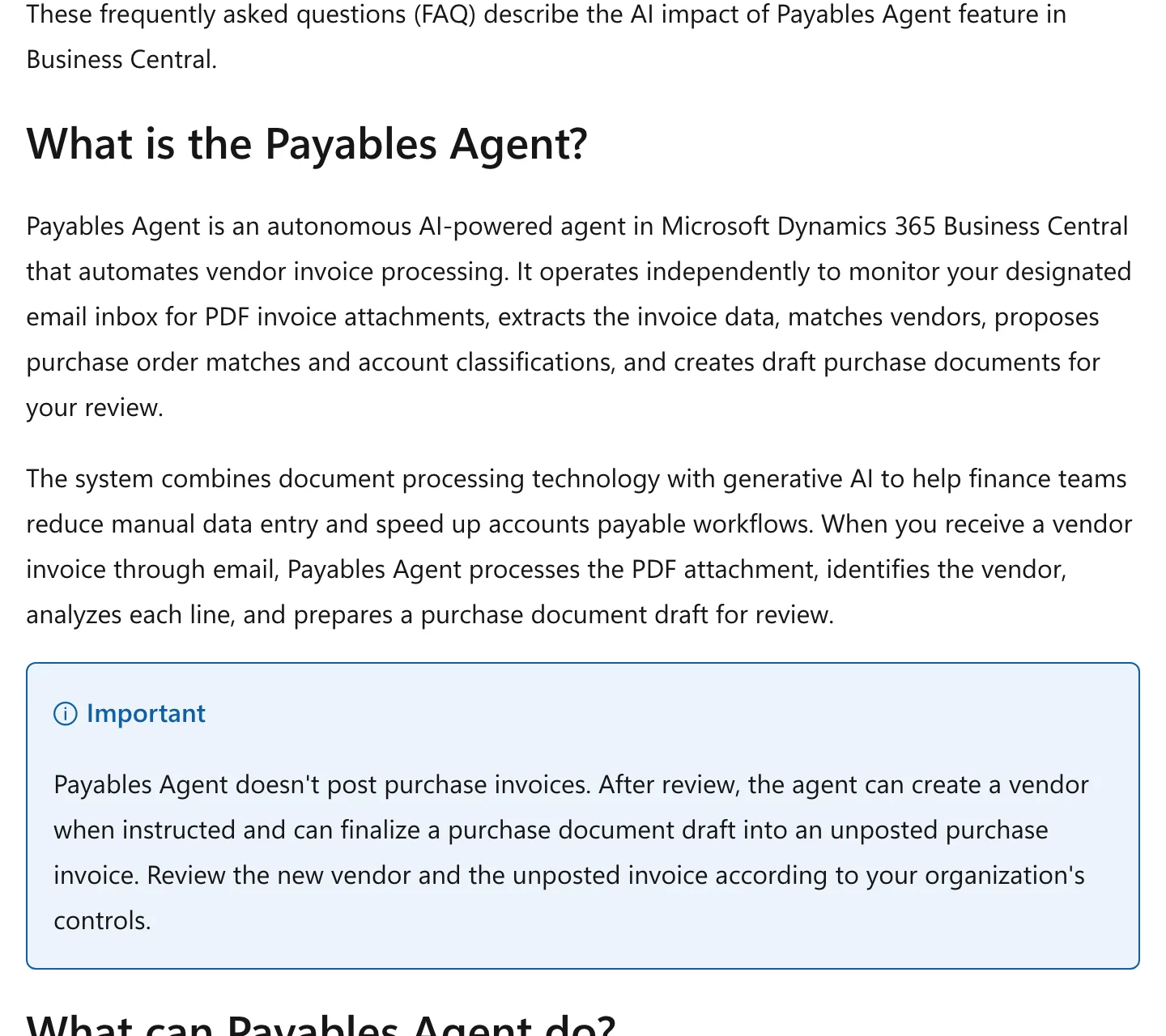
The software makers draw the same line. Microsoft's payables agent reads invoices from a mailbox, proposes the order match and drafts the purchase document, and its documentation says it "doesn't post purchase invoices"; a vendor it creates stays blocked until a person reviews it.3
Bank details are the step that never moves. Business email compromise, the scam that takes over or fakes business email to get a payment sent to the wrong account, drew 24,768 complaints and $3,046,598,558 in reported losses to the FBI in 2025.4
A request to change where money goes is a person's call to the vendor, on a number you already hold.
Agents left to finish whole jobs alone also do worst on this kind of work.
In TheAgentCompany, a benchmark set in a simulated small software company, the best leaderboard entry (November 2025) completed 4 of 12 finance tasks and 4 of 15 administrative ones with no person checking, the two lowest shares of its six named departments.5
Finance and Admin Were the Best Agent's Two Weakest Named Departments
% of tasks completed
View the data
| Label | Value | Note |
|---|---|---|
| Project management (28 tasks)5 | 57.14% | 16 of 28 tasks completed. |
| Data science (14 tasks)5 | 50% | 7 of 14 tasks completed. |
| Software engineering (69 tasks)5 | 46.38% | 32 of 69 tasks completed. |
| Human resources (29 tasks)5 | 37.93% | 11 of 29 tasks completed. |
| Finance (12 tasks)5 | 33.33% | 4 of 12 tasks completed. |
| Administrative (15 tasks)5 | 26.67% | 4 of 15 tasks completed. |
The person at the line is what stops a misread amount from becoming a payment.
What the Agent Is Worth on Your Invoices
Now price the line. Say the agent takes in, matches, codes and routes every clean invoice, so the clerk's part becomes a one-minute release, and each exception still goes to a person but arrives prepared, at 15 minutes instead of 20 (both assumed).
The job falls from about 223 hours a month to about 98: 125 hours back, about $5,000 a month at the same $40 an hour. Against that go the agent's running costs, its setup, and the review hours it adds. Put your own figures in, and the calculator gives the payback:
AI ROI Calculator
What Are The Saved Hours Worth?
Net Capacity Value Per Month
$1,560
10 hours less 4 hours per week, multiplied by 52 ÷ 12 and $60 per staff hour.
- Net Hours Per Week
- 6 hours
- Net Hours Per Month
- 26 hours
- Weekly Capacity Value
- $360
- Gross Monthly Capacity Value
- $2,600
- Review Monthly Capacity Value
- $1,040
On these numbers, review leaves 26 hours a month of staff capacity worth $1,560. That becomes a financial return only when it cuts a cost or earns additional contribution.
If the payback runs past a year, pick a different first job, or fix the exceptions the map found before anything is built. If your invoices look like the table above, they are a good first job to bring us.
Judge the First Month by the Team's Hours
The number that decides month one is the team's hours per case on the job, review and exceptions included, against last month's. If it is not falling, look first at the review time and the exceptions, where checking work tends to hide.
Two more counts show where it went: the share of drafts a person corrected, and the share of cases the agent sent back.
What Reddit says
Two accountants on what automation left them
We cut two AP and now just have a staff accountant that spends ~half her time on the exceptions
I've implemented and used these systems and they work just fine as accountants' tools. Soon as you allow bill.com to call vendors to try and do ANYTHING, you're in trouble.
Then the line moves one step at a time, and only on the record.
Ramp's bill agent, for one, creates a bill on its own only for a vendor with history and accurately coded past bills, never for a possible duplicate or an undismissed fraud risk, and a bill it creates still goes through every approver.6
Write the same kind of rule for each step you hand over.
Start With One Job This Week
Pick the job your team complains about most, pull last month of it, and price it in the three lines above.
The same six fields fit a carrier invoice in logistics, a deposit return in real estate or a conflict check in a law firm; the systems and the rules change, the method does not.
If the hours are there, the map is your brief. If they are not, you found out for the price of a month's export.
Frequently asked questions
How do I map a workflow before building an AI agent?
Pull last month's real cases for one job and follow each from arrival to done. Write one row per step: what it reads, its rule, what it changes, its exceptions and their count, and its owner. Then walk the cases with the person who does the job to fill in why.
How do I work out what an AI agent is worth?
Price the job first: cases a month, minutes for a clean case, minutes for an exception, and the hourly cost of the people who do it. Then price the job with the agent, release time and exceptions included, and set the difference against the agent's running costs and setup.
Which AI agent actions should require a person's approval?
To start, anything that changes a record in the books or leaves the company: posting, creating or changing a vendor, paying, and messages to vendors or clients. Reading and drafting can run alone. Bank-detail changes always stay with a person.
How do I know if an AI agent is creating more work than it saves?
Count the team's hours on the job per case each week, review and exceptions included, against last month's. If they are not falling, look at review time first: the share of drafts a person corrected and the share of cases sent back show where the time went.
Do I need a map if I am buying an agent instead of building one?
Yes. A bought agent still reads certain inputs, applies certain rules, and stops at certain steps. The map shows which of your cases it will reach and where its stop sits against your controls.
Sources
- Ardent Partners: The State of ePayables 2025: AP's Unfinished Journey (2025)
- AccountingWEB: How to Run a SOPathon: The Missing First Step in Every AI Strategy (2026)
- Microsoft Learn: FAQ for Payables Agent (Business Central) (2026)
- FBI Internet Crime Complaint Center: 2025 Internet Crime Report (2025)
- TheAgentCompany experiments on GitHub: Per-task results: TTE-MatrixAgent with DeepSeek-V3.2 (2025)
- Ramp Help Center: AP Agents available in Ramp Bill Pay (2026)