
On this page
- Pick One Document Task Whose Right Answers Are Already in Your Files
- What to Settle Before Day 1
- Size the Sealed Test Set by the Error Rate You Can Live With
- Sign the Pass Rule Before Anyone Has Seen a Result
- Days 1 to 3: Seal the Test Set and Clean the Inputs
- Days 4 to 7: Feed It the Ugliest Files and Log Every Miss
- Days 8 and 9: Run the Sealed Set Once and Score Each Document on Its Worst Error
- Day 10: Let the Rule Decide
- How Qvery Builds the Agents Your Pilot Tests
- After a Pass, Review Follows the Risk
- Frequently asked questions
Most companies have one document job that eats skilled hours every week: contracts checked against your positions, leases abstracted into the property system, carrier or supplier invoices matched to what was agreed.
At 45 minutes a contract, 220 contracts a quarter is 165 hours of a lawyer's time, and one uncapped liability marked as fine can cost more than all of them.
Before an agent takes that work you need two numbers: its cost per document and how often it is seriously wrong. The slow part is the right answers to test it against, written out by hand or gathered from weeks of live work.
There is a faster test in your files: the work your team finished last quarter already holds checked answers, so a pilot can replay it against the agent and score every document.
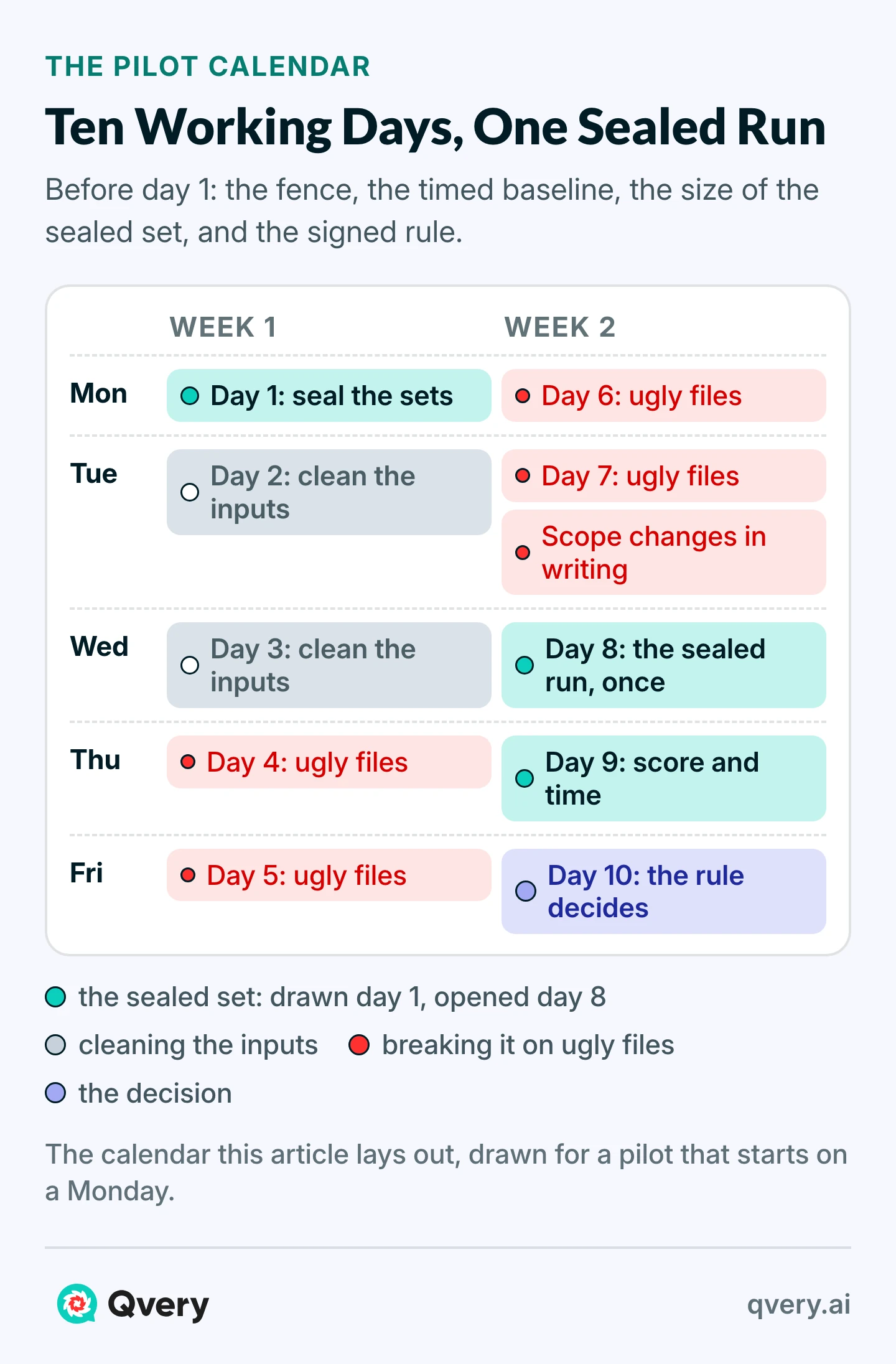
Pick one document task, price it as it is done today, seal a test set that neither the agent nor the vendor sees until day 8, and sign the rule that decides the result before anything runs.
Over the next 10 working days you clean the inputs, break the agent on your ugliest files, and score the sealed set once. Day 10 applies the rule: scale, fix, or kill. The method fits any task with a right answer; adoption and live volume come after a pass.
Pick One Document Task Whose Right Answers Are Already in Your Files
A pilot answers one question, so it tests one task, and each task needs its own sealed set and its own reviewer's hours.
Three things make a task pilotable. A right answer exists that two of your people would mostly agree on: whether a clause sits within your position has one; whether a contract is a good deal doesn't.
It recurs, so last quarter holds enough finished cases to seal a set. And one person owns it and can say what right means without a committee.
Pilot plans treat the answer key as something to build, and you probably own one already: each finished document beside its checked result in your contract, property or accounting system is a question and its answer, checked by someone you trust.
Checked is not the same as right. Before day 1, have the second reviewer re-check a small random slice, and fix the key if it shows serious errors: an agent that repeats an old mistake will score as a match.
The pairs also have to be findable. Choose a task whose final answer sits in a system, so building the key is an export, not a hunt through four inboxes for the version that went out.
| Industry | Document task | The answer key you already hold | A serious error | A cosmetic error |
|---|---|---|---|---|
| Legal | Review third-party contracts against your positions | The version you sent back, with the reviewer's notes | An uncapped liability marked as fine | A clause filed under the wrong heading |
| Real estate | Abstract a lease into the property system | The abstract your team entered | A wrong rent step, expiry, or notice date | An address written another way |
| Logistics | Audit a carrier invoice against the rate confirmation | The invoice as approved, with its adjustments | A charge passed that the rate confirmation doesn't allow | A carrier name spelled differently |
| Finance | Match a supplier invoice to its order and receipt | The posting and the match decision | A wrong amount, supplier, or duplicate passed | A date in another format |
The running example from here on is the first row: your team reviews other companies' paper against a short list of positions on liability, indemnity, governing law, termination, and confidentiality.
What to Settle Before Day 1
You are about to hand your contracts to software you don't control, so five decisions, made before any file moves, settle what it can read, keep, and write.
Name the files that never leave
In legal work the line is client information: the ABA's Formal Opinion 512 says a lawyer needs the client's informed consent before putting information about the representation into a self-learning tool whose output could disclose it to others1.
Get the provider's terms in writing
Whether it trains on your files, how long it keeps them, how they are deleted, and who else processes them. OpenAI says it does not train on data from its business plans or its API by default,2 while ChatGPT's personal Free, Plus, and Pro workspaces share data for training unless the user turns it off,3 and Anthropic says it does not train on data from its commercial products by default.4
Open one place, read-only
A folder or a system view that holds the pilot's files and nothing else on the drive.
Send its answers to an approved sheet
During the pilot the output goes to a sheet or folder your company already approves for this data, never into the contract system, the property system, or the ledger.
Read through the access production will use
If production will read the contract system, so does the pilot, with the same permissions and formats; a pass on files exported by hand can't decide scale.
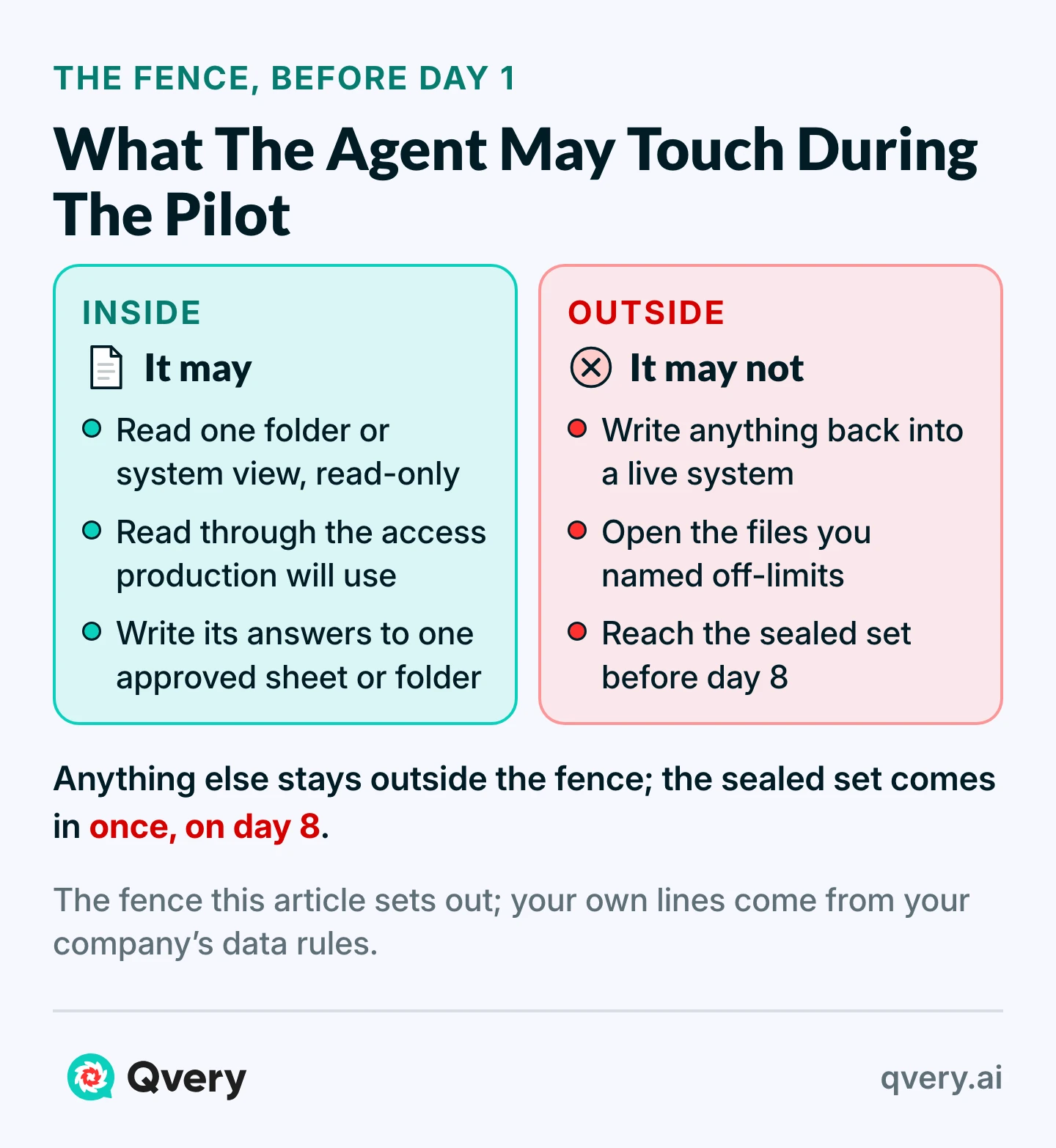
If a vendor runs the agent, it configures on the tuning documents you give it and nothing else, with every setting and manual fix written down, so you can tell the product's output from a person's work behind it.
The vendor never receives the sealed set before its one run on day 8, and never keeps or scores it. A vendor that won't run a read-only pilot on terms that rule out training on your files has answered before day 1.
Tell your team what this is before anyone times anything. Their finished work is the answer key and their judgment settles the disputes, so the pilot measures the job, not them.
Then time the work as it is done today, over one or two weeks before day 1: every case that arrives, not the ones someone picks, until you have about two dozen, timed start to finish, notes and back-and-forth included.
Don't ask people how long it takes. In METR's randomized trial of early-2025 AI tools, 16 experienced software developers believed afterwards that AI had made them 20% faster, and took 19% longer.5 METR has since said that newer tools likely do better and that self-reports stay unreliable.6 Your reviewers aren't developers, but use a clock.
From the timing, write down three things:
- Minutes per document.
- How many cases left the usual path or came back for rework.
- The cost per finished document: those minutes at the hourly cost your company already uses for the role.
Now put a price on the job. Say the clock gives 45 minutes a contract, and a lawyer can finish the agent's prepared review in 15; both are assumptions to replace with your own.
At the example quarter's 220 contracts, today's work is 165 hours a quarter, and the agent's is 55, plus the exceptions it hands back and the tool's price.
The difference before exceptions, 110 hours a quarter, is what the agent could free if it passes. Less the exceptions' hours and priced at your hourly cost, it is the most the agent can cost each quarter to build and run and still break even. Those hours become money only when they go to other work.
 Vlad ShvetsPartner @ Qvery
A pilot that only proves the agent is accurate has answered half the question. The other half is price: on 220 contracts a quarter, 110 lawyer hours are the most the agent can free, and they become money only when they go to work you would otherwise hire for. Decide where the freed hours go before day 1, and write it beside the cost margin in the pass rule.
Price both sides per usable document, with the review a person will still do: if someone reads every output for the first months, count that, not a lighter check you might switch to once the agent has passed.
The pilot's own hours (the setup, the preparation, the reviewers' scoring days) are a one-time price, paid whatever the result and kept out of the comparison. And because one serious miss can cost more than a quarter of saved hours, the rule counts serious errors before it counts savings.
Size the Sealed Test Set by the Error Rate You Can Live With
Start with the unit: score each sealed document pass or fail on its worst error, because a review that missed one uncapped liability failed, however many clauses it caught.
Keep serious narrow: an error that would change a decision or create a legal or financial exposure, and a right answer that rests on a clause that doesn't say it, since it is right by luck until the versions differ. A clause filed under the wrong heading is cosmetic, logged but never a fail.
Then the arithmetic, which statisticians call the rule of three7: zero events in N independent trials still allow a true rate up to about 3 in N, at 95% confidence.8
So a clean run on 100 sealed contracts puts the agent's serious-error rate on documents like them below 2.95%: a ceiling, not a zero.
A Clean Sealed Set Proves Less Than It Looks
upper limit on the error rate
View the data
| Label | No serious error found | One serious error found | Note |
|---|---|---|---|
| 25 documents | 11.29% | 17.61% | 25 clean documents rule out a serious-error rate above 11.29%. |
| 40 documents | 7.22% | 11.32% | 40 clean documents rule out a serious-error rate above 7.22%. |
| 50 documents | 5.82% | 9.14% | 50 clean documents rule out a serious-error rate above 5.82%. |
| 75 documents | 3.92% | 6.17% | 75 clean documents rule out a serious-error rate above 3.92%. |
| 100 documents | 2.95% | 4.66% | 100 clean documents rule out a serious-error rate above 2.95%. |
| 150 documents | 1.98% | 3.12% | 150 clean documents rule out a serious-error rate above 1.98%. |
| 200 documents | 1.49% | 2.35% | 200 clean documents rule out a serious-error rate above 1.49%. |
| 300 documents | 0.99% | 1.57% | 300 clean documents rule out a serious-error rate above 0.99%. |
Read the chart backwards and it becomes a sizing rule. Decide the highest serious-error rate you could live with on this task, then hold back enough documents to rule it out: 59 clean documents rule out a rate above 5%, 99 rule out 3%, and 299 rule out 1%.
The real cap on the set's size is your reviewer's time: scoring means comparing each answer with the key and ruling on every disagreement. At 10 minutes a contract, 100 contracts take about 17 hours.
Timing the review on two dozen adds 6 hours at the example's 15 minutes, so split the set with the second reviewer and start as the outputs land.
Draw a second sealed set, the reserve, at the same time and lock it away too: a set you have looked into can't test a fix, and the reserve's size sets what a fix round can prove.
Sign the Pass Rule Before Anyone Has Seen a Result
A rule written after the results arrive is a negotiation. Write it before day 1, with the person who owns the task, and sign it.
Filled in for the example quarter, the rule seals 100 contracts and passes at no more than one with a serious error, which rules out rates above 4.66%. Say the owner sets the cost margin at 30% and the exceptions at three hours a week, about four contracts at today's 45 minutes.
The reserve is 40, which rules out rates above 7.22% at best, so a clean fix round here earns the full-size test, drawn from next quarter's finished files, rather than a scale decision.
Under the rule, write the list of serious errors for this task, with an example of each from last quarter's files, and do it now: a list written after the misses are known gets written around them.
Days 1 to 3: Seal the Test Set and Clean the Inputs
On the morning of day 1, before anyone opens a document, export the quarter's finished pairs as a list: one row per agreement, its amendments with it, and the counterparty's template beside it.
Let a spreadsheet's random function pick agreements one at a time until the sealed set and the reserve reach their sizes. Any type the rule lets scale separately is drawn separately, to the count the rule gives it.
Then set aside every other agreement on a template a locked one uses, so no counterparty's paper sits both in a locked set and in the files the agent is tuned on.
If a few counterparties send most of your paper, that leaves almost nothing to tune on. Then set aside only each locked agreement's own versions and amendments: the test meets their paper as production will, and a new counterparty stays outside the bound.
Move both locked sets into a folder only the scorer can open. What remains is the tuning pile, and the worst of it the ugly pile.
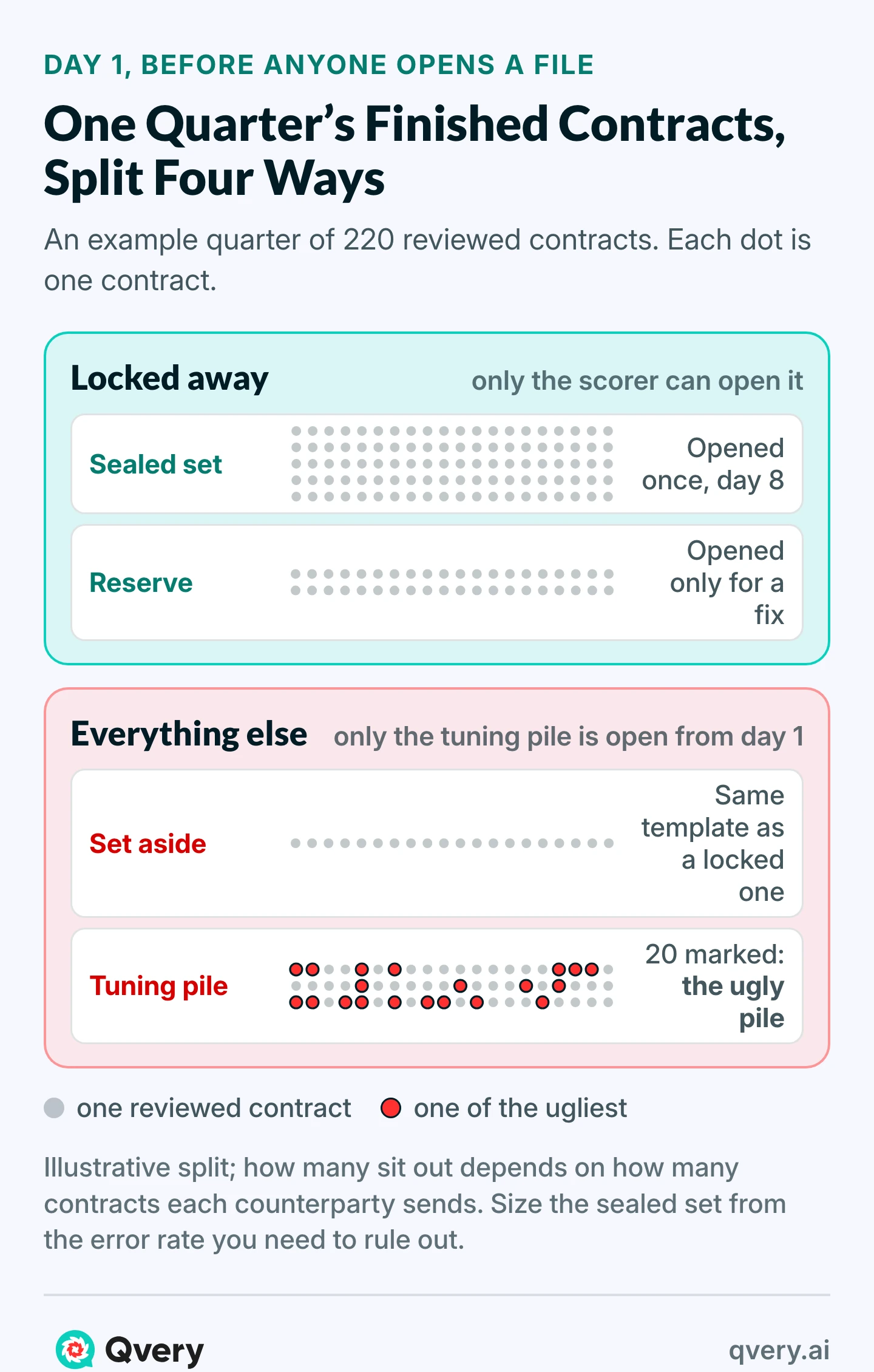
From then on nobody tunes against the sealed set, you included. Google's machine-learning course says test sets "wear out" with repeated use: the more often one guides changes, the less it says about the next document.9
Days 2 and 3 go to the inputs, because an agent can only be as right as what it reads.
| Input | What goes wrong | What to do |
|---|---|---|
| Unreadable files | Scans with no text layer, photographed signature pages, one PDF holding twelve documents | Run them through text recognition or set them aside, and note which |
| Two versions of one document | A draft and the signed copy in one folder, so the agent answers from the wrong one | Keep the source of truth and remove the other |
| Your own vocabulary | What your team means by "the MSA", "our paper", or "the cap" | Write each down in a line, so the instructions use your words |
| The positions | The checklist the agent reviews against | One position per line, in the words your reviewers use |
Days 4 to 7: Feed It the Ugliest Files and Log Every Miss
The tuning pile is where you try to break it. Pull its worst paper into the ugly pile: heavily negotiated agreements, a counterparty's old template, a carve-out three pages away from the clause it changes, side letters, a bad scan, defined terms that shift halfway through.
The failures to log are plain ones. Tools that vendors have configured on a team's own playbook for third-party non-disclosure agreements (NDAs) can still put clauses in the wrong place, duplicate language, and misread defined terms.
And the miss that matters can be one buried line: a note in an intake file that should disqualify a prospective client, read past by every system on trial.
A named reviewer logs every miss with one of three routes:
- An input to fix (the scan, the version).
- An instruction to fix (the position was ambiguous).
- A case to put out of scope (the agent won't see side letters in production either, so a contract with one goes to a person).
A narrower scope is an allowed outcome of these four days, written into the pass rule before day 8 with the type it leaves out. The signed ceiling on the error rate does not move, and the cost line counts the excluded share as work people still do.
Fewer sealed documents prove less: in the example, fewer than 63 can't rule out rates above 4.66% even with none wrong. So narrow only by a type you can count from the export's list, without opening a sealed document; if too few would remain, the narrowing is the rule's one fix.
If You Have No Tool Yet, Run It on an Assistant Before You Buy One
Claude or ChatGPT, on a business plan inside your fence, can run the same review one contract at a time. Fed by hand, it tests the task, not your production access: a pass says the job is worth buying a tool for, and that tool gets its own sealed test.
Ask for one row per position, with:
- The section it relied on.
- The exact words from the contract.
- NOT FOUND where it is silent, so it can't fill a gap with what such contracts usually say.
We ran a request like that in October 2026 on a Claude model as a plain chat assistant, against a public, partly redacted supply contract filed with the US Securities and Exchange Commission.10 All nine quoted lines were word for word in the contract.
Then we planted one sentence in a definition, pages from the liability section, removing the cap for later shipments. The assistant quoted it in the liability row and still marked the row UNSURE rather than NO.
One run proves nothing about a tool's accuracy, but it sets the rule for day 8: score what each row found and concluded, never the verdict column alone.
Days 8 and 9: Run the Sealed Set Once and Score Each Document on Its Worst Error
Day 8 is the only day the sealed set is opened. Freeze the setup the evening before: the instructions, the positions, the settings. Run all the sealed documents in one go, with nobody fixing anything between documents, and save the output exactly as it comes. Then score each document against the answer key:
| Verdict | What it means | How it counts |
|---|---|---|
| Match | The agent agrees with the key and cites the right place | Pass |
| Serious miss | The key flags a deviation the agent missed | Fail |
| Serious false answer | The agent states what the contract doesn't say, or cites the wrong place | Fail |
| False flag | The agent flags a deviation that isn't there | Pass, review time counted; fail if acting on it would change a decision |
| Unsure | The agent quotes the right clause but won't decide | An exception, priced at today's minutes; fail if it quotes the wrong clause |
| Cosmetic | Right substance, wrong heading or wording | Pass, logged |
| Key was wrong | The agent is right and last quarter's answer wasn't | Pass, logged as a finding about the old work |
The score comes from a person, or a formula where a field has one right value, never from the tool's report on itself: an assistant asked to confirm that two files match cell by cell can say they tie perfectly when every cell is off.
Every disagreement goes to the other reviewer, the one who didn't score that document, because last quarter's answers carry errors too. When the agent is right and the old review wrong, it counts for the agent.
Tips from Reddit
What people who test these tools insist on
First rule of thumb is to never take the sales rep's word -- test it for yourself.
Test the results, daily, against the original tool.
AI hallucinates, and makes mistakes. That doesn’t mean it isn’t a useful tool, but it needs external verification - you can’t rely on AI to check the work of AI.
Time the review apart from the scoring, on a random two dozen sealed documents: the minutes from opening the agent's output to a usable result, false flags included, taken before the reviewer opens the key.
Day 9 ends with four numbers: k, the documents with a serious error; the false flags per document; the exceptions, priced at today's minutes; and the cost per usable document.
Keep the exceptions apart from k: an agent that marks every row UNSURE makes no serious errors and saves no time, and only the cost and exception lines stop it.
Day 10: Let the Rule Decide
Before you read the rule, check that a pass would mean what it says.
A Pass Doesn't Count If Production Couldn't Repeat It
- Right for the wrong reason. The score sheet fails it as a serious false answer, but only where someone checks the quoted words, not just the verdict. Stanford researchers who tested the AI legal research tools of LexisNexis and Thomson Reuters in 2024 found them hallucinating 17% to 33% of the time,11 and named this failure: a response that "could be correct but improperly grounded."11
- Someone saw the sealed set. If anyone changed the setup after seeing sealed documents, the result describes those documents, not your next ones. The reserve becomes the test, and it spends the rule's one fix round.
- The review ate the saving. Accuracy held, but checking each output took nearly as long as doing the work: timed to a usable result on recent deal materials, the drafting can come out quicker while the proofing and checking eat most of the gain. The cost line is what catches it.
Then read the rule as written, and nothing else. Scale needs all three of its lines: k or fewer serious errors, the cost margin cleared, and the exceptions inside the named hours.
In the example, a day 9 line of one serious error, a cost 40% below today's and two hours a week of exceptions is scale; two serious errors make it fix or kill, however large the saving. Scale can be partial, one template's leases scaled while another's stay with people, if the rule named both types before day 1 and each had enough sealed documents of its own.
Fix and Kill go exactly as the rule says, and a kill is a result: two weeks and the reviewers' time bought a clear answer about a task that isn't ready, or a tool that isn't.
How Qvery Builds the Agents Your Pilot Tests
Our first working result comes within two weeks, the span of this pilot, so you can hold the agents we build for your document job to the same test as anyone's: your tuning pile, one run on the sealed set your scorer keeps, the rule your owner signed.
They are made for your company's paper and nobody else's, from a map of the job as your people do it now: the positions your reviewers apply, the files that arrive broken, the calls only the task's owner makes.
Once they pass, they take each new contract, lease or invoice on autopilot as it lands in the contract system, property system or ledger you already use, and prepare the review for the person who signs it today.
 Piotr BabelPartner @ Qvery
In production the agents read through the same access the pilot tested, so what passed on day 8 is what runs on the next contract. Every row carries the section and the exact words it relied on, or NOT FOUND where the contract is silent, so the person who signs checks a finding against the page instead of trusting a verdict. Any change to the model or the instructions sends the agents back to full review.
That person keeps signing, and we train them and the second reviewer to read the agents' rows and work the exceptions they hand back.
The pilot's two numbers keep running after day 10: each week, the reviewer hours saved against the minutes you timed, and the serious errors stopped before anyone signs or pays, from an uncapped liability to a duplicate invoice.
Last quarter's finished files hold both the answer key and the pile the agent is tuned on, so the build and the test start from one export.
After a Pass, Review Follows the Risk
A pass says the agent's serious-error rate on documents like your sealed set is probably below a bound. It doesn't say checking can stop.
So review changes shape. Keep a person on every document where an error would be expensive, judged before the agent reads it: a new counterparty, client or template, or a contract above an amount you name. Sample the rest, and size the sample by what it finds.
Write down what sends one document to a person at once (a NOT FOUND on a position that should be there, an UNSURE on liability, a side letter or another case the pilot put out of scope). Write down, too, what sends the whole agent back to full review: one serious miss in the sample, or any change to the model or the instructions.
Lawyers already have a rule for this. The ABA's Formal Opinion 512 says relying on an AI tool's output without an appropriate degree of independent review could breach the duty of competence.1 Its example reads like this pilot: a lawyer who tested a tool on a smaller set of long contracts and found its summaries accurate would not necessarily re-read the whole set.1
Outside law it binds nobody, but the person who signs off on the work today keeps signing, opening fewer documents only as far as the samples allow.
If you do one thing this week, export and count last quarter's finished pairs for one task. That count, less a tuning pile and a reserve, caps the sealed set, and so the lowest error rate your pilot can rule out, before anyone has opened a tool.
Frequently asked questions
How long should an AI pilot last?
Ten working days, after one or two weeks of preparation: the fence, the key check, the timed baseline, and the signed pass rule. A fix adds one round on the reserve set with its own date, and a full-size test when the reserve is smaller than the sealed set.
What should an AI pilot measure?
Two numbers on one task: what the agent costs per usable document against the job as it is done today, and how often it makes a serious error on documents like yours. Adoption and live volume come after a pass.
Which tasks suit a two-week AI pilot?
A document task with a right answer two of your people would mostly agree on, that recurs, and that one person owns: contracts reviewed against your positions, leases abstracted, carrier invoices audited, or supplier invoices matched to their orders.
Where does the answer key for an AI pilot come from?
From work your team already finished and checked: the contract you sent back with the reviewer's notes, the lease abstract in the property system, the invoice as approved. Pick a task whose final answer sits in a system, so the key is an export.
What if our past answers were wrong?
Some will be. Re-check a random slice before day 1 and fix the key if it turns up serious errors. During scoring, disagreements go to the second reviewer, and when the agent is right and the old answer wrong, it counts for the agent.
How do I measure what the job costs today?
With a clock, over one or two weeks before day 1: about two dozen cases as they arrive, start to finish. Don't ask people for an estimate; in METR's trial, developers who believed AI had made them 20% faster took 19% longer.
How many documents do I need for an AI pilot?
Enough to rule out the error rate you can't accept, drawn singly at random and each scored pass or fail on its worst error. At 95% confidence, 59 clean documents rule out a serious-error rate above 5%, 99 rule out 3%, and 299 rule out 1%.
What counts as a serious error?
One that would change a decision or create a legal or financial exposure, such as an uncapped liability marked as fine, or a right answer resting on a clause that doesn't say it. A clause filed under the wrong heading is cosmetic: logged, never a fail.
Why sign the pass rule before the pilot starts?
Because a rule written after the results is a negotiation. The owner of the task signs it before day 1: the serious errors allowed, the cost margin, and the weekly hours of exceptions, with the list of serious errors written beside it.
Should the vendor see the test set?
Not before the run. It configures on a tuning pile you give it, and the sealed set stays with your scorer until day 8; the vendor keeps no copy and scores nothing. A set it saw beforehand tests how well it was tuned to those documents.
Who reviews the AI output during the pilot?
The person who owns the task today and a second reviewer, who split the sealed set and settle each other's disagreements; the owner signs the decision. Neither the tool nor the vendor scores it.
How do I know if the AI pilot worked?
The sealed set met all three lines of the signed rule: no more serious errors than agreed, a cost per usable document below today's by your margin, and exceptions inside the hours you named, read through production's access with nobody having seen the set first.
When should I kill an AI pilot?
When the sealed set fails the rule and the misses don't trace to causes you can fix in one round, or when that round fails. A vendor that won't run the pilot read-only, on terms that rule out training on your files, has settled it before day 1.
Can we pilot with ChatGPT or Claude before buying a tool?
Yes, as a test of whether to buy one: one document at a time, on a business plan that keeps your files out of training, with the section and exact words behind every answer. In legal work, check client consent first. Scaling waits for the tool's own sealed test.
What happens after the AI pilot passes?
Review changes shape: a person keeps every document where an error would be expensive, such as a new counterparty or a contract above an amount you name, and samples the rest. One serious miss in the sample, or a model change, sends the agent back to full review.
What is a reserve set in an AI pilot?
A second sealed set, drawn and locked away with the first. A set you have looked into can't test a fix, so the reserve is what a fix round runs on, and its size sets what that round can prove: in the example, a reserve of 40 rules out rates above 7.22% at best.
Sources
- American Bar Association: Formal Opinion 512: Generative Artificial Intelligence Tools (2024)
- OpenAI: Business data privacy, security, and compliance (2026)
- OpenAI Help Center: Data controls in ChatGPT (2026)
- Anthropic Privacy Center: Is my data used for model training? (2026)
- METR: Measuring the Impact of Early-2025 AI on Experienced Open-Source Developer Productivity (2025)
- METR: We are Changing our Developer Productivity Experiment Design (2026)
- JAMA: If nothing goes wrong, is everything all right? Interpreting zero numerators (Hanley and Lippman-Hand) (1983)
- JAMA: If Almost Nothing Goes Wrong, Is Almost Everything All Right? Interpreting Small Numerators (Newman) (1995)
- Google for Developers: Machine Learning Crash Course: Dividing the original dataset (2026)
- U.S. Securities and Exchange Commission: Dot Hill Systems Corp., Form 10-Q, Exhibit 10.6: Development and OEM Supply Agreement with Network Appliance (2005)
- Journal of Empirical Legal Studies: Hallucination-Free? Assessing the Reliability of Leading AI Legal Research Tools (2025)
