On this page
If your company moves containers by sea, demurrage and detention bills reach you from three directions: the ocean carrier, the terminal, and the forwarder passing either one along. Each arrives in its own format, often weeks after the container moved, and lands in payables, where nobody has the gate times.
Checking one by hand means pulling the bill of lading (the carrier's receipt and contract for the cargo), the arrival notice (the carrier's notice that the container has landed), the trucker's gate slips (the terminal's record of a container leaving or returning) and the line's tariff (its published rates and rules), then recounting the charged days one by one.
Say that takes half an hour: forty invoices a month is twenty hours of someone's time, against charges where a single wrong day costs $200 to $370 on one large carrier's U.S. tariffs.
So a lot of them get paid as they come. A few hundred dollars a day doesn't look worth a fight with the line that carries next month's freight, and the screenshots that would win the strongest disputes had to be taken before the bill existed.
Check every invoice twice before you pay it: first against the facts the rule says it must state and the date it had to be issued by, then against your records of when the container could move. The second check works only if someone captured the evidence during free time, and a person decides what to dispute.
One Container, Two Clocks, $3,120
The bill comes from two clocks. Demurrage runs while a full container sits at the terminal after its free time, the days allowed before charges start. Detention, which some lines call per diem, runs while the line's container is outside the terminal, from the day your trucker pulls it until the empty comes back, and is charged once the line's own free days run out.
Put an invented container on one large carrier's Houston rates and run it six days late on each clock:
| Clock | Days charged | Daily rates | Amount |
|---|---|---|---|
| Demurrage, Houston | 6 | 3 at $270, 3 at $320 | $1,770 |
| Detention | 6 | 3 at $200, 3 at $250 | $1,350 |
| Both clocks | 12 | $3,120 |
It was discharged on Monday 2 March at a terminal closed on weekends, picked up on Thursday 12 March and returned empty on Tuesday 24 March. The invoice ends free time on Friday 6 March and charges demurrage from 7 to 12 March: six days, $1,770.
The terminal's own notice says it shut for weather on Tuesday 3 March, a closure inside free time, which runs it to Monday 9 March. Demurrage then runs 10 to 12 March: three days at $270, $810 instead of $1,770, a $960 difference from one line in a terminal notice.
Put your own payables desk in. The calculator opens on the example: 40 invoices a month, 30% carrying a charge not owed, about the $960 the container's recount took off, a fifth of those refused today and 70% once the agents check every invoice.
Demurrage Charges Recovered ROI Calculator
What You Pay In Charges You Don't Owe, And What An Agent Recovers
Recovered Per Year
$67,320
$69,120 more caught a year, after $1,800 to run the agent
- Charges Not Owed A Year
- 144
- Agent Running Cost (Estimate)
- $150 a month
- Payback Per $10,000 Of Build
- 1.8 months
On these numbers, the agent stops $69,120 a year from slipping through, $67,320 after its own running cost, and every $10,000 of the build is earned back in 1.8 months.
On the example, $110,592 a year of charges not owed gets paid today and $41,472 with the agents: $69,120 more refused, $67,320 after about $150 a month to run them, and every $10,000 of the build is earned back in about 1.8 months.
The 30%, the fifth and the 70% are our assumptions, to replace with your own. A person still signs every dispute, and some aren't worth the fight with the line that carries next month's freight.
The checking is a smaller line: about 12% of one clerk's year, about $9,180. Bookkeeping, accounting and auditing clerks earned a mean $53,560 in May 2025, the Bureau of Labor Statistics reports, and benefits are 30% of what private employers spend, so a clerk costs about $76,500. The running cost is an estimate: about 25 cents of AI model use an invoice, plus hosting.
Demurrage disputes sit beside freight bills and claims in our logistics playbook's ranking of where an agent pays off first in freight.
When an Invoice Isn't Owed
The rule is 46 CFR Part 541 of the Federal Maritime Commission (FMC), in force since 28 May 2024 for U.S. shipments. It lists the facts every demurrage or detention invoice must show, from the container and each date charged to the free time and the rule behind the rate.
Failing to include any of them "eliminates any obligation of the billed party to pay the applicable charge."
Timing works the same way: an invoice issued more than 30 calendar days after the last day charged need not be paid. This half of the check is a lookup, so the agents run it on every invoice on their own.
Evidence Starts at the Arrival Notice
Often a charged day isn't yours because the container couldn't move: no appointment to pick it up, or none to return the empty. Carriers that accept a "no appointment" dispute want timed screenshots of the terminal's appointment system, taken in set morning windows on and before the disputed day, and some deny any day without them.
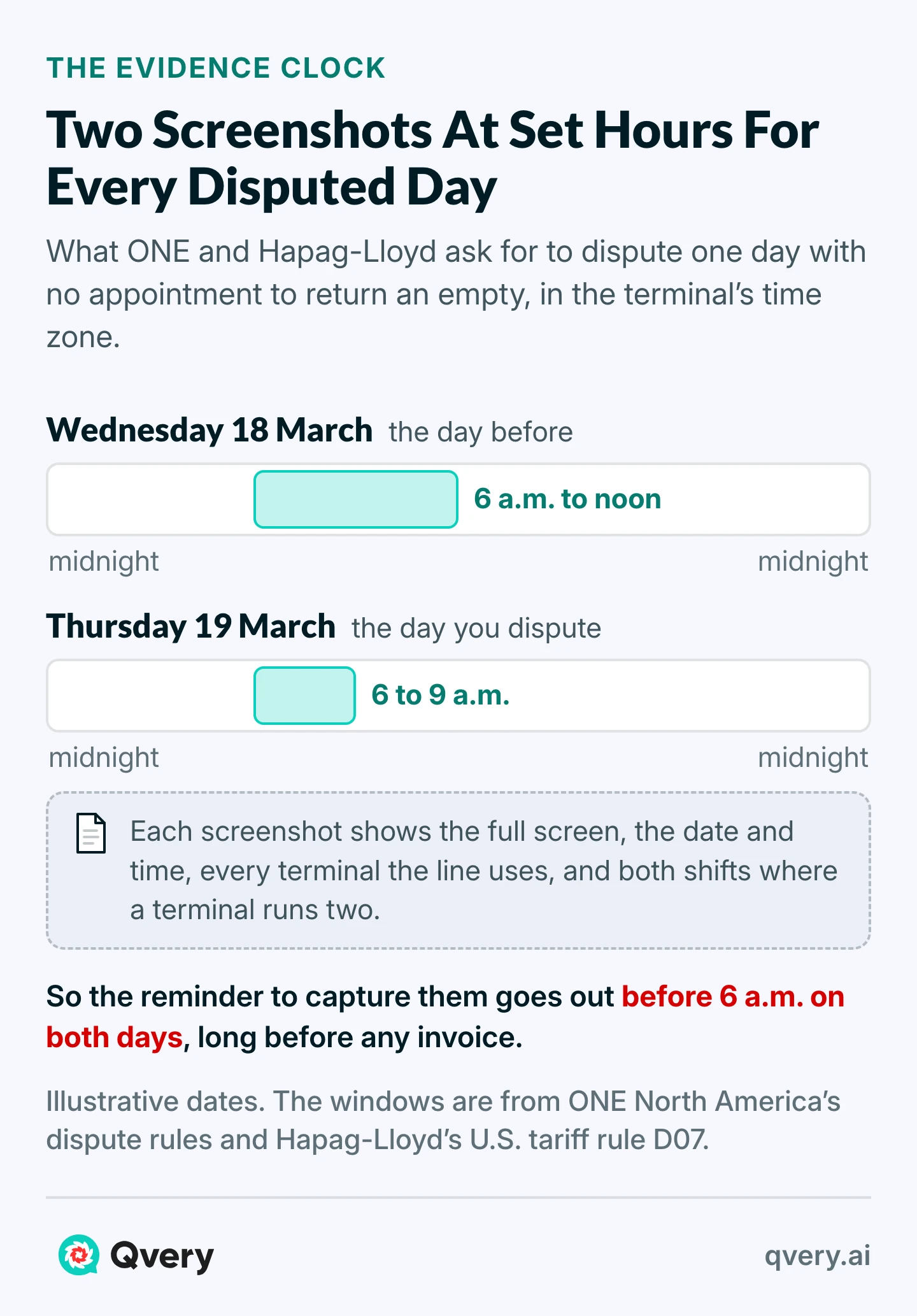
No one can take Thursday morning's screenshot on Friday. So the check can't start when the invoice arrives. It has to start at the arrival notice, when the last free day is known and someone can be told which screens to capture, and when.
The invented container's detention ran 19 to 24 March: six days, $1,350. The trucker found no empty-return appointment on 19 and 20 March. Those two days, at least $400, can be disputed only if someone took the screenshots in time. And an invoice that sits unopened in a shared inbox for two weeks has spent half its dispute window.
What Our Agents Do From the Arrival Notice
An assistant checks one invoice when someone remembers to run it. The agents we build for a shipper or a forwarder check all of them, on autopilot, from the moment the arrival notice lands, early enough to save the evidence.
Take the invented container. The agents work in the shared inbox where arrival notices, terminal notices and invoices land, with the trucker's gate slips, your service contracts and the carriers' published tariffs. Its arrival notice opens a file: discharge, availability, the last free day for demurrage and the terminals the line uses for returns.
When the trucker picks it up, the detention deadline joins the file. From the last free day on, every day the container hasn't moved or the empty hasn't gone back, the agents tell the dispatcher or the trucker which terminal screens to capture and in which window, and file each screenshot under the container and the date.
When the invoice arrives, they match it to the file, run the rule's list, the 30-day test and the recount, and write a verdict: pay, pay part with the reason for the rest, or not owed under the rule. They read only your own mail and systems and pages whose terms allow automated reading; for carrier portals that don't, they hand a person a list of what to open.
Nothing is paid or sent without the person who owns disputes signing it, and the agents never decide that a charge is worth fighting.
What they may open is set in a written agreement, your data is processed where that agreement says, and every check and verdict is logged. For the first weeks a person reads every verdict; which checks may later run without that review is your decision, in writing.
The build starts with how your team handles these bills today: who gets the arrival notices, who books the trucker, who signs a dispute. We train whoever signs disputes to work from the verdicts.
The weekly report shows the hours saved and the errors avoided, from charges paid that the rule says you didn't owe to disputable days lost because nobody took the screenshots.
A Person Still Decides
The agents can tell you a charge fails the rule. They can't tell you whether to fight it. Who is liable is a question the rule doesn't settle, and whether the invoice's reason holds is a judgment, sometimes a lawyer's.
How hard to push is a business call: the line that billed you also carries your freight. And when a documented dispute is still denied, a person decides whether to file the FMC's charge complaint; the agents assemble the file.
What We Need From a Month of Your Invoices
Bring a month of demurrage and detention invoices with the arrival notices and gate slips behind them. For the first weeks, the agents write a verdict beside each invoice while your team pays as before, and the first version runs on your containers within two weeks of access.
Frequently asked questions
Can AI write the dispute for me?
An assistant can check the invoice against the rule, recount the days from your documents and list the evidence each disputed day needs, and an agent can draft the request with that evidence attached. A person checks the recount against the gate slips and decides what to send.
What if the carrier rejects the dispute?
For U.S. shipments you can file a charge complaint with the Federal Maritime Commission. The carrier has to prove its demurrage or detention charge was reasonable.
Does the rule cover invoices my freight forwarder passes on?
Yes. The FMC has said a forwarder that passes an invoice through is still bound by the content rule, so its version has to carry the same facts.
What is the difference between demurrage and detention?
Two clocks. Demurrage runs while a full container sits at the terminal after its free time, the days allowed before charges start. Detention, which some lines call per diem, runs while the line's container is out of the terminal and not yet returned empty.
When does a demurrage or detention invoice not have to be paid?
Under the FMC's rule, 46 CFR Part 541, when it leaves out any fact the rule lists, from the container to each date charged, or when it is issued more than 30 calendar days after the last day charged. Either one ends the obligation to pay.
Does the FMC demurrage rule apply to my shipments?
It applies to U.S. shipments and has been in force since 28 May 2024. It lists the facts every demurrage or detention invoice must show.
How much can one late container cost in demurrage and detention?
In this post's invented example on one large carrier's Houston rates, six days late on each clock comes to $3,120. A single wrong day costs $200 to $370 on that carrier's U.S. tariffs.
How can a terminal closure change a demurrage bill?
In this post's invented example, a weather closure on 3 March fell inside free time and ran it to 9 March, cutting demurrage from six days to three: $810 instead of $1,770, a $960 difference.
What evidence wins a no-appointment dispute?
Carriers that accept no-appointment disputes want timed screenshots of the terminal appointment system in set morning windows on and before the disputed day. The check starts at the arrival notice so the evidence can be captured before the invoice arrives.
Why do companies pay demurrage charges they don't owe?
A few hundred dollars a day doesn't look worth a fight with the line that carries next month's freight, and checking takes time: forty invoices a month at half an hour each is twenty hours of someone's time.
How much does checking demurrage invoices by hand cost?
About $9,180 a year in this post's example: one clerk spending about 12% of the year on some 40 invoices a month, at about $76,500 with benefits. The bigger cost is the charges paid that weren't owed: about $110,592 a year on the same example.
What are the unowed charges worth compared with the checking time?
Much more than the hours. With 30% of 40 invoices a month carrying about $960 not owed, $110,592 a year gets paid today. With the agents refusing 70% instead of a fifth, that falls to $41,472, and every $10,000 of build is earned back in about 1.8 months.
What verdict do demurrage agents give on an invoice?
Pay, pay part with the reason for the rest, or not owed under the rule. They match the invoice to the container's file, run the rule's list, the 30-day test and the recount of days.
Can demurrage agents read every carrier portal automatically?
Portal terms limit automated reading. The agents read your own mail and systems and pages whose terms allow automated reading. For carrier portals that prohibit it, they give a person a list of what to open.
How do you start with demurrage and detention agents?
Bring a month of invoices with the arrival notices and gate slips behind them. For the first weeks, the agents write a verdict beside each invoice while your team pays as before.
Which disputed days need screenshots in the example?
The detention days when no empty-return appointment existed. The invented container's detention ran 19 to 24 March, $1,350, and the trucker found no appointment on 19 and 20 March: at least $400 that can be disputed only with screenshots taken in time.
What do the agents do between the arrival notice and the invoice?
Arrival notices open container files with demurrage deadlines; pickup adds detention deadlines. From the last free day on, agents tell dispatchers or truckers which terminal screens to capture and in which window. Instructions continue daily while containers have not moved or empties have not returned.