On this page
- About One Logistics Business in Eight Uses AI, Half the National Rate
- At 100 to 249 Employees, About Two Companies in Five Use AI
- Industry Surveys Find More AI Because They Ask Different Companies
- Few Logistics Companies Can Show What AI Returned
- Data Entry Is the Most Common Job Logistics Gives AI
- Missing Expertise Holds Logistics Back More Than Cost
- The Number to Get First Is Your Own Return
- Frequently asked questions
Forwarders, brokers, carriers and warehouse operators of a few hundred people still run on documents that arrive by email: rate confirmations, bills of lading, proofs of delivery, carrier invoices. Someone reads each one and keys it into the system where every load lives (the transportation management system, or TMS), then again into accounting. Meanwhile every vendor deck and trade-show stage says the industry already runs on AI.
So the owner's questions are practical. How many companies like mine use AI, on what work, and can any of them show what it paid back? The figures below answer each one with the group that was asked, because the surveys behind the headlines asked very different companies.
Among US companies with 100 to 249 employees, about two in five now use AI, in logistics as across all industries,1 and few logistics companies of any size can say what it returned.
About One Logistics Business in Eight Uses AI, Half the National Rate
The widest count is the US Census Bureau's business survey, sent every two weeks to a sample of all US employer businesses. In the round of 19 October to 1 November 2026, 12.6% of transportation and warehousing businesses said they had used AI in any business function in the previous two weeks,1 against 24.2% of all businesses.1
A year earlier, in the first round asked this way, the two figures were 7.9%1 and 17.3%.1
In the EU, 11.15% of transport and storage companies with ten or more people used at least one AI technology in 2025, up from 5.26% in 2023,4 while 19.95% of all companies outside farming, mining and finance did.4
Both figures average a whole sector, from small carriers to national warehouse operators, though Eurostat leaves out companies under ten people. Census's own researchers put transportation and warehousing among the sectors with much lower adoption, beside manufacturing and construction.5
More US Businesses Use AI Than a Year Ago, and Larger Ones Use It Most
% of businesses
View the data
At 100 to 249 Employees, About Two Companies in Five Use AI
Among all US businesses with 100 to 249 employees, 40.0% used AI in the latest round, up from 23.7% a year earlier.1 At 250 or more employees it was 44.1%,1 and among the smallest businesses, one to four people, 22.8%.1
Transportation and warehousing follows the same slope, and steeper. 39.5% of businesses with 100 to 249 employees in the sector used AI in the latest round,1 and 58.1% of those with 250 or more.1
Few companies that size land in each round's sample, so both estimates are rough: Census's standard errors on them, its own measure of how far a reading may be off, are 12.92 and 14.11 points.1
The pattern holds better than any one round does. In all 20 rounds since the question changed where Census published the 100-to-249 estimate, it sat above the sector's overall rate.1
Eurostat's figures across all sectors show the same pattern by size: 30.36% of companies with 50 to 249 people used AI in 2025, and 55.03% of those with 250 or more.4
AI Use in US Transportation and Warehousing Rises With Company Size
% of businesses
View the data
So the one-in-eight figure says little about your peers.
Among US businesses with 100 to 249 employees, two in five used AI in those two weeks and three in five did not,1 which leaves a company that size without AI still in the majority.
Industry Surveys Find More AI Because They Ask Different Companies
The higher numbers come from industry surveys of 30 to 616 companies, and they describe whoever answered.
| Survey | Who answered | Share using AI |
|---|---|---|
| US Census Bureau, October 2026 | US transportation and warehousing businesses of every size | 12.6% in the last two weeks1 |
| Eurostat, 2025 | EU transport and storage companies with 10 or more people | 11.15%4 |
| US Census Bureau, October 2026 | US transportation and warehousing businesses with 100 to 249 employees | 39.5%, with a wide margin1 |
| BCG and Alpega, January 2026 | 84 logistics providers, from small third-party logistics providers to global carriers | About 40% beyond pilots2 |
| Descartes and Sapio Research, 2025 | 616 shippers and logistics providers in the US, Canada and Western Europe | 96% use generative AI3 |
Descartes sells transportation management software; with Sapio Research it surveyed 616 participants, split evenly between logistics providers (brokers, forwarders and third-party logistics providers, the warehouses and transport firms that run freight for other companies) and shippers, the manufacturers, distributors and retailers whose freight it is.3 96% of them said they use generative AI in their operations.3
BCG and Alpega, a logistics software company, asked 84 logistics providers and 98 shippers in January 2026,2 and about 40% of the providers run AI beyond pilots.2 Large forwarders and third-party logistics providers, BCG notes, are well ahead of smaller ones.2
I read the distance between 12.6% and 96% as mostly the sample, plus the question. One survey asks every business about any AI in the last two weeks; the other asks 616 companies that answered a transportation software company's survey, about one kind of AI.
Shippers are starting to ask. More than 40% of shippers in BCG and Alpega's survey take a provider's AI into account when choosing one; fewer than 10% treat it as mandatory.2
Few Logistics Companies Can Show What AI Returned
Of BCG and Alpega's 84 providers, only 13% report measurable value, such as lower unit costs, better service levels or margins, from AI in daily operations,2 and one in ten has embedded it in core operations at scale.2 Shippers report less: almost 70% are still exploring or piloting, 7% can point to measurable improvements, and 1% have AI in their core logistics processes.2
At the top of the industry the gap is the same. In BCG's 2026 survey of 30 leading global logistics companies, 97% of executives call AI a strategic priority and 67% have a dedicated budget, but 13% say AI delivers measurable financial impact.6 Asked for their most impactful AI, 80% named a single standalone tool.6
Among 30 Leading Logistics Companies, Few Can Show What AI Returned
% of executives
View the data
The bigger returns on record are an estimate and one company's account. BCG estimates that running AI across a whole logistics operation would lift earnings margins (EBITDA, profit before interest, taxes, depreciation and amortization) by roughly 5 points.6
Flexport's president told BCG that over 70% of the forwarder's ocean operations are automated and that its cost to serve is on track to fall by around 30% within a year.6
Neither is a measurement across the industry: one is a consultancy's estimate, the other one large forwarder's account.
Descartes found the same split from the other side, between companies that automated their transportation work and companies that did not.
Over a third of respondents still lean mostly on manual work.3 The survey shows automation and results travel together; it cannot say which came first.
Most logistics companies using AI say it has not changed how many people they employ.
Of US transportation and warehousing businesses using AI, 87.6% say it has not changed how many people they employ over the last six months, and 9.9% say it raised the number.1 Across all US businesses using AI, 2.5% report a decrease.1 In BCG and Alpega's survey, about half of providers expect to retrain people, and fewer than 30% expect AI-led staff reductions soon.2
Data Entry Is the Most Common Job Logistics Gives AI
When Descartes asked where respondents use generative AI, data entry came first at 41%, ahead of route and load optimization at 39% and freight forecasting and automated load matching at 35% each.3 Customer service chatbots followed at 34%.7
Where Shippers and Logistics Providers Use Generative AI
% of respondents
View the data
In the EU, the AI technology transport and storage companies use most is the analysis of written language, at 5.92% of them, ahead of speech recognition at 4.04%.4 Only 2.14% use AI for logistics itself, the planning and moving of goods.4
Across US businesses whose workers use generative AI, writing and editing is the most common task, in 85% of them, with document analysis and information search next.5 The use is also narrow: 57% of US businesses using AI apply it in three or fewer business functions.5
BCG and Alpega's providers name transport planning and execution most often, at 64%, then tracking and visibility at about half.2 For a company your size, the document figures are the ones that match where a coordinator's day goes.
If those coordinators still answer rate requests, chase shipment status and check carrier bills by hand, our logistics playbook prices each of those three jobs and the agent that takes it over.
Missing Expertise Holds Logistics Back More Than Cost
Eurostat asks companies that do not use AI why not. In transport and storage, the reason given most is a lack of relevant expertise, named by companies making up 6.05% of the sector, ahead of unclear legal consequences at 4.47% and data protection at 4.45%.4 Cost comes lower, at 3.45%.4
In BCG's survey of 30 leading global logistics companies, 37% of executives name a lack of internal AI expertise as their main barrier.6 BCG and Alpega found roughly 40% citing an unclear return and internal capability gaps.2
Upfront cost weighs most on small firms: 44% of respondents at small firms call it a hurdle, against 25% at large ones.2 The motive is cost: nearly 80% of providers and shippers adopt AI to cut costs and run more efficiently.2
Intentions in the sector are modest too. 15.6% of US transportation and warehousing businesses expect to use AI in the next six months, against 27.6% of all businesses.1 Among the supply chain leaders MHI and Deloitte surveyed, 48% rate the change AI brings to supply chains as significant or greater, up 25 points in a year.8
The Number to Get First Is Your Own Return
For a company your size, AI use is common enough among your peers to take seriously, few companies report a measurable return from it, and the work it most often does is reading documents. So my suggestion for a first job is a document job whose return you can count.
Freight paperwork fits, because every rate confirmation, bill of lading and carrier invoice either matches the load in your TMS or it does not. What one coordinator spends on that matching today, in hours and in mistakes caught late, is the number no survey above can give you, and it can be counted from the first week.
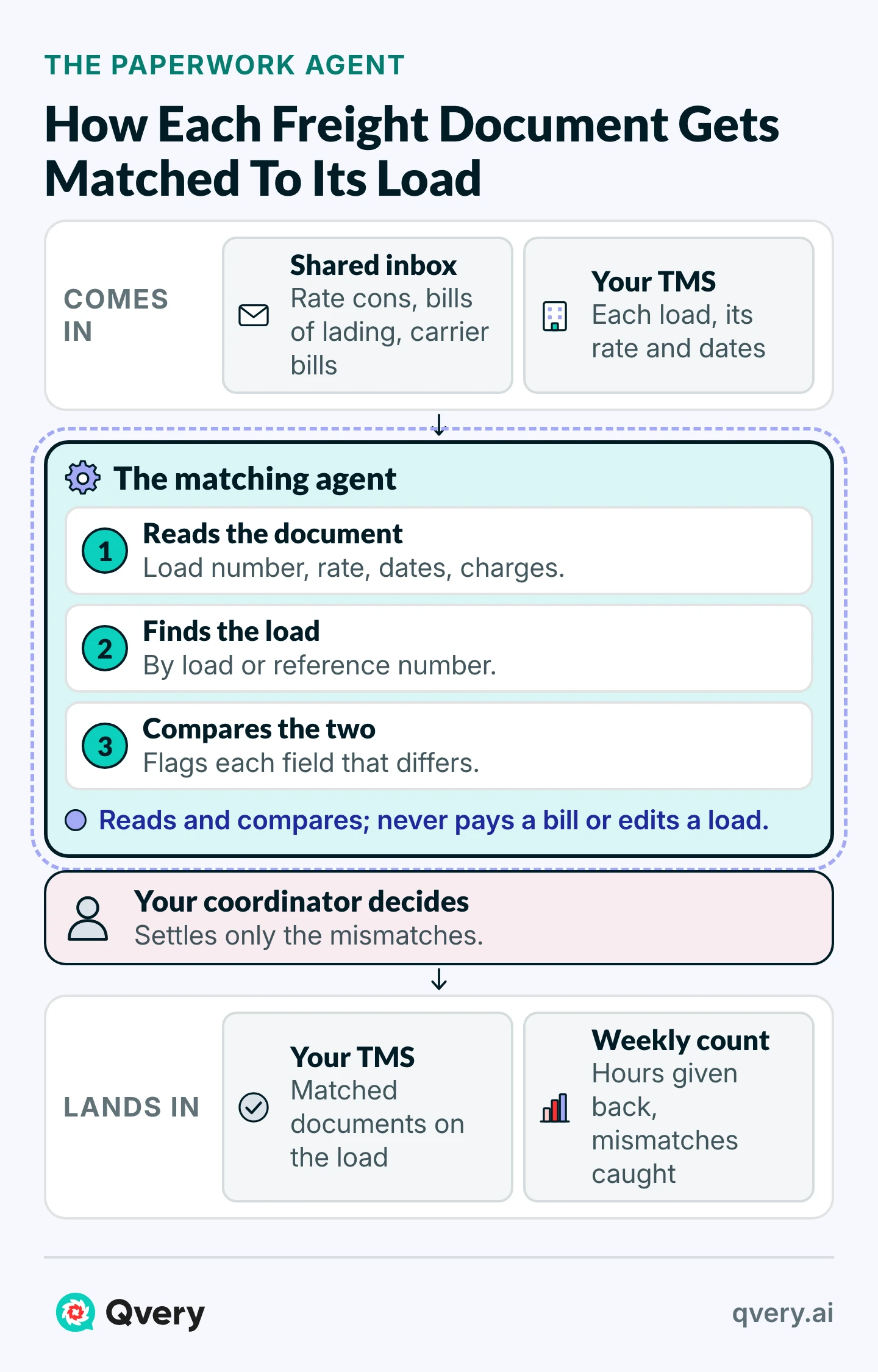
Our agents work inside the inbox and the TMS you already run. The first one is working on your own documents two weeks after we get access, and every week we report the two numbers these surveys rarely have: hours given back to your coordinators, and mismatches caught before an invoice was paid.
Frequently asked questions
What percentage of logistics companies use AI?
It depends on size. In the US Census Bureau's survey of 19 October to 1 November 2026, 12.6% of transportation and warehousing businesses used AI in the previous two weeks.1 Among those with 100 to 249 employees the estimate was 39.5%, with a wide margin.1 In the EU, 11.15% of transport and storage companies with ten or more people used AI in 2025.4
How many logistics companies get a measurable return from AI?
Few. In BCG and Alpega's January 2026 survey, 13% of logistics providers report measurable value from AI in daily operations,2 and among shippers it is 7%.2 In BCG's separate survey of 30 leading global logistics companies, 13% say AI delivers measurable financial impact.6
Are shippers or logistics providers further along with AI?
Providers. About 40% of the providers BCG and Alpega surveyed run AI beyond pilots,2 while almost 70% of shippers are still exploring or piloting and 1% have it in core logistics processes.2 Shippers still watch their providers: more than 40% weigh a provider's AI when choosing one.2
Do these statistics apply to a company of 200 people?
The size splits do. Census puts AI use at 40.0% among all US businesses with 100 to 249 employees1 and 39.5% in transportation and warehousing at that size, with a wide margin.1 The provider surveys mix every size, and BCG notes that large forwarders and third-party logistics providers are well ahead of smaller ones.2
Which logistics AI statistics come from vendors?
Several. Descartes, which sells transportation management software, ran the survey behind the 96% generative AI figure,3 and BCG ran its January 2026 survey with Alpega, a logistics software company.2 The US Census Bureau and Eurostat are government statistics offices that sample businesses of every size. Read each figure with the group that answered.
Is AI reducing jobs in logistics?
Rarely, so far. Of US transportation and warehousing businesses using AI, 87.6% say it has not changed how many people they employ over the last six months, and 9.9% say it raised the number.1 Across all US businesses using AI, 2.5% report a decrease.1 About half of BCG and Alpega's providers expect to retrain people instead.2
What do logistics companies use AI for most?
Paperwork first. In Descartes' survey, 41% of respondents use generative AI for data entry, 39% for route and load optimization, and 35% for freight forecasting.3 Analysis of written language is the most used AI technology among EU transport and storage companies, at 5.92%.4 Large providers in BCG and Alpega's survey lead with transport planning, at 64%.2
Why do surveys about AI in logistics disagree so much?
They ask different companies different questions. Census samples every US business and asks about any AI in the last two weeks, and finds 12.6% in transportation and warehousing.1 Descartes asked 616 shippers and providers about generative AI and found 96%.3 Company size, the kind of AI and the time window asked about each move the result.
What stops logistics companies from using AI?
Mostly a lack of expertise, more than cost. Among EU transport and storage companies, it is the reason given most for not using AI, ahead of cost.4 In BCG's survey of the 30 leading global logistics companies, 37% name a lack of internal AI expertise as their main barrier.6 Upfront cost weighs more on small firms: 44% call it a hurdle, against 25% at large ones.2
What counts as using AI in these surveys?
Each draws the line differently. Census counts any computer system that performs tasks normally needing human intelligence, used in any business function, with examples from forecasting and pricing to virtual customer service agents.9 Eurostat counts any of a fixed list of AI technologies, such as text analysis or speech recognition.4 Descartes asked only about generative AI.3
How fast is AI use growing in logistics?
It is growing from a low base. The share of US transportation and warehousing businesses using AI rose from 7.9% to 12.6% in the year to November 2026.1 In the EU, transport and storage companies using AI went from 5.26% in 2023 to 11.15% in 2025.4 Census also finds 15.6% of the sector expecting to use AI within six months.1
Sources
- US Census Bureau: Business Trends and Outlook Survey: Data Downloads (2026)
- Boston Consulting Group: AI Is Already Moving the Logistics Industry Forward (2026)
- Descartes Systems Group: Descartes' 9th Annual Study Finds Transportation Management Reaches Record Strategic Importance (2025)
- Eurostat: Artificial Intelligence by NACE Rev.2 Activity (2026)
- US Census Bureau: The Microstructure of AI Diffusion: Evidence from Firms, Business Functions, and Worker Tasks (2026)
- Boston Consulting Group: AI Hasn't Fully Paid Off Yet in Logistics. But It Will. (2026)
- Descartes Systems Group: 2025 Transportation Management Benchmark Survey (2025)
- MHI: New MHI and Deloitte Report Finds AI is Biggest Disruptor of Supply Chains Over the Next Decade (2026)
- US Census Bureau: Business Trends and Outlook Survey: Questionnaire, Cycle 2 (2026)