On this page
A third-party logistics provider (3PL), the warehouse that stores and ships goods for other companies, runs on its customers' orders. The biggest customers send them straight from their own systems. Everyone else emails them, and a Monday in the orders inbox looks like this:
- A purchase order as a PDF, listing the customer's own item codes instead of yours
- A spreadsheet laid out differently from the one the same customer sent last week
- "Same as last time, but 40 cases instead of 30" in the body of an email
- A phone photo of a handwritten order sheet
- A change to an order your rep entered an hour ago
Your customer service reps type every one of those into the warehouse management system (WMS) before anyone can pick. Three reps doing that for most of their week cost about $124,000 a year, and every order typed by hand can ship wrong.
At Qvery, we help 3PLs spend less on order entry and keep their reps on customers, with custom AI agents that read every emailed order as it lands, check each line against the customer's item list and enter the routine orders in your warehouse system.
What the Retyping Costs a 250-Person 3PL
Take a 3PL of about 250 people whose three customer service reps spend 60% of their week entering emailed orders. Order clerks, the Bureau of Labor Statistics' category for this work, earned a mean $48,220 in May 2025, and benefits are 30% of what private employers spend on a worker.
| What it takes | The example |
|---|---|
| Reps entering orders | 3, at 60% of their week |
| Cost per rep, pay and benefits | $68,900 |
| Hours on order entry | 3,744 |
| Cost of the desk | $124,020 |
| Orders keyed wrong | About 31 a month, at $120 each |
| Cost of those mistakes | $44,640 |
The mistakes are planning figures (one order in a hundred, each costing a re-pick, a second shipment or a credit), so swap in your own. Neither line appears on your P&L: one hides in customer service payroll, the other in the cost of mis-ships.
Put your own desk in. The calculator opens on the example, with AI agents taking 75% of the entry: the orders from known customers for known items.
3PL Order Entry ROI Calculator
What Entering Emailed Orders Costs You, And What An Agent Saves
Saved Per Year
$83,415
2,808 hours handed back, after $9,600 a year to run it
- Hours Handed Back
- 2,808 hours a year
- Agent Running Cost (Estimate)
- $800 a month
- Payback Per $10,000 Of Build
- 1.4 months
On these numbers, the agent saves $83,415 a year after its own running cost, and every $10,000 of the build is earned back in 1.4 months.
On the example, the desk falls from $124,020 to $40,605 a year, the agent's running cost of about $800 a month included. That is $83,415 a year and 2,808 hours handed back.
Every $10,000 of the build is earned back in about 1.4 months. Stop 70% of the mis-keyed orders and add $31,248 a year.
One Order, From the Inbox to the Pick List
An order lands at 7:40 with a spreadsheet attached: 40 lines in the customer's own codes.
Within a minute the agent has mapped each code to your item through that customer's cross-reference, checked the units against how the item is stocked (cases, not single units), confirmed the ship-to is on file and made sure the order is not a repeat of yesterday's.
Thirty-nine lines go into the WMS as an order, with the email attached and a confirmation drafted for the customer. Line 22 names an item the customer has never ordered, so the order waits for a rep with that one line marked.
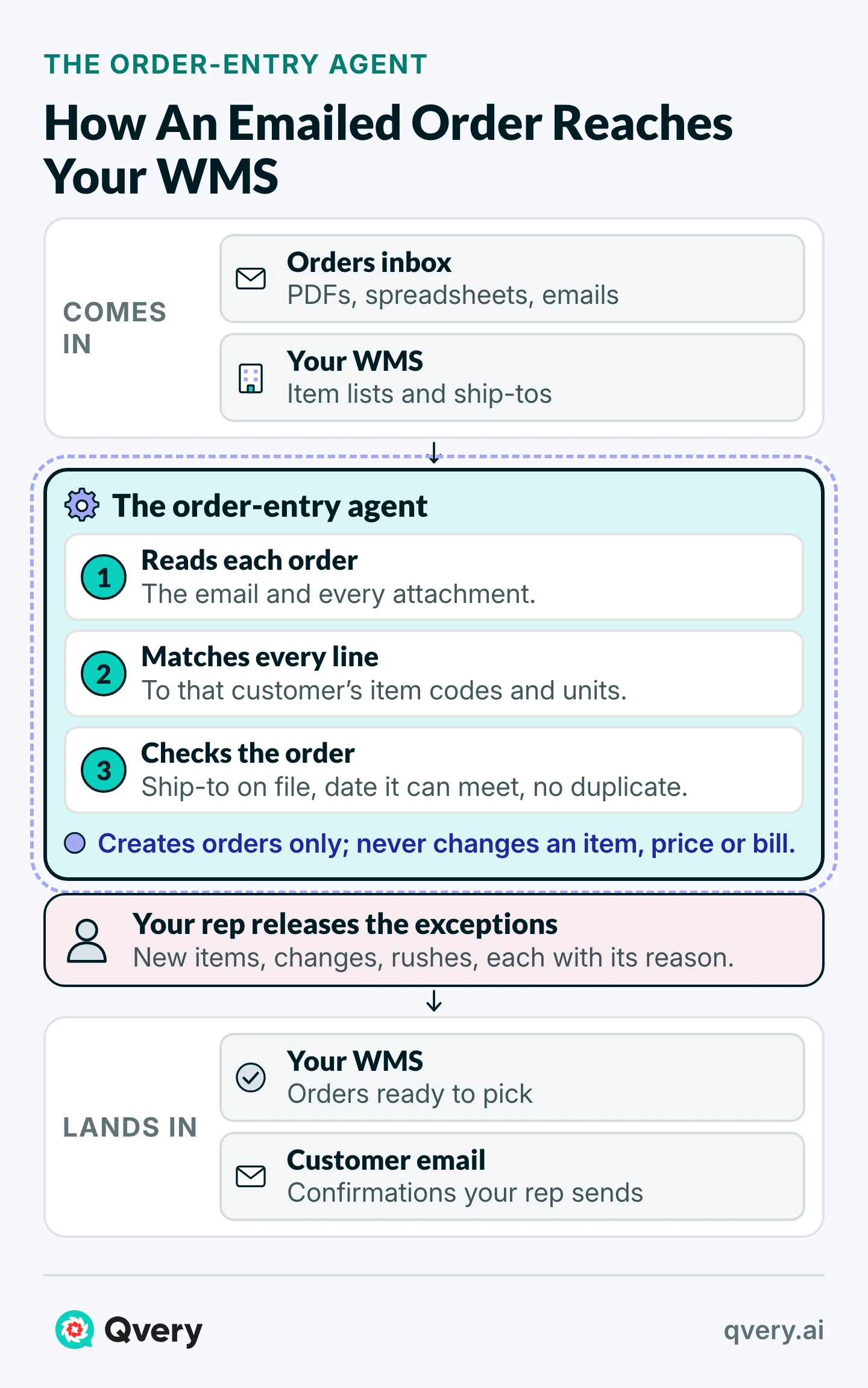
New items, new addresses, changes to an entered order, rush requests and price questions always go to a person. Your rep sees the order with the email beside it, decides in seconds and moves on.
What the Agent May Touch, and What It Never Does
Before it touches anything, we agree in writing what it may read and do, and where its data is processed.
| It may | It never |
|---|---|
| Read the orders inbox and its attachments | Change an item, a price or a customer's billing |
| Read item lists, ship-to records and recent orders | Edit or delete an order a person entered |
| Create orders through its own WMS user | Send a confirmation before a rep releases the order, in the first weeks |
| Log every action against the email behind it | Guess at a code, a unit or an address it cannot match |
After the first weeks, your rules decide which customers' routine orders go straight through. Qvery is an EU company and signs a data processing agreement before the build.
Working With Us on Your Order Desk
We learn how your reps handle each customer's habits, connect the agent to the inbox and a WMS user of its own, and run it on your real orders. Two weeks after access is in place, it is entering orders and your reps are releasing the exceptions.
Every week after that, we report the orders it entered, the hours it handed back and the mistakes it stopped. The price is fixed for that result before we build.
Frequently asked questions
Can AI agents read scanned or photographed purchase orders?
Yes, as long as a person could read them. Printed scans and phone photos read well. Handwriting is less reliable, so a customer who handwrites orders has them sent to a rep until the agent has proved itself on that customer's forms.
What happens when a customer orders an item that is not in our system?
The agent does not guess. The order waits for a rep with the line it could not match, and your rep sets the item up or asks the customer. Once the item is on the customer's list, the agent matches it on every order after that.
Does it work with our WMS?
It enters orders the way your WMS already accepts them from software: an API, an import file or an EDI-style file. We confirm which in the first conversation, and the agent works with any of the three.
How does it handle a customer who uses their own item codes?
Through the cross-reference your team already keeps, or one we build with you from past orders: the customer's code on one side, your item on the other. A code it has never seen goes to a rep instead of being guessed.
Can it read spreadsheets when every customer lays theirs out differently?
Yes. The agent reads the columns for what they hold rather than where they sit, so one customer's "Qty" in column C and another's "Units Ordered" in column F both land as the quantity. A layout it cannot place goes to a rep.
Can the agent also book the freight in our transportation system?
Yes, when an order needs transport you arrange. The same email that creates the order can create the load in your transportation management system (TMS), under the same rules and the same review. We usually prove the order entry first and add the freight once your team trusts it.
What happens if the agent stops working?
Nothing is lost. Every order email is accounted for as entered, flagged or waiting, and anything the agent has not touched stays in the inbox for your team to enter as they do today. We are alerted the moment it stops.
What does our team need to do to keep it running?
Keep the item lists and ship-to records current, as you already do for your reps. When you take on a new email customer, we add their order formats in a short setup, and every one of their orders waits for a rep until the agent has proved itself on them.
How do we know it is accurate before we trust it?
For the first weeks every order it prepares waits for a rep to release it, and you see its accuracy customer by customer. You then decide which customers' routine orders go straight through and which stay on review.
Who can see our customers' order data?
Only the systems and people we agree in writing before the build, including where the data is processed. Qvery is an EU company and signs a data processing agreement, the agent gets the least access the job needs, and every action it takes is logged.
What does the agent cost to run?
At about 150 orders a day, expect a few hundred to around a thousand dollars a month: model usage of a few cents per order, plus hosting and upkeep. The build is a fixed price, agreed before any work starts.
Will it replace our customer service reps?
It takes the typing, not the people. Reps keep the exceptions, the customer conversations and the problems that need judgment. The hours are worth the most when they go to growth you would otherwise hire for.
How much can AI agents save a 3PL on order entry?
In this post's example of a 250-person 3PL, the order desk falls from $124,020 to $40,605 a year, running cost of about $800 a month included: $83,415 and 2,808 hours back. Every $10,000 of build is earned back in about 1.4 months.
How often do hand-keyed orders ship wrong?
The example plans for one order in a hundred, about 31 a month at $120 each in re-picks, second shipments or credits. Stopping 70% of them adds $31,248 a year. Swap in your own mis-ship figures.
Why don't smaller customers send orders by EDI?
Customers sending hundreds of orders a week often use electronic data interchange, a direct system-to-system order feed. A distributor sending eight a week will not pay to set it up, and a portal moves the typing onto them.
Which emailed orders always go to a person?
New items, new addresses, changes to an order already entered, rush requests and price questions. The rep sees the order with the email beside it, decides, and releases it.
How long until AI agents enter a 3PL's orders?
Two weeks after access is in place, the agents are entering orders and your reps are releasing the exceptions. Every week after that you see the orders entered, the hours handed back and the mistakes stopped.