
On this page
- Every Document Can Be Real While the Packet Is Wrong
- Most Theft Now Runs Through Carriers That Already Passed
- One Miss Can Cost the Load Twice
- The Comparison Is the Step That Gets Skipped
- What Qvery's Agents Compare on Every Packet
- Your Team Still Calls and Still Decides
- Bring the Packets That Went Wrong to the First Week
- Frequently asked questions
A freight brokerage sets up every new carrier from a packet, the file a trucking company sends before its first load: its operating authority, its certificate of insurance, a W-9 tax form, a bank letter (or one from the factoring company it sells its invoices to) and your signed agreement. Someone on your carrier team checks each document, and the carrier is approved.
Each of those checks asks one question: is this document valid? The authority is active, the insurance is in force, the form is signed. None asks whether the five documents describe the same company, and whether that company is the one answering the email and getting paid.
That gap is where a load goes to the wrong truck, or a payment to the wrong account, with a complete file on record.
Take a brokerage of about 200 people that sets up about 100 new carriers a month. On the example worked out below, one packet a month hides a fraud and your team stops six in ten; the ones that get through, about five a year, cost about $120,000.
| Document | What the usual check confirms | What it says that the others don't |
|---|---|---|
| Operating authority | Active, three years old | Phone number ending 4410, the one on the federal record |
| Certificate of insurance | Issued by a real agency, dates current, limits above your minimum | Named insured at an address in another state |
| W-9 | Complete and signed | Contact email at a domain one letter off the carrier's own |
| Bank form | On letterhead, with a voided check | Account holder: a company named nowhere else in the packet |
| Signed agreement | Signed and dated | Signed by a dispatcher whose phone number isn't on the federal record |
The comparison takes a person about twenty minutes a packet. It's the step that disappears on a busy afternoon, and it's the one that finds the four lines above.
Every Document Can Be Real While the Packet Is Wrong
A carrier's identity is spread across documents that come from different places. The authority comes from the Federal Motor Carrier Safety Administration (FMCSA), the agency that registers carriers: an MC number for hauling across state lines and a USDOT number.
The certificate comes from an insurance agency, the W-9 from the carrier itself, the bank letter from its bank or its factoring company, the business that buys a carrier's invoices and collects on them.
Each source vouches only for its own page. A fraud gets through on genuine documents when one field in them points to someone other than the carrier, so these fields should agree across the packet and with the federal record:
- Legal and trade names: the same wherever each appears, on the authority, the certificate, the W-9 and the bank form.
- MC and USDOT numbers: digit for digit, on every page that prints them.
- Address: the authority's, the certificate's and the W-9's.
- Phone and email: against the numbers and contacts on the federal record, and against each other.
- The certificate: its named insured is the company on your authority, and its trucks are the ones the carrier sends, by vehicle identification number (VIN).
- The payee: the carrier itself, or a factoring company named in a signed notice of assignment, the carrier's written instruction to pay its factoring company instead.
Some disagreements are legitimate. Once a carrier that factors its invoices sends that notice, the commercial code says you settle an invoice only by paying the factoring company. A carrier may trade under a name that isn't its legal one. A twelve-year-old trucking company may still run on a Gmail address because changing it now would get it flagged.
A useful comparison knows those cases. It clears a payee that a notice of assignment explains and asks about one that nothing explains. A blunt rule, such as refusing every Gmail address or every recent phone change, stops good small carriers and still waves through the fraud that kept the carrier's real email.
Most Theft Now Runs Through Carriers That Already Passed
The packet is checked once. The carrier's identity is then used for months, by email and by phone, and that's where the largest share of reported theft now comes in.
WTW, the insurance broker, published a worked example that reads like many of the cases brokers describe. The broker booked a load on a carrier whose identity was real, but the information and the email used to book the load belonged to someone else.
The FBI's April 2026 alert describes it at scale. Criminals get into brokers' and carriers' systems through spoofed emails, fake links and hacked accounts, then, posing as the carrier, change its contact details with the FMCSA and its insurance information, so a check against the record confirms them. The real carrier may not know until a broker calls about a load it never booked.
Highway, a company that sells carrier identity checks to brokers, sorts the stolen loads reported to it by how the thieves got the freight. In the third quarter of 2026, more than 80% of them ran through real carrier identities, by three routes.
Highway: Freight Fraud Index Report, Q3 2026
The packet is the record of the carrier as it was checked, and every later message has to be held against it: the email that accepts the load, the phone number given at dispatch, the new bank form, the renewal certificate with a lower limit.
Theft by the booked carrier leaves nothing to compare. When the carrier you booked takes the freight under its own name, its documents and its emails all agree, and no comparison of paperwork catches it. The agents don't claim to.
One Miss Can Cost the Load Twice
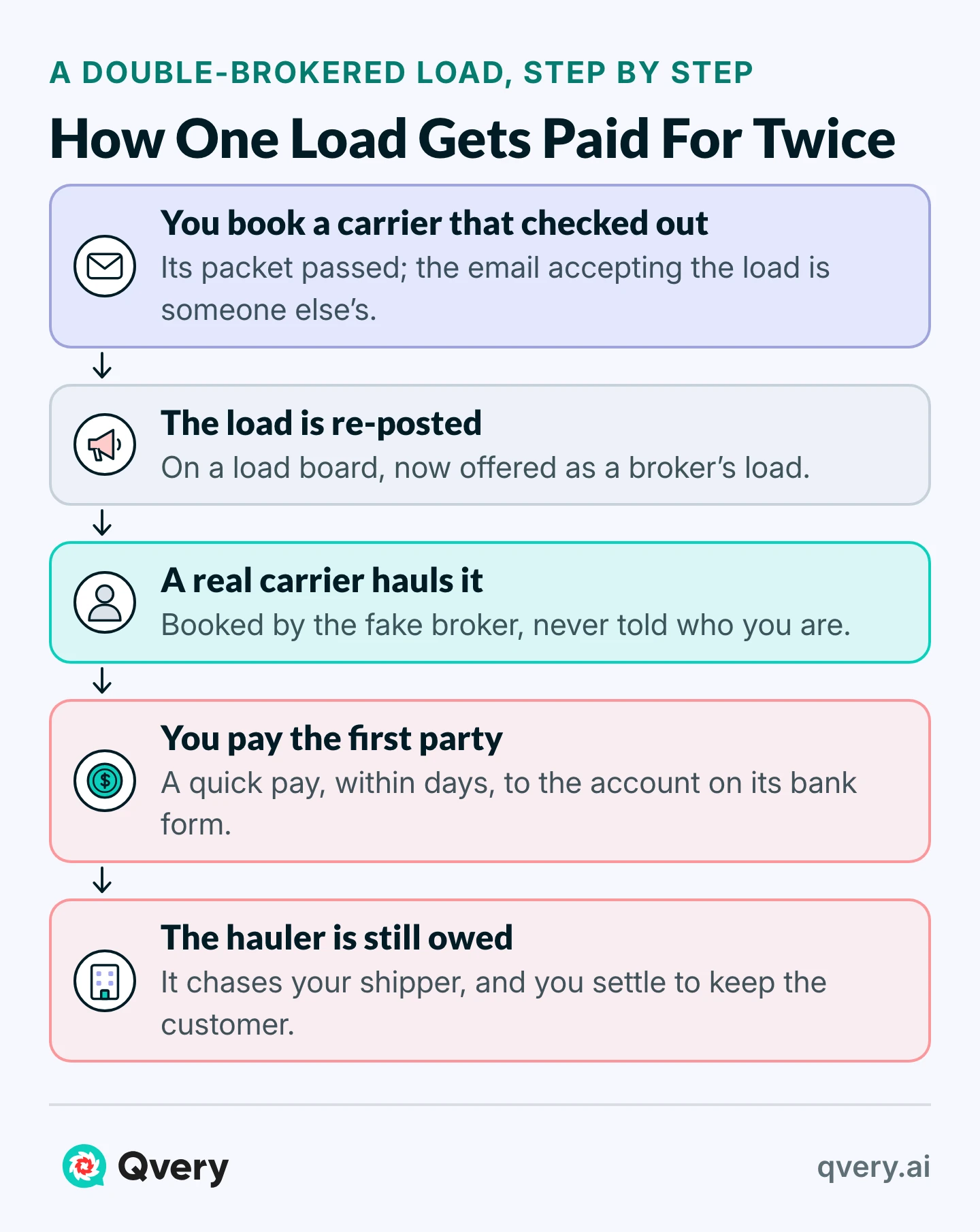
The cheapest miss is a double-brokered load, one passed on without the broker's approval. One broker described paying a $1,600 quick pay (a payment within days instead of on 30-day terms) to a carrier that had re-posted the load as a broker for $2,600 on a load board, the marketplace where loads are offered to trucks. The carrier that hauled it was never paid.
What usually happens next: the unpaid carrier goes after the shipper, and the broker settles with it to keep its customer out of the dispute, so the freight charge is paid twice.
The expensive miss is the load. In WTW's example the carrier's cargo insurance didn't respond, because the carrier never had the freight in its care. The broker's own contingent cargo cover pays only when a carrier's insurer fails a valid claim, and it excluded dishonest acts by any carrier, "real or not real".
A brokerage owner who lost $160,000 of frozen goods had clean reports on the carrier and contact details that its factoring company and insurer had confirmed. The insurer still refused the claim because the truck that took the load wasn't listed on the carrier's policy, a disagreement that sat in the paperwork before the load moved. Losses on that scale are common across the trade.
So the money in this job is the losses, not the twenty minutes.
The calculator opens on the example, for your own numbers: 100 new packets a month, 1% hiding a fraud, $25,000 lost on an average miss (mostly freight charges paid twice, now and then a whole load), 60% stopped today and 90% with the agents.
Carrier Packet Check ROI Calculator
What Packets That Hide A Fraud Cost You, And What The Agents Stop
Recovered Per Year
$81,180
$90,000 more caught a year, after $8,820 to run the agent
- Hidden Frauds A Year
- 12
- Agent Running Cost (Estimate)
- $735 a month
- Payback Per $10,000 Of Build
- 1.5 months
On these numbers, the agent stops $90,000 a year from slipping through, $81,180 after its own running cost, and every $10,000 of the build is earned back in 1.5 months.
On the example, 12 packets a year carry a fraud and $300,000 is at stake. About $120,000 gets through today and $30,000 with the agents.
That's $90,000 kept, or $81,180 after about $735 a month to run them (model use per packet and per later check, hosting and upkeep, an estimate). Each $10,000 spent on the build comes back in 1.5 months.
The 1% is the number to argue with. The first thing our agents read in a partnership is your past packets, and that gives you your own rate.
The Comparison Is the Step That Gets Skipped
At about twenty minutes a packet, 100 new carriers a month is about 33 hours of side-by-side reading. Nobody plans to skip it. It gets skipped at a quarter to five on a Friday, when a load has to cover and the packet looks complete.
A vetting service, the tool most brokerages already pay for, scores a carrier against the federal record and its own network: authority age, inspections, reports from other brokers, recent contact changes. A score doesn't say whether the bank form you were sent names the company on your authority. A carrier can clear one and still send a W-9 under a name its authority doesn't carry.
The brokers who catch these describe the same habit: one record held against another.
Tips from Reddit
How brokers catch a packet that disagrees with itself
Also you can google the routing number for the banking info they provide. If bank name on the info is different than what you’re finding online. Probably fraud
The number change in December to a FL number at the same time as the address change would have caused me to ask them to reply to an e-mail I sent to their e-mail on file.
They will have email addresses that will be one digit different than the legitimate carrier’s email.
Every one of those is a comparison, and every one depends on someone having the time that afternoon.
What Qvery's Agents Compare on Every Packet
When a packet lands in your carrier inbox, or in the folder your onboarding portal exports to, our agents read every page, a phone photo of a voided check included. On the invented packet above, they line up the names, the MC and USDOT numbers and the address on each document, each with its page.
Then come the checks that found the four lines. The phone and email are held against the federal record. The certificate's named insured, dates and limits are read as printed and set against your minimums. The bank form's account holder is held against the carrier's legal name, or against the notice of assignment when your rules allow factoring.
Your carrier team gets one table: what agrees, what differs and what's missing, each with its page, and a note to the carrier asking for every fix at once.
On the invented packet the table opens on the bank form, because a payee nobody can explain is the step where the money leaves.
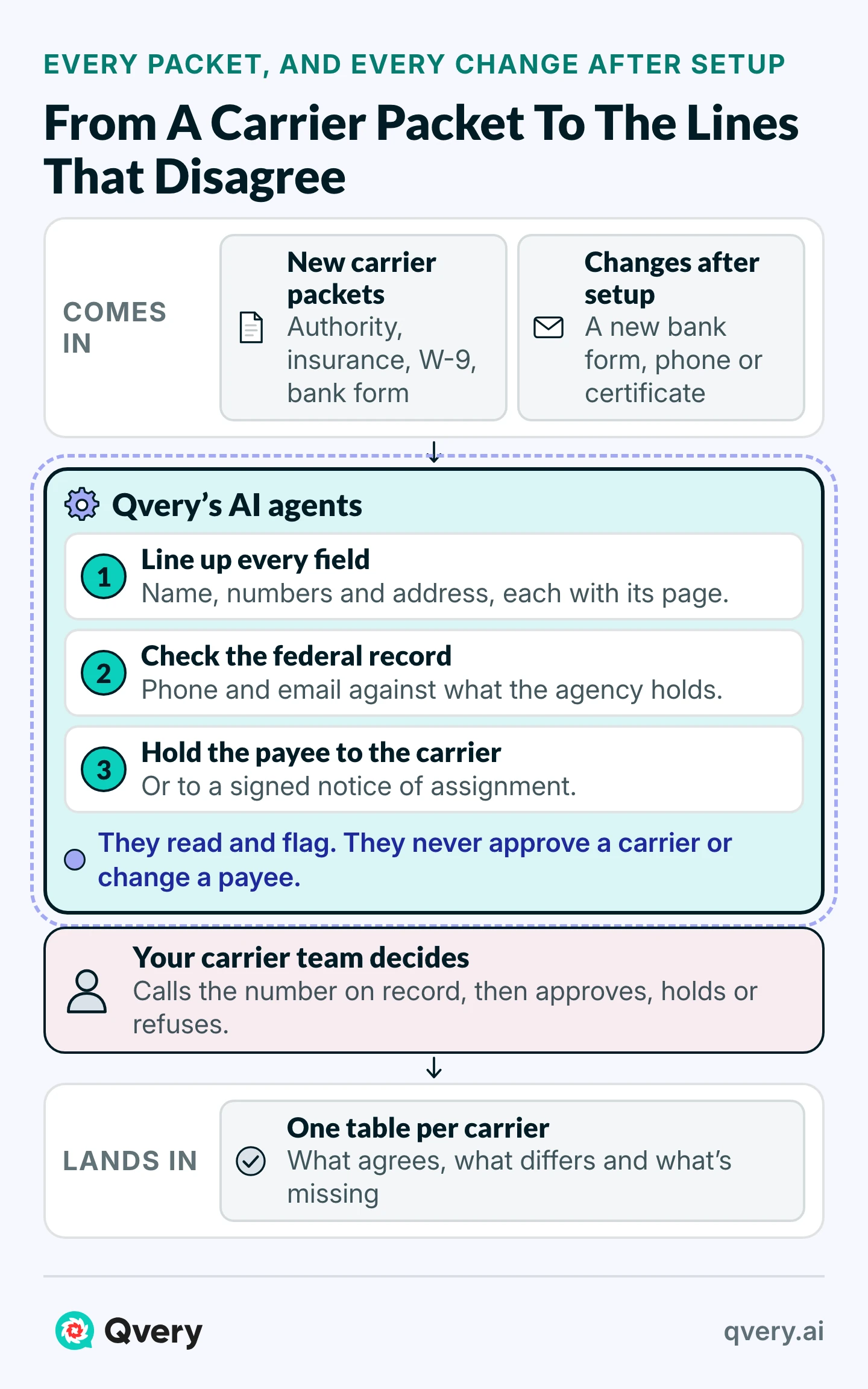
The same file is what everything after setup is checked against. A new bank form, a renewal certificate, a different phone number at dispatch: each is compared with what the packet said, and a difference goes to your team before a load or a payment moves.
To see that table on a packet from your own files, drop one into the comparison below.
 Piotr BabelPartner @ Qvery
The weak point of any comparison is the reference it uses. So our agents never treat a phone number or an email in the packet as the reference. The reference is the federal record and your carrier file, and when they disagree with the packet, the table shows both values with their pages. Nothing gets settled by guessing which one is right.
Your Team Still Calls and Still Decides
Carrier packets hold tax IDs and bank details, and a wrong move here costs money, so the agents' part is narrow and written down before they start.
| The agents | Your carrier team |
|---|---|
| Read the packets, the federal record and your carrier file | Approves, holds or refuses every carrier |
| Flag each disagreement with both values and their pages | Calls the number on the federal record |
| Draft the note to the carrier | Reads and sends it |
| List a new payee or a new bank form | Confirms it by phone before any payment changes |
| Log every comparison with its source | Keeps the file as the record of how the carrier was chosen |
They never vouch that a certificate is genuine or in force; your team still calls the insurance agency.
Tax IDs and account numbers stay out of every table and note. Our company is registered in the EU, the data terms go into a processing agreement you sign with us, and the agents get only the inboxes and records this job needs.
That log matters more since May 2026. The Supreme Court ruled in Montgomery v. Caribe Transport II that a claim a broker negligently hired a carrier can go forward under state law, so the file showing what you checked, and when, is now evidence of how you chose.
Bring the Packets That Went Wrong to the First Week
The partnership starts with your carrier standard: the documents you require, your insurance minimums, how you treat trade names and factoring. We write those into the agents and run them on twenty of your past packets, the ones that went wrong included, while your carrier team checks every line against what they found by hand.
The queue already waiting for review goes through on the first day the agents run. Then we count with you every week: packets compared, disagreements found, the ones your team cleared and why, and the hours your carrier team got back for covering loads.
 Vlad ShvetsPartner @ Qvery
Most brokerages already pay for a vetting service and have a rule about quick pay. Very few have someone who reads the bank form against the authority on every packet, because it's dull and it never feels urgent until the week it is. That's the first carrier job I'd hand to agents, because a wrong flag costs your team a phone call and a missed one costs a load.
Frequently asked questions
What is a carrier packet?
The set of documents a freight broker collects from a trucking company before giving it a load: its operating authority, a certificate of insurance, a W-9 tax form, a bank or factoring letter and the signed broker-carrier agreement. It's how the broker knows whom it's hiring and whom to pay.
What documents should a carrier packet include?
At least the authority (MC and USDOT numbers), a certificate of insurance with auto liability and cargo limits, a W-9, the bank details or a factoring company's notice of assignment, and your signed agreement. Many brokers add a carrier profile with contacts and equipment.
How do you verify that a carrier is legitimate?
Check the authority and the contacts on the FMCSA's public record, and call the number posted there, not the one in the email. Get the insurance certificate from the agency, not the carrier. Then compare the packet's documents with each other and with that record.
What is double brokering?
Passing a load to another carrier without the broker's approval. In the fraud version, someone books the load as a carrier, re-posts it as a broker, collects the payment and disappears, leaving the hauling carrier unpaid.
Doesn't our vetting service already do this?
It checks the carrier against the federal record and its network: authority, inspections, reports, contact changes. It doesn't read the documents the carrier sent you against each other. The two work together; the agents read your packets and leave the score where it is.
What if the payee on the bank form is a factoring company?
That's normal when the carrier factors its invoices and a signed notice of assignment is on file; after that notice, you pay the factoring company. The agents check the notice against the carrier's name and the factoring company's details, and flag a payee nothing explains.
What happens when the agents flag a good carrier?
Nothing is blocked. A flag is a question with both values and their pages, and your team clears it with a call or a document. Cleared answers go into your carrier standard, so the same legitimate difference isn't raised twice.
Can the agents tell a forged insurance certificate from a real one?
Not by looking at the PDF. They check what the certificate says against your authority, your minimums and the carrier's other documents, which is where a borrowed certificate usually slips. Whether the policy is real and in force is for the insurance agency to confirm, and your team calls it.
What should we do when a carrier's phone number doesn't match the federal record?
Call the number on the record, not the one you were given; that's the FMCSA's own advice. If the record shows no phone number at all, the agency suggests not contracting until you can confirm the carrier another way.
Do the agents work with our onboarding portal?
Yes. Most portals export each packet to a folder or an inbox, and the agents read it from there. Carriers sign up exactly as they do now, and your vetting service keeps running beside them.
Can the results go into our TMS?
Where your transportation management system (TMS) allows it, the comparison is attached to the carrier's record with a status your team can filter on. Where it takes nothing in, the table reaches your carrier team by email.
Do the agents re-check insurance after setup?
They can. Renewal certificates that arrive by email are held to the same minimums and matched to the carrier on file, so a lower cargo limit or a lapse before a booked load shows up as a dated gap.
Who sees our carriers' tax and bank numbers?
The agents read the names on those forms, not the numbers. Tax IDs, account and routing numbers stay out of every table and note, and the contract carries the data processing terms.
How is the build priced?
At one fixed price, set before any work starts, for an outcome we write down with you. The calculator above shows how quickly the money kept repays each $10,000 of it on your own numbers.
How soon are our packets checked?
In about two weeks after access. The first days go into your carrier standard; then the agents run on your past packets and your waiting queue, and on each new packet as it arrives.
