On this page
- Cargo Theft Losses Rose 60% in 2025 on Almost the Same Number of Incidents
- Most Loads Reported Stolen to Highway Left on a Real Carrier's Identity
- Tighter Registration Pushed Fraud Toward Carriers You Already Trust
- Criminals Now Change the Record Brokers Check Against
- Brokers Pay for Fraud Twice: In Losses and in Hours
- How Qvery Builds an Identity Check Into Every Tender
- Brokers Now Need a Record of Why They Chose Each Carrier
- Frequently asked questions
A freight brokerage checks a carrier properly once. When the carrier is onboarded, someone on the carrier team pulls its operating authority, its insurance certificate and its safety record into a file, and from then on the loads go out by email and phone to whoever answers for that carrier.
The checking still takes hours every day. And when a load goes to the wrong people anyway, the broker is the one left explaining it to the shipper.
The 2025 and 2026 numbers show where that routine breaks.
The average stolen load is worth more than it was two years ago while the count of incidents has held flat or fallen, and most of the loads reported stolen to Highway, a carrier-verification network, now leave on a real carrier's identity in the wrong hands: a hijacked inbox, a bought authority, or a carrier that passed every check and then took the freight.
A check run once at onboarding sees none of the three.
This page gives each number with who counted it, then the check those numbers call for: the carrier's identity confirmed again at every tender and at every change before delivery, which is the job we build an AI agent to do on its own.
Every figure here comes from a network or a survey that counts what was reported to it, so none of them is a census of the industry.
Cargo Theft Losses Rose 60% in 2025 on Almost the Same Number of Incidents
Verisk CargoNet runs a theft-reporting network that the freight and insurance industries share with law enforcement in the US and Canada. It recorded 3,594 supply chain crime incidents in 2025 against 3,607 in 2024, and estimated the losses at nearly $725 million, up 60%.1 Confirmed cargo thefts within those incidents rose 18%, to 2,646.1
The money moved because the loads did. The average theft was worth $273,990 in 2025, up 36% in a year.1
The second quarter of 2026 widened the gap. CargoNet counted 677 incidents, 26% fewer than a year earlier, and estimated losses of $304.6 million, more than double the $135.7 million of the second quarter of 2025.6 A few multimillion-dollar thefts did much of that.6 For a broker the shape matters more than the total: fewer incidents, with more of the loss riding on each one.
The FBI's April 2026 alert on cargo theft uses the same 2025 figures,7 so that is one count, not two.
For double brokering, the only estimate with a publisher's name on it is TriumphPay's, from 2023: it put the freight affected at $500 million to $700 million a year.8
The figure of more than $800 million a year that vendor blogs credit to the FBI does not appear in the FBI's own alert.
Most Loads Reported Stolen to Highway Left on a Real Carrier's Identity
Highway, which sells carrier identity verification to brokers, publishes a quarterly index of the fraud reported to it. Its report for the third quarter of 2026 sorts the stolen loads by how the thieves reached the freight, and its own caveat is that it describes activity reported to Highway, not the whole industry.3
Compromised Communications Led the Thefts Reported to Highway
share of stolen loads reported to Highway
View the data
Three routes accounted for more than 80% of the loads reported stolen to Highway in the third quarter,3 and each one runs through an identity a broker had already checked:
Compromised communications: 40.2%.3 Someone controls the carrier's real email or phone, so the thread looks like every earlier load.
Direct theft by the carrier: 36.4%.3 The carrier you booked takes the freight itself, and in Highway's cases some took several loads within a few days.3
A bought authority: 7.1%, down from 21.1% in the second quarter.3 The company's name, number and history stay the same; the people behind them change.
On September 29, 2026, a federal jury in Los Angeles convicted two men who had bought or misused real trucking companies, one of them for about $22,000, booked loads through brokers and never delivered them; prosecutors put the loss at no less than $2 million.9
The FMCSA tells carriers not to sell or buy a USDOT or MC number outside a legitimate corporate transaction.10 CargoNet describes criminal networks doing both: buying carriers outright, and harvesting carriers' email, phone and load-board logins so they can work as the carrier.11
What Reddit says
Brokers on carriers that passed every check
The scammer's carrier information seemed legitimate because they had a clean Carrier 411 report /HIGHWAY report, had been in business for three years, and had no previous issues with their Motor Carrier (MC) number.
The number and email on file was exactly who I was in contact with.
411 shows a phone # change to FMCSA contact info on 10/7 and again on 10/18. Potential huge red flag indicating data breach, or sale of the MC to a bad actor.
Tighter Registration Pushed Fraud Toward Carriers You Already Trust
On May 19, 2026, the FMCSA moved registration to a new system, Motus,12 where every user verifies their identity to log in,13 and the agency says Motus will randomize newly issued USDOT and docket numbers to help prevent fraud.14
In the second quarter Highway saw fake identities created from scratch decline as registration controls tightened.15
CargoNet's numbers show the same move on a different network. Between the second quarter of 2025 and the second quarter of 2026, incidents it classified as theft fell from 488 to 378, while fictitious pickups fell only from 165 to 158.6
A control that works at the door moves the fraud to identities that already passed it, and past the tender itself: CargoNet expects deception groups to go after shipments already tendered to legitimate carriers, misdirecting them around compliance checks that have centered on the tender.1 Its operations lead calls for identity verification "from booking to delivery".11
The registry is also a weaker witness than it looks this year.
Existing USDOT and docket numbers do not change under Motus,14 and since the move the FMCSA has stopped inactivating USDOT numbers for missed biennial updates due from June 1, 2026, until further notice.12 An active number in a 2026 carrier packet proves less than it did a year ago.
Criminals Now Change the Record Brokers Check Against
The FBI's alert describes the sequence. Criminals reach brokers' and carriers' systems through spoofed emails, fake links and compromised carrier accounts, and then change the legitimate carrier's contact information with the FMCSA.7 A broker who confirms the carrier against that record is confirming with them.
Highway flagged 2,256 unauthorized changes to carriers' FMCSA contact details in the first quarter of 2026,4 13,746 in the second15 and 15,491 in the third.3 In the second quarter, half of the classified fraud vectors reaching it came through communications (compromised inboxes, spoofed emails, account takeovers, impersonation calls), up from 42.7% in the first.15
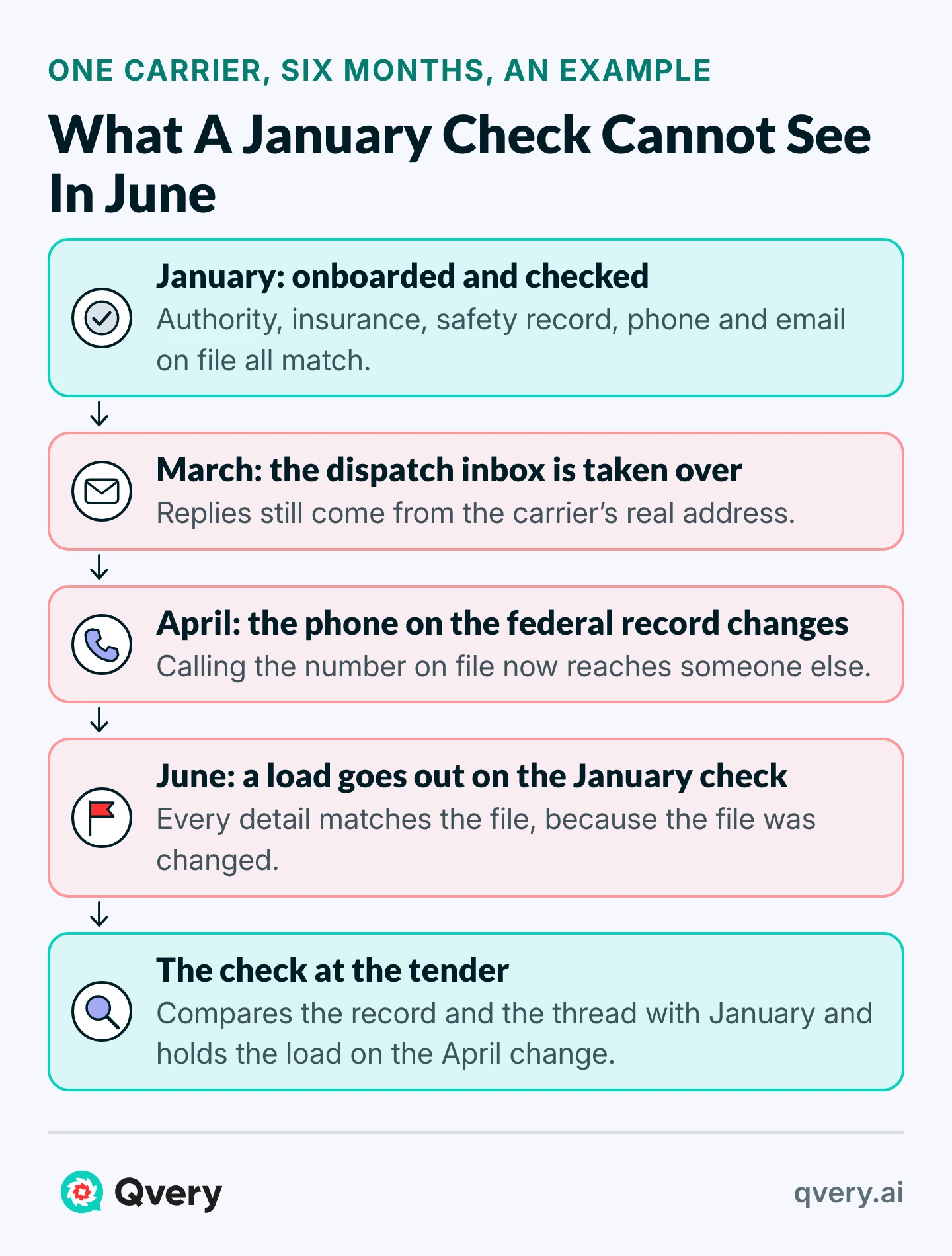
The phone number on file, the email on file and the reply chain all belong to whoever controls them now.
The FBI's advice is to verify every shipment request and pickup through a second channel before a load is released, because a familiar name or email address does not prove who is on the other end.7 When the number a carrier gives does not match its public SAFER record, the FMCSA says to phone the number the record shows.16
Both checks belong on every load, at the tender and at every change after it.
Brokers Pay for Fraud Twice: In Losses and in Hours
The Transportation Intermediaries Association, the trade body of third-party logistics companies, surveyed its members early in 2025. It received 59 responses, so read its figures as direction, not census.17 22% of respondents had lost more than $200,000 to fraud in the previous six months,5 and 53% more than $10,000.17 36% had lost less than $5,000.17
22% of Respondents Lost More Than $200,000 in Six Months
share of respondents
View the data
Prevention is a cost of its own: 10% had spent more than $200,000 on technology, staff time, insurance and training.17 And it is a cost in hours. 65% of respondents said they spend more than two hours a day, on average, preventing fraud, and 24% the whole day.17
Most Respondents Spend More Than Two Hours a Day Preventing Fraud
share of respondents
View the data
The checks TIA's members cited most are comparisons: authority, insurance and safety records against more than one trusted source, recent contact or ownership changes, emails and phone numbers against established records.17
Run them on your own volume. Say your carrier team tenders 1,500 loads a month and a careful re-check takes five minutes a load (an assumption; time your own): that is 125 hours a month.
If the team skips the re-check for carriers it already knows, those repeat carriers' loads are the ones the three routes above run through. An agent can run the same comparison on every load and leave your team only the loads where something changed.
Insurance does not reliably close the gap. In WTW's worked example of a fraudulently booked load, the carrier's cargo policy did not respond because the carrier never had the load in its care, custody and control.
The broker's contingent cargo cover, which typically pays only when a carrier's insurer fails a valid claim, carried a full dishonesty exclusion for the carrier it had entrusted.18 Read that exclusion in your own policy before you lean on it.
How Qvery Builds an Identity Check Into Every Tender
The agent we build sits between your carrier team and the rate confirmation.
Before a rate confirmation goes out, it reads the load, the carrier on it and the email thread, and sets what it sees today against what your file held when that carrier was onboarded:
- The contact details on the carrier's FMCSA record.
- Its ownership and its insurance.
- The email domain and the phone number in the thread.
- The result from the vetting service you already pay for.
It repeats the comparison whenever the load changes before delivery: a reroute request, a new dispatcher on the thread, the driver and truck details sent at pickup.
When nothing has changed, the load moves on schedule and nobody has to touch it.
When something has, the agent holds it for your carrier rep with the reason in one line: a phone number changed on the federal record nine days ago, a reply from a free email address, an insurance certificate that names a different insurer. The rep confirms through the number on the public record, not the one in the email.
It is built for one brokerage. We map how your carrier team vets and tenders now, connect the agent to the TMS, inbox and vetting tools it already uses, and get a first working result live within two weeks.
After that it works on its own beside your carrier reps, and every week we report what it did: the hours of manual re-checking it took off your carrier reps, and the loads it held that should not have moved.
Brokers Now Need a Record of Why They Chose Each Carrier
On May 14, 2026, the Supreme Court held, unanimously, that a state claim that a broker negligently hired a carrier is not preempted by the federal law that deregulated trucking, because that law leaves states their authority over safety.19
The case was about a crash, not a theft, and how far it reaches into cargo losses is not settled. What it changes is what a carrier check is for: it is also the broker's evidence of how it chose.
The agent compares and flags; your carrier team decides which flagged loads still move, and the reason goes in the file with every comparison the agent made. After a loss, the FBI asks for a complaint to its Internet Crime Complaint Center as well as a police report.7
This week, pull last month's tenders and count the ones that went to a carrier whose phone, email or ownership changed after you onboarded it. Those are the loads your onboarding check could not see.
Frequently asked questions
How much does freight fraud cost each year?
The closest measured figure is CargoNet's: it estimated 2025 cargo theft losses reported to it in the US and Canada at nearly $725 million.1 For double brokering, the only named estimate is TriumphPay's 2023 figure of $500 million to $700 million of freight a year.8 The $800 million figure credited to the FBI online is not in the FBI's own alert.
Why are cargo theft losses rising faster than the number of incidents?
Because thieves pick more valuable loads. CargoNet's average theft in 2025 was worth $273,990, up 36% in a year, while total incidents held flat.1 In the second quarter of 2026 incidents fell 26% and estimated losses more than doubled to $304.6 million,6 with a few multimillion-dollar thefts doing much of it.6
What is double brokering?
A load you tendered to one carrier is passed to another carrier without your approval, so you no longer know who is hauling it. The FBI describes criminals posing as a compromised carrier, accepting loads and double-brokering them to partially unwitting drivers, with manipulated bills of lading and a changed destination.7
What is change-of-ownership fraud?
Someone buys an established carrier, or its operating authority, and books loads under its clean history. Highway's change-of-ownership reports rose from 148 to 399 between the first quarters of 2025 and 2026.4 In September 2026 a federal jury convicted two men who bought carriers, one for about $22,000, and never delivered the loads.9
Do MC number checks stop double brokering?
No. A valid number proves a carrier is registered, not who is answering its email or phone. More than 80% of the loads reported stolen to Highway in the third quarter of 2026 went through a real carrier's identity.3 The FBI warns that a familiar name or email address alone does not confirm authenticity.7
Does insurance cover a double-brokered load?
Often not in full. In WTW's worked example, the carrier's cargo policy did not respond because the carrier never had the load, and the broker's contingent cargo cover carried a full dishonesty exclusion for the carrier it had entrusted.18 Coverage depends on your policy's wording, so read its dishonesty and agreement conditions before a loss.
How is cargo theft different from freight fraud?
Cargo theft is the freight itself stolen, by breaking into a trailer or by deception. Freight fraud is wider: payment fraud, double brokering, identity theft and spoofed emails. Asked which fraud they meet most often, TIA's respondents named unlawful brokering (34%), then spoofing (22%) and identity theft (20%).17
Which states see the most cargo theft?
California. CargoNet counted 1,218 incidents there in 2025, the most of any state, while New Jersey rose 50%, Indiana 30% and Pennsylvania 24%.1 In Highway's third-quarter 2026 data, California was the pickup state for nearly half the loads reported stolen, and New Jersey was second.3
How effective is AI carrier vetting?
The results published so far come from the companies running the checks. Uber Freight's chief executive said in late 2024 that more than 70 carrier signals and other measures had cut fraud on its own network by 80% in a year.20 Highway's stolen-load reports fell 28.1% from the second quarter of 2026 to the third, though they were 8.2% above a year earlier.3
What should a broker check before tendering a load?
Whether anything changed since onboarding: the phone and email on the federal record, ownership, insurance, the email domain in the thread. TIA's members cite these checks most.17 Confirm through a second channel, as the FBI advises,7 and call the number in the FMCSA's public record, not the one in the email.16
Where do you report freight fraud?
File a police report and a complaint with the FBI's Internet Crime Complaint Center.7 The FMCSA also suggests reporting scams to the Federal Trade Commission, and telling your insurer, the load boards and your factoring company when someone is using your company's information.16 TIA members can also file through its Watchdog tool, which logged 1,611 fraud reports from September 2024 to February 2025.17
Sources
- Verisk: Cargo Theft Losses Surge to Estimated $725 Million in 2025, Verisk CargoNet Analysis Reveals (2026)
- Verisk: Cargo Theft Surges to Record Levels in 2024, Verisk CargoNet Analysis Reveals (2025)
- Highway: Freight Fraud Index Report, Q3 2026 (2026)
- Highway: Freight Fraud Index Report, Q1 2026 (2026)
- Transportation Intermediaries Association: TIA Releases State of Fraud in the Industry April 2025 Report (2025)
- Verisk: Cargo Theft Losses More Than Double to $304 Million in Q2 Despite a Drop in Thefts (2026)
- FBI Internet Crime Complaint Center: Cyber-Enabled Strategic Cargo Theft Surging (2026)
- TriumphPay: TriumphPay Partners with Highway to Combat Double-Brokering Fraud (2023)
- U.S. Attorney's Office, Central District of California: Two Indian Nationals Found Guilty of Participating in Cargo Theft Scheme in Which Freight Was Stolen from Shippers (2026)
- Federal Motor Carrier Safety Administration: Fraud Alerts (2026)
- Verisk: Incident Volume Falls as Organized Crime Reshapes Cargo Theft Landscape Through Impersonation and Targeted Commodity Selection (2026)
- Federal Motor Carrier Safety Administration: Temporary Suspension of the Biennial Update Requirement (2026)
- Federal Motor Carrier Safety Administration: Move into Motus (2026)
- Federal Motor Carrier Safety Administration: About FMCSA Registration Changes (2026)
- Highway: Freight Fraud Index Report, Q2 2026 (2026)
- Federal Motor Carrier Safety Administration: Broker and Carrier Fraud and Identity Theft (2026)
- Transportation Intermediaries Association: State of Fraud in the Industry, April 2025 Report (2025)
- WTW: Under the current economic climate, fraudulent load booking by bad actors is a common occurrence (2023)
- Supreme Court of the United States: Montgomery v. Caribe Transport II, LLC, No. 24-1238 (2026)
- Bloomberg Intelligence, Talking Transports: Uber Freight CEO on Supply Chain Innovation (episode transcript) (2024)