
On this page
A staffing firm's recruiters are the people its placements come from, and a large part of their week goes to typing. After every first-round screen, someone writes up what the candidate said about pay, notice, licenses and availability, from scribbles and memory, against criteria that live in the recruiter's head.
The next recruiter, the account manager and the client all work from that note, and none of them can check it.
On the example firm we work through below, that typing comes to about 4,160 hours a year, close to $198,000 of recruiter time.
The usual plan for a first AI project starts somewhere else. AI near candidates sounds like a lawsuit waiting to happen, so the safe plan starts in payroll or credentialing, where the work follows rules. I think that plan starts in the wrong place, and the order runs the other way, from the recruiters' desks back.
Write up the screening calls first
At the same firm it takes more hours than checking nurse packets or replaying finalists' interviews, and every line of an agent's write-up can be checked against the recording.
Check credential packets and timesheets next
A credential packet is the licenses, cards and test results a hospital checks before a nurse starts. Its misses and the timesheet's cost real money, a start that slips or a payroll correction, but at a firm built around its recruiters they take fewer hours.
Review interviews for fraud last
A review agent can only point at moments, and every flag lands on a real candidate.
None of these agents decides who is submitted, placed or rejected. That stays with your recruiters.
Two kinds of firm should start in the back office instead: one whose late nurse packets are holding starts back, and one that pays thousands of hourly workers a week through a small recruiting team. And if your screens aren't recorded, with each candidate's consent, the agents have nothing to read yet.
Screening Write-Ups Take the Most Hours
Take the firm our staffing playbook works on: about 200 people on staff, placing temporary workers and nurses. Say a dozen of its recruiters run recorded first-round screens, about 20 a week each, and spend 20 minutes writing up each one. That's about 1,040 write-ups a month.
Recruiters fall under the federal survey's human resources specialists, who earned a mean $33.33 an hour at employment services firms in May 2025. Pay is 70% of what a private employer spends on a person, so a recruiter costs about $47.61 an hour, and the write-ups cost about $198,058 a year.
On the playbook's own assumptions, the same firm's other reading work comes to far fewer hours: eight people checking about 12 nurse packets a week each at 25 minutes, and ten recruiters spending about 6% of their week replaying finalists' interviews.
| The job | Who does it | Hours a year |
|---|---|---|
| Writing up first-round screens | Recruiters | 4,160 |
| Checking nurse credential packets | Credentialing team | 2,080 |
| Replaying finalists' recorded interviews | Recruiters | 1,248 |
The packets are half the write-ups' hours. Replaying finalists' interviews, where the fraud worry lives, takes less than a third.
The timesheet match doesn't fit this table, because its hours grow with every worker out, not with the recruiters. On the example in what chasing timesheets costs a staffing firm, a firm with about 350 workers out spends about 675 hours a year chasing them, and a firm paying thousands of workers a week can match the write-ups.
Our staffing playbook prices each of these jobs for a firm this size and shows what the agents for each one do.
The Back Office Is the Safer Place to Start
The back office has rules. A timesheet either matches the hours the client approved or it doesn't. A nurse's card is either valid on the start date or it isn't.
When the check misses, the money leaves the same week: in a client's vendor management system (VMS, the portal a large client uses to approve its staffing suppliers' hours) such as SAP Fieldglass, an invoice can only be made from an approved time sheet, and fixing one after it's invoiced means a revised sheet the client has to approve again.
And most healthcare staffing firms haven't automated it yet. In Bullhorn's 2026 survey, 57% of healthcare staffing firms had technology to automate candidate search, and 23% had it for payroll and billing.
EY survey for Paycom (2026); Cross Country Healthcare 10-Q (Q1 2026); Bullhorn GRID 2026
Recruiting, meanwhile, is where the worry is. HireVue's 2026 survey of more than 3,100 hiring managers found that 77% of HR teams use AI regularly and only 41% fully trust it. Gartner found that 26% of job candidates trust AI to evaluate them fairly.
In New York City, an employment agency may not use an automated tool that substantially assists its screening decisions unless the tool has had a bias audit within the past year and candidates were told about it.
Recruiters put it more bluntly.
What Reddit says
Recruiters on AI notetakers and screening notes
Omg do not use AI to recommend hiring decisions. That's serious legal territory.
These tools are not designed to know what you’re evaluating and they are not intended to offer an evaluation.
I was hand-typing phone screen notes for six months while the video ones got transcribed automatically. This mismatch was killing my afternoon notes. By 5:00 p.m. the phone screen write-ups were unreadable.
All of that is true, and the packet and timesheet agents are the next ones we build for a staffing firm. The recruiter warning against AI that recommends hiring decisions is right, and these write-ups recommend nothing.
The notetakers recruiters complain about transcribed the call and summarized it, with no idea what the recruiter was screening for, so the recruiter had nothing to check the summary against.
Write-ups built on your own criteria quote each answer in the candidate's words with the second it was said, so a recruiter checks a line by clicking it, not by replaying the call. The agents never score, rank or recommend anyone; they quote, and they mark what nobody asked.
 Vlad ShvetsPartner @ Qvery
Payroll's checks protect money you've already earned, and every staffing firm should have them. But the first agents should go where the hours are, and in a firm built around its recruiters that's their desk, because their hours are where the next placement comes from. The write-ups take hours they could spend on the phone. Put the first agents there, and build the packet and timesheet agents right after.
Interview Fraud Review Comes Last
In Gartner's 2025 survey of 3,000 job candidates, 6% admitted to interview fraud, either posing as someone else or having someone pose as them, and Gartner predicts that one in four candidate profiles worldwide will be fake by 2028.
A review agent reads every finalist's recording to find the ones that need a second look, and it can only point at moments, never prove anything.
Each mark is a question about a real person, and recruiters already see hiring managers turn "they used AI" into a vague reason to reject someone.
So we build the fraud review agents as a second pair of eyes on finalists only. They list the moments worth replaying, each with its time in the recording, and suggest questions for a live follow-up. They never say a candidate cheated. Your recruiter replays, asks and decides.
The Write-Up Qvery's Agents Hand Your Recruiters
Our agents start from the moment your phone or video interview tool saves a recorded screen. They transcribe it and read it against the criteria for that role: the pay range, the shift, the licenses, the start date, the questions your recruiters ask every candidate.
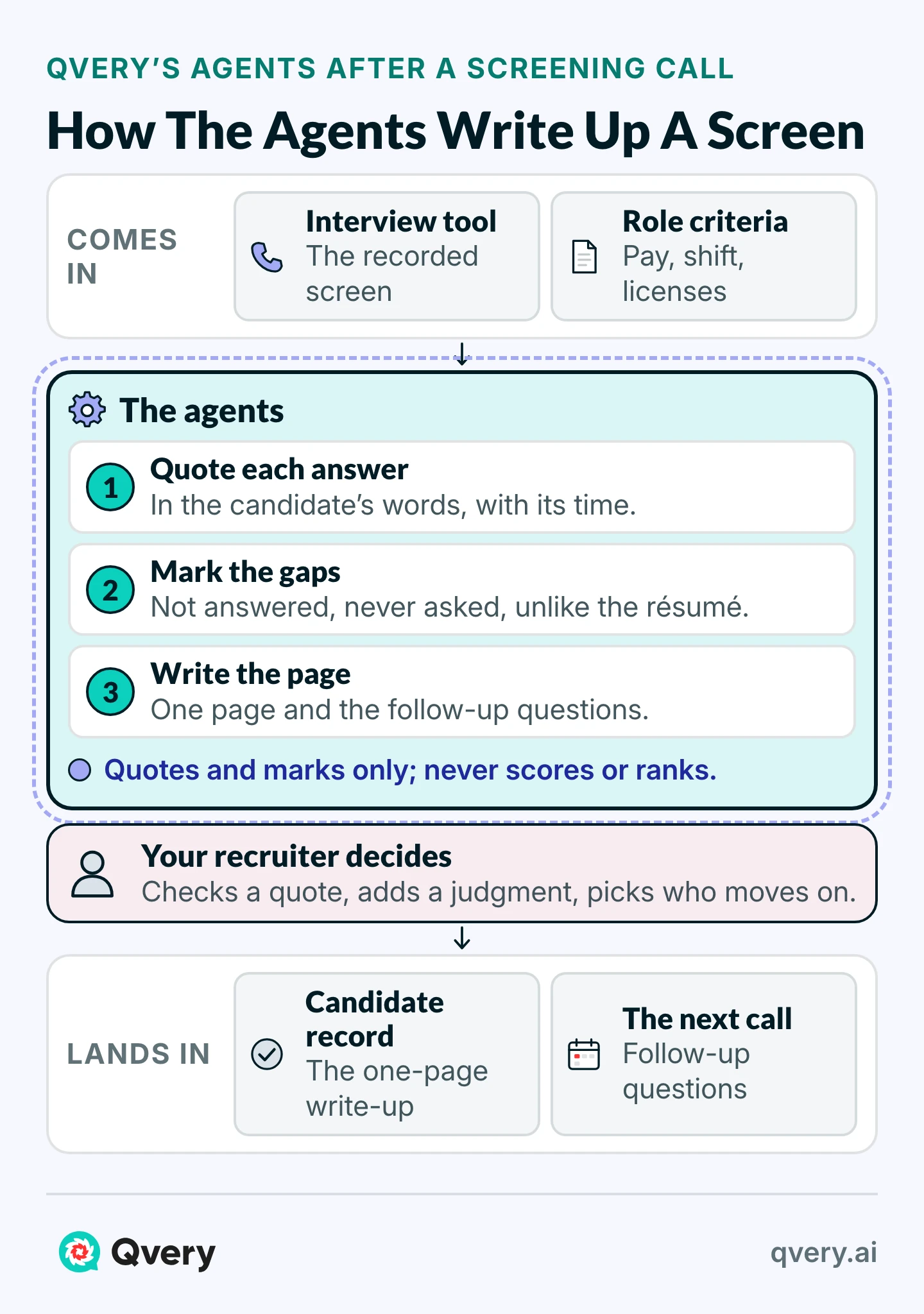
For each criterion they quote the candidate's answer with its time in the recording. They mark the questions that were asked and not answered, the ones nobody asked, and any answer that seems to differ from the résumé. A one-page write-up and the follow-up questions land in the candidate's record in your applicant tracking system.
The recruiter reads it, clicks a quote when an answer matters, and adds a judgment. Who goes to the client stays the recruiter's call.
 Piotr BabelPartner @ Qvery
A write-up a recruiter can't check is just another opinion about the candidate. So the agents we build quote the candidate's own words and the second they said them, and they mark every criterion the call never reached. That lets your recruiter trust the page in a glance, and the decision about the person stays exactly where it was.
On the example's numbers, a write-up by hand costs about $15.87 of a recruiter's time. With the agents it costs about $7.28, their running cost included: 8 minutes of reading and judgment instead of 20 on our assumption, plus about 50 cents of transcription and model use a call and $450 a month to host and keep them.
That takes the write-ups from 4,160 hours a year to 1,664, about $107,195 a year of recruiter time, and every $10,000 of build comes back in about 1.1 months. Those hours are worth that money when they go to calls the firm would otherwise hire another recruiter for. Put in your own recruiters' numbers:
Screening Write-Up ROI Calculator
What Writing Up Screening Calls Costs You, And With The Agents
Saved Per Year
$107,195
2,496 hours handed back, after $11,640 a year to run it
- Hours Handed Back
- 2,496 hours a year
- Agent Running Cost (Estimate)
- $970 a month
- Payback Per $10,000 Of Build
- 1.1 months
On these numbers, each screening call costs $7.28 instead of $15.87, the agent saves $107,195 a year after its own running cost, and every $10,000 of the build is earned back in 1.1 months.
A screen is a recording of a person, and the trust questions come with it. Each call is recorded with the candidate's consent where the law asks for it, and in California, recording a confidential call needs the consent of everyone on it.
Before the agents read anything, we agree in writing which recordings and fields they may read, that they write only to the candidate record, and where the recordings are processed. Every write-up they make is logged, nothing reaches a candidate or a client before a recruiter has seen it, and Qvery AI OÜ signs a data processing agreement as an EU company.
The quickest way to judge a write-up is to read one made from your own call.
We set them up on your interview tool and your applicant tracking system, run them on your own calls within two weeks of access, and train your recruiters to work from the write-ups. Each week you see the hours handed back and the criteria the calls missed.
The First Agents Belong Where Your Recruiters Type
A packet agent that reads every card against the hospital's list, and a timesheet agent that lays your hours beside each client's approvals, come second and third, in whichever order your misses cost more.
The first agents should take the most hours a person can still check line by line, and in a staffing firm that's the screening write-up.
The criteria your best recruiters screen on are the first thing we write down with you, and from their first week on your recordings the agents write every call up against them.
Frequently asked questions
Can AI legally screen job candidates?
It depends on what the AI does and where you hire. New York City bars an employment agency from an automated tool that substantially assists its screening decisions unless the tool had a bias audit within the past year and candidates were told. Our write-up agents quote, never score or rank, and your counsel confirms how each state's rules apply.
Do we need a candidate's consent to record a screening call?
In some states, yes. California's law makes recording a confidential call without the consent of everyone on it a crime, so check the rule in each state you recruit in. A short disclosure at the start of each call, with the consent noted in the candidate record, is the simple way to have it on file. The agents only read calls your firm has recorded.
Will AI agents replace our recruiters?
No. The agents take the typing after each call: the write-up, the quotes, the follow-up questions. Recruiters still run the call, judge the candidate, talk to the client and decide who is submitted. The hours they get back can go to more calls and more candidates sent to clients.
Which staffing jobs should never be automated?
The decisions about people: who is submitted to a client, who is placed, who is rejected, whether a nurse is cleared to work, and whether a candidate cheated. Agents can prepare the evidence for each of those decisions, with the quote, the page or the time in the recording, but a person makes the call.
Does it work with our applicant tracking system and interview tools?
We connect the agents to the systems your recruiters already use: the phone or video tool that records the screen and the applicant tracking system where the candidate record lives. Nobody moves to a new platform. The write-up appears in the record the recruiter already opens.
What does an AI screening write-up include?
One page per call: each of your criteria for the role with the candidate's answer quoted in their own words and the time it was said, the questions that were asked and not answered, the ones nobody asked, and anything that seems to differ from the résumé. Below it sit suggested follow-up questions and room for the recruiter's own judgment.
How accurate are AI write-ups of screening calls?
Transcription can mishear a name, a number or a license type, so a write-up is never meant to be taken on trust. Every quoted line points to its second in the recording, a recruiter checks any answer in a click, and a passage the transcript can't make out is marked unclear rather than guessed.
What if our recruiters screen by phone without recording?
Then there is nothing for the agents to read yet. If your phone or video tool can record, the first step is turning recording on for screens, with each candidate's consent, and saving the calls where the agents can reach them, which we set up with you before the agents start.
What does it cost to run screening write-up agents?
On the example's volume of about 1,040 calls a month, roughly $970 a month: about 50 cents a call for transcription and model use, plus $450 a month for hosting, logging and keeping your criteria current. The build is a fixed price agreed before we start.
How long until the agents pay for themselves?
On the example's numbers, about $107,195 a year of recruiter time comes back after the agents' running cost, so every $10,000 of build is repaid in about 1.1 months, counted in recruiter time rather than cash. Put your own recruiters, volume and minutes into the calculator above for your firm's figure.
What about checking credential packets and matching timesheets?
They're the next agents we build for a staffing firm. A packet agent reads each nurse's licenses, cards and test results against the facility's list and flags what's missing, expired or mismatched, with the page. A timesheet agent matches your hours to each client's approved hours and lists the differences before payroll runs. If late packets are already holding back starts, the packet agent comes first.
How common is candidate fraud in interviews?
In Gartner's 2025 survey of 3,000 job candidates, 6% admitted to interview fraud, either posing as someone else or having someone else pose as them. Gartner predicts one in four candidate profiles worldwide will be fake by 2028. At that rate, fraud review works best on finalists, as a second look.
Do hiring teams trust AI?
Not fully. HireVue's 2026 survey of more than 3,100 hiring managers found 77% of HR teams use AI regularly but only 41% fully trust it. Write-ups that quote the candidate with the time in the recording let a recruiter check any line in seconds, which is how that trust gets built.
