
On this page
- Step 1: Check the Criteria Sheet Against the Client’s Brief
- Step 2: Write Out the Call With Who Spoke and When
- Step 3: Read Each Answer Against Each Criterion
- Step 4: Keep What Nobody Asked Apart From What Went Unanswered
- Step 5: Lay the Page Beside the Recruiter’s Write-Up
- Step 6: Send the Page Where the Account Manager Reads
- A Wrong Write-Up Costs More Than the Typing
- Where Qvery’s Agents Pick Up After the Call
- We Start From Calls Your Recruiters Already Wrote Up
- Frequently asked questions
At a staffing firm, most first-round screens end the same way: the recruiter hangs up, opens the applicant tracking system (ATS) and types up the call from notes and memory, in their own shorthand. The account manager then decides whom to submit from that page.
Some of those pages match the call. The ones that do not get found by the client, in an interview your firm set up:
| Criterion | The recruiter’s write-up | The call, at 01:31 |
|---|---|---|
| Second shift, 2:00 to 10:30 pm | “available for second shift” | “No, I cannot do evenings. I do school pickup at three thirty.” |
That candidate was submitted. So was another whose second shift nobody asked about, and both told the client’s supervisors they could not work the hours.
Typing up a call takes a recruiter about 22 minutes, and nothing in that routine checks the page against the call.
AI agents can now write the call up on one page against the order’s own criteria: each answer in the candidate’s words, with the minute it was said, and every criterion nobody asked kept in plain view.
At Qvery, we help staffing firms put recruiters back on the phone, with custom AI agents that quote every screen against the order’s criteria and list what nobody asked.
We ran one order end to end for a firm that does not exist: Bluestem, a 340-person light industrial and logistics staffing firm in Kansas City. No firm publishes its candidates’ calls, so every file below is invented, and the answer key was written before anything ran.
The order is three second-shift warehouse supervisors for a distribution client. The files are six screening calls, the recruiters’ six write-ups, eight weeks of their log and the client’s email after the interviews.
Six steps get there. Steps 2, 3, 4 and 6 are what Qvery’s agents do after every call; steps 1 and 5 are how we set them up on a firm’s own calls.
This covers first-round phone screens for one order. It does not screen resumes, run the client’s interviews or decide who moves forward.
Step 1: Check the Criteria Sheet Against the Client’s Brief
Before a single call is read, put the order’s criteria sheet beside the client’s brief and compare them field by field. The agent does this in code, not with a model, because a comparison of two numbers should come out the same every time.
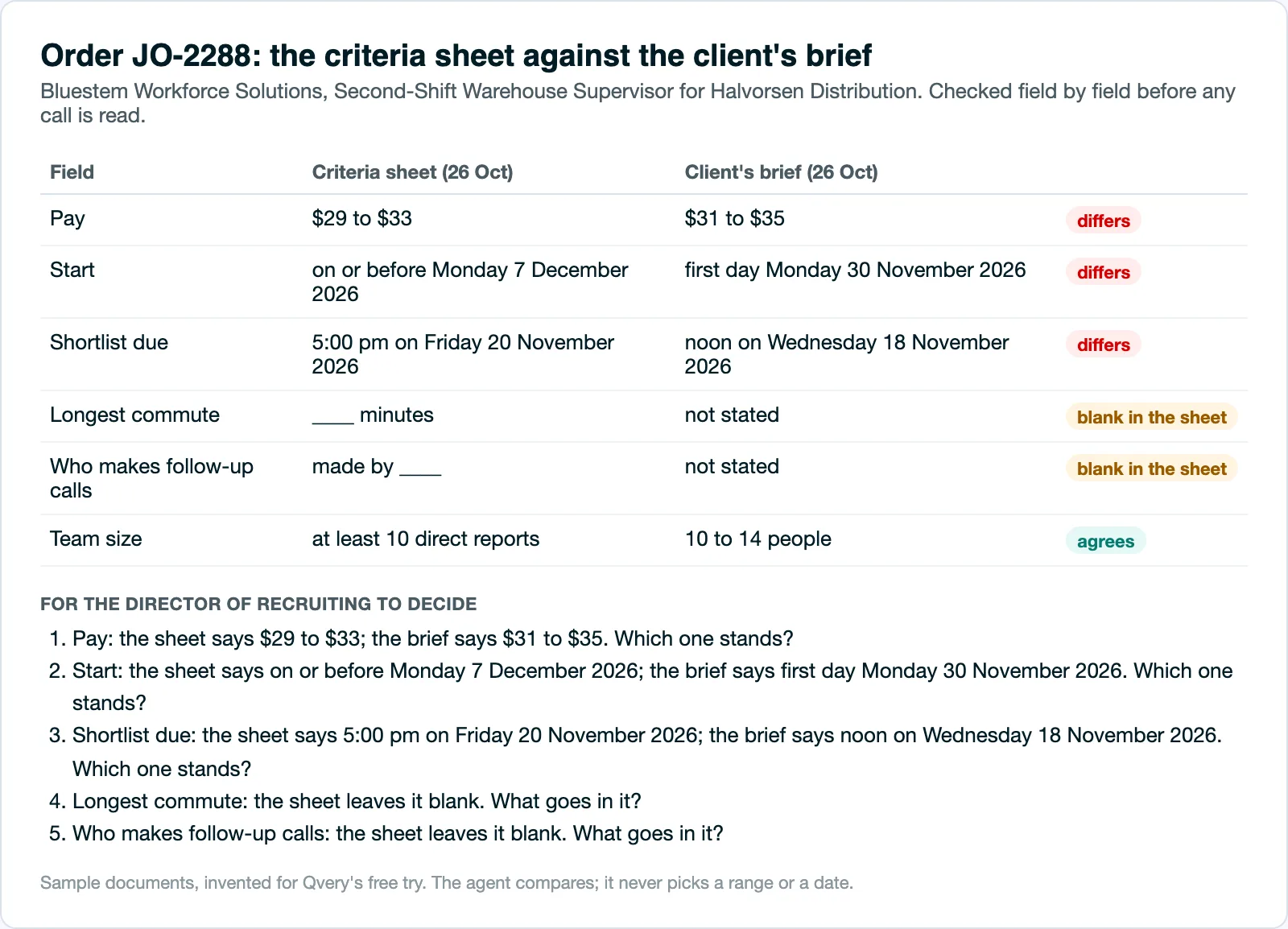
Bluestem’s sheet says pay of $29 to $33 an hour; the client’s brief says $31 to $35. The sheet wants a start by December 7, and the client’s first day is November 30. The sheet has the shortlist due Friday the 20th, and the client wants it Wednesday the 18th.
Two lines are blank: the longest commute anyone may have, and who makes the follow-up calls.
The agent shows both versions and leaves the choice to her. One line that looks like a mismatch is not one: the brief’s teams of 10 to 14 people and the sheet’s “at least 10 direct reports” say the same thing.
Step 2: Write Out the Call With Who Spoke and When
Every later step leans on the minute beside each line, so the agent starts from the call as it was said.
A plain phone call works: a dialer or phone system that records hands the audio over when the call ends, with no video link and no bot on the line. Bluestem’s recorder had already written each call out with the speakers and their times, so the run starts there.
One candidate’s commute answer reads “It is about [inaudible 02:44-03:00] minutes”. The page marks it inaudible and leaves the number blank.
Step 3: Read Each Answer Against Each Criterion
The model has one job here. For each of the nine criteria it finds what the candidate said, anywhere in the call, because an answer given to another question still counts.
It copies the words exactly, with their minute, and gives each criterion one of four statuses. Next to each quote it adds a reading, labelled as its own: appears to meet, appears to differ or unclear. It gives no score, no ranking and no recommendation.
The statuses are the part of the instruction the rest of the page depends on:
- "covered": the candidate gave an answer to this criterion;
- "unanswered": the recruiter raised it, and the candidate's reply gives no yes, no, number, date or condition for this criterion ("I would have to check", "let me think about it", a change of subject). Quote the reply anyway, so the next recruiter sees what was said. A conditional answer ("only if I get comp time") IS an answer: it is "covered";
- "not_asked": nobody raised it and the candidate never spoke to it;
- "inaudible": the answer is in a passage marked [inaudible], so there is nothing to quote.
Then code checks the model’s work: every quote has to be in the written-out call, word for word, in a turn that starts at the minute given. On the final run all 50 of 50 passed.
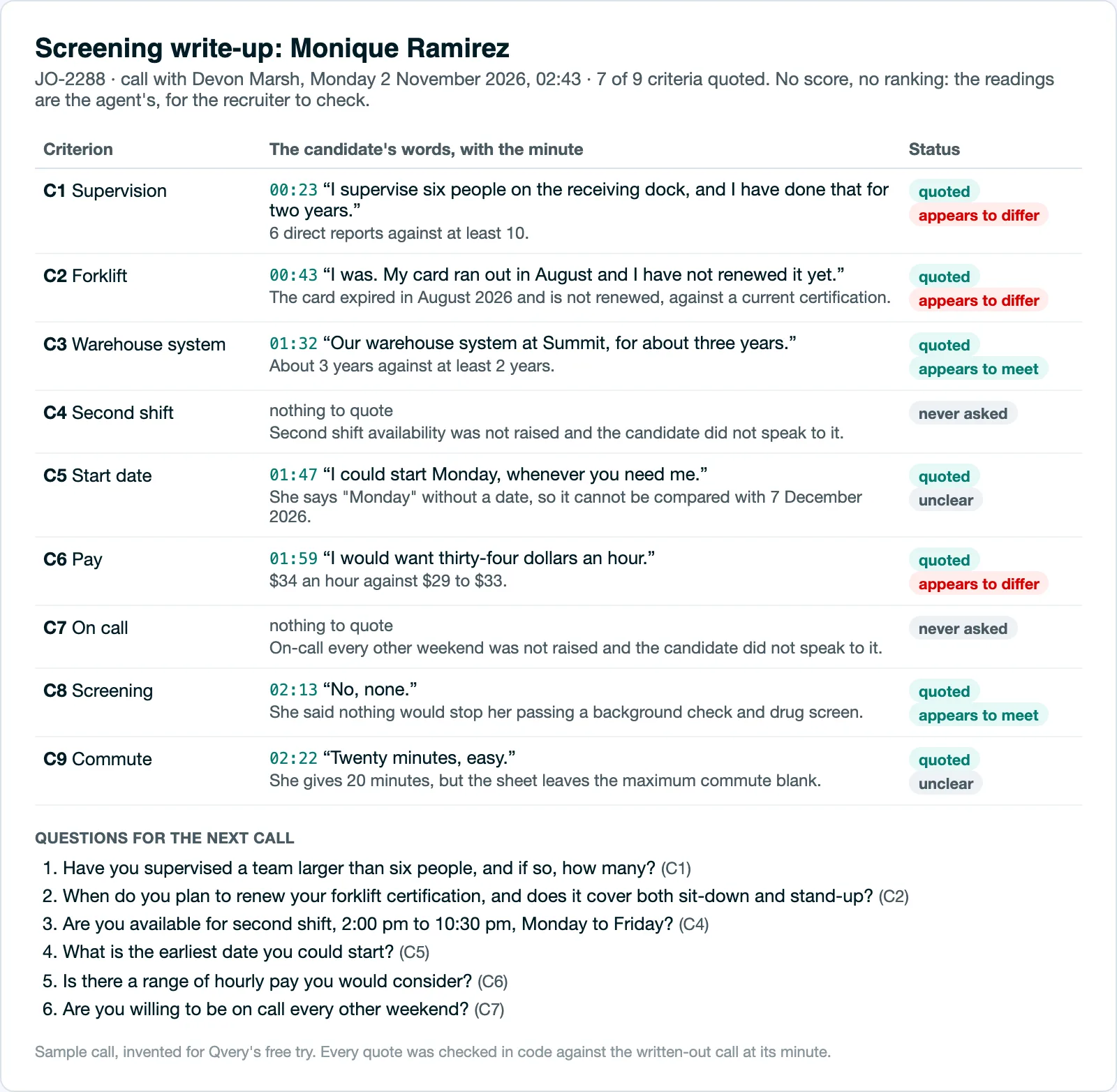
The “unanswered” rule was not in the first version of the instruction. Asked “Could you work evenings on this role?”, one candidate said “I would have to look at my kids’ schedule.” Both models we ran filed that as an answer.
The reading was right (unclear) and so was the next question, but the status told the next recruiter the shift had been covered. One sentence in the rules fixed it, and on the re-run the larger model matched the answer key on all 54 criteria.
The smaller model then read another candidate’s “Only if I get comp time off for it.” as a difference, where the larger one read it as unclear. That is the reason the page labels every reading as the agent’s and puts the quote right beside it: the recruiter reads the words, not the label.
To see a page like this for one of your own calls, the try below takes one recording and your criteria.
Step 4: Keep What Nobody Asked Apart From What Went Unanswered
Across the six calls the pages quoted an answer on 47 of the 54 criteria. The other seven fall into three kinds, and each sends the next recruiter to a different call:
- Never asked: 5. On call every other weekend was skipped in three calls, second shift in one, the commute in one. The next call asks it fresh.
- Asked, not answered: 1. The evenings question above. The next call presses for a yes or a no on the actual hours.
- Inaudible: 1. The commute answer lost to the line. The next call asks again, and nobody guesses.
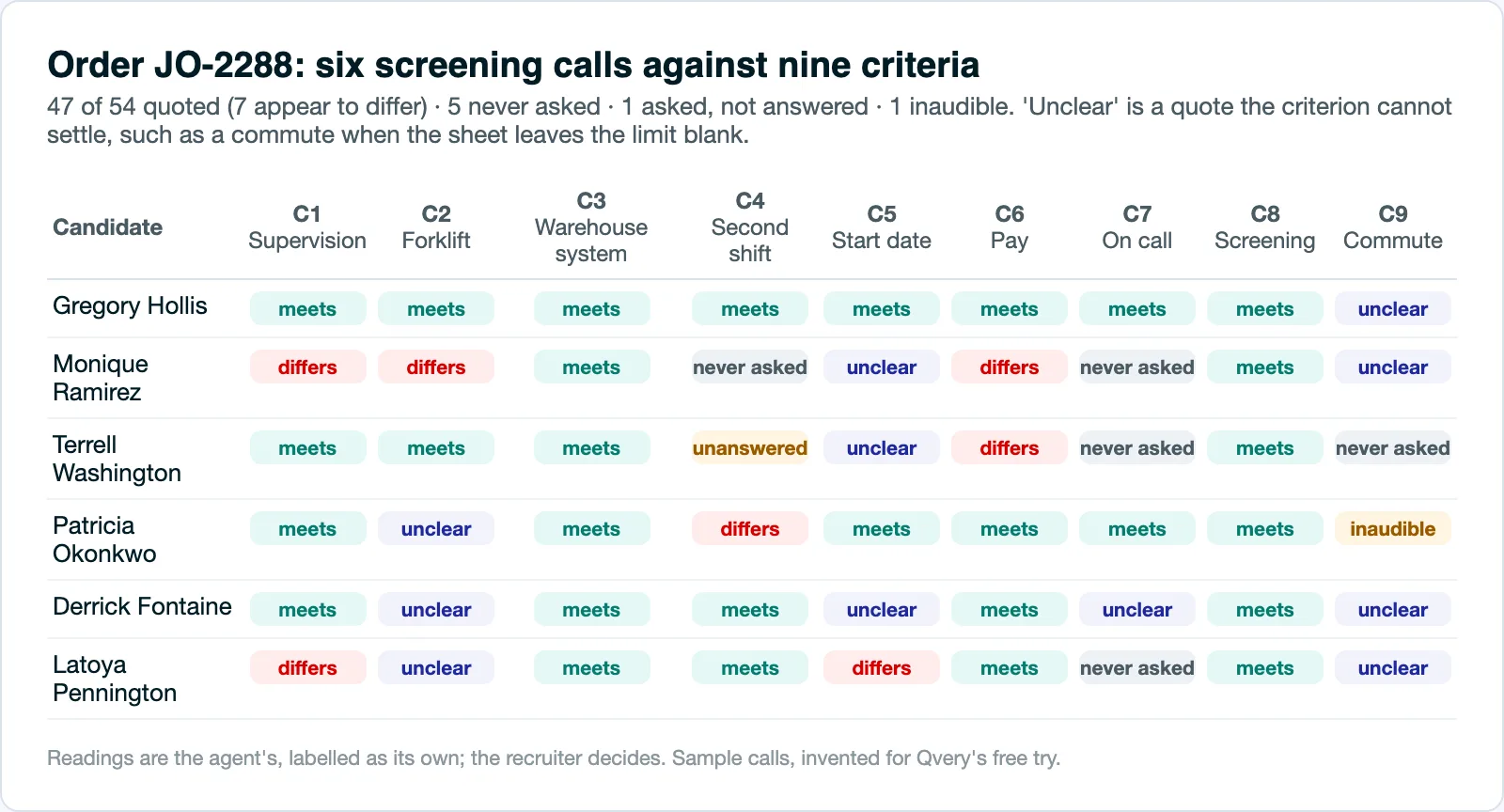
Three flags on the grid are not problems:
- Ten reports against “at least 10” meets the criterion. The sheet says a minimum is met at equality, and the agent reads it that way.
- Comp time for weekend on-call is a condition, not a no. The recruiter takes it to the client.
- Every commute answer reads unclear only because the sheet left the longest commute blank. That goes back to step 1.
A criterion nobody asked costs a repeat call. Bluestem’s log counts 252 of them in eight weeks, about two for every five screens, and a candidate waiting on a callback can take another agency’s offer in the meantime.
Tips from Reddit
How recruiters keep a screen on its criteria today
I just have a doc with the 5 things I need to make sure I hit, fill in the info as I’m asking on the call, and then upload it to ATS.
Sounds like you lack a standardized process with standardized questions and standardized criteria
do not expect any of these notetaker tools to evaluate candidates or make decisions about employment. You and your team are responsible for evaluating the candidates.
Step 5: Lay the Page Beside the Recruiter’s Write-Up
Next, the page goes beside the write-up a recruiter already typed for the same call, which is also how a firm’s first week with the agents runs.
A second pass of the model reads both and lists every claim in the write-up the call does not support. It works from the page in step 3, not from a fresh reading of the call, so every claim it lists points to a quote that is already checked.
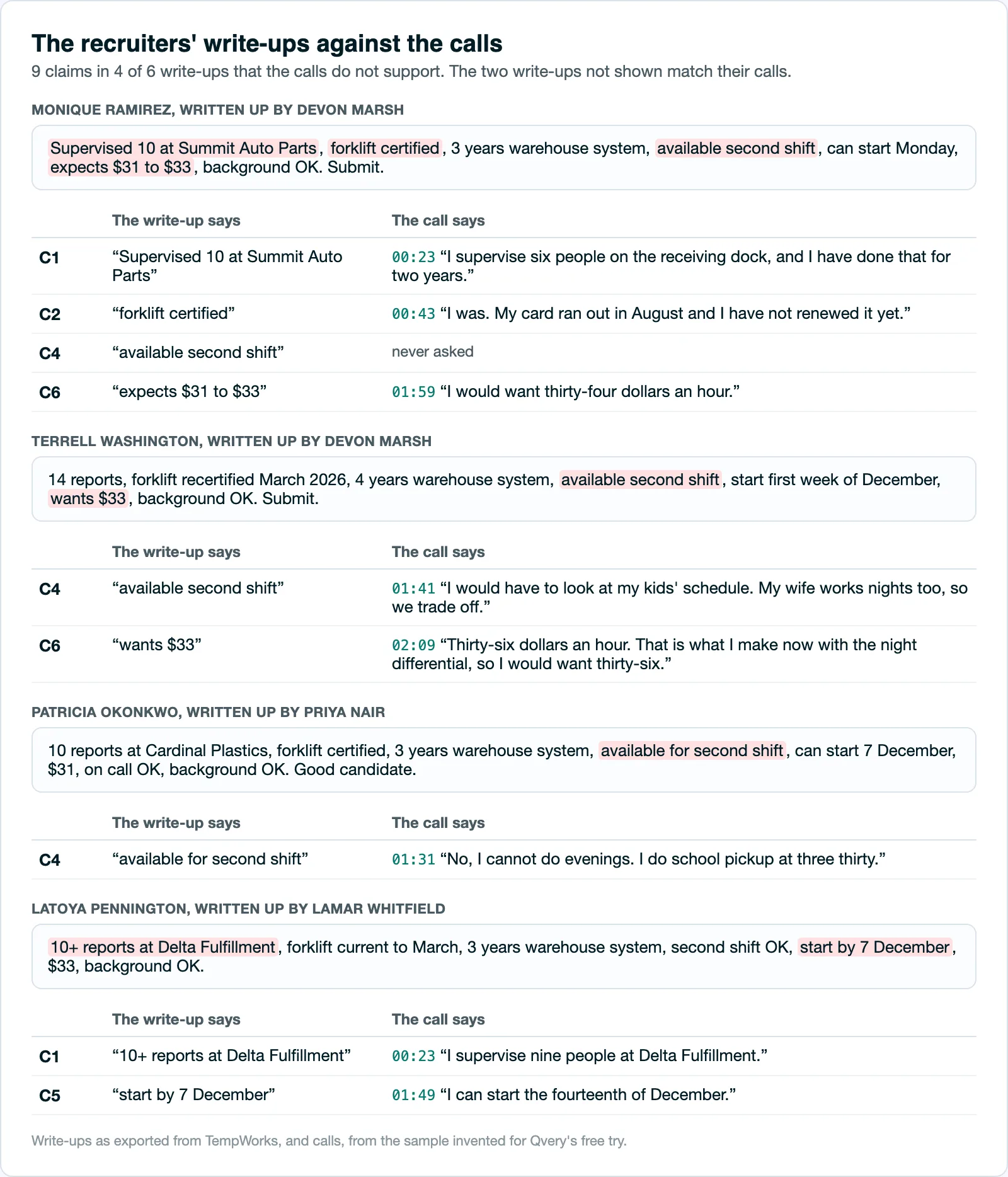
Two write-ups match their calls. The other four hold 9 claims the calls do not support: six reports written as 10, a forklift card that ran out in August written as “certified”, an ask of $34 written as $31 to $33, $36 written as $33, nine reports written as “10+”, December 14 written as “by 7 December”.
Second shift is written as available in three write-ups: for a candidate who was never asked, one who did not answer and one who said no. Both models found all nine claims and nothing that was not there.
The client’s brief puts a number on the fill deadline: 85% of the openings filled by November 23, or a credit of 3% on October’s $212,400 of invoices, $6,372. The three openings themselves bill $64,740 over their first 13 weeks.
Step 6: Send the Page Where the Account Manager Reads
The page goes onto the candidate’s record as a note, where the ATS lets an outside service add one, with the whole call written out behind it. Where it does not, the page arrives by email and the recruiter pastes it in.
The questions for the next call sit at the bottom of the page for whoever makes the callback.
Take the evenings answer: the page asks that candidate “Are you available to work 2:00 pm to 10:30 pm, Monday to Friday?”, the hours themselves, which the first call never put to him. The recruiter asks it on the callback, and that call is written up the same way.
The candidate’s status stays where the account manager puts it, and so does the decision on who goes to the client, now made with the candidate’s words in front of them.
A Wrong Write-Up Costs More Than the Typing
Start with the typing, from Bluestem’s own log for its four recruiters:
Bluestem’s recruiter log, eight weeks from September 14, 2026, sample files made by Qvery
The calculator below starts from a firm of about 200 people with twelve recruiters screening about 20 candidates a week each: 1,040 calls a month.
It assumes 20 minutes to write up a call by hand, close to Bluestem’s 22, and 8 minutes with the agents: the time to read the page, replay the quotes that matter and add the recruiter’s own judgment.
A recruiter costs $47.61 an hour with benefits. By the Bureau of Labor Statistics, human resources specialists, the federal category that covers recruiters, earned a mean $33.33 an hour at employment services firms in May 2025, and pay is 70% of what a private employer spends on a person.
Screening Write-Up ROI Calculator
What Writing Up Screening Calls Costs You, And With The Agents
Saved Per Year
$107,195
2,496 hours handed back, after $11,640 a year to run it
- Hours Handed Back
- 2,496 hours a year
- Agent Running Cost (Estimate)
- $970 a month
- Payback Per $10,000 Of Build
- 1.1 months
On these numbers, each screening call costs $7.28 instead of $15.87, the agent saves $107,195 a year after its own running cost, and every $10,000 of the build is earned back in 1.1 months.
On those numbers a write-up costs $15.87 a call today and $7.28 with the agents. That is 2,496 recruiter hours a year handed back and $107,195 a year after the agents’ own running cost.
We estimate that cost at about 50 cents a call for transcription and model usage, plus $450 a month for hosting, the log of every page and upkeep of the criteria: $970 a month at that volume. At that return, every $10,000 the build costs comes back in about 1.1 months.
Those hours are worth most as more screens and more calls to clients, not as fewer recruiters. And the calculator leaves out what a wrong page costs: the client interview spent on a candidate who cannot work the shift.
 Vlad ShvetsPartner @ Qvery
An owner sees a write-up as admin. It’s the page your account manager sells from, and when it’s wrong, the client finds out in an interview you set up. The hours of typing fit on a calculator. The interview a client spent on someone who can’t work the shift doesn’t; it shows up in how they read your next shortlist.
Where Qvery’s Agents Pick Up After the Call
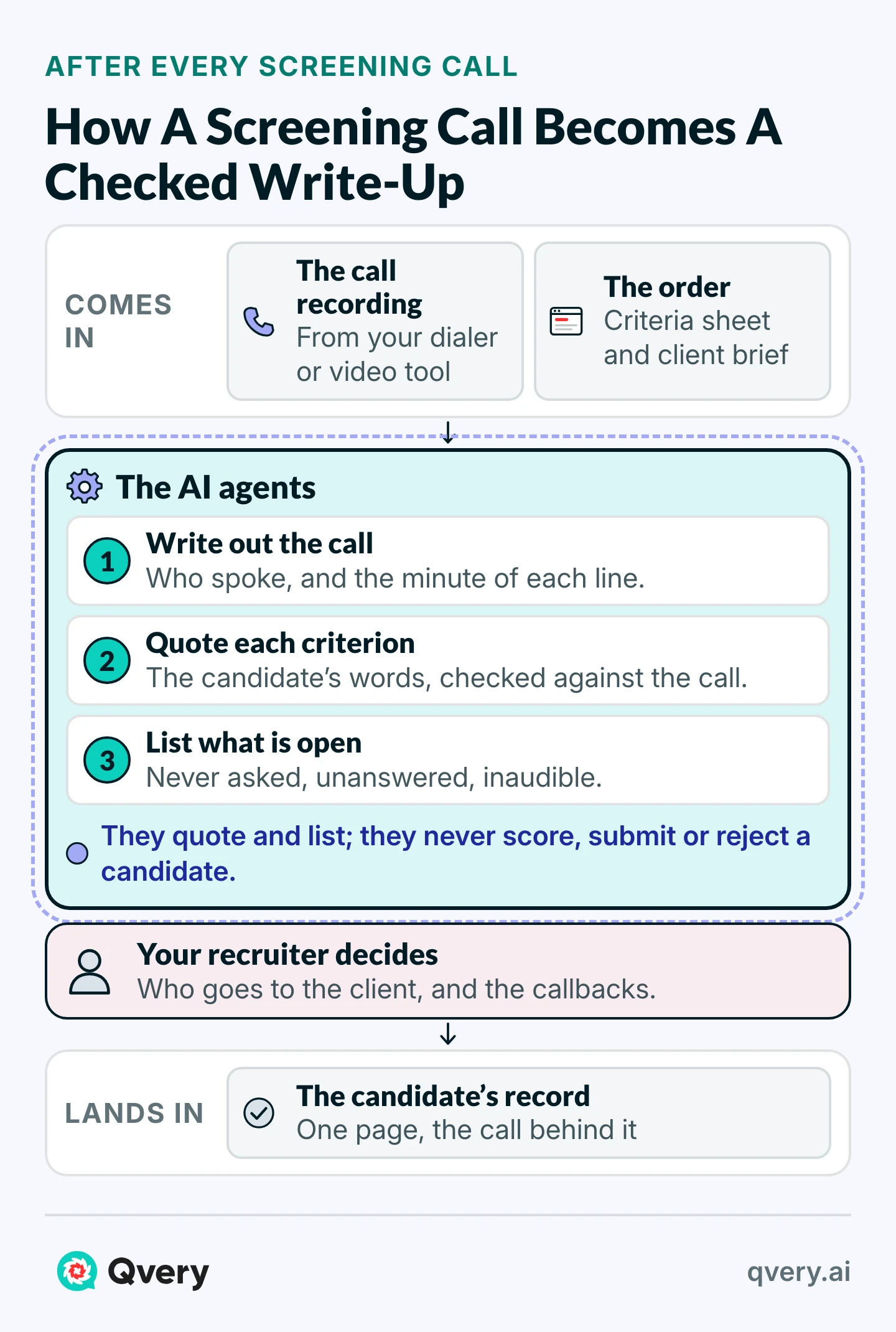
The agents we build for staffing firms start when a screening call ends. The dialer, phone system or video tool hands over the recording, and the agents read it against the order’s criteria and the client’s brief.
They quote each answer with its minute, keep the never-asked, the unanswered and the inaudible apart, and put one page on the candidate’s record with the call written out behind it. The recruiter decides who moves forward.
A recording carries a candidate’s voice, work history and pay expectations, so what the agents may touch is agreed in writing before anything is connected:
| The agents may | The agents never |
|---|---|
| Open the recordings your process already collects, for the roles you name | Join or speak on a call |
| Read the order’s criteria and the client’s brief | Score, rank, submit or reject a candidate |
| Write the page and the next questions, logged | Copy phone numbers, street addresses or anything the criteria do not ask for into the page |
| Send the page to the recruiters on that role | Use your recordings to train another firm’s AI |
Consent stays where it is today, and the rules differ by state. Federal law lets a call be recorded with one party’s consent, while California requires every party’s consent to record a confidential call.
The agents work under the notice your recruiters already give, and if your script needs a line saying the call is written up, we draft it with you. How long recordings and pages are kept is set in the same written agreement, along with every outside service that processes the audio and where.
New York City regulates hiring tools that issue a score, a classification or a recommendation used to substantially assist screening, and requires a bias audit and notices before a firm uses one.
The agents issue no score and no recommendation, and their readings are labelled as opinions a recruiter can overrule. Whether that keeps your use outside the rule is your counsel’s call, and we build to their answer.
 Piotr BabelPartner @ Qvery
Every step in this agent that can be code is code: reading the sheet, comparing it with the brief, the arithmetic of “at least 10”, checking each quote against the call at its minute. The model does the one thing code can’t, which is hear that an answer given to another question settles a criterion. That split is why a recruiter can trust the page, and why it reads the same on every call.
If your recruiters type up screens from memory and your account managers submit from those notes, this is the job Qvery’s agents take first.
We Start From Calls Your Recruiters Already Wrote Up
Screen write-ups are one of three jobs of the same kind the Staffing Playbook prices for a firm of about 200 people, beside finalists’ interviews replayed by hand and nurse credential packets checked page by page.
For this one we start from calls your recruiters have already written up: a week of recorded first-round screens, the criteria sheets they were run against and the write-ups that went into the ATS. The agents run on those first, and your recruiters lay each page beside their own notes for the same call.
Where the agent’s reading feels off, they tell us, and we adjust the wording of the criteria. Once access is in place, the first pages run on live calls within two weeks.
Each week we count the recruiter hours the write-ups hand back and the repeat calls they stop, and more roles follow by adding their criteria.
Frequently asked questions
Does it work on plain phone calls with no video link?
Yes. The agents work on the recording after the call, so it can come from a dialer or a desk phone system as easily as from a video tool. Nothing joins the call. MP3, WAV, M4A and MP4 files all work, and where your dialer stores recordings, each one can be pulled as the call ends.
Does the candidate ever talk to the agent?
No. The agents never speak to anyone and never call a candidate. They read the recording your recruiter made and write a page for your recruiter. Everything the candidate hears is still your recruiter’s voice and your firm’s script.
What happens when an answer is unclear?
An unclear passage is listed with its time, and the criterion it would have answered shows nothing to quote, so the next recruiter asks again instead of reading a guess. Background noise and a bad line show up as gaps, never as filled-in answers.
Can it write up screens held in Spanish?
Yes, if your recruiters screen in Spanish or switch languages mid-call, we set that up in the build. It is tested on your own recordings first, and every quote still carries its minute so a bilingual recruiter can replay it.
Can the page go to our client as written?
The page is written for your recruiters and account managers. What your client sees stays your account manager’s to write. The quotes help there: the profile your account manager sends the client can say what the candidate said about the shift, word for word.
What if an order’s criteria change halfway through?
Your director of recruiting updates the sheet, and the calls that follow are read against it as it now stands. When a role’s needs change we review its criteria with you again, because a criterion that no longer fits the role screens people out for the wrong reason.
How is this different from the notetaker in our video tool?
A notetaker writes a paraphrased summary of the conversation as it went. The agents take each criterion on the order and look for what the candidate said about it, keeping the exact words and the minute. A summary also cannot tell you that nobody asked about weekend on-call; the page lists it.
Do recruiters still need to take notes during the call?
No. Nobody has to type while the candidate talks, so the recruiter can listen and follow up where an answer is thin. What the recruiter noticed beyond the criteria goes onto the page afterwards as their own note, next to the quotes rather than mixed into them.
Can it screen resumes as well?
Not this one. It starts once a call has happened and works only from what was said against what the order asks. Resume screening decides who gets a call at all, from documents, and raises its own fairness questions, so it would be scoped separately.
What is left for the recruiter after each call?
Reading the page, replaying the quotes that matter and adding their own judgment: about 8 minutes a call against 20 by hand, on the calculator above. Then the callback with the page’s questions, if there are any, and the decision on whether the candidate goes forward.
Can we use the criteria sheets we already have?
Yes. A spreadsheet, a PDF or a Word file of criteria works, one line per criterion. Before the build we go through your sheets with you, because a blank line or a range that disagrees with the client’s brief would mislead every page written against it.
Do recruiters have to follow a script?
No. An answer given to another question still counts for the criterion it covers, so a recruiter can let the conversation run. The page then shows which criteria never came up, and the next call asks those.
What if a candidate gives two different answers?
Both quotes stay on the page, each with its minute. A candidate who says “next Monday” and later “the first week of December” gets both, and the start date reads unclear until the recruiter settles it.
How long are recordings and pages kept?
As long as your written agreement with us says, set before the build together with who can open them and which outside services process the audio. The pages leave out phone numbers, street addresses and anything your criteria do not ask about.
